To avoid these ads, REGISTER NOW!

different standards in Europe?

MBfreak

MEMBER EMERITUS
Joined
Dec 10, 2010
Messages
2,301
Location
Linkoping , Sweden
Tech only from me.
This is a gross oversimplification re cable area OH vs in soil
No, underground would just need more insulation and the ground stays cooler than the air out here in the central valley where temps can sore well past 100* in the summer...
Manufacturers of power cables and OH wires have specialists and programs to assist buyers in the correct design of power cable/OH networks.
And with regard to the "stone problem". Can only happen in totally incompetent companies.

Ola
 
To avoid these ads, REGISTER NOW!

wyliesdiesels

Well-known member
Joined
Aug 14, 2012
Messages
19,994
Location
Modesto, CA
Come on guys, putting xfrmers on poles is what Edison did, there's got to be a better way. This isn’t a bowling alley where there is a machine to stand the pins back up when mother nature knocks them down.

Utilities have monopolies because short term profits shouldn't be the primary measure of success for certain services. Just because a utility may be poorly managed is not a reason to avoid progress.

I am not saying that burying transmission line is a panacea, but power grid engineers need more tools in their toolbox than wooden poles or metal poles for that matter.
you talk like the rate payers have control over what the PoCo does... you should really educate yourself on the power and control Profit gouge and execute has over california... they do what they want...
 

wyliesdiesels

Well-known member
Joined
Aug 14, 2012
Messages
19,994
Location
Modesto, CA
Putting transformers underground isn't necessarily a great idea either. I was at work one day in Sandy Eggo when had a big rainstorm blow thru, a transformer blew and sent the car parked over the top of it about 20 feet into the air......made one HELL of a bang when it went too!
we dont have any underground transformers here. just pad mount.... the only place youll find underground transformers is big cities like SF and LA... wouldnt make sense to use UG transdformers in the rural areas. just install pad mounts...
 

Norcal

Well-known member
Joined
Mar 16, 2008
Messages
13,752
we dont have any underground transformers here. just pad mount.... the only place youll find underground transformers is big cities like SF and LA... wouldnt make sense to use UG transdformers in the rural areas. just install pad mounts...
It's not uncommon for underground ******'s, SF has them & the downtown of the community I live in got them when it was converted to a underground system, (120/208V & 208/120V).
 

tool_scrounge

Well-known member
Joined
Jul 20, 2010
Messages
4,173
Location
Southern California
Why the hell not, putting up poles and having Mother Nature knock them down, causing fires, lost productivity and importantly injuries and loss of life, costs more than just $$$.

Plus the grid needs to be updated anyway, old technology has it's place but I don't think that this is it.
Be careful what you ask for….

In San Diego, a more affluent section of town decided they wanted to have underground power lines. So SDG&E added a surcharge every month to their bills to pay for ungrounding the power lines. That was 50 years ago. They are still paying that surcharge. SDG&E does underground a little more of it every year. I suspect at the current rate they will compete the project in another 50-100 years.
 

Wiz02

Well-known member
Joined
Jul 13, 2007
Messages
2,399
Location
Southeastern PA
Be careful what you ask for….

In San Diego, a more affluent section of town decided they wanted to have underground power lines. So SDG&E added a surcharge every month to their bills to pay for ungrounding the power lines. That was 50 years ago. They are still paying that surcharge. SDG&E does underground a little more of it every year. I suspect at the current rate they will compete the project in another 50-100 years.
Your phone bill, if you have a landline, haven't checked wireless has a tax from the Spanish American war
 

cannuck

Well-known member
Joined
Nov 30, 2021
Messages
4,602
Location
Rural SK
While it might seem nice to go UG for everything the costs would be prohibitive. I watched our crews doing a single 230KV run across a large sub station a few years ago, and the termination and testing was a month long project. In the end, in the course of pulling 3x thousand foot cables, one single pebble dragged into the conduit and a lead failed. The delay to replace one conductor ended up as a 7 figure loss....from one tiny piece of gravel. Now, let me qualify this as I am the mechanical guy working with a bunch of sparkies, but when we were looking to replace a very short run of 500 MCM in a genset with some Type W: the first question was why was that particular cable selected in the first place (WAY too big and inflexible in an installation that needs to be able to move a bit). I listed to the engineers and techologists argue for over 3 hours as to WHICH table in that section of the NEC applies. The person who did the original selection obviously chose one (that called for 350MCM) and probably didn't have that on hand so in went some 500 causing lots of problems later. BUT: the moral of that story was that going from overhead to underground or into cable trays the difference between even the ampacity of 3 conducts of "X" size vs. 4 is quite significant. Multi conductor cable heat rejection is a really big deal inside of insulation jackets, conduit or cable trays.

The other thing to think about is distribution in local sense. The reason you see cans hung on poles is that you can tap onto the live overhead conductor at any pole at any time. Around here, the service from pole to home/shop is underground, but once the pole can is hung, for my neighbour across the road you need to dig a really big pit to directional drill under the road and then dig a huge trench through endless 200 to 500 lb. granite boulders to get to the house. WAY more bux then an overhead service. Shaking in my boots as to the cost of running a quarter mile to my next shop with 3 phase. Now imagine how difficult that could be if the main 25kv distribution run was burried (beside the gas, water and telephone that IS already there)? Oh, my 3 phase line has to cross all of those other utilities to get to my yard.
 
Last edited:

Old tool guy

Well-known member
Joined
Apr 13, 2023
Messages
3,187
Initial installation cost is higher, but over the life of the cable you save in reduced storm damage repairs. Acknowledging that some areas are much more prone to storm damage. About 10 yrs ago our local utility started a multi-year project to move much of the service underground.
 

Fav Onefour

Well-known member
Joined
Jul 14, 2022
Messages
696
Location
MN cold and hot
Here the frost goes as far as 8 feet where the snow is plowed off. This brings rocks to the surface and on their way they shave insulation off wires causing open circuits and leakage.
Frost movement alone is a problem without the rocks.
I'm not saying it's a bad idea, but it needs to be done right. We usually move wires underground around farm sites when we upgrade service. It's not cheap. It's not easy. Doing it wrong is even worse. Some of our early electric buries have been problematic. Most are the result of poor installation. We have a couple pit barns that had shallow bury aluminum stuff. :cautious:
Those things were a disaster. Backup power is worthless when the barn is off line.
If we want to bury high pressure gas for driers, the process is complicated, but managed with rules. Depth, sand wrap, bla bla bla.
I don't even recall having problems with gas lines after the fact.

One extreme advantage of buried lines up north is their ability to work through ice/snow/wind. Our area has seen a number of large failures in big storm events. We had a derecho that wiped out most of the local north south lines. Ironically, the transformer poles mainly stood because they had guy wire reinforcement. Ice storms are an ongoing issue even without trees.

The local service lines are slowly being replaced with underground as poles reach the end of their service life. That slow transition is doable in rural areas without all the other utilities in the way.
It's a whole different scenario in urban areas. I have a city house that is near a scheduled road upgrade. They have been using sniffers, sensors, line cameras, and who knows what else, for months. They're digging exploratory holes all over too. There's no fast way to do those holes. Lots of hand digging with hard hats barely visible. In the end, the road will move less than ten feet.
 

MBfreak

MEMBER EMERITUS
Joined
Dec 10, 2010
Messages
2,301
Location
Linkoping , Sweden
Wiz 02
Kudos to Mr Tesla for his many inventions, that were way ahead of other people.
Like 3-phase AC.
But the magnetic, "wireless" power transmission was a dud, because it was based on hopes, not physics.

Ola
 

Firebrick43

Well-known member
Joined
May 12, 2015
Messages
13,998
Location
West central Indiana
Actually - we were paying for undergrouonding, but istead the money was giving shareholders a better return and the continued debacle of decomissioning things like Diablo Cyn (don't get me started on that) and the demolition of Humboldt bay and... well... damn.
Seriously. IF it were a priority, PG&E COULD HAVE undergrounded a LOT of the agen overhead infra they have, but it's cheaper to roll the dice and hire lawyers. After all, "What would the shareholders say???"

Ya know... I get that undergrounding (especially up in northeast california, where the big trees grow) is expensive and difficult... BUT... When you have a company that says "Hey, if the town burns down, our lawyers will get us out of it, and it'll be cheaper than the infra we could have been upgrading and installing for the past, IDK, 70 years".... WE, the rate payers, have been paying for infra maintenance and upgrades (including undergrounding where feasable) for, yeesh, decades now, and instead it gets routed to the "deferred" colum because, hey, our priority isn't infrastructure, it's investor relations.

That's PG&E. I mean, what are a few dead people and totalled out towns where thousands lived that had no reason to burn except for that effing disaster? Especially when it means our shareholders and execs won't get the return they feel they deserve.... because... Grrr....

And we won't even mention San Bruno and the entire fragile as hell ancient NG delivery system, OK?
If the town itself burns down there is much more than the power company to blame.

Where I lived in Socal all the old houses were down on the flats and the "old timers" used a disc around everything at least three pass wide. Fires never did hit them. Sure they burned in the surrounding hills, but it wasn't till people started building in the hills and not maintaining any of the vegetation growth did the brush fires start taking homes.

Putting underground wires thru disintegrated granite during the summer is like digging thru concrete, would be hell for the big rock saws to navigate the hills and mountains, and would cause fires in their own right in the process. The cost to maintain the chain/wheel and its carbide inserts would be astronomical.
image4-scaled.jpg

Then on top of it, due to the sharp DG they would have to encase the wires in conduits or haul in millions of tons of sand to bed the conductors in.
 
To avoid these ads, REGISTER NOW!

American Locomotive

Well-known member
Joined
Jan 8, 2017
Messages
10,935
Location
Rhode Island
Generally what seems to determine if your utilities are under or above ground is density. Dense cities in the U.S generally have underground utilities, low density suburban areas are above ground. While I am strongly under the opine that if you shovel enough money at something, you can do anything (Interstate Highway System, Apollo, etc..), burying ALL of the utilities in the United States would be a monumental endeavor. Not even mentioning the seismic concerns for the west coast.

Europe is generally very dense in comparison, and they also had a big event during the 1940s that "reset" much of their infrastructure, and allowed them to re-do things in a more modern way. Other countries with relatively low density and large swaths of open land (Australia, New Zealand) also extensively utilize overhead powerlines.
 

MBfreak

MEMBER EMERITUS
Joined
Dec 10, 2010
Messages
2,301
Location
Linkoping , Sweden
Sweden is definitely low density, rocky as hell and big temperature swing. Most distribution ( ie 20 kV to 0,4 kV ) is underground.
Also, quite a lot of the "big city" ( ie Stockholm) transmission is underground, in totally rocky places. Tunnel boring in granite and worse is a prominent technology of Atlas Copco.
There are some technically interesting protection challenges for large MV cable networks.
WRT cable sealing ends DO NOT USE SHRINK TECHNOLOGY.

Ola
 

cannuck

Well-known member
Joined
Nov 30, 2021
Messages
4,602
Location
Rural SK
Sweden is definitely low density, rocky as hell and big temperature swing. Most distribution ( ie 20 kV to 0,4 kV ) is underground.
Also, quite a lot of the "big city" ( ie Stockholm) transmission is underground, in totally rocky places. Tunnel boring in granite and worse is a prominent technology of Atlas Copco.
There are some technically interesting protection challenges for large MV cable networks.
WRT cable sealing ends DO NOT USE SHRINK TECHNOLOGY.

Ola
For medium voltage (38KV and down for us) we usually encounter or apply 3M "cold shrink" termination (or equivalent). 33 years ago when I first started working in HV it was common to manually pencil the layers and build up with semiconductor tapes, insulating tapes, protective tapes, etc. but I haven't done such work for nearly 30 years. Even HV stuff we have people specifically trained by termination kit manufacturers to follow their exact procedure. What are you doing now in MV?
 

MBfreak

MEMBER EMERITUS
Joined
Dec 10, 2010
Messages
2,301
Location
Linkoping , Sweden
The shrink tubing sealing ends are problematic. Since they have no resilience the expand at high load season and crimp at low load. Creating a void, partial dischargers starts and causes flashovers after some time.
We use silicone 1 or three phase units that are pulled over the shaped cable end. Semiconductor shields integrated .
Fast to install and VERY reliable.
But as always, the shaping of the insulation on the cable end itself is as demanding as with shrink stuff.

Ola
 

MBfreak

MEMBER EMERITUS
Joined
Dec 10, 2010
Messages
2,301
Location
Linkoping , Sweden
Cannuck . Sorry abt that.
Try this one
file:///C:/Users/Heribert/Downloads/ABB_Kabeldon_SOT_Terminations.pdf

Or search Kabeldon 3 phase MV cable termination.

Ola
 

wyliesdiesels

Well-known member
Joined
Aug 14, 2012
Messages
19,994
Location
Modesto, CA
Cannuck . Sorry abt that.
Try this one
file:///C:/Users/Heribert/Downloads/ABB_Kabeldon_SOT_Terminations.pdf

Or search Kabeldon 3 phase MV cable termination.

Ola
Ummm youre posting windows address locations on your C drive

Thats not downloadable

And i dont think PDFs are allowed on the platform
 

Firebrick43

Well-known member
Joined
May 12, 2015
Messages
13,998
Location
West central Indiana
Sweden is definitely low density, rocky as hell and big temperature swing. Most distribution ( ie 20 kV to 0,4 kV ) is underground.
Also, quite a lot of the "big city" ( ie Stockholm) transmission is underground, in totally rocky places. Tunnel boring in granite and worse is a prominent technology of Atlas Copco.
There are some technically interesting protection challenges for large MV cable networks.
WRT cable sealing ends DO NOT USE SHRINK TECHNOLOGY.

Ola
The majority of customers in California are served by underground cable, as the majority live in the large cities. There is very little above ground lines in the major metropolitan areas of California. The LA basin alone has more population than all of sweden.

The lines that we are talking about are through the relatively sparsely populated hills and mountains which are drastically different that Sweden due to the fact that for all practical purposes is a high desert. During much of the year its a dry arid tender box for fires.

Sweden's transmission lines in the rural mountains areas are not much different than what california has.

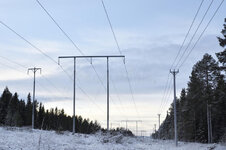
l-against-cloudy-sky-picture-north-sweden-82830845.jpg

These kinds of lines up every hill and mountain to the small communities they serve would be the ones insanely expensive to bury in the rock.
 

reader2580

Well-known member
Joined
Dec 31, 2014
Messages
14,516
Location
Minneapolis, MN
we dont have any underground transformers here. just pad mount.... the only place youll find underground transformers is big cities like SF and LA... wouldnt make sense to use UG transdformers in the rural areas. just install pad mounts...
There is basically an entire substation underneath a building in downtown Minneapolis. It happens to be an office building for the same utility company (Xcel Energy) that provides power in Minneapolis. Every few decades they have to dig up the street outside to do major work on the substation. Xcel Energy was really upset when they built a light rail train down that street as they wouldn't be able to dig up the street to get to the substation. I am sure Xcel figured something out with the local transit agency so the substation can still be maintained.

I think there may even be a second substation underground in downtown Minneapolis.
 

MBfreak

MEMBER EMERITUS
Joined
Dec 10, 2010
Messages
2,301
Location
Linkoping , Sweden
Firebrick
Thanks for a good answer.
The 7 420 kV lines that go from way up north to mid Sweden ( 300-600 miles) are quite old ( some from 1940s)but well maintained. And as far as I am aware has never caused any fire or been destroyed by weather. At most, we have snow-storms.
I have no knowledge of the power system in California, except that a power station upgrade killed two perfectly working NPs.
Great way to destroy money.
My pics come from New Orleans, where I have been a regular visitor since 1972. Love the music, ambiance and food. And they are sprouting new musicians all the time as the older retire or pass.
And the sub at the end of Canal street is an abomination , as is the distribution corridor on the other pic. It would be very easy and probably very profitable to renew the Canal Street sub with an indoor sub at 10 % of the area. And the distribution corridor is easy to renew with buried cables and kiosk type subs. Quite sure there is now frost heaves, and digging 6 feet down is as easy as falling off a chair!

Best regards
 

reader2580

Well-known member
Joined
Dec 31, 2014
Messages
14,516
Location
Minneapolis, MN
Most of the city I live in has underground electrical service. The city passed an ordinance in the late 1970s that all utilities must be underground. My house was built in 1980 with underground service. I have lived here over eight years now and no power outages in that time other than about once a year I lose power for a few seconds during a thunderstorm.

I don't think any new suburban subdivision in my area has been built with overhead power for close to 40 years. My parent's subdivision was built in the late 1970s and has underground power. They still lose power often as the power switches to overhead a block away.

I bought and demolished a condemned house that had overhead service. The utility said they would do underground service to my new house. I had no problem with that.
 
To avoid these ads, REGISTER NOW!
Top Bottom