To avoid these ads, REGISTER NOW!

Different wire gauge in the same sheath?

Copymutt

Well-known member
Joined
Sep 3, 2016
Messages
3,390
Location
Colorado
See the shorter ground wire. Compared to the hot & common & the load grounds IMG_5794.jpegit looks smaller AWG.
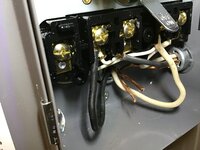
The timer went out on the electric water heater. In the act of replacing it w/ a non-digital Intermatic timer I noticed the line feed has 10Awg on both common & hot, but looks to be 14AWG ground wire🤔.
Everything on a 30 amp circuit should be 10AWG especially when its 240 which this is because the ground is the return leg for both 120s. It’s been this way since the build in 1957.
Do I need to do a complete home run with 10 gauge on all?
 
To avoid these ads, REGISTER NOW!

dscheidt

Well-known member
Joined
Apr 26, 2017
Messages
2,890
See the shorter ground wire. Compared to the hot & common & the load grounds IMG_5794.jpegit looks smaller AWG.
The timer went out on the electric water heater. In the act of replacing it w/ a non-digital Intermatic timer I noticed the line feed has 10Awg on both common & hot, but looks to be 14AWG ground wire🤔.
Everything on a 30 amp circuit should be 10AWG especially when its 240 which this is because the ground is the return leg for both 120s. It’s been this way since the build in 1957.
Do I need to do a complete home run with 10 gauge on all?

This was common in the dark ages, up until ~1970. I wouldn't worry about it. Electric water heaters are 240V straight resistance loads, with no 120V components. There's no current on that wire unless there's a short, in which case the wire has to carry enough current to trip the breaker. 14 AWG will melt with 150ish A through it, but it takes a few seconds. A properly working circuit breaker should be clearing a fault that big in a cycle or two.
 

Bert_

Well-known member
Joined
Dec 24, 2016
Messages
9,717
Location
NW Iowa
A ground is not a return path unless you have a short. No current should be on that wire under normal circumstances. If you have current on a ground wire then you have a problem and it needs to be fixed.

Reduced ground wires in Romex was pretty common years ago. It's not done today but it's not a big deal on existing wiring.
 
OP
C

Copymutt

Well-known member
Joined
Sep 3, 2016
Messages
3,390
Location
Colorado
School me.
I can accept that it was a product in the 50’s. So if two legs line provide 120 each. What is the return path if not ground?
 

dscheidt

Well-known member
Joined
Apr 26, 2017
Messages
2,890
School me.
I can accept that it was a product in the 50’s. So if two legs line provide 120 each. What is the return path if not ground?

The two hot leads are 180 out of phase with each other, so the current flows in one and out the other, reversing 60 times a second. a neutral in a 240V circuit carries the difference in load between the two phases. Since a water heater is a straight 240 V load, there's no current difference, so no need for a neutral. compare this to something like an electric stove, which uses 120V for the controls. In that case, one of the hot leads is supplying more current than the other, so the neutral is required. The 'only carries the difference between phases' is the reason that neutrals are often reduced size in large cables, as there's no reasonable way to have enough current imbalance that all the load is on one phase.
 

wyliesdiesels

Well-known member
Joined
Aug 14, 2012
Messages
20,004
Location
Modesto, CA
See the shorter ground wire. Compared to the hot & common & the load grounds IMG_5794.jpegit looks smaller AWG.
The timer went out on the electric water heater. In the act of replacing it w/ a non-digital Intermatic timer I noticed the line feed has 10Awg on both common & hot, but looks to be 14AWG ground wire🤔.
older NM had reduced size EGCs....

Everything on a 30 amp circuit should be 10AWG especially when its 240 which this is because the ground is the return leg for both 120s. It’s been this way since the build in 1957.
Do I need to do a complete home run with 10 gauge on all?
this is totally incorrect. An EGC is NEVER to be used as a "return wire" aka neutral/grounded conductor. The EGC is the safety and provides a low impedance pathway for fault current. under normal circumstances/operation, there should be no current whatsoever on the ground wire.

and on a 240v circuit, the current flows between the 2 hots aka ungrounded conductors 60x per sec and nothing else.... definitely NOT on the ground wire....

having said all that, the reduced size EGC in the NM would be grandfathered-in so dont worry about it
 
OP
C

Copymutt

Well-known member
Joined
Sep 3, 2016
Messages
3,390
Location
Colorado
Understand the phase and thats what I suspected. Given that then the two hot 120s should be from different feed legs, Yes?
 

u2slow

Well-known member
Joined
Nov 20, 2011
Messages
3,586
Location
BC
Even today's cable, bare bonding wire is smaller than the insulated conductors. No smaller than #14 though.
 

Bert_

Well-known member
Joined
Dec 24, 2016
Messages
9,717
Location
NW Iowa
School me.
I can accept that it was a product in the 50’s. So if two legs line provide 120 each. What is the return path if not ground?
The water heater does not care about voltage to ground. There could be no connection to ground and it will function.

The water heater only cares that there are two wires with 240 volts between them.

The current flows between the two hot wires. Draw out a picture with a center tapped transformer and it becomes very clear.
 

mike93lx

ALLIANCE MEMBER
Joined
Dec 9, 2013
Messages
37,498
Location
Richmond, VA
The water heater does not care about voltage to ground. There could be no connection to ground and it will function.

The water heater only cares that there are two wires with 240 volts between them.

The current flows between the two hot wires. Draw out a picture with a center tapped transformer and it becomes very clear.
Someone that doesn't understand 120/240 wiring has no idea what a center tapped transformer is
 
To avoid these ads, REGISTER NOW!

u2slow

Well-known member
Joined
Nov 20, 2011
Messages
3,586
Location
BC
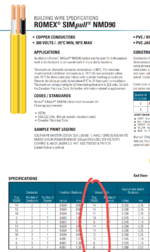
For 10. 12, & 14 AWG, the grounding conductor must be the same size as the insulated conductors, for 6 & 8 AWG the grounding conductor is 10 AWG.

Yet here it's different! Imagine that.
 

Attachments

  • Screenshot_20250531-085106-250.png
    Screenshot_20250531-085106-250.png
    427.9 KB · Views: 28

Jim greengo

Well-known member
Joined
Sep 3, 2018
Messages
7,415
Location
Behind my house
See the shorter ground wire. Compared to the hot & common & the load grounds IMG_5794.jpegit looks smaller AWG.
The timer went out on the electric water heater. In the act of replacing it w/ a non-digital Intermatic timer I noticed the line feed has 10Awg on both common & hot, but looks to be 14AWG ground wire🤔.
Everything on a 30 amp circuit should be 10AWG especially when its 240 which this is because the ground is the return leg for both 120s. It’s been this way since the build in 1957.
Do I need to do a complete home run with 10 gauge on all?
Is it connected with a whip?
 

mm08822

Well-known member
Joined
Jan 13, 2012
Messages
5,904
Location
NJ
Looks like your #6 has a #8 ground. Ours has a #10 ground. I already specialize in the naughty words on a job, I'd be even better at it trying to shove a device with #6 conductors and a #8 solid ground into a box.
Just use a 5# lump hammer to get it all in and lined up. This way you eliminate the chance of stripping out the 6-32s. ;)
 

sparky 1971

Well-known member
Joined
Oct 9, 2018
Messages
7,969
Location
Central Iowa
Just use a 5# lump hammer to get it all in and lined up. This way you eliminate the chance of stripping out the 6-32s. ;)
but, but , but, my fingers! You hold the device for me and I'll give it a shot. I already use 4X4's with a bracket and 5/8 mud ring for dryers and ranges, bond the box and call it good enough. I think I'd continue to do so in Cananada.
 

rharman

Well-known member
Joined
Apr 22, 2012
Messages
8,812
Location
SoCal
Just use a 5# lump hammer to get it all in and lined up. This way you eliminate the chance of stripping out the 6-32s. ;)

but, but , but, my fingers! You hold the device for me and I'll give it a shot. I already use 4X4's with a bracket and 5/8 mud ring for dryers and ranges, bond the box and call it good enough. I think I'd continue to do so in Cananada.
1748752153397.png
 

Milton Shaw

Well-known member
Joined
Feb 11, 2011
Messages
4,837
Nobody has mentioned this. Isn't a water heater grounded already if it is on metallic (copper or galvanized) pipe. But since that is only in older houses that would not apply to anything thing built now. I saw a neighbors house being built and the main electric ground from the electrical box was attached to the brass pressure regulator only on PEX pipe. Lots of good that did. And then there are dielectric fittings on metallic pipe to prevent electrolysis. If you had an element short would there not be enough resistance to trip the fuse.
 

mm08822

Well-known member
Joined
Jan 13, 2012
Messages
5,904
Location
NJ
On a copper pipe system, water systems have to be bonded across the water meter, hot water heater and boilers if present as well as bonded back to the main panel.

Changes in plumbing materials due to modifications of the water system can comprise the previously existing copper path.

You actually want LOW resistance to quickly trip the cb. Water alone could be of low/variable resistance so it is not considered as a conductor.
 

wyliesdiesels

Well-known member
Joined
Aug 14, 2012
Messages
20,004
Location
Modesto, CA
Nobody has mentioned this. Isn't a water heater grounded already if it is on metallic (copper or galvanized) pipe. But since that is only in older houses that would not apply to anything thing built now. I saw a neighbors house being built and the main electric ground from the electrical box was attached to the brass pressure regulator only on PEX pipe. Lots of good that did. And then there are dielectric fittings on metallic pipe to prevent electrolysis. If you had an element short would there not be enough resistance to trip the fuse.
not if the water heater was installed properly with dielectric unions that isolate the plumbing from the tank
 

KansasArt

Well-known member
Joined
Jan 29, 2020
Messages
280
Location
Kansas
I had a similar issue with pex. Did a major remodel and substituted a bunch of copper pipe with pex. It wasn’t until months later I was looking at where the ground was bonded to the remaining copper. It then dawned on me that it wasn’t copper all the way out. I ran a new ground from the box to where the water enters the basement.
 
To avoid these ads, REGISTER NOW!
Top Bottom