To avoid these ads, REGISTER NOW!

Dig down or build up for the floor

tomralph

Well-known member
Joined
Dec 16, 2016
Messages
105
Location
Colorado Front Range
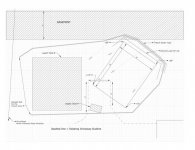
The site I have selected for a small 36'x48'x16' pole barn is slightly sloped. The rear corners of the building at (rear right) 28" and (rear left) 24" higher than the front right corner, and the front left needs to come up 13" to meet with the right corner. The front of the building will meet up with an existing driveway, if I bring the front up too much I will need to bring up the driveway to match the higher building.

Raising the driveway isn't too much of an issue, next year we plan to re-pave our neglected (it was neglected before we moved in) driveway, we could raise its level then, which would take out some of the slope to the house.

I plan to run a French drain around the rear of the building as it is in the path of the natural flow right now. As well as reworking the slope to help shuttle water around it.

I will be putting a slab in the building, still checking with the regional building mafia if I can do a mono slab with frost walls, or if I have to do a true foundation, etc. We live at 7450' in Colorado on the front range so we do get some nice temperature swings.

The slab will be plumbed for radiant heating to take the chill out of the building, with overhead heaters when the wife needs the building to be 'warm'.

Back to the question...

Would you build up the 3 feet in the front to match the rear? Dig it out in the back to lower it by 2 feet? Or split the difference and dig down 18" in the back and raise up the front by 18"?
 
To avoid these ads, REGISTER NOW!

joe_padavano

Well-known member
Joined
Feb 26, 2011
Messages
1,788
Location
Northern VA
Back to the question...

Would you build up the 3 feet in the front to match the rear? Dig it out in the back to lower it by 2 feet? Or split the difference and dig down 18" in the back and raise up the front by 18"?

Digging down ensures you will have a swimming pool.
 

rsanter

Well-known member
Joined
Dec 22, 2007
Messages
18,521
Location
visalia ca
Dig the back out but dig it out further than the building, create a retaining wall with stone, block, or ties and good drainage around the back side so you have a walking path around the back.
Keep the soil off the back wall to prevent having to use a block wall or waterproof wall.
Digging down 2-3 feet is no big. Building up 2-3 feet is a much bigger pain and expense

Bob

Bob
 

astroracer

Well-known member
Joined
Jun 22, 2005
Messages
3,001
Location
Mid_Michigan
In order to do it right you still need to remove all of the top soil. However much that is. Where are you located? Is there an issue with rocky ground?
Your best course of action is to do as Bob said. Prep the site so no water can make it's way into the building. After the topsoil is removed I would bring in compactable fill enough to raise the floor at 6" above your "new" grade. Plan your French Drains but don't depend on them to keep the area free of standing water.
mark
 

John in OH

Well-known member
Joined
Jun 2, 2007
Messages
2,444
Location
SE Ohio & Eastern Virginia
Many of the big old barns in the hill country of eastern Ohio where dug into hillsides. Not a problem if done properly.

I’d do a little of both …. raise the driveway somewhat … say, maybe 8” and then dig in the rear. I assume you are planning pour a footer below the slab elevation to the depth required by your local jurisdiction and lay a block foundation.

Lay a perforated drain line around the rear and both sides of the foundation at the footer elevation and route to open discharge point. When the block is complete, parge the block and place a vertical layer of visqueen on the parge. Fill half-way with gravel then install a second perforated drain line and then complete fill with gravel.

The overall key is to prevent ANY water from standing against the foundation wall.
 

PWC Repair

Well-known member
Joined
Dec 27, 2012
Messages
3,182
Location
Arkansas
I vote to dig in, view my budget build thread. Reasoning for this,
-Digging into "virgin" ground lessens chances of underlying compaction issues.
-Proper drainage will alleviate any potential pooling of runoff.
-Cost to pour retaining walls versus all the dirt work might be close to even.
-Easier to hold the slab heat in.
-Won't have to raise driveway.
-Your footers need go down about 40" below grade anyway.

Sounds logical to me, no????
 

Falcon67

Well-known member
Joined
Jun 11, 2009
Messages
18,371
Location
Merkel, TX
I'd dig it out as above with a space around the perimeter. Your slab needs to be on packed undisturbed earth if at all possible. Just make sure you have a place for the dirt, you start piling it up and it quickly becomes another mountain LOL.
 

Radix2

Well-known member
Joined
May 28, 2014
Messages
1,853
Location
the thumb!, MI
The french drain needs to be thought of as a way to prevent saturated soils in an area.

It is not a solution for rainwater!

Whichever you decide, make sure you excavate such that you have a slope away from your building well past the drip zone and also a grade to take the water away. If this is not possible, raise the building until it is. In any case make sure your floor is well above the outside grade line.

Those spring rains on frozen ground or melting snow are when you risk flooding
 
Last edited:
To avoid these ads, REGISTER NOW!

ItsNemo

Well-known member
Joined
Mar 5, 2016
Messages
4,806
Location
Canada
Half and half so you don't need to buy fill or dispose of fill...just move what's in the back to the front ;)
 

rburke65

Well-known member
Joined
Nov 10, 2007
Messages
12,349
Location
Canfield, Ohio
You need to remove all the top soil first. Then you need to keep the build up out of the water. You NEED to get this right now or you will kick yourself every day if you do not. High and dry.
 
OP
T

tomralph

Well-known member
Joined
Dec 16, 2016
Messages
105
Location
Colorado Front Range
In order to do it right you still need to remove all of the top soil. However much that is. Where are you located? Is there an issue with rocky ground?
Your best course of action is to do as Bob said. Prep the site so no water can make it's way into the building. After the topsoil is removed I would bring in compactable fill enough to raise the floor at 6" above your "new" grade. Plan your French Drains but don't depend on them to keep the area free of standing water.
mark

I am in CO... not too rocky where I am. There also is not a lot of top soil, it is about 3" then a clay/sand mixture. Water doesn't stand on the lot, it drains down the slope.

Here is a picture of the building the site... thoughts?
 

Attachments

  • Workshop - 36x48 - Elevation Plans.jpg
    Workshop - 36x48 - Elevation Plans.jpg
    70.2 KB · Views: 26

Radix2

Well-known member
Joined
May 28, 2014
Messages
1,853
Location
the thumb!, MI
The french drain is at the top of the retaining wall?

I think you need more space from the building to the wall - in a rainstorm, the french drain is not going to do anything with the water running at you down the slope - put a swale up there to channel it around your building.

put a swale at the base of the retaining wall to also channel any surface water that makes it down there with enough space to slope the ground around your building away for at least 3 feet.

Put the french drain low behind and if possible a second line running in front of the wall to keep the toe of the wall as dry as possible.

If you really cant dig away, then build a block foundation and raise the ground so that you again can keep the slopes away from the building and build effective swales to control surface water.
 
OP
T

tomralph

Well-known member
Joined
Dec 16, 2016
Messages
105
Location
Colorado Front Range
The french drain is at the top of the retaining wall?

I think you need more space from the building to the wall - in a rainstorm, the french drain is not going to do anything with the water running at you down the slope - put a swale up there to channel it around your building.

put a swale at the base of the retaining wall to also channel any surface water that makes it down there with enough space to slope the ground around your building away for at least 3 feet.

Put the french drain low behind and if possible a second line running in front of the wall to keep the toe of the wall as dry as possible.

If you really cant dig away, then build a block foundation and raise the ground so that you again can keep the slopes away from the building and build effective swales to control surface water.
Thanks Radix2!

We don't see that much water, usually pretty dry.

Annual high temperature: 59.3°F
Annual low temperature: 32.4°F
Average temperature: 45.85°F
Average annual precipitation - rainfall: 21.93 inch
Av. annual snowfall: 111 inch

Even the snow fall melts slow enough to not cause run off. I am just planning on the once in 10 year type storms.

The swale makes good sense for the top water. The French was going to run at the base of the wall to catch anything at the bottom. I will put a concrete swale up top to catch any 'sudden storms', then tie its output to the piping of the drain.

With the french behind the wall (4' off the building) and at the bottom, the 4' area between it and the building should stay pretty dry, gutters will be on the building and shuttle the roof water else where. Do you see a need for a 2nd french in that 4 foot span? Or can I get away with just some rock in that 4 foot span...?
 

Ggg

Well-known member
Joined
Mar 17, 2008
Messages
230
Location
N.W. IL.
After looking at the site drawing I would check local laws on building within the easement and make sure you can get a variance if needed. Around here you are not allowed to drive over the septic tank or its discharge line, they will not issue a variance for that. Been there, and lost that battle with my county.
 
OP
T

tomralph

Well-known member
Joined
Dec 16, 2016
Messages
105
Location
Colorado Front Range
After looking at the site drawing I would check local laws on building within the easement and make sure you can get a variance if needed. Around here you are not allowed to drive over the septic tank or its discharge line, they will not issue a variance for that. Been there, and lost that battle with my county.
The septic is in a bad spot (IMO)... but it has been there for 30 years, under a paved asphalt driveway. Currently it is used as a parking pad (when guests are here) and basketball court.

The overhead doors on the building will be to the opposite side of the tank. I am trying to limit the amount of traffic over it, just can't afford or justify moving it. Especially if I can reduce the traffic over it. I am also moving that extra parking to the south side (right side of the document) of the building, hopefully reducing the traffic over the tank to the occasional trailer swinging in to the workshop as I back it in.

The easement as shown I can do anything shorter than 5 feet in it. It is also a HOA property boundary easement, the county's easement is at 15 feet compared to the 25 feet for the HOA. The county shouldn't have an issue there either the retaining wall to them is similar to a fence.

That is pretty much the flattest part of the 2.5 acre lot that I have. Wife and I staked out a spot about 10' to the south of the current candidate but ran in to the under ground power line. We would have had to have the line and meter pole moved. The elevation change there was much greater with nearly 5' between the highest and low spots.
 
To avoid these ads, REGISTER NOW!
Top Bottom