To avoid these ads, REGISTER NOW!

Digging up damaged house sewer line in basement

branimal

Well-known member
Joined
May 31, 2016
Messages
1,938
I have a 4" CI sewer pipe running under the cellar floor. I recently snaked out the clogged up roof rainwater connection to the sewer line. But I could only get my snake out about 12' before it starts getting stuck. (Ridgid k-400 with 1/2" cable) I think I hit a 2nd elbow and I've been unable to get past it. I got the line cleaned - 20 minutes with garden hose on full blast and no water backup. There was a couple of puddles forming in the basement near the back of the house in the utility room (gas steam boiler, electric water heater). I can see small bubbles in the concrete slab where the water is coming up.

I'd like to dig up the pipe and replace the damaged section with PVC.

I think the floor is what they call a rat slab (2-4" of concrete). I think it's closer to 2" based on some damage in a nearby area.

The house trap at the front is about 3' below the slab. The leak is about 52' toward the back. If there's 1/4" drop per foot that would make the pipe about 2' below the slab.

How should I go about digging this up? I ordered a concrete saw with a water attachment. How wide a cut should I make? Should I pay for a camera inspection and locater? Or will a DIY sewer camera do the job? Vevor sells some at lowes

Thanks for the help!!
 
To avoid these ads, REGISTER NOW!

larry4406

Well-known member
Joined
Jan 27, 2006
Messages
19,257
Location
Northern Virginia
I’ve used a typical circular saw with a concrete blade to cut slabs. I have a hand pump sprayer that sprays water as I cut to keep the dust down. Cuts 3”+. After that I chip it out.

I would suggest 16” wide trench cut or more.

How much “groundwork’s” are present under the slab? Might be easier to abandon the groundwork’s and perhaps change to a hung sewer with a local excavated connection at the end?
 

carlaisle

Well-known member
Joined
May 14, 2022
Messages
374
Saw to produce a nice pair of break lines then remove what's left between the lines however you find most convenient. A wider trench is easier to work in than a narrower one. 18" is about the narrowest you're going to want to work in. All of those cheap sewer cameras I've seen are junk. I have found paying to have the good camera run money well-spent every time. This would be especially true in your case if they will mark the location of the line. This would be the perfect time to remove that house trap. If you can go overhead that would save a monumental amount of labor.
 

andyvh1959

Well-known member
Joined
Feb 15, 2020
Messages
2,598
Location
Green Bay WI
Before cutting/busting anything up I'd hire someone with a professional sewer camera to really find out what you have. Once you bust and cut, there is no going back until it is all resolved, and there may well be a lot more to contend with. Thing is, once water and sewer to your house is interrupted its pretty much not livable until its all repaired, meaning no toilets, showers, kitchen water, etc. Things can "back up" in a real hurry.

My 1st house, one bathroom, one toilet. I needed to replace the toilet after I installed a new floor in the bathroom. No big deal right? After three attempts to get the toilet down and sealed (don't recall why) its was VERY close to GO TIME and christen the just installed toilet. Those last few minutes I was working fast, under pressure, duress actually. Ahhh,....sweet relief.
 

mm08822

Well-known member
Joined
Jan 13, 2012
Messages
5,925
Location
NJ
I would want the pipe located before I started any saw cutting, either the trench or just for the clean out.

Just because you sawcut/excavated, doesn't put the line out of service.

You may also want to check what is happening beyond the basement walls before fully shutting down.
 

finn

Well-known member
Joined
Mar 27, 2005
Messages
16,253
Location
The UP, God's country
When I was a kid, we had a septic system and what I always called overhead sewers. The township passed a bond issue to install a public sewer system.

My dad wasn’t real handy, but he did demolish the slab, using a shovel, sledge hammer, a wheelbarrow, and some five gallon buckets. I was probably 11 or maybe 12 at the time, so I’m not sure if I was a help or hindrance, but the process was to smash the concrete with the sledge, and once started, undercut the gravel, then smash som more until we reached the wall.

Didn’t take long at all.
 

leadfoot415

Well-known member
Joined
Nov 28, 2012
Messages
1,256
Location
Livonia, MI
I have a 1955 ranch on a full basement with a poured foundation and floor slab; about 14 years ago I had a sewage backup from the floor drain on the laundry room side of the basement from the floor drain. Paid a plumber to snake it out and it was good for another 7 years until it plugged up again and no longer flowed enough to keep up with a dishwasher or clothes washing machine, mind you this is cast iron piping.

I waited until the water slowly drained, and added measured amounts water to the floor drain rather quickly until it backed up level with the floor. I then calculated the amount of water poured in and the volume/capacity this pipe could hold, and measured out from the floor drain for an approximate distance and started electric jack hammering up the floor in that area. I was about 2-3 feet off from where I anticipated the issue was at (pipe failed, rusted out and leaking thru the bottom/totally plugged inside with a ball of literal rust/turds/tp).
 

Wrench97

Well-known member
Joined
Jun 23, 2018
Messages
12,097
Location
Southeastern Pa
Rain water in the sewer system is outlawed everywhere that I know of the cost of treatment per gallon is very costly especially if it's clean rain water. If you are on your own septic system it will cause premature failure.
How is it tied in internally in the house or externally?
 

tarmy

Well-known member
Joined
May 28, 2014
Messages
4,679
Location
Nor Cal
Was surprised to read that roof rainwater combines with the sewer…….
The city of San Francisco has a combined storm and sanitary system for the whole city! It all flows to treatment plants…BUT…when it rains the plants are overwhelmed easily and it ALL ends up, untreated, in the Bay and Ocean.
 

rooster59

Well-known member
Joined
Nov 16, 2014
Messages
955
Location
Land of the Pines
If you are near a HomeDepot they may have a Bosch electric jack hammer for rent that makes quick work of this. Saw cuts for the break line and jack hammer rubble-izing goes pretty clean.
 

DGersic

Well-known member
Joined
Mar 12, 2017
Messages
6,310
Location
DeKalb, IL
Was surprised to read that roof rainwater combines with the sewer…….

Old designs did that. My house (1948) had the perimeter drain tile connected to the sanitary sewer. Not the roof / gutters, those just dump on the ground, which works its way down to the perimeter drain tile.

When the sewer failed (clay tile, shifted and separated), I had to fix it. In doing so, my perimeter drain tile was disconnected, and then had nowhere to go. This led to basement flooding, and I had to dig in a sump pit, sump pump, and figure out where to make the water go.
 

larry4406

Well-known member
Joined
Jan 27, 2006
Messages
19,257
Location
Northern Virginia
The city of San Francisco has a combined storm and sanitary system for the whole city! It all flows to treatment plants…BUT…when it rains the plants are overwhelmed easily and it ALL ends up, untreated, in the Bay and Ocean.
Washington DC has the same problem, it overflows into the Potomac River. They have a major project underway to try and solve this.
 
OP
B

branimal

Well-known member
Joined
May 31, 2016
Messages
1,938
Here's a diagram of what I know of my sewer system in the basement. The gutter pipe in question is in the top right corner. And I can see it making a 90 turn into the basement. The seepage happens in the first 10' or so (see diagram). Based on where the 4" soil stack, the basement toilet, and the house trap are located, the sewer line is making another 90 turn to get to the front of the house.

In terms of groundworks, there doesn't seem to be anything in the area of the seepage. The floor drains in the back of the house are for a potential leak of the gas steam boiler (2018) and water heater (2023) and potential basement flooding from heavy rains. I cleaned all of the floor drains out recently and they are flowing fine with no signs of leaking (no water seeping up).

A hung sewer is an option and I could tie into the soil stack if needed.

House traps are required in NYC.

In terms of putting the line out of service - I don't believe that's an issue given that all of the building services are downstream of the repair location. (4" soil stack).

I do feel like a repair can be made in the seepage area and then I can retest it the line. I will call around and see what it costs to get the line marked.
 

Attachments

  • IMG_4555.JPG
    IMG_4555.JPG
    808.4 KB · Views: 168
To avoid these ads, REGISTER NOW!
OP
B

branimal

Well-known member
Joined
May 31, 2016
Messages
1,938
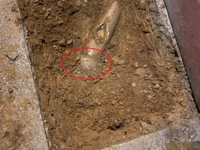
Found the cracked pipe. It looks like clay pipe. Can I get thru this with a 9" diamond grit sawzall blade? My fear is cracking the pipe further upstream. I'll start the cut with a diamond blade on my angle grinder.

I'm going to replace this section with PVC pipe.
 

Attachments

  • 78059658503__1E8356BE-FE67-4913-B485-A1EE16CB7C05.jpeg
    78059658503__1E8356BE-FE67-4913-B485-A1EE16CB7C05.jpeg
    1.2 MB · Views: 101

Pen & Wrench

Well-known member
Joined
Jan 12, 2015
Messages
658
Location
Huron, SD
Where I live there's a guy who runs a service that can do cured in place pipe like they do with municipal sewer pipes. Most of the house is plastic sewer pipe with 2 cast iron drain lines and 4 inch line from the main sewer stack to where it exits the foundation. My plan is to have that done if necessary, it sounds way better than tearing up the floor. It may not be a viable option in all cases.
 

Pen & Wrench

Well-known member
Joined
Jan 12, 2015
Messages
658
Location
Huron, SD
I forgot to mention, most would probably know, but the process is to clean out the existing pipe, then reline it with a fabric sock, impregnated with epoxy, resin and maybe some other things, and the sock is forced into the existing pipe with light air pressure, then the chemicals in the fabric are cured, and when you are done it looks like a plastic pipe and the diameter is not much less than the existing pipe. I'm not sure how small a pipe they can do but it sounded like 2 inch might be able to be done, for sure 3 and 4 inch can be done.
 

PoorUB

Well-known member
Joined
Mar 29, 2021
Messages
11,637
Location
Fargo, ND
I forgot to mention, most would probably know, but the process is to clean out the existing pipe, then reline it with a fabric sock, impregnated with epoxy, resin and maybe some other things, and the sock is forced into the existing pipe with light air pressure, then the chemicals in the fabric are cured, and when you are done it looks like a plastic pipe and the diameter is not much less than the existing pipe. I'm not sure how small a pipe they can do but it sounded like 2 inch might be able to be done, for sure 3 and 4 inch can be done.
And it it expensive!

I had to repair the sewer from the hose to the street and looked into it. They gave me a quote of $25K to do it. I already had a quote from a company to dig up each end and shove PVC through the existing pipe for $8K. You might be able to guess which way I went.

One thing about doing the relining the pipe with the sock thing is it doesn't leave a perfectly smooth surface and if there is any irregularities in the pipe, it follows them. Where PVC is smooth and straight.
 

larry4406

Well-known member
Joined
Jan 27, 2006
Messages
19,257
Location
Northern Virginia
Nice find! First try?

I would think your 9" diamond grit sawzall blade should cut it ok.

Looks like there is a hub fitting circled in red. I would be concerned that the upstroke on the sawzall might disturb the joint. I have no idea how the original joints would have been made.

Assuming you insert a short section of PVC, use Fernco couplings with the metal shear bands on the them to ensure no settling.

1758912275478.png
 

carlaisle

Well-known member
Joined
May 14, 2022
Messages
374
I would cut flush on the bell end of the hub then as far past the damage as necessary to get to undamaged pipe. Try to do as much as possible with the angle grinder. The diamond blade on the sawzall will work fine for the rest. High speed so it can't grab and shake things around. Excavate enough so there's nothing for the sawzall blade to hit when running. You don't want to make the job bigger. Check availability of the appropriate Ferncos - clay to PVC is not commonly stocked around me, but it may be different in your area. Torque the clamps properly. A little too loose is better than way too tight - they'll fatigue crack and fail if (significantly) over tightened.
 

DGersic

Well-known member
Joined
Mar 12, 2017
Messages
6,310
Location
DeKalb, IL
Nice find! First try?

I would think your 9" diamond grit sawzall blade should cut it ok.

Looks like there is a hub fitting circled in red. I would be concerned that the upstroke on the sawzall might disturb the joint. I have no idea how the original joints would have been made.

Assuming you insert a short section of PVC, use Fernco couplings with the metal shear bands on the them to ensure no settling.

1758912275478.png

Clay tile is slip fit together. I had clay tile that shifted over time and a couple of the skip joints separated, allowing rocks and dirt to drop in, blocking the sewer.
 

DGersic

Well-known member
Joined
Mar 12, 2017
Messages
6,310
Location
DeKalb, IL
And it it expensive!

I had to repair the sewer from the hose to the street and looked into it. They gave me a quote of $25K to do it. I already had a quote from a company to dig up each end and shove PVC through the existing pipe for $8K. You might be able to guess which way I went.

One thing about doing the relining the pipe with the sock thing is it doesn't leave a perfectly smooth surface and if there is any irregularities in the pipe, it follows them. Where PVC is smooth and straight.

It is expensive, but in my case it was less expensive than the other alternatives. My sewer runs 150’, under the house (addition built later, over the sewer), under the concrete patio, under the detached garage, across the property line and under a chunk of my neighbor’s yard.

The sleeve maxed out at 75’, so we had to dig behind the garage, and sleeve from the house to the excavated hole, then from the hole to the city sewer. There’s now a section of PVC with a cleanout right behind the garage.

The sleeve does follow the pipe irregularities. Since mine was imperfect clay tile, the result is Imperfect. It goes up and down a bit as it drops from the house to the sewer. That could lead to some pooling of water, but it’s been ~20 years trouble free. I did get some roots coming in to the end from the city sewer, but that’s not the fault of the sleeve.

I think mine was the first, or one of the first, that this company had done. They ran in to some problems, so it took longer than they had expected, and cost them quite a bit of money to complete the job. The sleeve is epoxy impregnated cloth with a plastic liner and a rubber bladder. After pulling it in, inflate the bladder, and wait for the epoxy to cure. The epoxy burned through the liner and effectively glued the bladder to the inside of the pipe. When they winched the bladder out, it tore where it was stuck. A lot of fun was then had with the water jet trying to cut the remains loose. They had to buy a new, longer hose to reach the blockage, and had to overnight ship it to get my sewer opened up again. They did eventually get it, and a camera inspection showed that the sleeve was not damaged.

Overall, 20 years in, I’m still happy with it. Was a $10K job back then, I assume it’s more now. I wouldn’t be surprised at your $25K estimate if that was recent.
 
OP
B

branimal

Well-known member
Joined
May 31, 2016
Messages
1,938
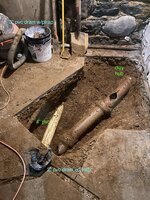
I vacuumed out the hole in the pipe and sent a hose down the line. Water started gushing up a couple of feet past that clay hub. So I excavated that. Seems like the line is completely crushed at that point. I'm debating sending a snake into the hole in the picture. Maybe there is good line after that? Or maybe this clay pipe was abandoned by some previous owner.

I see there are three floor drains nearby this excavation area. All are PVC. One of them is deep enough for me to wye into it with the gutter line. It is a 3" line though. I really need a 4".

Both sides of my double trap (house side and street) are pvc. That's another clue that this clay pipe was abandoned.

What kind of shovel should I use to dig under the pipe? Maybe some variety of garden scoop?
 

Attachments

  • IMG_4569.JPG
    IMG_4569.JPG
    1.2 MB · Views: 96

carlaisle

Well-known member
Joined
May 14, 2022
Messages
374
Mike's suggestion is good. A margin trowel is also super handy in tight spots. A shop vac can save you a lot of time, too. Just loosen the material and then **** it out.
 

firebirdparts

Well-known member
Joined
Jun 8, 2016
Messages
10,621
Location
Kingsport, TN
The city of San Francisco has a combined storm and sanitary system for the whole city! It all flows to treatment plants…BUT…when it rains the plants are overwhelmed easily and it ALL ends up, untreated, in the Bay and Ocean.
All old cities did. They built their sewer systems before waste treatment was invented. But that's different from running your gutters off your house into the sewer line in your house.
That's weird.
 
OP
B

branimal

Well-known member
Joined
May 31, 2016
Messages
1,938
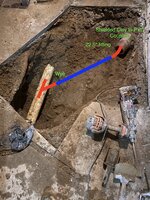
Looks like I got lucky. I knew the 3" pvc drain in the back (where the shop vac is in the picture) had to run to the front of the house. I dug where I thot it was going to pop out. And it was there! And the prior owner used 4" pvc to connect it!! Plan is to cut a 4" wye into the pvc. I might install a floor drain / clean out while I have the hole open.

I'm going to cut the clay pipe just upstream of the hole in the pipe. But first I'll do a couple of practice cuts downstream. Sounds like a 4" grinder, no guard can do the job. I saw a video where the guy cuts a rectangle on the pipe, knocks out the rectangle (kind of like cutting tile) and then can reach the under side of the pipe with the grinder to finish the cut. I have to be careful not to dislodge the clay hub just north of the hole.

Good tips on digging tools. Thanks. In addition to those tools I used my bosch bulldog with a chisel bit to loose up the soil near the pipe. Very cautiously.

I might have to cut the slab back a little more on the pvc side to be able to dig enough get the wye installed. I'll use a pvc slip coupling on one side.

thanks for the help and i'll keep you posted.

btw, the old clay pipe was abandoned.
 

Attachments

  • IMG_4579.JPG
    IMG_4579.JPG
    1.3 MB · Views: 86

reader2580

Well-known member
Joined
Dec 31, 2014
Messages
14,532
Location
Minneapolis, MN
All old cities did. They built their sewer systems before waste treatment was invented. But that's different from running your gutters off your house into the sewer line in your house.
That's weird.
It was very common in the old days to do this. This was before cities were concerned about untreated water leaving sewage treatment plants. The city I previously lived in made a concerted effort to stop property owners from dumping sump pump and gutter discharge into the sewer system about fifteen years ago. The city gets fined if they dump too much water into the sewer system during rain events.
 
To avoid these ads, REGISTER NOW!
Top Bottom