poprockcrusher
Banned
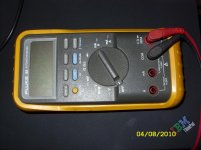
the Fluke 87 is also known as GM special tool J6360
I have had mine for almost 20 years
I have had mine for almost 20 years

By cutting the strands, you aren't changing the resistance of the wire, just the ability of the wire to carry current. Your test will never show the difference you are looking for.
I'm pretty sure the resistance changes when there is only one small strand. I'm just saying that hand held meters are not accurate enough to pick up the change. It would be like taking a two inch hose and putting a 1/4 coupler in the center of it, it's going to cause resistance.
Yes, but the multimeter doesn't load the wire and you wouldn't know if the hose had any resistance unless you open the valve. Put current on the one strand and your analogy makes sense.
By cutting the strands, you aren't changing the resistance of the wire, just the ability of the wire to carry current. Your test will never show the difference you are looking for.
All a meter does when it measures resistance is send current through the wire and measure the voltage drop. So it is putting a load on it, although small.
He most certainly is and current is inversely proportional to resistance. V=IR. I=V/R. Can't diagnose anything without understanding this.
Edited: to correct relationship due to a momentary lapse of reason.
If you are going to quote formulas at me, you might want to understand them. If you re-read what I stated: "the resistance doesn't change, just the ability of the wire to carry current", you'll see that Ohms law will verify what I just said.
If the resistance stays the same, and the voltage stays the same, the only thing that changes is how much current can flow through the wire. By cutting strands of wire, you cut down on the available paths for electrons to flow through the wire, reducing the amount of current that can flow through it.
Think about it, by cutting strands of wire, you cut down on the available paths for electrons to flow through the wire, reducing the amount of current that can flow through it.
Think about it, by cutting strands of wire, you cut down on the available paths for electrons to flow through the wire, reducing the amount of current that can flow through it.
If you are going to quote formulas at me, you might want to understand them. If you re-read what I stated: "the resistance doesn't change, just the ability of the wire to carry current", you'll see that Ohms law will verify what I just said. If the resistance stays the same, and the ability to move current drops, it will lower how much voltage can flow through the wire before it melts. Just like in the real world.
Look up the formula for power.
Try editing again. No better this time. First of all Voltage doesn't flow. It exists as a potential difference between two points. Current flows. "The ability to move current drops" What does this mean? Sounds like you are trying to say the resistance increases.
I'll own this one and admit you are correct, I can see where I didn't think through what I was saying. I think Caper was able to sum up the point I was trying to make.
Because the wire isn't loaded, the meter can't tell the difference between a 22g wire with one intact strand and a 4/0 wire with all of the strands intact. To the meter, the wire is the same, even though the overall resistance of the wire is much higher with the strands cut. Most meters aren't sensitive enough at the extreme low end of the scale, so tests like Michael was describing aren't a good indication of if the meter is accurate or not.
You get credit for fessing up. I was hoping you would do that.
Now, as to whether the wire is "loaded" is not a good way of looking at things and will only harm your ability to understand. I have no idea what "loaded" means.
Okay, so if I'm looking at a fluke multimeter, in relation to working with cars, is the 87 model the only way to go? I looked at the fluke site, and cars weren't an area they referred to... are they much of a muchness, or is there a particular type I should be looking for?
Nah, I got this, but I was wondering if that was the only model, or if there were others... I looked on the fluke website, but couldn't find the automotive section (as I figure there isn't one! lol)- cheers for the reiteration, I'm now looking for the model on the site specifically... Cheers!You missed my post on page two:
Re: digital multimeter stuff[i/]
Okay, so if I'm looking at a fluke multimeter, in relation to working with cars, is the 87 model the only way to go? I looked at the fluke site, and cars weren't an area they referred to... are they much of a muchness, or is there a particular type I should be looking for?
I added a pic of mine in my previous post (you can see at the top of the meter is printed "Automotive")
[...]
Ive got a small tool box for my meter and almost all my accessories are aftermarket (spelled affordable!).

Thanks for the heads up - you're all quite right of course, a Fluke is massive overkill for my knowledge and needs, but if I get one for an awesome price...I read on another forum that Rexel is having a Fluke sale - getting out of the brand apparently. It looks like they have a few shops in Christchurch - http://www.rexel.co.nz/index.php/pi_pageid/4 Give them a call and give them heaps...
 I'll see what they've got!