
Rileysan
Well-known member
There's plenty of info on these via Google search, but not much on GJ, so I thought I'd share my find with you.
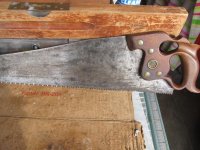
I picked this up at a local thrift store for $3.95. What caught my eye were two things 1) the shape of the handle, and 2) the etched insignia on the blade.
Here's an excerpt on this saw from the "Distonian Institute".
"The D-8 was the first Disston saw to use the letter "D" in its designation. The D-8's handle (and that of the No. 120 ACME) had the unique "cover-top" feature for decades before any other saw. It was not open at the top like other handles, providing an additional surface on which the blade would bear, making the fit of the handle tighter and preventing rocking of the blade within the handle. Other Disston saws adopted the feature in 1928, but the D-8 and No. 120 had it first, beginning in 1875.
The most obvious feature of some D-8's is the extra hole in the handle. Offered on 26" and longer ripsaws from the about 1880 until about 1950, the Dual-Grip or thumbhole-handled saw was designed for those laborious rip cuts. The handle is gripped normally with the lead hand and the thumb of the second hand is put through the thumbhole. The fingers of the hand are then wrapped across the top of the saw handle."
http://www.disstonianinstitute.com/d8page.html
I haven't had the chance to try my saw just yet, but I don't intend to bury it and forget about it.
edit: I should add - the "hammer" is missing from the top of the saw handle, so it's not really worthy of restoration - thus the reason I intend to use it.
Brian
I picked this up at a local thrift store for $3.95. What caught my eye were two things 1) the shape of the handle, and 2) the etched insignia on the blade.
Here's an excerpt on this saw from the "Distonian Institute".
"The D-8 was the first Disston saw to use the letter "D" in its designation. The D-8's handle (and that of the No. 120 ACME) had the unique "cover-top" feature for decades before any other saw. It was not open at the top like other handles, providing an additional surface on which the blade would bear, making the fit of the handle tighter and preventing rocking of the blade within the handle. Other Disston saws adopted the feature in 1928, but the D-8 and No. 120 had it first, beginning in 1875.
The most obvious feature of some D-8's is the extra hole in the handle. Offered on 26" and longer ripsaws from the about 1880 until about 1950, the Dual-Grip or thumbhole-handled saw was designed for those laborious rip cuts. The handle is gripped normally with the lead hand and the thumb of the second hand is put through the thumbhole. The fingers of the hand are then wrapped across the top of the saw handle."
http://www.disstonianinstitute.com/d8page.html
I haven't had the chance to try my saw just yet, but I don't intend to bury it and forget about it.
edit: I should add - the "hammer" is missing from the top of the saw handle, so it's not really worthy of restoration - thus the reason I intend to use it.
Brian
Attachments


Last edited:


