To avoid these ads, REGISTER NOW!

Distributor testing machine, Homemade?

N8sToolz

Well-known member
Joined
Oct 27, 2022
Messages
97
I've been finding myself doing quite a bit of classic car work and I've had to do a couple distributors too. I've always kind of eyeballed getting an old sun machine and even turned one down at one point years ago. Kicking myself for it now..they seem to fetch a premium and nothing for sale near me either.

I came across and old thread about plans to build one at home. It's tempting and now with brush less motors and speed control common, I could cannibalize an old drill or maybe even incorporate an Arduino to make something happen. So in the search for ideas has anyone any experience with such a machine, building or what features should be incorporated?
 
To avoid these ads, REGISTER NOW!

American Locomotive

Well-known member
Joined
Jan 8, 2017
Messages
10,929
Location
Rhode Island
You could definitely cobble something together with parts from McMaster-Carr. I don't see any need for an arduino if you wanted to build one.

You just need a variable speed motor, some bearings, some shafting, two "toothed" pulleys - one twice as big as the other, a toothed timing belt to connect them, a degree wheel and a timing light. I'm not quite sure how you'd attach the distributor to the shaft on the "big" pulley. Maybe some kind of large drill chuck that just grabs the distributor's driveshaft?
 
To avoid these ads, REGISTER NOW!

1Bad55Chevy

Well-known member
Joined
Feb 20, 2025
Messages
607
You can do it on the engine same as a distributor tester. You will need is the factory service manuals that outline the test procedure, hand held vacuum pump, dial back timing light, and to Remember distributor rpm is half of engine RPM.

Steps
1. Hook vacuum pump with gauge to vacuum advance.
2. Start engine and set idle screw to double test distributor RPM. If you don't have a tach use the tach read out on the timing light.
3. Using the dial back timing light dial back the flash until the timing mark reads zero on the pointer. Write the number displayed on the light down, this number is the initial timing plus any mechanical advance added.
4. Using the vacuum pump apply the correct amount of vacuum to the vacuum advance as outlined in the service manual.
5. Using the timing light, dial back the flash until the pointer is back at zero, write this number down.

The total timing recorded in step 5 minus the total timing in step 3 is the amount of advance the vacuum regulator is applying.

This is a very crude way of doing this but it works well.
 

Milton Shaw

Well-known member
Joined
Feb 11, 2011
Messages
4,835
You really need a ignition scope to fully test the distributor, most machines do not have the capability to show dwell error from a bent shaft or worn bushings. A scope shows it very well with a spark line when stacked does not show as straight. I ran into a few 40-50 years ago that had bent rods and a lot of difference in the dwell per cylinder. I don't know what difference that would make on electronic but with point triggered ignition it made a big difference.
 

Gaspen

New member
Joined
Dec 13, 2025
Messages
2
Hello

It is interesting that someone linked my machine here :)

Yes it is working in some way with points ignition but I still can not figure out how to test an electronic dizzy without the coil.

I would be grateful for some help.
 

Schurkey

Well-known member
Joined
Oct 27, 2011
Messages
2,366
Location
The Seasonally Frozen Wastelands
I still can not figure out how to test an electronic dizzy without the coil.

I would be grateful for some help.
I had an ancient table-top Allen Synchrograph distributor machine. Photo stolen from The Internet--not my machine.

Very small, compact. (This was destroyed in a flood nearly thirty years ago.) No photos, so I'm working off of my memory here.

I added some wires and a common four-pin HEI module for testing mag-pickup distributors. The machine had a built-in automotive ignition coil that fired the strobe light. I just connected the HEI module to the existing coil and power supply, and had leads from the "G" and "W" tabs on the module to connect to the pickup coil wires on the distributor.

I mounted the HEI module with heat-sink paste to...something...probably the sheetmetal housing of the machine, but maybe I used an actual aluminum heat-sink.


Replaced the Allen Synchrograph with a Sun 504; the 504 has a very dim strobe light due to age and--I suspect--failed electrolytic capacitors. Bought--but have not installed--a strobe kit from a guy on this forum. I guess his kit fits all or nearly-all the Sun machines, includes a new LED "strobe" plus all the electronics needed to make it work. I have high hopes...
 
Last edited:

Gaspen

New member
Joined
Dec 13, 2025
Messages
2
I guess that HEI unit acts as an amplifier (?)

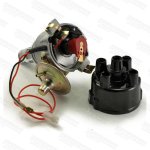
I have some PowerSpark unit here. These need a +12V supply and they trigger the primary circuit on the black wire.
 

Attachments

  • powerspark-lucas-45d-type-distributor-from-powerspark-ignition__35038.jpg
    powerspark-lucas-45d-type-distributor-from-powerspark-ignition__35038.jpg
    149.4 KB · Views: 6
To avoid these ads, REGISTER NOW!
Top Bottom