To avoid these ads, REGISTER NOW!

DIY Garage Help - Any Engineers Here?

Rivet110

New member
Joined
Jan 18, 2018
Messages
3
Location
Fort Worth, TX
Hi all,

We recently moved to a historic house in the city (Fort Worth, TX) will be DIYing a garage. I had a local builder make some plans that we were able to walk through the Historic District's approval process, but they fall short of what I need for the city's building permit. The company I used cannot provide any further help.

This is a super basic small garage (unfortunately) but I'll take what I can get. In order to get the green light from the city I need "Wall bracing" and "Structural framing details." I know there are complete plans online....which I wish I did in the first place, but I'm stuck with the garage design that was already approved by the historic district.

Here is a pic of what it will look like and what I'm trying to garage ;) . Any thoughts on where to get the detailed wall bracing and framing detail drawings?

 

Attachments

  • Screen Shot 2018-04-19 at 7.16.10 PM.jpg
    Screen Shot 2018-04-19 at 7.16.10 PM.jpg
    20.1 KB · Views: 158
  • Screen Shot 2018-04-01 at 7.12.56 PM.jpg
    Screen Shot 2018-04-01 at 7.12.56 PM.jpg
    20.2 KB · Views: 113
To avoid these ads, REGISTER NOW!

bczygan

Well-known member
Joined
Nov 4, 2009
Messages
22,002
Location
DETROIT! Arsenal of Scrappers
Ask what kind if wall bracing they like and what kind of details they are looking for.

Ask what is typical and will get approved.

See if they have standards or an approved plan you can look at.

Bill
 
OP
R

Rivet110

New member
Joined
Jan 18, 2018
Messages
3
Location
Fort Worth, TX
Yes Jim, that's exactly what I'm looking for. The receptionist at the city wasn't much help other than saying it had to be to scale and show how the walls are going to be braced. She scribbled an example on a sheet of paper but I'm guessing the city wants something that looks professional. I'd rather not shell out another $500 for what they need if it is a simple drawing. I'll see if I can get someone on the phone that can give me a better answer as to what they need.
 

matt_i

Well-known member
Joined
Mar 14, 2008
Messages
10,725
Location
SE Michigan
Typical wall bracing involves osb or plywood on the stud walls, (thickness up to you), you can call out the nailing schedule of #10d at 12" oc thru the panel center, 6" oc along panel edges. If that's insufficient you can put in Simpson CS16 flat strap in an "X" pattern (or "V" pattern if windows are there, nail thru every stud it crosses, and top and bottom plates as well, with #10s as I recall but must be hot dipped galvanized or stainless in the treated bottom plate.

They probably want to see your header sizes and thicknesses, jack and king studs, etc.

I would include the Simpson H1Z uplift connectors for your trusses, there's a bendable hanger for the top end to ridge if you are doing rafters...I would include trussco quote drawings in your package or else spec your rafter sizes as well. Include roof sheathing thickness, 5/8" ply or osb is about right.

I think you need to spec anchor bolt sizes and placement, I forget the rules on those, but every plate needs at least 2 bolts, must be a certain distance close to the ends, and a minimum spacing, spec a treated bottom plate and HDG washers. I would also use the galvanized anchor bolts despite a slight cost increase, the other ones rust immediately and can stain the concrete and you saved like $40...
.
These are just ideas. I can't tell you for sure what to do. The wall connections to foundation and to trusses *are* important for the building to have a chance in surviving a high windstorm. All bets are off with tornados due to the wind-whipped rotating debris field.
 
Last edited:

GMCGarage

Well-known member
Joined
Jan 31, 2017
Messages
1,264
I would go thru their building code they have on line and cobb together details from there and see if you can get them to pass it. Its their details, why would they question them??
 
To avoid these ads, REGISTER NOW!

nolimits76

Well-known member
Joined
Jul 11, 2013
Messages
959
Location
Oklahoma
It's been my experience, details like below are more common on light commercial or multi-family complexes, at least in OK. Although close by, I don't live in TX and am not familiar with their requirements.

For most RESIDENTIAL construction I don't normally see anchor plates, Simpson flat straps, nailing schedules, etc. Here, having a footing detail and wall section with roof details similar to the Google link provided would normally be okay for home builders.

I did a $10 million student housing complex for a local college that had details very similar to what Matt mentioned. It was a four story wood structure and had to have hurricane bracing. The anchor plates, strapping, etc. was all part of the package and Simpson products were specified. I also established a strong relationship with the Simpson rep and can point you in that direction as well. They were very helpful in doing takeoffs, submittals, etc. I think I still have an old set of my plans for that job, and will try to get you the details so you have a solid example to look at.

I should note, I am not an engineer, but rather my exposure is from the contractor side.

Typical wall bracing involves osb or plywood on the stud walls, (thickness up to you), you can call out the nailing schedule of #10d at 12" oc thru the panel center, 6" oc along panel edges. If that's insufficient you can put in Simpson CS16 flat strap in an "X" pattern (or "V" pattern if windows are there, nail thru every stud it crosses, and top and bottom plates as well, with #10s as I recall but must be hot dipped galvanized or stainless in the treated bottom plate.

They probably want to see your header sizes and thicknesses, jack and king studs, etc.

I would include the Simpson H1Z uplift connectors for your trusses, there's a bendable hanger for the top end to ridge if you are doing rafters...I would include trussco quote drawings in your package or else spec your rafter sizes as well. Include roof sheathing thickness, 5/8" ply or osb is about right.

I think you need to spec anchor bolt sizes and placement, I forget the rules on those, but every plate needs at least 2 bolts, must be a certain distance close to the ends, and a minimum spacing, spec a treated bottom plate and HDG washers. I would also use the galvanized anchor bolts despite a slight cost increase, the other ones rust immediately and can stain the concrete and you saved like $40...
.
These are just ideas. I can't tell you for sure what to do. The wall connections to foundation and to trusses *are* important for the building to have a chance in surviving a high windstorm. All bets are off with tornados due to the wind-whipped rotating debris field.
 

biggziff

Well-known member
Joined
Apr 9, 2015
Messages
623
Location
Upstate NY
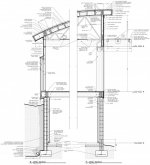
They may want something like this. I drew something like this out on graph paper in my inspector's office while he told me what he needed. Easy.
 

Attachments

  • balewood-side-view-of-a-wall-section.jpg
    balewood-side-view-of-a-wall-section.jpg
    36.7 KB · Views: 33
  • wall_section_modern_house.jpg
    wall_section_modern_house.jpg
    119.2 KB · Views: 32

Falcon67

Well-known member
Joined
Jun 11, 2009
Messages
18,371
Location
Merkel, TX
I would go thru their building code they have on line and cobb together details from there and see if you can get them to pass it. Its their details, why would they question them??

Because the lady at the desk and the inspector on site don't work together LOL. nice to know my home town hasn't moved that needle very much since the 1980s. They were more than a little **** about small things even then.

If they have outbuilding details online, use some of those. A lot of "historic" small garages would be using let in bracing, set at diagonals in the outer side of the stud wall. I still use that - reference Jim's first google link.

I would try providing the elevations approved by the historical district along with some generic wall framing details. Your builder should be able to spec that - if not, say what? Door header sizes, let ins - it's not complicated. Small garage door, one man door, one window and a roof. Fort Worth is 500+ miles from the coast, so no hurricane issues. However, since they had the one tornado downtown they may have upped the ante to requiring hurricane ties on roof members. Again - I use those anyway. Not costly and could make a difference in a storm.

Where in Fort Worth are you building? Just to make me a bit home sick LOL.
 
Last edited:

Wildstar

Well-known member
Joined
Jan 19, 2005
Messages
52
Location
Texas
See if you get through to talk to an inspector, he'll tell you what you really need to do. With the right info, a drawing on a napkin would most likely work. FTW City Planning can be a bit of a pain, but they seem to be helpful if you are really trying to do it correctly.
 

6768rogues

Banned
Joined
Nov 28, 2007
Messages
4,524
Location
Western NY
Biggziff gave you samples of wall sections. Ask them if wall sections will be sufficient and if so, do something like Biggziff demonstrated.
I extend my condolences for your owning an historic property. I would never consider one because everything is regulated, even what color to paint your door, by some busybody who has nothing better to do than stick his/her nose in everything you do.
 
To avoid these ads, REGISTER NOW!
Top Bottom