To avoid these ads, REGISTER NOW!

DIY hot tank - rust removal by electrolysis

rmchrgr

Well-known member
Joined
Dec 27, 2010
Messages
151
Any of you resourceful types here make your own hot tank/electrolysis tank? Getting things like engine blocks and heads down to the machine shop, paying to have them cleaned then hauling them home seems like too much effort.

Been reading about rust removal through electrolysis which seems fairly do-able for the average garage guy. Have also run across guys using heavy duty laundry detergent, lye and purple power in their solutions to get things really clean.

Would like to hear your recipes/ideas/setups and if you used other chemicals in your water in addition to letting the electricity do it's thing. :shocking:

- Greg
 
To avoid these ads, REGISTER NOW!

THEFIX

Well-known member
Joined
Jun 14, 2009
Messages
51
Location
Ypsilanti, MI
I just did it on some old wrenches and they turned out great. A lot smaller scale than what you are talking, but same concept. Only thing that was a pain is the rust is reduced to a black coating that is a little bit tough to remove.

I used a plastic wash tub, 1/2" x 4' re-bar, wash soda and my battery charger. Biggest trick is making sure you have good electrical connections to the part you're cleaning.
 

Bruce4310TX

Well-known member
Joined
Nov 4, 2009
Messages
507
Location
Forth-Worth, TX
I have done it if you a big battery charger it works better its slow, if i was doing engine parts that are going to be rebuilt use the MS there process is superior.
 

slopecarver

Well-known member
Joined
Dec 29, 2008
Messages
342
Location
Erie, PA
Works great for line of sight surfaces but does nothing for internal surfaces. Look for a shop with an ultrasonic cleaner tank large enough.
 
OP
R

rmchrgr

Well-known member
Joined
Dec 27, 2010
Messages
151
Works great for line of sight surfaces but does nothing for internal surfaces. Look for a shop with an ultrasonic cleaner tank large enough.

But the parts are immersed in a water-based solution. Unless whatever you were tying to clean had it's inner passages sealed off I can't see how the solution would not find it's way inside. :confused:
 

rsanter

Well-known member
Joined
Dec 22, 2007
Messages
18,523
Location
visalia ca
was looking on the web one time and saw directions a guy did where he used a 55 gal drum, added a grate inside to keep things off the bottom and then used the heating elements from electric tank type water heater to heat the thing up
he used water with some stuff (dont remember what) as the fluid
suposedly worked well

bob
 

slopecarver

Well-known member
Joined
Dec 29, 2008
Messages
342
Location
Erie, PA
But the parts are immersed in a water-based solution. Unless whatever you were tying to clean had it's inner passages sealed off I can't see how the solution would not find it's way inside. :confused:

electrolysis primarily only works line of sight between anode and electrode, even if the solution gets to internal surfaces it won't do a darn thing.
 
OP
R

rmchrgr

Well-known member
Joined
Dec 27, 2010
Messages
151
electrolysis primarily only works line of sight between anode and electrode, even if the solution gets to internal surfaces it won't do a darn thing.


...“Line-of-sight rust” removal?

Many electrolysis instructions will tell you that the process is “line-of-sight.” That is, rust will only be removed from the side of your part that faces the waste electrode.

When I first started using this process I noticed the line-of-sight thing. In the years since, when I use electro-de-rusting, all sides of the part come clean. The only exceptions are shielded pockets or nooks and crannies.

I wondered why my experience was different from others; and, I wondered why I experienced line-of-sight then, but not now. I think I’ve discovered the answer.

When I first experimented with electro-de-rusting my container was a one gallon ice cream bucket. Then, I moved up to a five gallon bucket. Finally, I settled on using a fifty-five gallon barrel.

Aha! That’s it! The large barrel allows a large “field” of voltage to surround your entire part. Thus, all sides of your part get de-rusted all together.

Contrast this to using a small container. There is not enough space around your part to allow a large field of voltage to develop.

I can demonstrate this “voltage field” effect, easily, by moving the waste electrode from the side to the middle of the vat. By allowing a large space around the waste electrode, the back side of it became “electrically involved” in establishing a connection to the solution. The same effect occurs at the part being de-rusted."...
 

Shadowdog500

Well-known member
Joined
Dec 7, 2009
Messages
9,872
Location
Down the shore
Ive done electrolyses rust removal in a plastic tub. electrolyses rust removal is line of sight with the electrode. It would not be good for removing rust from the inside of the engine.

I start every rebuild with a hot tank and magnaflux of the block and heads, cheap insurance that you aren't wasting your time on bad components IMHO. I would not skimp here, it isn't too much money and is worth the drive.

Chris
 

Ford12508

Well-known member
Joined
Jul 7, 2010
Messages
858
Location
Middletown NJ
Ultrasonic cleaner or a chemical dip would be my preferences when it comes to something like an engine block. Even if the rust could come off from not being line of sight, you have rust settling in the nooks and crannies. A machine shop would be responsible for your item, so they will do the job very thoroughly.
 
To avoid these ads, REGISTER NOW!

Alchymist

Well-known member
Joined
Mar 1, 2009
Messages
4,423
Location
Central PA

btmatt

Well-known member
Joined
Feb 14, 2008
Messages
59
Back in the day, we cleaned the crud off big compressor cylinders with a big dip tank. Solution was water and soda ash (sodium carbonate). Heat and agitation really sped the process up. The cast parts came out completely clean, i.e. nor grease, carbon, paint, nor rust.
 
OP
R

rmchrgr

Well-known member
Joined
Dec 27, 2010
Messages
151
Just wanted to update the thread here.

Amazingly enough, I recently found out that we (dealership where I work) actually have a working hot tank that I can use whenever I want. It's in another part of the shop that I don't work in so I never noticed it before. (only been working there a few months) I've gathered that there's only water in there right now so I offered to buy the chemicals to get my junk really clean. The guy in charge of the tank said he we take care of it. I'm stoked!

Thanks for the replies though, I may have to try the electrolysis deal at home on a small scale. So many cruddy parts, so little time.
 

matt_i

Well-known member
Joined
Mar 14, 2008
Messages
10,744
Location
SE Michigan
My Dad has done loads of parts in electrolysis. He uses rebar, washing soda and plastic tote bins, and a 12v battery charger. Cold water, no heating.

I did the rear rims for my tractor in a couple of stages, rotating them thru. Also got all of the paint off.

On carbon steel there's a black patchy deposit (maybe the stable ferric oxide??) that's tough to get off without mega powered wire brushing. I don't know what would happen with cast iron. In any case its easier than wire brushing the entire thing or media blasting it.
 

lakelandcat

Well-known member
Joined
Sep 25, 2017
Messages
7,327
I've done it with a 10gal. trash can, small bat. charger, hooked to a 12v car bat., rebar, Arm and Hammer wash soda (its important to use wash soda). I was doing a lot of parts from a 1950 truck, it worked great. It is kinda slow depending on the amount of rust but the parts rinsed off great, with a little bit of wire brushing they came out like new.Put a coat of primer on right away. Do it outside or in a well vented area because the bubbles are Hydrogen, a large scale operation in a closed in room could get exciting. I got all my instructions from utube. Its fun to watch.
 

njhoudini

Well-known member
Joined
Feb 27, 2018
Messages
351
Location
Central Jersey
I have been derusting a table saw cast iron table in a 40-gal Rubbermaid garbage can. I use an old steel shelf that had started to rust already as my anode, but have also used rotors. Any steel should be fine as long as it is not stainless as that may release hexavalent chromium which is the bad chemical that was in the movie Erin Brockovich. Line of sight is important, and many people will figure out ways to line their container with the sacrificial steel to improve coverage. Many modern battery chargers require a load which is why it is sometimes necessary to connect the setup to a car battery, but I find when the battery is not being charged, it will eventually discharge completely between the charging cycles so use a battery you don't particularly worry about. Depending on the amount of rust you're trying to remove, you may end up with a decent layer of black iron. Sometimes, it takes more elbow grease or a coarser abrasive to get back to bare metal, but with patience, you should be able to eliminate the rust.

You can get pretty creative with the container too. I've seen people use kiddie pools, 55-gal drums, I think someone even used a swimming pool that was no longer in use. The closer the sacrificial anode is to the item to be derusted the fast the process goes, but here, faster isn't always better. As long as you see some bubbles forming where there's rust, the process is moving forward. Washing soda is highly recommended. Baking soda is not the same and much slower. Graphite I hear is a great anode as it takes much longer to breakdown. With the steel anodes, you will need to scrape off the rust that gathers on it every so often. Here's a picture of my current setup and a smaller tank next to it that I used for smaller parts. Once you get setup, it's crazy fun.

Other observations, don't let your copper clamps touch the tank water as they will break down and eventually release not so healthy copper compounds into the water. If you use a wire to connect your sacrificial anodes, try to keep them out of the water as they too will break down (ask me how I know). I was using steel hangers to hold onto my old brake rotors but eventually I would have to fish them out by hand. I try to keep the rotor use to shallower tanks now unless I have a bendable steel rod handy.

20180511_212316

One method I observed but have not tried, someone soaked a towel in the washing soda solution and then connected an anode to it and laid it on top of a planer surface which had rusted pretty severely. He connected the black clamp (cathode) to the table itself and it effectively derusted anything that got wet from the towel. Pretty clever.
 

metalmagpie

Well-known member
Joined
Nov 1, 2011
Messages
799
Location
Seattle
I have been doing electrolytic derusting (EDR) for many years. I have also been doing hot soaks to remove paint and grease for years. I don't see that combining them would make much sense.

To do hot soaks I keep a few old stainless pots around and an outdoor propane burner. I put the item in a pot, immerse in water, and then add whatever chemical I want to use. Lye works the best but is by far the most dangerous. TSP works well too, still very very strong. Both of these will eat away alumnum so be very careful of nameplates or of aluminum pots. Next strongest but more safe is Cascade dishwashing detergent. I didn't know you could do a hot soak with washing soda, might try that.

For the EDR process, the important thing isn't the tank. The important things are the DC power supply and the anodes. I have a Volteq 30/30 power supply that can source 30 amps at 30 volts DC or less, in either voltage source or current source mode. Works great. I burned out about half a dozen little car battery chargers which aren't made for continuous use before I got a real DC power supply. For anodic material I prefer sheet lead. The bath stays clean and clear and the metallic lead's electrical resistance doesn't change as the lead oxidizes (unlike steel).

For the tub I use anything from a hand soap travel container to a Rubbermaid cattle trough depanding on the job. For odd sized items I've often knocked together some kind of box and lined it with Visqueen to make an ersatz tub just for the job.

There isn't a magic best number for DC volts or amps. It stands to reason that the actual figure of merit is current density, i.e. amps per square inch. And there is a range of current densities that work well. Less current will take a lot longer and more current will bubble off hydrogen and oxygen much more vigorously and thus be more susceptible to accidental gas conflagration above your tank. I like to turn up the current until I can visibly see bubbles coming off the workpiece. Then if I want to kick **** and burn rubber, I turn it up more. If I want to gently reduce the rust to elemental iron and plate as much of it back on the part as possible I'll turn it down some from that point. Experience will rapidly teach you.

metalmagpie
 

TractorJeff

Well-known member
Joined
Dec 8, 2013
Messages
3,309
Location
Elkhorn, WI
My brother does it out in NYS, I've never asked him what he does with the "leftover's" after the process is done? I know he did the inside of a tractor gas tank by putting an Anode in the filler neck.
 

mikegt4

Well-known member
Joined
Sep 12, 2005
Messages
3,277
Location
sw ohio
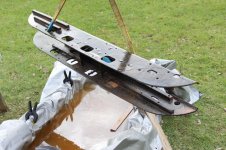
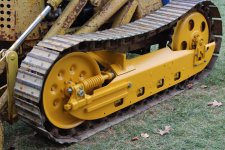
I have had great success with objects too big to fit in my blast cabinet. I usually make a frame out of wood boards on edge them use a cheap HF tarp as a liner. Big parts take longer to process. I usually pull the part out after 24 hours and clean the scum off it and the electrodes. Here is a track frame from my Oliver crawler being cleaned up. I wire brushed any loose paint, rust and dirt off of it before starting to quicken the process which took about 3 days. I did the front idler and drive sprocket as well.
 

Attachments

  • IMG_2137.jpg
    IMG_2137.jpg
    161.1 KB · Views: 30
  • IMG_2142.jpg
    IMG_2142.jpg
    164.2 KB · Views: 27

kbs2244

Well-known member
Joined
Nov 11, 2006
Messages
14,065
Last time I did it, I used "Industrial Vinegar"
I don’t remember where I got it
Maybe at janitorial supply place.

Only heat was letting it sit in the summer sun.
It worked pretty well.
 
To avoid these ads, REGISTER NOW!
Top Bottom