To avoid these ads, REGISTER NOW!

DIY Hydraulic Hard Lines?

RonRock

Well-known member
Joined
Oct 6, 2007
Messages
1,173
Location
Iowa, USA
Anybody here do that kind of work? I have a backhoe attachment for my skidloader that needs some lines replaced. Too expensive to buy so I figure I'll do it myself. Actually I prefer to do it myself.

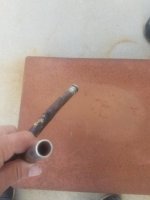
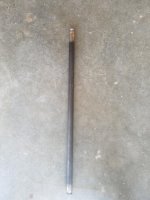
So I started with one of the cylinders. It had a hard line that goes from a "block" on the bottom to a port on the top of the cylinder. Pipe was smashed, several times. So I had to cut it to remove it. I took it to a local hydraulic shop to see about replacing it. They didn't have the correct stuff to do it, but sold me a chunk of thick wall tubing that was close to the correct size. The ends would have to be built up with my TIG then turned down to correct size to fit into the socket in the cylinder.

I got to looking at the bad line and see that the ends have been brazed to the tube. So heated and removed one. OK that makes the job easier. Just face the thick wall that I have and bore it to fit the end piece from the original. Trouble is that they have been banged around enough that both ends are now different. There is a grove where the O ring and Backup ring fit. That grove is distorted.

Does someone sell these end pieces for hydraulic lines? How about the actual tubing? Where can it be bought?

My OEM lines are 5/8" OD.

Any instruction on fabricating hydraulic hard lines? A Google gives a lot on brake lines, but not much on hydraulic.
 
To avoid these ads, REGISTER NOW!

Farmall450

Well-known member
Joined
Dec 23, 2011
Messages
13,371
Location
Marengo, Illinois
The most I've seen is guys welding on leaking ends. I'll be interested to know how this turns out, if you're a good tig welder it should go quick. I imagine grainger/zoro would sell the ends.
 
OP
R

RonRock

Well-known member
Joined
Oct 6, 2007
Messages
1,173
Location
Iowa, USA
I called a different hydraulic shop yesterday and from that conversation it sounds like they have the end fittings on hand. I plan to go there tomorrow. IDK maybe they turn them as needed.

I was going to turn my own yesterday. But since the ends I have are banged up I don't know the correct dimensions. I looked in my Machinery Handbook for O ring info. Of course it was way more involved than I hoped.

Are O rings all "standard" sizes? Or do manufactures size and have made O rings to fit the application? From what I read they are standard size, but not sure that is fact.
 
OP
R

RonRock

Well-known member
Joined
Oct 6, 2007
Messages
1,173
Location
Iowa, USA
Some pictures may help,
 

Attachments

  • 20180729_083429 (Medium).jpg
    20180729_083429 (Medium).jpg
    59 KB · Views: 227
  • 20180729_083650 (Medium).jpg
    20180729_083650 (Medium).jpg
    85.7 KB · Views: 205
  • 20180729_083604 (Medium).jpg
    20180729_083604 (Medium).jpg
    31.6 KB · Views: 211
  • 20180729_083557 (Medium).jpg
    20180729_083557 (Medium).jpg
    73.1 KB · Views: 205
  • 20180729_083543 (Medium).jpg
    20180729_083543 (Medium).jpg
    44.3 KB · Views: 202
  • 20180729_083539 (Medium).jpg
    20180729_083539 (Medium).jpg
    59.9 KB · Views: 211
  • 20180729_083439 (Medium).jpg
    20180729_083439 (Medium).jpg
    78.5 KB · Views: 216

matt_i

Well-known member
Joined
Mar 14, 2008
Messages
10,752
Location
SE Michigan
Orings are typically sized by the diameter of the "rope" and also the ID/OD in a relaxed state. I typically use a dial caliper to get some measurements.

If you don't have the full ring, then I default to the ID has to be slightly smaller than the groove's ID. In other words it has to stretch to fit snugly on the ID. I forgot how much, guessing 5% or so. So if its 1" ID then should be about .050" smaller.

If you have to machine anything, getting a good surface finish is key on the metal parts.

If you have to source tubing it should be "seamless" either thinwall or DOM (drawn over mandrel) in thicker walls.

I try to bring as much as possible to JIC fittings, its a 37 degree flare with a lot of tube fittings in that style to match.
 
Last edited:

Bretny

Well-known member
Joined
Jul 31, 2017
Messages
3,918
Location
Dutchess county NY
Personaly i would replace that section of hard line with rubber hose. Weld the fittings onto the round blocks on the cylinder and hook up the cotrect hose. Rubber dosnt crush and stay crushed line steel but it dosnt have the cut resistance as steel.

I hate non standard hyd hoses. When i can i alwaye change them to something standard. JIC or npt.
 

BukitCase

Well-known member
Joined
Apr 11, 2017
Messages
1,075
Location
Oregon
The one fitting on the cylinder looks like it could already BE a JIC - if so, there's another option -
https://www.discounthydraulichose.com/SAE_37_Flare_JIC_Hydraulic_Tube_Fittings_s/24.htm

https://www.discounthydraulichose.com/category_s/1005.htm

https://www.discounthydraulichose.com/category_s/1006.htm

If you go this route, I can post the sometimes hard to find instructions on the Convert-a-flare fittings.

The spendy part is getting a decent tubing bender for 5/8 steel tube - my 1/2" one that does NOT flatten/distort the tubing -

https://www.amazon.com/gp/product/B008ULY74G/?tag=atomicindus08-20

I'm not sure Ridgid even offers a 5/8" version of that one, but I've used NON-roller versions and it's kind of a **** shoot in the sizes bigger than 3/8". The advice to go to hoses might be the lesser evil... Steve
 

plinker

Well-known member
Joined
Feb 28, 2007
Messages
4,286
Location
Northern Wi
Where I worked last, I made JIC flared lines, 5/8, 1" & 1-1/4. The tube has to be pressure rated and seamless.

Parker makes a flare tool for doing it (expensive), runs off a foot/air pump or similar. Bending the tube can be problematic, depends on tube material and tool used.

I would say look up a local hydraulic shop as they may have an alternative that is less expensive. Adapting to use hose instead may be the better option, certainly cheaper.
 

Firebrick43

Well-known member
Joined
May 12, 2015
Messages
14,223
Location
West central Indiana
I make hardlines as part of my living. Under 7/8 is doable with hand bending tools. That connection is non standard. If you can convert to jic fitting on the cylinder I would. Some tunes I make have face seals. I silver braze these ends on.

For the bender I recommend a ridgid ratchet bender. Model 358. I bought mine for around 100$ on eBay in nearly new condition.

5/8 can be bent with standard benders but it can take significant effort. 5/8 is 10/16 so a ridgid or imperial hand bender would be model 310. Again look on eBay.

The instructions (available online show you exactly how to lay out everything.
For example https://cdn2.ridgid.com/resources/media?key=2e41f31c-a070-4682-8b74-d3b6b7fcbb89&languageCode=en&countryCode=US&type=document

I prefer the ridgid 377 flaring tool. The 377 has a clutch to so can't overwork a flare. I would buy this tool new as it would not be apparent on ebay if this was broken or not from the pictures. This tool has its flaring mandrel offset and actually rolls out the flare. Imperial makes an equivalent tool called a Rol-aire but I don't recall the model. I does not have a clutch. Do not try to use the cheap flaring tools that just force a cone straight down. They **** and mis shape the flares. Again the directions are excellent. Another hint is to make sure your cutting wheels are sharp. Dull ones work harden the tube and lead to cracked flares.

Also thank you for at least thinking of replacing it with a hard line. Hardlines are preferable in many situations, or the manufactures wouldn't use them. I repair a lot of machinery that hacks replace a hardline with a hose ( or use a hose initially) and a hardline is usually a permanent and lasting repair where hose come back due to chafing and pinching. Most high quality manufacture only use hoses at movable joints for this reason.
 
Last edited:

Mr. T

Well-known member
Joined
Sep 4, 2013
Messages
636
Location
Central PA
Personaly i would replace that section of hard line with rubber hose. Weld the fittings onto the round blocks on the cylinder and hook up the cotrect hose. Rubber dosnt crush and stay crushed line steel but it dosnt have the cut resistance as steel.

I hate non standard hyd hoses. When i can i alwaye change them to something standard. JIC or npt.


I would personally disagree with this advice. Also, NPT might be somewhat common in the US but it is perhaps the absolute worst way to make a hydraulic connection.

To the OP, I’m all for DIY but I’d try to buy the part from the OEM first. And if you’re set on doing it yourself, EO (DIN) is about as idiot proof as hardline connections get. You just have to cut it square and deburr it; no flares, no fuss.
 
OP
R

RonRock

Well-known member
Joined
Oct 6, 2007
Messages
1,173
Location
Iowa, USA
Good response guys, thanks. Sorry I got distracted. But I'll see what they have to say at the hydraulic shop tomorrow. I intend to keep the hardline on this cylinder, at least for now.

Would be hard to go to anything other than OEM type of setup on this. I will see what hey have to say, may be best to just let them make the line and move on. But I would rather make it myself. For one reason I preffer the DIY is that there are other hard lines that need work if not replacement. This is an old Davis D100 backhoe attachment. Parts seem to be available for most part, but not all and expensive.

I must like the D100 for some reason. This is my 3rd one. Sold the first two for other reasons but plan to keep this one. It's better than a shovel, and I hate to rent equipment. Sold my Bobcat 333 excavator.


Took a glance at the O-Ring Gland Calculator. That looks like it will be a very helpful link. Thanks
 

plinker

Well-known member
Joined
Feb 28, 2007
Messages
4,286
Location
Northern Wi
:headscrat

Used everywhere, everyday, successfully.


If the fittings are quality and a good sealer is used, NPT is no worse then JIC, in me experience.

We had some issue with dust gathering oil seeps when using plain teflon paste and switched to Loctite 545 hydraulic thread sealer and had zero seep/leak problems with quality fittings.
 

Farmall450

Well-known member
Joined
Dec 23, 2011
Messages
13,371
Location
Marengo, Illinois
If the fittings are quality and a good sealer is used, NPT is no worse then JIC, in me experience.

We had some issue with dust gathering oil seeps when using plain teflon paste and switched to Loctite 545 hydraulic thread sealer and had zero seep/leak problems with quality fittings.

If you get them tight enough you really don't need any sealer.

Granted, I always use good US teflon tape. Not a big fan of the goo, although I've heard the Loctite is good from other places too.

I feel NPT is also cheaper and a bit more durable, especially exposed.
 

bigguns69

Well-known member
Joined
Aug 23, 2011
Messages
411
Location
Iowa
The hard line build as a do it yourself project is not going to be the easiest thing to do as much of this is done with CNC bent, seamless, zinc plated or SS tubing, DOM that is not readily available for the average guy. The fittings are custom machined to match the tubing end then welded or brazed on. This part you could accomplish by taking standard fittings and machining the ends to fit the tubing you are working with then weld them together.

Tubing is better then hose but hose is usually the replacement choice due to availability and time and is not a bad way to go if you use hangers to get a good routing of the hoses. At the OEM level, tube lines are cheaper then hose and will last longer except for vibration fatigue issues.

NPT fittings for hydraulic connections have been pushed out decades ago with the ag sector being the last to adopt JIC, (3,000 psi), o-ring boss known as SAE, (6,000 psi), or o-ring face seal, (6,000 psi). Most of the NPT in hydraulic systems are 20 to 30 years in age or more and or the pressure level is 1,500 psi or less. Otherwise NPT is a bad way to go.

Piece of advice, not knowing what operating pressure you are dealing with. If you have a pin hole leak in a high pressure line, it can cut skin and if the lines happens to be close to human presence, operator station, etc. you could get high pressure oil penetration through the skin and that means you better get to a hospital in a hurry or you could loose a hand or limb.

This isn't stuff to be screwing around with. I've seen a lot, done alot of crazy stuff as a 25 year OEM hydraulics guy in the ag and construction sectors.
 
OP
R

RonRock

Well-known member
Joined
Oct 6, 2007
Messages
1,173
Location
Iowa, USA
Well I went to the hydraulic shop. They were very helpful but had not seen such a thing as I have. They did set me up with O rings and backup rings. Took a look at what I have and what I have done and plan to finish. All agreed that my plan is sound and should work.

I must not have explained very well on Saturday when I talked to the first guy on the phone. Hard to explain something like this over the phone.

One guy tried my pipe with a new O ring in the "socket" and said that it felt like it had a good fit. So I'll go ahead and do the other end like I did the first and give it a try.

One thing that has caused me another question. I got two different answers from different guys.

The grove where the o ring and backup fit is wide enough that I can fit two backups and an o ring. One guy says use 2 another says only 1 and don't worry about the extra gap.

What do you think?
 

paulsomlo

Well-known member
Joined
Jul 16, 2013
Messages
3,913
Location
Northern Colorado
The grove where the o ring and backup fit is wide enough that I can fit two backups and an o ring. One guy says use 2 another says only 1 and don't worry about the extra gap.
What do you think?
I don't know much about the application, but the backup ring that matters is the one "downstream" - the one that the o ring will be pushed up against when it's under pressure. If there's pressure in both directions, then you should have both (but I doubt that's the case). I think it's probably industry practice to use two backups, but not really necessary.
 
To avoid these ads, REGISTER NOW!

WittHay

Well-known member
Joined
Jan 6, 2016
Messages
2,157
Location
Surrey, BC Canada
Not understanding how you would put the new pipe in. Is there some special removable fitting at the bottom of the cylinder or does the top fitting have to be cut off and then re welded

For me the quick fix if this is a 2 way cylinder, would be to tap the top fitting for either pipe or SAE straight thread o-ring and plug the bottom fitting and run either a hose or a length of regular threaded pipe

Hoses don't work well were there a sharp bends or multiple lines in cramped spaces. Regarding fittings on farm equipment, seen brand new German equipment with pipe thread hose ends on them and 50 year old stuff with JIC and SAE fitings
 

Attachments

  • 20180729_083650 (Medium).jpg
    20180729_083650 (Medium).jpg
    85.7 KB · Views: 64
Last edited:

Mr. T

Well-known member
Joined
Sep 4, 2013
Messages
636
Location
Central PA
:headscrat


Used everywhere, everyday, successfully.


For a one time use, with the appropriate sealant, and on a lower pressure system; they’re okay.

The sealing through interference design doesn’t work that well to begin with (which is why you need the sealant) and once you take it out cleaning off the cured sealant is a major PITA. Not to mention having to wait for hours for it to cure to begin with. And then on top of all that, the threads are usually trashed after the first use, so you’re buying a new hose anyway.

Give me something with an elastomer seal please!

Also, I can’t claim to have an exhaustive knowledge of all hydraulic equipment but I’ve never seen an NPT hose fitting on anything bigger that a 3/4” hose.
 

zkling

Well-known member
Joined
Jan 23, 2007
Messages
16,939
If NPT didn't work your house, work, and church's NG/propane wouldn't be plumbed with it.

How'd the fix work, OP?

There might be a slight pressure difference between NG/propane and a hydraulic oil actuator. As well as a static vs dynamic pressure system.

OP, find a savvy Parker store, they will get you straightened out.
 
Last edited:
OP
R

RonRock

Well-known member
Joined
Oct 6, 2007
Messages
1,173
Location
Iowa, USA
Haha!

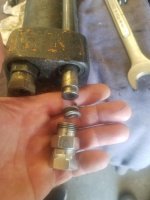
Well I got it all done. Both ends brazed and cleaned up. Made the pipe fit just as I planned it fit into the socket's and when I threaded in the O Ring Boss - FPT adapter into the hole that holds the pipe in perfectly. I left just a small amount of space so the pipe would not interfere with the O ring boss seal. Yay!

Then when I went for the final fitup with O rings on the pipe I found the error! ****! The pipe is longer than the original and the o ring is in the threads of the O ring boss fitting. Sloppy loose no way that is going to seal.

But I do have another cylinder from this backhoe attachment with the same type cylinder. Measured them up and the 2 cylinders are the same. I did not want to disturb this one, but had to take it apart to see what holds the pipe in.

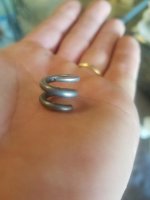
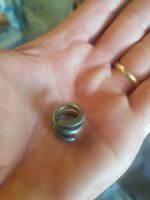
There is a spring in the bottom of this one that was missing on the first. So I simply cut the fitting that I had brazed into the pipe, shortened the pipe so that the o ring will position where it belongs and re braze. So a time setback, but it's done. Now I have to figure out how to find a spring that can be used.

Suggestions?
 

Attachments

  • 20180731_103648 (Medium).jpg
    20180731_103648 (Medium).jpg
    87.5 KB · Views: 65
  • 20180731_154901 (Medium).jpg
    20180731_154901 (Medium).jpg
    61.1 KB · Views: 68
  • 20180731_154912 (Medium).jpg
    20180731_154912 (Medium).jpg
    36.5 KB · Views: 61
  • 20180731_154915 (Medium).jpg
    20180731_154915 (Medium).jpg
    47.2 KB · Views: 57
  • 20180731_154935 (Medium).jpg
    20180731_154935 (Medium).jpg
    63.7 KB · Views: 59

Mr. T

Well-known member
Joined
Sep 4, 2013
Messages
636
Location
Central PA
If NPT didn't work your house, work, and church's NG/propane wouldn't be plumbed with it.


Yeah, I’d ride a scooter to the local store but I wouldn’t take it on a cross county trip. I.E. great for some things terrible for others.
 

plinker

Well-known member
Joined
Feb 28, 2007
Messages
4,286
Location
Northern Wi
Also, I can’t claim to have an exhaustive knowledge of all hydraulic equipment but I’ve never seen an NPT hose fitting on anything bigger that a 3/4” hose.

The hose wing couplers that we used were #16/1" NPT, return lines up to #24/1.5" NPT. The suction line fittings were either 2" or 2-1/2 NPT. There are some other smaller fittings used mainly to plug tank ports, but some had pressure application. Keep in mind the pressures were average of 2600psi but quite a few were 3200-3500 psi.

Not saying right or wrong application, but NPT is still pretty common even though better fittings are available.
 

toplessHO

Well-known member
Joined
Oct 20, 2014
Messages
14,097
Location
central florida
to OP I would make a guard to go over that tubing so it wont be crushed again.
make the guard so it can be replaced when it gets crushed
also it might be too late since you already fixed but Im sold on quad rings(X RINGS)
 
Last edited:
OP
R

RonRock

Well-known member
Joined
Oct 6, 2007
Messages
1,173
Location
Iowa, USA
to OP I would make a guard to go over that tubing so it wont be crushed again.
make the guard so it can be replaced when it gets crushed
also it might be too late since you already fixed but Im sold on quad rings(X RINGS)

It's not assembled yet. I just read about quad rings when I started this project. Kind of noticed them, but not really. Are they a direct swap for a common O ring? Maybe something like that would be a better fit here than the original type O ring.

Of course I still need to resolve the spring issue.
 

Thefixer66

New member
Joined
Mar 23, 2020
Messages
1
Location
Chicago suburbs
I make hardlines as part of my living. Under 7/8 is doable with hand bending tools. That connection is non standard. If you can convert to jic fitting on the cylinder I would. Some tunes I make have face seals. I silver braze these ends on..../QUOTE]

I cant find anywhere to buy actual hydraulic hard lines to cut and bend. If you know of any places near the Chicagoland area it would be greatly appreciated. Trying to rebuild an old gehl 4400 skidsteer.
Thank you
 

Copymutt

Well-known member
Joined
Sep 3, 2016
Messages
3,408
Location
Colorado
I’d wager most have more experience than me w/ hydraulic hose and line repair. What I do know is that I prefer hard line. Fab protection if it’s likely to get damaged. Angle iron works great.
Flex hoses will degrade and they fail when you are on the job. If equipment is not in a garage or barn the sun will accelerate flex hose cracking and failure.
Just my life experience.
 

astroracer

Well-known member
Joined
Jun 22, 2005
Messages
3,001
Location
Mid_Michigan
I cant find anywhere to buy actual hydraulic hard lines to cut and bend. If you know of any places near the Chicagoland area it would be greatly appreciated. Trying to rebuild an old gehl 4400 skidsteer.
Thank you

Most online metal supply stores carry hydraulic hard line. Alro, On-Line Metals, etc. McMaster-Carr also carries a good selection.
Here is a link to Alro. I use a lot of the J524 seamless 1/2" x .049 wall for fuel line. Bends and welds beautifully.
Mark
 

sberry

Banned
Joined
Jun 18, 2005
Messages
35,747
Location
Brethren, Michigan
I fixxed a lot of stuff, brazed them, welded ends on common pipe, to pieces of used tubing. Have also replaced steel with hose that has now outlasted the original. Repairs on old worn common equipment is different than new hi tech, hi pressure stuff. Sometimes I am surprised about dealer replacement, on occasion I bite it to get done fast and right.
Often even replace one part at a time vs full seal kits etc.
 

rbgearz

Well-known member
Joined
Nov 20, 2011
Messages
2,899
Location
Illinois
Not all pipe and fittings will work on hydraulic lines. Make sure that you check the pressure ratings.
 

Firebrick43

Well-known member
Joined
May 12, 2015
Messages
14,223
Location
West central Indiana
I make hardlines as part of my living. Under 7/8 is doable with hand bending tools. That connection is non standard. If you can convert to jic fitting on the cylinder I would. Some tunes I make have face seals. I silver braze these ends on..../QUOTE]

I cant find anywhere to buy actual hydraulic hard lines to cut and bend. If you know of any places near the Chicagoland area it would be greatly appreciated. Trying to rebuild an old gehl 4400 skidsteer.
Thank you

Sorry to get back to you late but as mentioned by autoracer we buy from alro for standard tubing. We buy metric tubing from a place in Michigan that specializes in metric fittings but the name escapes me right now.
 
To avoid these ads, REGISTER NOW!
Top Bottom