markag
Well-known member
Hey Guys! It's been a while since I've posted, but I wanted to pick your brains to see if you had any information to help me with my rain barrel system that I am getting ready to build.
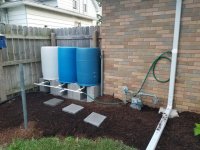
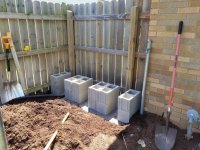
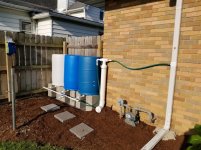
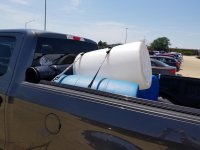
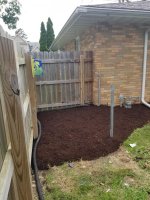
I picked up some free 55 gallon plastic water drums, 3 of them in total, and I'm hoping to get them setup over this long weekend to start collecting rain water that I can use for watering our garden and general outside use. The pictures are of the barrels loaded up in my truck, and then the spot in my back yard where I want to keep them. I can fit the barrels 3 wide in that section of fence between the house and the side run of the fence. And they are relatively close to that downspout that I can use as a fill source.
The barrels I got were perfect for this use, as they originally were filled with distilled water. I plan on rinsing them out, but I'm not too concerned about chemicals or issues from their previous contents. They are 2-3 years old already, and were just setting as trash, so I was able to pick them up for free (with permission).
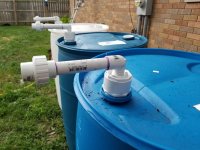
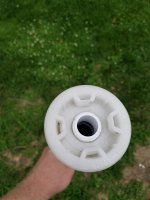
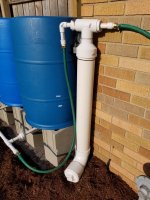
I've been looking up information on rain water collection systems, and I think what I want to do is an upside down barrel style as a "closed system" where I wouldn't have to do any drilling in the barrel itself. The barrels already have the bungs on them, and I would like to flip them upside down and use the bungs and a bottom manifold to connect them together. It would act as both my fill port, as well as have a ball valve with garden hose adapter on it for the disbursement. I plan to use the 2nd port on the barrels to attach a vent tube that would extend inside the barrel and open up above the internal water level.
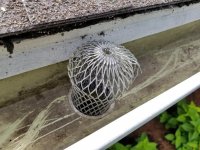
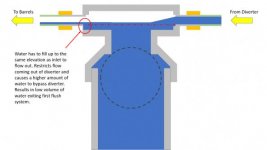
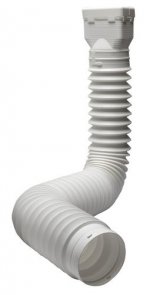
I purchased a downspout diverter that already has a course screen built into it for larger leaves and debris. I was planning on running a garden hose from the output of that diverter to the bottom manifold of the rain barrels to fill them from the bottom up. I would install the diverter slightly below the top of the barrels so that when the barrels fill up, the diverter hose will fill and stop flowing water into the barrels. The water would just spill down the downspout as normal.
The only thing that concerns me about a bottom fill setup like this is buildup of fine sediment over time. The way this will work is that the manifold will end up being the lowest point in the system. My plan is to use the bung ports to attach the manifold to avoid having to drill the barrels. With the bung side down, the manifold will be sitting below the bottom surface of the barrel, making it the lowest point in the system. A lot of the top fill systems I have seen seem to have the outlet port drilled into the side of the barrel a few inches up from the bottom. I was hoping to avoid drilling the barrels since I'm fairly new to this, and I may want to re-configure these once I learn more in the future.
My roof has shingles, and I know that there is a fine layer of gunk that builds up from the runoff of the roof in my gutters today. I know there is also organic matter from leaves and stuff that will make it through the course and even the fine screens no matter what I do. I would think that would eventually build up in the manifold. What I don't know is if it would actually end up being a problem or not. I purchased a union for each barrel so I can disconnect the manifold if I need to clean out the barrels or clean out the manifold. My hope is that might be a once a year type of thing.
As of now, I've purchased 3/4" schedule 40 PVC fittings and pipe for the manifold plumbing. I could tolerate some sediment and gunk, but not a lot with that pipe size.
My plan for this long term is to hook up a soaker hose in my garden and let open the outlet valve of the rain barrel to feed the soaker hose or drip system if I go that route. I would hate to be sending fine sediment into a soaker hose and clogg the thing up so it won't work properly. That sounds like a good way to waste some money.
The internet, in all of its vastness, doesn't seem to have a good source of consistent information out there on rain barrels. There are a million ways to do it, but not a lot of information out there on how to manage or prevent sediment in systems like this (at least that i could find).
The only other question I have is if I need to try and figure out a way to prevent mosquitoes from getting to the tiny bit of water that would be sitting in the diverter. With a bottom fill system, the diverter will be sitting full of water when the rain barrels are full. Even if they are partially full, the mosquitoes could in theory fly down the tube and get to wherever the water level is. I bought a roll of window screen, specifically the "fine insect" grade stuff, to strategically put in place to keep the bugs out. Do I need to try to set that up in my diverter so they can't get in from that access point, or is that not really a concern? I planned to use it on the vent pipes to keep them from getting in there, but I don't know how realistic is that they would fly in from the downspout.
Thanks for the help. I'll take pictures as I build this thing and post back with updates as I go.
I picked up some free 55 gallon plastic water drums, 3 of them in total, and I'm hoping to get them setup over this long weekend to start collecting rain water that I can use for watering our garden and general outside use. The pictures are of the barrels loaded up in my truck, and then the spot in my back yard where I want to keep them. I can fit the barrels 3 wide in that section of fence between the house and the side run of the fence. And they are relatively close to that downspout that I can use as a fill source.
The barrels I got were perfect for this use, as they originally were filled with distilled water. I plan on rinsing them out, but I'm not too concerned about chemicals or issues from their previous contents. They are 2-3 years old already, and were just setting as trash, so I was able to pick them up for free (with permission).
I've been looking up information on rain water collection systems, and I think what I want to do is an upside down barrel style as a "closed system" where I wouldn't have to do any drilling in the barrel itself. The barrels already have the bungs on them, and I would like to flip them upside down and use the bungs and a bottom manifold to connect them together. It would act as both my fill port, as well as have a ball valve with garden hose adapter on it for the disbursement. I plan to use the 2nd port on the barrels to attach a vent tube that would extend inside the barrel and open up above the internal water level.
I purchased a downspout diverter that already has a course screen built into it for larger leaves and debris. I was planning on running a garden hose from the output of that diverter to the bottom manifold of the rain barrels to fill them from the bottom up. I would install the diverter slightly below the top of the barrels so that when the barrels fill up, the diverter hose will fill and stop flowing water into the barrels. The water would just spill down the downspout as normal.
The only thing that concerns me about a bottom fill setup like this is buildup of fine sediment over time. The way this will work is that the manifold will end up being the lowest point in the system. My plan is to use the bung ports to attach the manifold to avoid having to drill the barrels. With the bung side down, the manifold will be sitting below the bottom surface of the barrel, making it the lowest point in the system. A lot of the top fill systems I have seen seem to have the outlet port drilled into the side of the barrel a few inches up from the bottom. I was hoping to avoid drilling the barrels since I'm fairly new to this, and I may want to re-configure these once I learn more in the future.
My roof has shingles, and I know that there is a fine layer of gunk that builds up from the runoff of the roof in my gutters today. I know there is also organic matter from leaves and stuff that will make it through the course and even the fine screens no matter what I do. I would think that would eventually build up in the manifold. What I don't know is if it would actually end up being a problem or not. I purchased a union for each barrel so I can disconnect the manifold if I need to clean out the barrels or clean out the manifold. My hope is that might be a once a year type of thing.
As of now, I've purchased 3/4" schedule 40 PVC fittings and pipe for the manifold plumbing. I could tolerate some sediment and gunk, but not a lot with that pipe size.
My plan for this long term is to hook up a soaker hose in my garden and let open the outlet valve of the rain barrel to feed the soaker hose or drip system if I go that route. I would hate to be sending fine sediment into a soaker hose and clogg the thing up so it won't work properly. That sounds like a good way to waste some money.
The internet, in all of its vastness, doesn't seem to have a good source of consistent information out there on rain barrels. There are a million ways to do it, but not a lot of information out there on how to manage or prevent sediment in systems like this (at least that i could find).
The only other question I have is if I need to try and figure out a way to prevent mosquitoes from getting to the tiny bit of water that would be sitting in the diverter. With a bottom fill system, the diverter will be sitting full of water when the rain barrels are full. Even if they are partially full, the mosquitoes could in theory fly down the tube and get to wherever the water level is. I bought a roll of window screen, specifically the "fine insect" grade stuff, to strategically put in place to keep the bugs out. Do I need to try to set that up in my diverter so they can't get in from that access point, or is that not really a concern? I planned to use it on the vent pipes to keep them from getting in there, but I don't know how realistic is that they would fly in from the downspout.
Thanks for the help. I'll take pictures as I build this thing and post back with updates as I go.


 ). I would think based at least on my gutters a lot of the debris from the shingles stays in the gutter until I clean them.