My Old Tools
Well-known member
Late to the party, has anyone figured out using their whole house generator to keep the solar panels active without using batteries?

@rebelranger - the legislation that extends tax credits - better or worse? I think my state (NY) also has incentives kicking in.Bill conner- do it and don't look back. You'll need to do a good load calculation for 100% off grid but the tax credit takes a decent nose dive at end of this year, time to pull the trigger.
There is a solar forum which this has come up multiple times. Short answer almost impossible to do while keeping grid tied. If off grid then use an "island" invertor. Solar ark has a great solution for this with batteries.Late to the party, has anyone figured out using their whole house generator to keep the solar panels active without using batteries?
Besides not needing a lot of power, where I'd like to build is $20,000-30,000 just to get service from road. Seemed fed and state tax credits/incentives plus cost of service might cover solar with batteries. Might look a coal/wood/pellet for heat, to reduce load.Billconner- I'm just referring to Federal Tax credits. State is very specific. I know under the current administration they are pushing it hard. I believe the administration revived the highest write-off percentage.
My utility electric is so cheap it would take 10plus years, life of batteries, to recoup cost. Further I like the idea of having unlimited electricity when needed, which batteries do not offer.
I am pretty conservative however the idea of solar and reducing reliance on others/utilities is a worthwhile investment. When you price the install as a DIY vs Company it's a no brainer.
That is awesome! I am looking to do something very similar. What size is your system? Did you install any batteries? Thank you.I paid $200 for Boxed Solar to design a system, since I was new to solar. Bought my equipment from them, they refunded the $200. I needed all their details to get an electrical permit anyway, and it would have been a maddening experience for me to do all that work and research. I had to pass an electrical inspection, but around here, homeowner can do the entire install. Their prices on equipment was as good or better than most companies. They were very responsive and helpful with questions, and I would recommend them.
Did the entire ground mount install minus the actual hooking up and routing of wires into the subpanel and inverter, I paid an electrician to do that. Was just over $12k with everything including trencher and Bobcat rental. With federal credits and local power company credit, payback will be 5.5-6 years.
I don't understand the question. The solar panels are "active" (to use your word) when the sun is shining. The generator is another source (although some solar kits are called generators). Guess you are referring to other parts of the system being active?Late to the party, has anyone figured out using their whole house generator to keep the solar panels active without using batteries?
He's referring to the fact that if you have solar it does not produce power unless there is a "grid sync". They're designed to "turn off" otherwise so they don't electrocute someone working on the line.I don't understand the question. The solar panels are "active" (to use your word) when the sun is shining. The generator is another source (although some solar kits are called generators). Guess you are referring to other parts of the system being active?
Thanks! Wasn't thinking of the grid sync required. Makes perfect sense now. I am thinking of a small system but independent from the grid since I don't have net metering.He's referring to the fact that if you have solar it does not produce power unless there is a "grid sync". They're designed to "turn off" otherwise so they don't electrocute someone working on the line.
So typically when you install solar with a generator setup, solar goes in BEFORE the generator transfer switch. When grid power goes down, solar shuts down too, the transfer switch transfers to generator power.
What can happen if you're running solar with a generator, solar can backfeed the generator and that's BAD (for your generator).
The only way to do this, that I know about is to get an inverter that essentially is the switching infrastructure and can accept multiple power sources (solar/generator) at the same time. Almost all I've seen are associated with a battery setup, as they're not designed to do more than 10KW total.
What's the main purpose of the system? IE - Emergency power, reducing energy consumption, etc?Thanks! Wasn't thinking of the grid sync required. Makes perfect sense now. I am thinking of a small system but independent from the grid since I don't have net metering.
Getting a small RV so perhaps put them on that although I am wondering about the payback. Seems like a few minutes of running the engine would be equivalent to lots of sun time.What's the main purpose of the system? IE - Emergency power, reducing energy consumption, etc?
Getting a small RV so perhaps put them on that although I am wondering about the payback. Seems like a few minutes of running the engine would be equivalent to lots of sun time.
Also thinking of home use. A small system could run light loads if the power was out without starting the generator.

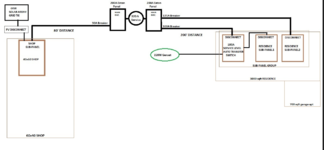
I have a 320a service to the property, set up with two 200 amp switches. One is dedicated to the house, the other will be split with 125 amp breaker to my shop, and another 125 amp to the house as a secondary panel.
I want to run grid tie, with the solar mounted on my shop. My understanding is that this will allow for the power to be fed back to the meter via the wire ran to supply the shop.
I also want to set up a whole home generator (for the purpose of the explanation) next to the meter, and have that feed the 200a house feed (AC/heater, lights, stove, etc) for back up power, on an automatic transfer switch.
Is this possible with currently available DIY setup? I was planning on DIY setup for the panels and inverters, and having a solar installer/electrician come in and handle hookup to panels, and the generator.
Matt, if you PM an email, I'll send you the complete architectural plan for the house.With that said, tell me a little more about your house and decision on the 6kw system? I am up in the DFW area, and am building a significantly more efficient house than my current one. It will be a little smaller than yours (about 2700sq ft downstairs, and about 500ft "mother in law" suite upstairs, and all electric.
Shop is a little over 2k sq ft, and I do plan on several 220 amp and high draw tools, but they will be used infrequently as a hobby shop, not a full time shop.
Im planning on 3 tons of inverter/variable AC for the house and a 1 ton mini split inverter system upstairs based on manual J, all LED lighting, heat pump water heater, etc - but most places tell me that I need to be considering at least twice your solar size.
With the extension to the solar tax credits, I am considering just waiting a year after we move to see what bills look like and size from use, but I also want to do all the projects I can before I move in.
Matt
That makes a huge difference. The big utilities in my state are required to do net metering but I'm on a small coop that doesn't. I am happy with the coop overall but no net metering makes grid intertie not very financially attractive. I'm thinking of some solar panels and inverter running fairly constant loads and using a charger from the grid to top up the batteries when I don't have enough sun. No grid tie issues and associated costs because the system can never backfeed the grid and I have some emergency power when the grid is out. Haven't gotten into the details yet though. Wondering if or what permits would be needed - seems like maybe a gray area especially if the system is only plug connected.One of the biggest issues is definitely the changing of net metering in certain regions. Just make sure to check your local counties practices and see if solar would be beneficial for you, even in a DIY capacity.
I was asked to build something similar. PV solar system that feeds a non-grid tie inverter that powers an EVSE (EV charger). It's definitely a little gray, there was code around putting DC lines into a residence - so I'd "guess" that it would be similar to permits required to relocate a sub panel or relocate outlets. Whole thing (like you suggest) could be plugged into the wall for low-rate charging of the battery system, but was not permanently connected and could not back-feed...Wondering if or what permits would be needed - seems like maybe a gray area especially if the system is only plug connected
Late to the party, has anyone figured out using their whole house generator to keep the solar panels active without using batteries?
There is a solar forum which this has come up multiple times. Short answer almost impossible to do while keeping grid tied. If off grid then use an "island" invertor. Solar ark has a great solution for this with batteries.
I don't understand the question. The solar panels are "active" (to use your word) when the sun is shining. The generator is another source (although some solar kits are called generators). Guess you are referring to other parts of the system being active?
He's referring to the fact that if you have solar it does not produce power unless there is a "grid sync". They're designed to "turn off" otherwise so they don't electrocute someone working on the line.
So typically when you install solar with a generator setup, solar goes in BEFORE the generator transfer switch. When grid power goes down, solar shuts down too, the transfer switch transfers to generator power.
What can happen if you're running solar with a generator, solar can backfeed the generator and that's BAD (for your generator).
The only way to do this, that I know about is to get an inverter that essentially is the switching infrastructure and can accept multiple power sources (solar/generator) at the same time. Almost all I've seen are associated with a battery setup, as they're not designed to do more than 10KW total.
There ARE systems that will support on-site generators with PV, but those aren't your typical home standby systems. think off-grid mining site, where they have a local grid run by diesel, and the PV will load shave the genset to save fuel. they typically also watch to maintain a minimum kVA load on the genset to maintain proper engine operation.Thanks! Wasn't thinking of the grid sync required. Makes perfect sense now. I am thinking of a small system but independent from the grid since I don't have net metering.
It was resurrected by a spam post...I know this was resurrected by a first post on the forum but anyways
There are a number of residential options that support running both a generator and solar at the same time. Enphase is a big one, but might require storage batteries to make it work. There are others too, but they usually have an off grid style inverter that doesn't need to sync to the grid for frequency. They don't want you running solar with a generator because the frequency can vary much more than the grid.There ARE systems that will support on-site generators with PV, but those aren't your typical home standby systems. think off-grid mining site, where they have a local grid run by diesel, and the PV will load shave the genset to save fuel. they typically also watch to maintain a minimum kVA load on the genset to maintain proper engine operation.
It makes sense in cases where unusual weather conditions don't support solar recharge.. Say 3-7 days overcast (and no grid power). You can recharge (slowly) from a moderate generator source (assuming you're not drawing down more than the generator at the same time). Thing to watch is that not all inverters like "dirty" generator power and we use a separate "charge unit" that is generator -> charger -> battery and doesn't involve the inverter....I can understand wanting to still use solar in conjunction with a small portable generator, but it hardly makes sense to do it with a big automatic standby generator. The costs to do it right would be more than any possible fuel savings unless your power goes out a lot for long periods.
My answer was assuming grid-tied which mostly means no batteries. Off grid and grid-tied often, but not always, use different inverters. In an off grid situation your solar doesn't depend on having a power source to sync frequency from. If you're grid-tied and have batteries then you usually have an inverter that works without syncing with another power source.It makes sense in cases where unusual weather conditions don't support solar recharge.. Say 3-7 days overcast (and no grid power). You can recharge (slowly) from a moderate generator source (assuming you're not drawing down more than the generator at the same time). Thing to watch is that not all inverters like "dirty" generator power and we use a separate "charge unit" that is generator -> charger -> battery and doesn't involve the inverter....
nothing small and off-grid is battery free (barring larger micro-hydro systems). it doesn't make (economic) sense.My answer was assuming grid-tied which mostly means no batteries. Off grid and grid-tied often, but not always, use different inverters. In an off grid situation your solar doesn't depend on having a power source to sync frequency from. If you're grid-tied and have batteries then you usually have an inverter that works without syncing with another power source.
The solar inverter world has changed a lot over the past three years or so. It used to be grid-tied inverters were generally significantly less expensive than most off grid solar inverters. The influx of Chinese inverters has made off-grid inverters quite a bit less expensive.
How much are utility rates in your area to make LFP batteries cost less than being on grid? My utility rates are just under 13 cents per KWH. I have 11KW of solar that produces about twice as much electricity as I use on an annual basis. Solar production in winter is terrible. I buy extra power in the winter and sell power the rest of the year. My basic charges are over $30 per month so I need to sell quite a bit to the utility just to cover those charges. (I pay $21 a month for having solar.)Lifecycle round trip cost per kWh on LFP batteries are at parity or below utility power at this point.
You can get an EG4 5kWh LFP battery for $999 today, rated for 7k cycles. so 7k*5kWh = 35,000kWh, that's $0.02/kWh cycled through it.How much are utility rates in your area to make LFP batteries cost less than being on grid? My utility rates are just under 13 cents per KWH. I have 11KW of solar that produces about twice as much electricity as I use on an annual basis. Solar production in winter is terrible. I buy extra power in the winter and sell power the rest of the year. My basic charges are over $30 per month so I need to sell quite a bit to the utility just to cover those charges. (I pay $21 a month for having solar.)
I figure I would need at least a dozen 100 amp hour 48 volt batteries to cover my needs without the grid. This past winter/early spring we saw weeks with heavy cloud cover for the entire week. I'm not convinced 12 batteries would even cover long periods with little sun. It gets even worse if I switch to a heat pump for heat. The twelve batteries plus new inverter(s) and other parts could easily cost $30,000 before tax credits. That is easily 50% more that my current solar system cost.
I am guessing that I use about 400 KWH per month in the winter and more in the summer with A/C. I don't have a consumption meter to see how much I self consume.
I would only use an EG4 battery if it was free. Signature Solar is a joke for the most part. The SOK batteries are a bit over $1500 each. Those I would use because Current Connected actually answers the phone and stands behind them. I have two of them in my motorhome. It isn't just the batteries. You have to have the inverters, solar panels, racking, cabling, and all the rest.You can get an EG4 5kWh LFP battery for $999 today, rated for 7k cycles. so 7k*5kWh = 35,000kWh, that's $0.02/kWh cycled through it.
yes it's not total system cost, just batteries, but batteries are consumables so the cost to cycle them is very relevant.I would only use an EG4 battery if it was free. Signature Solar is a joke for the most part. The SOK batteries are a bit over $1500 each. Those I would use because Current Connected actually answers the phone and stands behind them. I have two of them in my motorhome. It isn't just the batteries. You have to have the inverters, solar panels, racking, cabling, and all the rest.
Maybe $30,000 to add batteries is too high, but I could easily see spending $20,000 to go full off grid. I already have two Solaredge inverters and optimizers along with four Enphase microinverters I don't want to get rid of.
Maximum System size
Three phase systems
Using our 15kVA Quattros, the maximum system size is a 180kVA three phase system. Which then consists of four units on each of the three phases: 12 units in total.
Signature Solar is largely supported by people willing to experiment with their stuff and because of their pricing. Same hardware exists in a few other "brands" also. I agree, if you're not buying a "lot" from them on not on a special list of commercial users, the support can be "not great" (and I'm very under-stating it).I would only use an EG4 battery if it was free. Signature Solar is a joke for the most part. The SOK batteries are a bit over $1500 each. Those I would use because Current Connected actually answers the phone and stands behind them. I have two of them in my motorhome. It isn't just the batteries. You have to have the inverters, solar panels, racking, cabling, and all the rest.
Easily 20-30k for off grid, roll your own, and that's not going to get you by through a week of overcast if you depend on PV.Maybe $30,000 to add batteries is too high, but I could easily see spending $20,000 to go full off grid. I already have two Solaredge inverters and optimizers along with four Enphase microinverters I don't want to get rid of.