To avoid these ads, REGISTER NOW!

DIY Water Level - inconsistent elevation?

65cayne

Well-known member
Joined
Sep 26, 2010
Messages
216
Location
Oklahoma
I'm perplexed...

Building a 8x20 wood shed (build thread once I complete it) and was using a water level to get an elevation reference on each post. I marked all of the posts and came back to the first to find my water level was off by about an inch.

I brought the two ends together and the liquid was even on both ends. Walked back to the first post and my water level was at yet a different elevation than the first two marks?? Walked back to again pair up the two ends and they were equal but now both were about 5 INCHES HIGHER :confused:

It's a 3/8"(?) by 80ft piece of clear plastic tubing filled with water. Temps were high 30's to low 40's (F). I did not lose any liguid from the tube and there are no air bubbles in the tube. Additionally tube and liquid was "at temp" when I used it (not filled with warm water and brought outside into the cold) so I cant see any expansion contraction issues.

I cut the tube in half down to about ~30ft and experienced the same issues being off in measurement anywhere from 1/4" to 1" typically after letting the liquid find it's level.

Thoughts anyone?

I am going to buy a string level today and give that a go. I checked out the laser levels and the accuracy for the cheapo's is about what I'd get out of a string level. I had really high hopes for the water level though...

<edit> In case anyone is wondering. The shed is a post-in-ground construction like a pole barn
-8'x20' footprint with 7ft wall and 2x8 top/bottom gurts
-vertical 1x10 cedar (?) plank siding (gapped for air flow)
-two 7Wx6H openings on the long side
-10/12 pitch corrugated steel roof over 4ft OC wood trusses
-eaves and gable overhang (6"?) and possibly a small cupola if the project goes well

Hoping to have it finished in a couple weeks and then I will post pictures.
 
Last edited:
To avoid these ads, REGISTER NOW!

jkwilson

Well-known member
Joined
Dec 5, 2012
Messages
758
Location
SW Indiana
The only way both can be off is distortion of the tubing. Water volume can't change so space inside the tube had to change.
 
OP
6

65cayne

Well-known member
Joined
Sep 26, 2010
Messages
216
Location
Oklahoma
Is the tube capped? It won't work if it is.
No it's not capped.

The only way both can be off is distortion of the tubing. Water volume can't change so space inside the tube had to change.
These are my thoughts exactly but I could not come up with an explanation for it. I wasn't kinking the tube or distorting it anymore than it was already flopping around on the ground (it was a little stiff due to the chill in the air)
 

buddyboy

Well-known member
Joined
Oct 8, 2007
Messages
616
make sure the ends are capped whenever you move the tube, the water will come out easier than you think.

when you get it in place inspect the tube for kinks and air bubbles... then remove the caps to let the water find level.

i have a feeling you are losing water when you move the tubes after putting them together to check to make sure it's working.
 

nadogail

Well-known member
Joined
Jan 23, 2009
Messages
32,259
Location
Coronado, CA
After making sure that both ends of the tube are open to atmosphere avoid quick movements of the level.

Although it has been years since I've used a water level, I recall a little food color in the liquid made the level much easier to use.
 

matt_i

Well-known member
Joined
Mar 14, 2008
Messages
10,802
Location
SE Michigan
I've experienced that. It seems to defy logic. I think its a timing thing, due to the small diameter and the small force that's trying to equalize.

A stringline level would be good, I would also trust any 6foot beam level that reads roughly the same when swapped end-for-end on the same plane or same measurement. Then just daisy-chain the measurements together.

A laser is nice, I invested in one for building and hope its going to be a good reference tool for many years to come.
 
OP
6

65cayne

Well-known member
Joined
Sep 26, 2010
Messages
216
Location
Oklahoma
...i have a feeling you are losing water when you move the tubes ....
I watched for this and was not losing anything.

After making sure that both ends of the tube are open to atmosphere avoid quick movements of the level... I recall a little food color in the liquid made the level much easier to use.
Yes, both ends open and a drop of food dye in each end. No sudden movements and I put my finger over the end when I move.

I've experienced that. It seems to defy logic. I think its a timing thing, due to the small diameter and the small force that's trying to equalize.

A stringline level would be good, I would also trust any 6foot beam level that reads roughly the same when swapped end-for-end on the same plane or same measurement. Then just daisy-chain the measurements together.

A laser is nice, I invested in one for building and hope its going to be a good reference tool for many years to come.
Glad to hear someone else has been on this road.

I am going to try the string level today. If that doesn't get me the accuracy I desire then I will get a laser level. HF has one that has good reviews for a DIY'r project for around $60.
 

aka Larry

Well-known member
Joined
May 2, 2012
Messages
8,151
Location
Eastern, NC
The one I used had a central reservoir and the tube coiled around inside so it could be stored as a unit easily. I used it for building a deck. I started by placing the reservoir on a ladder at the correct elevation, and them stretched the tube out to each post to mark them. Worked like a champ.

Last I checked water is always level, so there is something amiss with your rig IMO.
 

tymbo

Well-known member
Joined
Apr 6, 2012
Messages
613
Location
West Chicago
Just a thought:
I wonder if a temperature differential between the two ends may be causing expansion of the liquid. If half the fluid is in sunlight, it will expand and raise the level at that end. A thinner tube would tend to magnify the expansion. (think of a thermometer):headscrat
 

KaiserJeep

Active member
Joined
Sep 4, 2015
Messages
43
I used a home-made water level for my pole barn, and experienced the same issues as you. The varying levels drove me crazy for a few hours until I worked out a method that worked. Here's what we did...

1) affixed one end of line to a corner post and plugged the line with a bolt;
2) carefully moved the other end of line to another post without loosing any water (which wasn't a real problem with plug at other end);
3) removed the plug and verified water level didn't drop;
4) marked the new post at the water line.

The key to our methodology was keeping one end stationary, and not loosing any fluid.
 

Aerogt01

Well-known member
Joined
Nov 5, 2014
Messages
227
Was it windy? Different air velocities over the top of the tube could easily change the level.
 

larry_g

Well-known member
Joined
Apr 28, 2007
Messages
16,927
Location
oregon
I'm perplexed...


I brought the two ends together and the liquid was even on both ends. Walked back to the first post and my water level was at yet a different elevation than the first two marks?? Walked back to again pair up the two ends and they were equal but now both were about 5 INCHES HIGHER :confused:


Hoping to have it finished in a couple weeks and then I will post pictures.

Are you keeping a consistent length of empty tube above the water line. When you align the ends, mark the tubes where the water is and call that your zero point. Mark this zero point on a fixed point (post?). Move the tube, bring the water to the lines and then measure to the ground to determine rise and fall. For marking the post bring the water to the line and then transfer the zero line to the post.

You also have to keep one end fixed and at a fixed height. When measuring, the water in the tube must be at the zero line on the tube at both ends.

lg
no neat sigline
 
Last edited:
To avoid these ads, REGISTER NOW!

CTyankee

Well-known member
Joined
Jan 13, 2013
Messages
3,804
Location
CT
The one I used had a central reservoir and the tube coiled around inside so it could be stored as a unit easily. I used it for building a deck. I started by placing the reservoir on a ladder at the correct elevation, and them stretched the tube out to each post to mark them. Worked like a champ.

Last I checked water is always level, so there is something amiss with your rig IMO.

This. ^^^

Look here: http://www.factsfacts.com/MyHomeRepair/WaterLevel.htm
 
OP
6

65cayne

Well-known member
Joined
Sep 26, 2010
Messages
216
Location
Oklahoma
The one I used had a central reservoir and the tube coiled around inside so it could be stored as a unit easily. I used it for building a deck. I started by placing the reservoir on a ladder at the correct elevation, and them stretched the tube out to each post to mark them. Worked like a champ.

Last I checked water is always level, so there is something amiss with your rig IMO.
I think using a reservoir or larger tube might help. Something I will try down the road on my garage project.
Just a thought:
I wonder if a temperature differential between the two ends may be causing expansion of the liquid. If half the fluid is in sunlight, it will expand and raise the level at that end. A thinner tube would tend to magnify the expansion. (think of a thermometer):headscrat
I considered the sun's effect on the tube (expanding or contracting) but it was overcast.
I used a home-made water level for my pole barn, and experienced the same issues as you. The varying levels drove me crazy for a few hours until I worked out a method that worked. Here's what we did...

1) affixed one end of line to a corner post and plugged the line with a bolt;
2) carefully moved the other end of line to another post without loosing any water (which wasn't a real problem with plug at other end);
3) removed the plug and verified water level didn't drop;
4) marked the new post at the water line.

The key to our methodology was keeping one end stationary, and not loosing any fluid.
I had one end tie wrapped to a t-post while I walked around with the other end. Did not lose any liquid.

Was it windy? Different air velocities over the top of the tube could easily change the level.
Had not considered that one. It was breezy?

Are you keeping a consistent length of empty tube above the water line. When you align the ends, mark the tubes where the water is and call that your zero point. Mark this zero point on a fixed point (post?). Move the tube, bring the water to the lines and then measure to the ground to determine rise and fall. For marking the post bring the water to the line and then transfer the zero line to the post.

You also have to keep one end fixed and at a fixed height. When measuring, the water in the tube must be at the zero line on the tube at both ends.

lg
no neat sigline
Here is where it got interesting. Yes, one end was fixed to a post, the other end in my hand, and plenty of extra tube to prevent spillage. I walked back to the reference post and observed both water marks were equal at a given height. I marked it, then walked away with the tube and came back to re-verify....both water levels were equal but now were HIGHER. I stared at it scratching my head for some time. No distortion or kinks in the tube. Very strange.

Thanks for that link! Good reading on such a simple device. I believe using a reservoir will indeed cure the problem.
 

Gerald O

Well-known member
Joined
Mar 5, 2013
Messages
1,884
Location
NC
The trick is to not move the water level at all once you set both ends up.

Whenever you move the tube/hose it distorts and changes internal volume enough to change the water level. Don't bother bringing the two ends together to check that they match. That is a waste of time as they will always match each other. Leave one end fixed at your marked reference location and then only move the other end once to the location you want to measure and attach it. Then walk back to the first reference end and see where the level has moved to relative to your reference mark. It will usually move. Just measure the difference between the new water level and your reference mark, walk back to the other end and apply that measurement offset to the second location that you are leveling.
 
Last edited:

Bluedodge

Well-known member
Joined
Jun 22, 2015
Messages
1,995
Location
Michigan (not the Detroit part)
...I brought the two ends together and the liquid was even on both ends. Walked back to the first post and my water level was at yet a different elevation than the first two marks?? Walked back to again pair up the two ends and they were equal but now both were about 5 INCHES HIGHER :confused:

I cut the tube in half down to about ~30ft and experienced the same issues being off in measurement anywhere from 1/4" to 1" typically after letting the liquid find it's level.

I've experienced that. It seems to defy logic..

Well, make that three of us.:eyecrazy:

I had trouble several summers back while attempting to level a long deck with a water level.

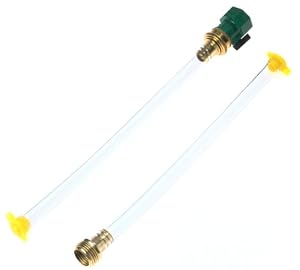
I used a pair of these on a garden hose:
31FEJCMS1DL._SX300_.jpg


First thought was maybe a portion of the garden hose was in sunlight and part was in the shade. Let that sucker sit all afternoon in direct sunlight and still had bizarro readings.

I wound up using mason's line and a string level.
 

Radix2

Well-known member
Joined
May 28, 2014
Messages
1,853
Location
the thumb!, MI
The trick is to not move the water level at all once you set both ends up.

Whenever you move the tube/hose it distorts and changes internal volume enough to change the water level. Don't bother bringing the two ends together to check that they match. That is a waste of time as they will always match each other. Leave one end fixed at your marked reference location and then only move the other end once to the location you want to measure and attach it. Then walk back to the first reference end and see where the level has moved to relative to your reference mark. It will usually move. Just measure the difference between the new water level and your reference mark, walk back to the other end and apply that measurement offset to the second location that you are leveling.

This is the correct answer. The water level is used to give you a consistent reference in two places - but is poor at giving an absolute reference. So it works every time if you set it up between your reference place and another place and use it to measure the result. I.e. As above - measure the water to your reference - transfer this measurement to the spot you are working on. Simple and consistent - and more accurate than a line level over long distances.
 

chiggly626

New member
Joined
Dec 8, 2015
Messages
1
Used water levels for many years in the commercial side of the ceramic tile industry. Clear vinyl tubing with two people at each end. One at the reference mark, one to transfer the mark to the post, wall, etc.. Just as described earlier, wait for the water to settle and you are level. The water will be level, doesn't matter if you lose some out of the tube when you move it around. Just make sure that there are no air bubbles and you are golden. Don't overthink it, just be patient and consistent.
 

404

Well-known member
Joined
Aug 23, 2014
Messages
3,463
Location
Mass
I made my fixed reservoir out of a metal trash can lid upside down. Set the lid on a platform and did not move it at all during my entire project. The larger the surface area of the reservoir, the less sensitive the level is to water loss.

Zip tie the clear open end of the tube in multiple locations along a length of wood strapping. This way the level can be let go of leaned against something without spilling any water.

A yardstick spring clamped to the strapping next to the clear tube lets one calculate and slope a grade, which I did when pouring my sidewalk.

Most of my level tube was garden hose, I only used 6 feet of clear tubing on the one end held to the strapping.

The reason a plain hose alone changes level is that inner diameter, length, shape, cross sectional area, and volume of the hose changes as it is dragged around.
 

WVBrady

Well-known member
Joined
May 5, 2005
Messages
1,679
Location
WV

He says that if you raise one end of the tube, the water level in the other end will change, but he doesn't say why.

I was going to suggest putting a little detergent in the water also. The note at the bottom says it is to reduce the size of the meniscus. I think it would also help the water level change more smoothly. I have found that the water level in a plastic hose tends to "stick" as you move the hose.
 

myredracer

Well-known member
Joined
Nov 1, 2015
Messages
557
Location
Langley, BC
I tried a water level on the foundation for a house years ago. Quickly found that it was very inconsistent when moving it around (as noted and explained above) and tossed it away. That was before the days of lo-cost laser levels and ended up renting a builders level.

I eventually bought an inexpensive self-leveling rotary laser on a tripod (around $30 IIRC) and have used it for concrete forms, trim work and even for 1800 feet of fencing around our property. Only thing about a laser like this is that they just don't work in the daylight so I waited until near dusk to mark elevations. One of the most useful tools I've owned.

I would say put the water level aside and get a laser level.
 

CTyankee

Well-known member
Joined
Jan 13, 2013
Messages
3,804
Location
CT
I tried a water level on the foundation for a house years ago. Quickly found that it was very inconsistent when moving it around (as noted and explained above) and tossed it away. That was before the days of lo-cost laser levels and ended up renting a builders level.

I eventually bought an inexpensive self-leveling rotary laser on a tripod (around $30 IIRC) and have used it for concrete forms, trim work and even for 1800 feet of fencing around our property. Only thing about a laser like this is that they just don't work in the daylight so I waited until near dusk to mark elevations. One of the most useful tools I've owned.

I would say put the water level aside and get a laser level.

Our company has a couple of laser levels along with a water reservoir level. Both have their place IMO. I can set up our water level in a couple of minutes, and by myself, check elevations against other elevations all around the building site...even behind walls.

What I've never had a problem with is it being "inconsistent" Just based on a water levels principle, the only way it's going to be inconsistent is due to operator error. YMMV...if you're not using it correctly. :dunno:
 

53Sparky

Well-known member
Joined
Feb 22, 2015
Messages
175
Location
Northglenn, CO
What I've never had a problem with is it being "inconsistent" Just based on a water levels principle, the only way it's going to be inconsistent is due to operator error. YMMV...if you're not using it correctly. :dunno:

A water level with no air in the system will ALWAYS give you two marks that are absolutely level relative to each other. However, when you move either end from one location to a new location, there is no guarantee that you will be able to make the third mark be exactly at the same level as the previous marks. You will just make two new marks that are exactly level relative to each other. A simple trick if you have two people to work together is to make a "master" mark at one location which is observed by one person. Then, as the other person moves around the site, he can change the level of the water in the tube simply by raising or lowering his end. As long as the tubing diameter is the same diameter on both ends, it is easy to predict what adjustment you need to make to maintain a consistent reference point anywhere you want. Adjusting the height of the hose by 2" (up or down) should result in 1" of meniscus movement at the other end. The observer can raise or lower his end until he matches match the "master" mark. Using this method you could theoretically get to a perfectly level plane hundreds of feet away.

Variations in temperature, accidental spills, etc will have no effect on this method. You don't need to worry about the amount of water in the system so you can be fairly careless about the hose end as you walk around. It doesn't have to be a careful or tedious process at all.

Soapy water with food coloring is a great way to make this easier to read.

Done.
 
Last edited:

JTG

Well-known member
Joined
Sep 24, 2009
Messages
408
Location
New Jersey
I used a water level for years building above ground pools. Previous posts are correct that the height will fluctuate when moved but if you think about it that doesn't matter. We would have a ruler on both sides of the hose with one end always stationary. So when setting the first block the water may be at the 4" mark on the stationary side so we set the block on the other end to match the same 4". Then when moving to the next block the hose may compress a a bit and now the stationary side shows at 5". That's fine we just make that black correspond to 5".

This was a good 20years ago when laser level were not as cheap as they are now but the water level was a simple solution for us.
 
To avoid these ads, REGISTER NOW!
Top Bottom