To avoid these ads, REGISTER NOW!

Do breakers go bad? Scratching head here.

HoosierBuddy

Well-known member
Joined
May 9, 2006
Messages
2,935
Location
Southern Indiana
Hey guys,

As part of my 2006 Garage Build...I had to sell it to the wife. How did I do that? I designed a deck in the L between the new garage and the house and drew in a hot tub on the deck. Suddenly my garage project was greenlighted!

Fast forward to 2017. The Spa keeps tripping the 50 Amp double throw breaker my main box. This has been happening on and off for a couple of months, but with the arrival of colder weather it has become much worse.

The 240 V 50 Amp Circuit only feeds the spa. It was new wiring in 2006, installed by a licensed electrician...it runs from a Cutler-Hammer Type BR250 120/240 V breaker about 40 feet to a 50 AMP GFI (Disconnect I guess would be the correct description?) Breaker adjacent to the hot tub. From there it goes to the hot tub. The GFI breaker is not an issue. It's the C-H breaker that feeds the disconnect that keeps tripping.

I pulled the front cover off the tub and disconnected each subsystem one-at-a-time to diagnose the problem area. The only thing that I could disconnect to keep the breaker from tripping was the 5.5 KW electric heater. The heater is protected by a separate 30 AMP fuse in the spa...but as it was only $40, I went ahead and replaced the heating element. Hooked everything back up and it ran about 15 minutes and tripped the breaker.

I bought a clamp on meter and put it around the main feed coming into the spa and started playing around with it. After the spa runs for about 15 minutes the breaker will trip. The clamp on amp meter was showing 28 amps when it tripped. The breaker was warm to the touch.

I've tried to contact the electrician that installed the circuit, but it's rolling to voice mail. I live in a very small town, so there is basically no one else to call.

Any advice here?

Phil
 
To avoid these ads, REGISTER NOW!

wyliesdiesels

Well-known member
Joined
Aug 14, 2012
Messages
20,074
Location
Modesto, CA
Yes breakers do fail. And BR breakers arent top of the line.

If the GFCI breaker is not tripping, and the current draw isnt high, it sounds like you may have a short.
 
Last edited:

dragrcr890

Well-known member
Joined
Dec 11, 2011
Messages
47
Location
Salem, WI
absolutely breakers can fail. It sounds like you have investigated everything I would have. the only thing is the wiring, if you had a direct open spot touching ground as soon as you flipped it on it would short to ground and trip on overcurrent however yours is running for sometime then tripping. You could have bad insulation on the wire and once hot fails but that's very unlikely. Seems like a simple fix of replacing the breaker. I have had 2 fail in a one year old house but they were the new arc rated breakers which ****. I think once you get a qualified electrician out and replace the breaker youll be in business. Hopefully others will chime in.
 
OP
H

HoosierBuddy

Well-known member
Joined
May 9, 2006
Messages
2,935
Location
Southern Indiana
absolutely breakers can fail. It sounds like you have investigated everything I would have. the only thing is the wiring, if you had a direct open spot touching ground as soon as you flipped it on it would short to ground and trip on overcurrent however yours is running for sometime then tripping. You could have bad insulation on the wire and once hot fails but that's very unlikely. Seems like a simple fix of replacing the breaker. I have had 2 fail in a one year old house but they were the new arc rated breakers which ****. I think once you get a qualified electrician out and replace the breaker youll be in business. Hopefully others will chime in.

I too doubt it's wiring.

By resetting the breaker about a dozen times, I was able to get the spa up to temperature last night. I put the cover on it...and the breaker stayed on all night. What gets us into trouble is we turn the spa down a few degrees to save $, then turn it up an hour or so before we're going to get in it. That trips the breaker every time. It's the long heater cycle that's getting it. I had to drain the spa to replace the heater element...so starting with 75 degree water yesterday and trying to get it up to 101 degrees was a major PIA. The first cycle it ran for about an hour before tripping...but after that it was shorter.

Phil
 
Last edited:

nh_yota

Well-known member
Joined
Mar 10, 2015
Messages
4,078
Location
Seacoast New Hampshire
It's not uncommon for an upstream breaker to trip on a fault before a downstream breaker does, even if the downstream breaker is smaller. It happens for any number of reasons, so don't rule out a problem with the heater in the hot tub. Different brands and different styles of breakers have different trip curves based on a function of overload current + time. If it were me I would get an amp clamp to see how many amps the hot tub is pulling before I went ahead and changed out a suspect breaker.

EDIT: I missed the part about the OP checking amp draw with a meter. Carry on.
 
Last edited:

KenC

Well-known member
Joined
Dec 20, 2009
Messages
2,596
Location
oklahoma
Probably a bad breaker as they do fail

I had a 100A in my shop's main disconnect box fail a few years ago. INstalled in about '66 and never had any issues. Went in one morning and no lights. Found the breaker open and wouldn't reset.

The only load was lights, and the 100A failed. Anyway, used the opportunity to upgrade to 240v 3phase service.
 

rlitman

Well-known member
Joined
Oct 18, 2010
Messages
24,677
Location
Long Island
... The only thing that I could disconnect to keep the breaker from tripping was the 5.5 KW electric heater. The heater is protected by a separate 30 AMP fuse in the spa...but as it was only $40, I went ahead and replaced the heating element. Hooked everything back up and it ran about 15 minutes and tripped the breaker.

I bought a clamp on meter and put it around the main feed coming into the spa and started playing around with it. After the spa runs for about 15 minutes the breaker will trip. The clamp on amp meter was showing 28 amps when it tripped. The breaker was warm to the touch....

5.5KW heating element on 240V should draw around 23A. 5A for the rest of the spa sounds reasonable. Though maybe something happens after some time that suddenly trips the breaker (like a pump that runs and then occasionally seizes).

A 50A breaker should be able to run indefinitely at 40A. Above 40A, under continuous load, it may start to trip on the thermal protection. It is normal for a breaker at 80% load (the absolute lowest load where it should begin to trip on thermal) to feel a little warm. Breakers get warm when loaded.

If your clamp meter reading is to be believed, (you should check this at the breaker itself, not at the spa side), and the breaker is not tripping immediately, then it would appear to be a problem with your breaker. If the clamp meter shows more current at the breaker than at the spa end, then perhaps you have current leaking to earth somewhere in the conduit?

As for the breaker itself: a breaker can trip on the thermal for several reasons.
1) Perhaps it is actually overloaded
2) Perhaps it is defective or bad
3) It could be getting heated by an "external" heat source that makes it act as if it is under more load than it actually is. This heat would most likely either be from a bad connection with the bus, or a loose wire terminal that is getting hot. An electrician should know what to look for in terms of visible signs of a wire being overheated (I'd just use my thermal camera).
 

rlitman

Well-known member
Joined
Oct 18, 2010
Messages
24,677
Location
Long Island
It's not uncommon for an upstream breaker to trip on a fault before a downstream breaker does, even if the downstream breaker is smaller. It happens for any number of reasons, so don't rule out a problem with the heater in the hot tub. Different brands and different styles of breakers have different trip curves based on a function of overload current + time. If it were me I would get an amp clamp to see how many amps the hot tub is pulling before I went ahead and changed out a suspect breaker.

EDIT: I missed the part about the OP checking amp draw with a meter. Carry on.

"Breaker coordination" is a real headache of mine. In the case of a dead short, the current that flows through both the upstream and the downstream breakers is the same (not accounting for other loads on the upstream). As such, if the short circuit current exceeds the instantaneous trip rating of the upstream breaker (something depended upon the impedance of the circuit and the sub-transient reactance of the source), it can trip the upstream breaker. And if that breaker is just a little bit faster than the downstream, then the downstream might not be tripped at all. But it was mentioned above that the 30A downstream was a fuse and not a breaker, so I don't think there is a hidden issue in the heater.
 

wil

Active member
Joined
Sep 18, 2010
Messages
43
Location
massachusetts
I would also look if there is corrosion where the circuit breaker connects to the bus AND at the wiring screw at the breaker box. If you have an IR temperature probe, check the circuit breaker temperature. A hot circuit breaker from a bad connection
can also cause early trip outs.
 

gungatim

Well-known member
Joined
Jan 8, 2013
Messages
8,101
Location
west mich
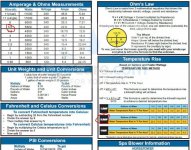
do you have another 40 or 50 amp breaker to swap it out with and test? even if it's not the required GFCI, you can swap it and see if it gets up to temp. btw, it shouldn't take that long to heat 75 degree water, depending on how big the tub is of course. my 6' round tub heats up in less than an hour after being off during the week.

you can calculate the heat rise on the chart below, and I would also test the heating element as well. I just rehabbed the tub I got at auction, rewiring the switches, heater, sensors, etc. and replaced the gfci which was built into the spa-pak (mid 90's tech) which is NLA...
 

Attachments

  • spa.jpg
    spa.jpg
    136.7 KB · Views: 24
To avoid these ads, REGISTER NOW!

dragrcr890

Well-known member
Joined
Dec 11, 2011
Messages
47
Location
Salem, WI
another thermal issue would be if they electrician was trying to save money for the job and undersized the wire for any reason. If I missed it then sorry but you may want to verify wire sizing and make sure its adequate for the 50a circuit. I don't know the code off hand but its one of those things we may all take for granted because a licensed guy did it.... just a thought. I'm betting hands down its a bad breaker. I've seen too many failed in my line of work.
 
OP
H

HoosierBuddy

Well-known member
Joined
May 9, 2006
Messages
2,935
Location
Southern Indiana
I still hadn't heard from the electrician, so I drove around town and LUCKILY I found his truck (I TOLD YOU it was a SMALL TOWN!) and once I found his truck I found him. He promised to go by and check the breaker.

I just got a text from home. They said he found a loose connection in the box that might be an issue...so he suggested we try it for a few days and if that doesn't fix it...he'll replace the breaker.

Thanks for all your help guys. I'm not 100% convinced the problem is in the breaker...but compared to replacing pump/motors in the spa...it's a cheaper/easier alternative!

Phil
 

tmcquinn

Well-known member
Joined
Oct 3, 2014
Messages
187
Location
Cincinnati
Gotta love a happy ending.

I was taught, and maybe this is no longer the case, that breakers are designed to fail safely. If one is tripped enough to begin to cause wear, it will start to trip at a lower current. While this is a complete PIA, it's better than having it trip at a higher current and cause a fire. Also, it will make someone get fed up and call an electrician.
 

MBfreak

MEMBER EMERITUS
Joined
Dec 10, 2010
Messages
2,301
Location
Linkoping , Sweden
Hey,
maybe some physics can help explain your trips. You state that they have increased in frequency during cold weather. Only part that cured it was disconnecting the 5,5 kW heater.
Resistance heaters will most of the time have a positive temperature coefficient which will cause the heater to have a lower power consumption warm then cold.
So if you are on the tripping margin and the weather is cold , this could be the culprit.
There are several metallic compounds that does not act like stated above, ie Kanthal etc. But they are quite expensive and usually only applied in precision power resistors, DC measurement shunte etc.

Ola
 

Bert_

Well-known member
Joined
Dec 24, 2016
Messages
9,777
Location
NW Iowa
Breakers outside seem especially prone to failure. Corrosion I assume will make them run hotter at lower amps.

Just changed one out about an hour ago. 2 pole 100A started tripping pretty often. Breaker was to hot to even touch and an amp meter showed ~70A, which is normal for a 15hp fan. Changed the breaker and all was good. Its not uncommon. :dunno:
 

wyliesdiesels

Well-known member
Joined
Aug 14, 2012
Messages
20,074
Location
Modesto, CA
OP- does your clamp meter have a min max avg function?

If it does i suggest, using that and leaving the clamp on the hot conductor for a long period of time to see what the max current draw is.
 

T_R

Well-known member
Joined
Jul 2, 2015
Messages
902
Location
Maine
They fail. I had 1/2 of a 100 amp main breaker fail. Nothing 220 worked, lights flickered etc.
 
OP
H

HoosierBuddy

Well-known member
Joined
May 9, 2006
Messages
2,935
Location
Southern Indiana
Just a final follow up on this post.

After a week or so since the electrician tightened up the connections in my breaker box, the breaker has never tripped again. This includes yesterday when I did a water change and had to run the heater for hours to bring the spa up from 70 degrees to 100 degrees.

The breaker stayed cool to the touch and never tripped. So...stick a fork in this one. It's done.

Phil
 

rlitman

Well-known member
Joined
Oct 18, 2010
Messages
24,677
Location
Long Island
Yeah torquing to spec is important but many people including electricians do not.

I very recently dealt with a panel where one circuit was not working. At first, I suspected an issue with the breaker. But looking inside with the FLIR, I saw that the neutral bar on the left side of the panel was hot.

This was a factory installed neutral bar in a Square D 3-phase NQ panelboard (with bolt down breakers, etc.). The panel came with neutral terminal bars on both the left and right side, which were connected to a plated copper bus bar bridging both sides of the panel (of the same construction as the phase bus bars in the panel). This panel was ordered as loaded (breakers already bolted into every position) from the factory.

The neutral feeding the panel was connected to a lug screw on the right side neutral terminal bar. All of the circuits on the right side of the panel (which used the right neutral bar) worked fine.

The left side of the panel only had four active single-phase circuits. Three drew almost no current, with the fourth being an exhaust fan. The exhaust fan was the one having trouble. When I reset the breaker to the fan, I heard a buzzing from inside the panel, which is what got me to open it up and take a closer look. When I reset the breaker again, I saw a spark jump from the neutral bar, and I turned my attention from the breaker itself.

The factory used an 8-32 screw to bond the neutral terminal bars to the copper bus behind it. The screw on the right side was tight. The screw on the left was sticking out around 1/8", so that the current was passing through the threads, and not directly from bar to bar. It disintegrated (from heat damage) when I tried to unscrew it.

I was able to clean up (scotchbrite) the surfaces, tap out the hole for a 10-32, and put a new bolt in there, and now we're all good. But that one couldn't be blamed on the electrician.

On a similar note, an adjacent panel (480V this time) had a breaker burn up it's bus position several years ago. This one was also ordered loaded from the factory, so in theory, every breaker would have been torqued in by Schneider Electric.
 
Last edited:

Bert_

Well-known member
Joined
Dec 24, 2016
Messages
9,777
Location
NW Iowa
I very recently dealt with a panel where one circuit was not working. At first, I suspected an issue with the breaker. But looking inside with the FLIR, I saw that the neutral bar on the left side of the panel was hot.

This was a factory installed neutral bar in a Square D 3-phase NQ panelboard (with bolt down breakers, etc.). The panel came with neutral terminal bars on both the left and right side, which were connected to a plated copper bus bar bridging both sides of the panel (of the same construction as the phase bus bars in the panel). This panel was ordered as loaded (breakers already bolted into every position) from the factory.

The neutral feeding the panel was connected to a lug screw on the right side neutral terminal bar. All of the circuits on the right side of the panel (which used the right neutral bar) worked fine.

The left side of the panel only had four active single-phase circuits. Three drew almost no current, with the fourth being an exhaust fan. The exhaust fan was the one having trouble. When I reset the breaker to the fan, I heard a buzzing from inside the panel, which is what got me to open it up and take a closer look. When I reset the breaker again, I saw a spark jump from the neutral bar, and I turned my attention from the breaker itself.

The factory used an 8-32 screw to bond the neutral terminal bars to the copper bus behind it. The screw on the right side was tight. The screw on the left was sticking out around 1/8", so that the current was passing through the threads, and not directly from bar to bar. It disintegrated (from heat damage) when I tried to unscrew it.

I was able to clean up (scotchbrite) the surfaces, tap out the hole for a 10-32, and put a new bolt in there, and now we're all good. But that one couldn't be blamed on the electrician.

On a similar note, an adjacent panel (480V this time) had a breaker burn up it's bus position several years ago. This one was also ordered loaded from the factory, so in theory, every breaker would have been torqued in by Schneider Electric.

The factory work must depend on the day of the week...
I guess it's not a problem than often but I have seen a few breaker with the bolts loose, even had the bolts connecting a 600A main to the buss cross threaded one time.

Had a panel where the factory put some single pole breakers on the B phase, it was ordered as 120/240 delta...
Didn't notice that one right away until I tried running a few tools on it. A shop vac and PVC heater were the only casualties though,
 
Last edited:
OP
H

HoosierBuddy

Well-known member
Joined
May 9, 2006
Messages
2,935
Location
Southern Indiana
This one was also ordered loaded from the factory, so in theory, every breaker would have been torqued in by Schneider Electric.

You know Rlitman, I don't know if this applies or not, but years ago I bought a set of "complete" cylinder heads from AirFlow Research. Complete means the valves and rocker studs come preinstalled. I put them in the car and several months later one of the rocker studs backed out to the point the rocker arm got loose, got sideways, and the pushrod came flying out and started slamming off the valve cover. Made a HELL of a racket. Sounded catastrophic, but really the only damage was a bent pushrod.

So I pulled the valve covers and all the studs were loose to one degree or another and I called up AFR and was like "WTF Dudes?"

Here's what they told me. "We do not install the rocker studs in our cylinder heads. We merely screw them into the threaded holes as it is a convenient way to ship them and
to protect the threads. It's up to the customer to properly torque those studs."

You could have knocked me over with a feather. I figured if the factory installed something it was going to be done to a high standard. Seems that is not necessarily true. I wonder if you check with Schneider if they would tell you some version of what AFR told me?

Phil
 
Last edited:

Lelandwelds

Well-known member
Joined
Sep 6, 2017
Messages
2,443
Location
Central Texas
You know Rlitman, I don't know if this applies or not, but years ago I bought a set of "complete" cylinder heads from AirFlow Research. Complete means the valves and rocker studs come preinstalled. I put them in the car and several months later one of the rocker studs backed out to the point the rocker arm got loose, got sideways, and the pushrod came flying out and started slamming off the valve cover. Made a HELL of a racket. Sounded catastrophic, but really the only damage was a bent pushrod.

So I pulled the valve covers and all the studs were loose to one degree or another and I called up AFR and was like "WTF Dudes?"

Here's what they told me. "We do not install the rocker studs in our cylinder heads. We merely screw them into the threaded holes as it is a convenient way to ship them and
to protect the threads. It's up to the customer to properly torque those studs."

You could have knocked me over with a feather. I figured if the factory installed something it was going to be done to a high standard. Seems that is not necessarily true. I wonder if you check with Schneider if they would tell you some version of what AFR told me?

Phil

Wow. They should use a label " Torque before installing ".

I used to do service work. I would swap in a known good part until problem was fixed. Then replace with final new part. It was just faster.

With breakers you could juggle breakers and see if problem moves with the breaker.
 

arkieguide

Well-known member
Joined
Aug 10, 2017
Messages
50
Your best solution is a qualified licensed electrician.Some problems are not easy to solve by the home owner diy person.To technical. Good luck.
 
To avoid these ads, REGISTER NOW!
Top Bottom