

You are using an out of date browser. It may not display this or other websites correctly.
You should upgrade or use an alternative browser.
You should upgrade or use an alternative browser.
Do I need these - Truss supports?
- Thread starter Augus7us
- Start date

99driver
Well-known member
Those look a whole lot like collar ties or potentially rafter ties, depending on their height.
Rafter ties prevent the roof from spreading the walls apart. Collar ties prevent the roof peak from separating from wind uplift or other unbalanced loads.
Leave'r be.
Rafter ties prevent the roof from spreading the walls apart. Collar ties prevent the roof peak from separating from wind uplift or other unbalanced loads.
Leave'r be.
Ugg looks like something rotated my photos.
I'll go out and try to take a few more photos. They do not look like they were intended to offer any kind of structural support. They are just held up with a few 16p. And they cannot be on every truss as they are 4' O/C and my posts are 8'.
The reason I want to get rid of them is so I can insulate and sheath the inside and I really don't want to work around them.
I'll try to get some more photos and report back. Thanks for the reply.
-Clint
I'll go out and try to take a few more photos. They do not look like they were intended to offer any kind of structural support. They are just held up with a few 16p. And they cannot be on every truss as they are 4' O/C and my posts are 8'.
The reason I want to get rid of them is so I can insulate and sheath the inside and I really don't want to work around them.
I'll try to get some more photos and report back. Thanks for the reply.
-Clint
dreamingmuscle
Well-known member
How wide is the span? My pole building is 30" and does not have those. But I don't have your snow load either.
I say yank em out. But a call to the builder might be in order
I say yank em out. But a call to the builder might be in order
dreamingmuscle
Well-known member
They're not on every truss so I believe you can take them out without worries. They are a eye sore.
dfiler2
Well-known member
You really wouldn't need them in a 30 inch pole barn
It looks like they are cut at an angle and placed against the face of the pole, if so, they wouldn't hold much anyway.
It looks like they are cut at an angle and placed against the face of the pole, if so, they wouldn't hold much anyway.
Thanks guys. I know from reading on here and talking to my pops that you can't rely on nails or screws to support load.
Plus as others have said they are an eyesore. They look terrible, were installed half *** and don't seem to offer any real support.
Its 30' across (30' x 40') and
I think I'm going to deep six them so I don't have to look at them or hang sheetrock around them.
Here's a few more photos I was able to take this evening.


Plus as others have said they are an eyesore. They look terrible, were installed half *** and don't seem to offer any real support.
How wide is the span? My pole building is 30" and does not have those. But I don't have your snow load either.
Its 30' across (30' x 40') and
I think I'm going to deep six them so I don't have to look at them or hang sheetrock around them.
Here's a few more photos I was able to take this evening.
Attachments


cdestuck
Well-known member
They most certainly prevent racking from happening when wind hit the side walls. Much like a wind brace on a gable end truss.
jbwilkins
Well-known member
Do you have the plans/truss designs on hand? If they're called out on the plans, then they are required per the engineering, otherwise they could just be 'habit' by the installer.
spudley
Well-known member
Hopefully you're planning on storing pillows on those "higher end" shelves.Your eye may be drawn to those amazing hanging shelves. I thought you all
might like another.
Here is the "higher end" hanging shelf.
For your viewing pleasure:

-Clint
mcbane
Well-known member
That sort of strut is used as a temporary assembly aid to keep the structure upright until you get plywood on the end walls. But I dont see any plywood.
lakeroadster
Well-known member
I'm pretty sure I've read on here a few times that these are not needed and were used when initially installing the trusses.
I don't see what they offer outside that but I'm no expert at any of this.
Thanks
-Clint
It would appear that the diagonals were added at a later date by whomever installed the shelves... and they were planning to put shelves all around.
The diagonals interfere with the proper loading of the trusses.
As for the shelves.. geeze
 , tear that **** down. Possibly the worse craftsmanship I have ever seen.
You bought the place like that.. and didn't do it yourself, right?
Disregard some of the comments made above by other GJ members.. fellas thought the first photo was of the barns ridge, since the photo's were rotated. Here are the photo's... in the correct orientation:
Attachments
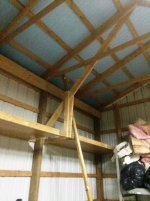

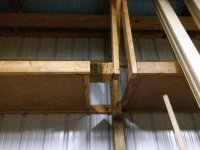

Last edited:
My dad had a pole shed put up 15 or 20 years ago. He was told they keep the wind from racking the structure. Call it a secondary brace. Now the shed him and I built 30 years ago using the same method, didn't call for them. Talk to shed contractors in the area. The way those braces are nailed to the face of the poles, not doing much!
Sent from my SAMSUNG-SM-G870A using Tapatalk
Sent from my SAMSUNG-SM-G870A using Tapatalk
Thanks for the replies guys. And thanks Lake for fixing my photos, I can see how some would mistake the rotated ones for a ridge beam.
I can absolutely see that if they had some type of proper fastner. But as it stands each one of those boards is held up by seven nails and I don't think a few boards like that will prevent anything! But I think Lake cleared up the confusion.
For the record - No I did not put up, nor would I ever, those horrible shelves. I agree about the pillows and joked with a few folks I have had over that I measure their capacity in grahams. They will be coming down along with the rest of the **** the PO did...
I'll start a thread in the gallery for those that are interested and show some of the other handy work this guy did. No joke, I had an electrician come over to look at getting more power out there and he apologized but ask if he could take photos of some of this handy work to send to his buddies. And he didn't even take one of the shelves haha.
-Clint
My dad had a pole shed put up 15 or 20 years ago. He was told they keep the wind from racking the structure.
I can absolutely see that if they had some type of proper fastner. But as it stands each one of those boards is held up by seven nails and I don't think a few boards like that will prevent anything! But I think Lake cleared up the confusion.
For the record - No I did not put up, nor would I ever, those horrible shelves. I agree about the pillows and joked with a few folks I have had over that I measure their capacity in grahams. They will be coming down along with the rest of the **** the PO did...
I'll start a thread in the gallery for those that are interested and show some of the other handy work this guy did. No joke, I had an electrician come over to look at getting more power out there and he apologized but ask if he could take photos of some of this handy work to send to his buddies. And he didn't even take one of the shelves haha.
-Clint
The Tool Tyrant
ALLIANCE MEMBER
They ARE preventing racking in the direction of the trusses. The diagonal brace opposite the wind direction would be in compression and vice-versa. If they were meant to be temporary, They most likely would have been nailed to the side of the post rather than taking time to place an angle cut on them. Personally, I would add a Simpson A35 angle clip at the brace to post connection and leave them. They may not be 'attractive' but they look better than a building laying flat on the ground. 'FORM FOLLOWS FUNCTION'
I have to respectfully disagree with Lake as to the diagonals being added later by the hideous shelf builder as he could have easily ran the vertical shelf supports up to the trusses and attached them there.
I have to respectfully disagree with Lake as to the diagonals being added later by the hideous shelf builder as he could have easily ran the vertical shelf supports up to the trusses and attached them there.
Last edited:
ard
Well-known member
I would NOT assume that just becuase they were added later, that taking them out is 'OK'....
Especially if the initial construction wasn't engineered to begin with....
I'd start with the location, what is required for roof loads, what roof you have, whether or not the exsiting framing members will support that load. THEN decide what you can take out.
Especially if the initial construction wasn't engineered to begin with....
I'd start with the location, what is required for roof loads, what roof you have, whether or not the exsiting framing members will support that load. THEN decide what you can take out.
lakeroadster
Well-known member
I think you've gotten some good advice from the guys above.
Don't remove the diagonal braces unless the original engineering shows that they are not required.
Check with the county. If the barn was built with a permit they will have the original drawings.
Your bracing... looks like the bracing here:

Link: http://www.apmbuildings.com/Graphics/Glossary/lateral-truss-bracing-lg.jpg
Don't remove the diagonal braces unless the original engineering shows that they are not required.
Check with the county. If the barn was built with a permit they will have the original drawings.
Your bracing... looks like the bracing here:
Link: http://www.apmbuildings.com/Graphics/Glossary/lateral-truss-bracing-lg.jpg
Attachments

rburke65
Well-known member
I have a 32' X 40' X 8' poke barn and the builder installed these braces on my trusses. Trusses were 8' on center. Been standing for ..?..35 years.
manwithtools
ALLIANCE MEMBER
They ARE preventing racking in the direction of the trusses. The diagonal brace opposite the wind direction would be in compression and vice-versa. If they were meant to be temporary, They most likely would have been nailed to the side of the post rather than taking time to place an angle cut on them. Personally, I would add a Simpson A35 angle clip at the brace to post connection and leave them. They may not be 'attractive' but they look better than a building laying flat on the ground. 'FORM FOLLOWS FUNCTION'
I have to respectfully disagree with Lake as to the diagonals being added later by the hideous shelf builder as he could have easily ran the vertical shelf supports up to the trusses and attached them there.
Rodger that, I thought the same thing earlier, but was to lazy to type it. My 30 x 40 has very similar braces. They resist racking when the wind blows against the long side of the building. Many different construction methods in the pole building industry.
Mine are 10' on center.
Ok I hear what you all are saying. What I am struggling with is that I cannot imagine any engineer would say toenail a 2x8 wtih three nails to your posts, every other truss and that will keep your building from racking.
If they were not connected to my truss I could pull the board and three nails out with one hand, hell gravity would pull them down?
I genuinely want to understand this and am not trying to start a debate or anything. But when you guys that are saying it absolutely is preventing my building from racking are you saying that as it is? That the three nails in the three boards on each 40' wall are enough to keep my building from collapsing? Or are you saying that, were they properly fastened to the posts, they would keep it from collapsing?
At the end of the day I'm going to see if I can pull the permit and plans, as was recommended above. But I still feel like I'm missing something and I'd like to understand what. Either way I appreciate you all taking the time to help me out here. The Journal is a great place!
-Clint
If they were not connected to my truss I could pull the board and three nails out with one hand, hell gravity would pull them down?
I genuinely want to understand this and am not trying to start a debate or anything. But when you guys that are saying it absolutely is preventing my building from racking are you saying that as it is? That the three nails in the three boards on each 40' wall are enough to keep my building from collapsing? Or are you saying that, were they properly fastened to the posts, they would keep it from collapsing?
At the end of the day I'm going to see if I can pull the permit and plans, as was recommended above. But I still feel like I'm missing something and I'd like to understand what. Either way I appreciate you all taking the time to help me out here. The Journal is a great place!
-Clint
stingry
Well-known member
I live in farming country and have seen a lot of pole barns. I’ve never seen this type of bracing. Side loading is taken care of by the fact that the poles are buried in the ground. I also agree with you that the few nails attaching the bracing to the upright post isn’t doing much of anything other than holding the brace to the post.
lakeroadster
Well-known member
.... If they were not connected to my truss I could pull the board and three nails out with one hand, hell gravity would pull them down?....
-Clint
Agreed. Toe nailing ***** as a structural attachment method. We used joist hangers for all the girts and purlins on my barn for that very reason.
Hey Clint, next time you are out in the barn look to see if the braces are nailed to the lower truss chord also. I'm curious?
mike93lx
ALLIANCE MEMBER
I'm not an engineer by any stretch, but wouldn't sheathing the gable ends with structural ply strengthen the building significantly?
lakeroadster
Well-known member
I'm not an engineer by any stretch, but wouldn't sheathing the gable ends with structural ply strengthen the building significantly?
The engineering is based on the steel sheathing on the building acting as a diaphragm, no need for plywood sheathing from a strength perspective.
mike93lx
ALLIANCE MEMBER
The engineering is based on the steel sheathing on the building acting as a diaphragm, no need for plywood sheathing from a strength perspective.
Ah, good point, i wasn't thinking about thr steel
manwithtools
ALLIANCE MEMBER
I live in farming country and have seen a lot of pole barns. I’ve never seen this type of bracing. Side loading is taken care of by the fact that the poles are buried in the ground. I also agree with you that the few nails attaching the bracing to the upright post isn’t doing much of anything other than holding the brace to the post.
Not all post buildings have the post buried in the ground. Mine sit on top of the concrete foundation. I suspect that the diagonal bracing on my barn were as much of a construction aid (holding posts and trusses square) as they are a needed brace now.
The toe nailing is likely to be sufficient to hold in compression, but not very good in tension. For instance, the east wall diagonal bracing would be resisting a west wind, the west wall brace not so much. I'll agree that toe nailing is not a good attachment method regardless the situation.
Last edited:
The Tool Tyrant
ALLIANCE MEMBER
I say...'Kiss my ****' to those that state that toe-nailing is not a good method of connecting lumber!
Take a 2X4 and place two 16D sinker toe-nails on each side, attaching it to another 2X and try to pull the 2X4 off by hand. Toe nailing has much better holding power in withdrawal than end nailing as the angle of the nails in toe-nailing resist each other.
Take a 2X4 and place two 16D sinker toe-nails on each side, attaching it to another 2X and try to pull the 2X4 off by hand. Toe nailing has much better holding power in withdrawal than end nailing as the angle of the nails in toe-nailing resist each other.
lakeroadster
Well-known member
I say...'Kiss my ****' to those that state that toe-nailing is not a good method of connecting lumber!
Take a 2X4 and place two 16D sinker toe-nails on each side, attaching it to another 2X and try to pull the 2X4 off by hand. Toe nailing has much better holding power in withdrawal than end nailing as the angle of the nails in toe-nailing resist each other.
I say "kiss your own ****".
All of the above *****... compared to hangers and structural screws.
The reality is toe nailed wood splits... and over time as the wood dries the strength of the joint decreases.
The problem is the nails are to close to the end of the board.
I say...'Kiss my ****' to those that state that toe-nailing is not a good method of connecting lumber!
Take a 2X4 and place two 16D sinker toe-nails on each side, attaching it to another 2X and try to pull the 2X4 off by hand. Toe nailing has much better holding power in withdrawal than end nailing as the angle of the nails in toe-nailing resist each other.
Toe nailing is not a good way to secure lumber. It’s a temporary or only if there’s no other way type of fastening.
The Tool Tyrant
ALLIANCE MEMBER
I say "kiss your own ****".
All of the above *****... compared to hangers and structural screws.
The reality is toe nailed wood splits... and over time as the wood dries the strength of the joint decreases.
The problem is the nails are to close to the end of the board.
Toe nailing is not a good way to secure lumber. It’s a temporary or only if there’s no other way type of fastening.
Yeah...what do I know?...32 years of framing experience...I guess I'm a slow learner.

Yeah...what do I know?...32 years of framing experience...I guess I'm a slow learner.
Lol I meet bad framers everyday. It happens. I’m a carpenter myself. Most “framers” are rushed and cut corners. Not saying you are.
rburke65
Well-known member
My 2x6s are not toe nailed to the posts. They are nailed to the sides of the posts. They, at least, appear to be a better way of joining the two pieces of lumber.
Thanks all for the replies. I've learned a lot from this thread.
Hey Lake,
There are three nails attaching the diagonal to my post and two each in the top and bottom chord of my truss.
My building does have the poles buried in the ground and the pad poured around them. No idea how deep they were buried or how much concrete is down there.
Thanks to Lake's picture he posted I did some searching and found the site it was hosted on and what they are called.
From http://www.apmbuildings.com/pole-building-glossary.shtml#.WnJcJd-nGUl

Since this says they should be nailed to the side of the post I'm believing the PO put them up. The only reason I have reservations is because the diagonals go all the way up to my top chord and this guy half-assed everything he did so I would suspect they would be nailed only to the bottom chord likely with finish nails or deck screws. Better fits his MO.
The other thing I was thinking is that the way they mitered the end to connect it to the post essentially gives the trusses a little mechanical advantage to rip them out vs if they were nailed to the side as some mentioned here and on ampbuildings.com.
If I can get the plans I'll know, but I'm guessing they aren't supporting anything save those rock star hanging shelves...
-Clint
Hey Clint, next time you are out in the barn look to see if the braces are nailed to the lower truss chord also. I'm curious?
Hey Lake,
There are three nails attaching the diagonal to my post and two each in the top and bottom chord of my truss.
My building does have the poles buried in the ground and the pad poured around them. No idea how deep they were buried or how much concrete is down there.
Thanks to Lake's picture he posted I did some searching and found the site it was hosted on and what they are called.
From http://www.apmbuildings.com/pole-building-glossary.shtml#.WnJcJd-nGUl
Knee Bracing - Used to tie the roof trusses to the posts of the building for additional stability. The knee bracing is nailed to the side of the post and angles up to meet and be nailed to the truss.
Since this says they should be nailed to the side of the post I'm believing the PO put them up. The only reason I have reservations is because the diagonals go all the way up to my top chord and this guy half-assed everything he did so I would suspect they would be nailed only to the bottom chord likely with finish nails or deck screws. Better fits his MO.
The other thing I was thinking is that the way they mitered the end to connect it to the post essentially gives the trusses a little mechanical advantage to rip them out vs if they were nailed to the side as some mentioned here and on ampbuildings.com.
If I can get the plans I'll know, but I'm guessing they aren't supporting anything save those rock star hanging shelves...
-Clint
lakeroadster
Well-known member
Hey Lake,
There are three nails attaching the diagonal to my post and two each in the top and bottom chord of my truss.....
-Clint
Thanks for the feedback Clint.
I find these braces problematic. They are changing the load pattern on the trusses since the braces nail to both the top and the bottom chords.
So in effect they are basically adding a web to the trusses.. but not on every truss, just some of the trusses. This makes for uneven loading.
I wonder if the truss manufacturer is aware of these braces being added?
Seems like a piss poor design.
Local farmer removed such braces because they were in the way of convenient hay stacking. Barn collapsed under a heavy snow. Not sure if it was an open ended barn though which would make them even more crucial.
Last week I was in my own pole barn during some wind gusts. I heard some creaking and found it was from the whole shop flexing in the wind. It was moving about 1/4 inch at six feet so probably moving 1/2 inch up at the 14 foot eave height. Mine doesn't have those braces.
Last week I was in my own pole barn during some wind gusts. I heard some creaking and found it was from the whole shop flexing in the wind. It was moving about 1/4 inch at six feet so probably moving 1/2 inch up at the 14 foot eave height. Mine doesn't have those braces.
tinysparky
Well-known member
- Joined
- Oct 22, 2016
- Messages
- 195
I was talking to my engineer about this. His comment....everyone is making a wild **** guess. Without knowing loads, exposure, wind, soil type, compaction, footing type, depth, roof material, underlayment if any, truss design and calcs, he thinks we are just guessing. He said lots of buildings could require that type of extra support. He would typically see it near the ends of a wall then half way...but he said every one is differwnt.
My garage journal vote is to leave them.
using Tapatalk....In Renton wa, and i can't change my location from the app......
My garage journal vote is to leave them.
using Tapatalk....In Renton wa, and i can't change my location from the app......