To avoid these ads, REGISTER NOW!

Do I really need copper or iron airlines?

radelow

Active member
Joined
Oct 11, 2009
Messages
39
Location
La Jolla, CA
My compressor is going to be mounted just outside my garage. The line to the interior fitting for the airtools around the car is around 3 feet (and then maybe 30 feet of hose for use around the car). My interior fitting for my bench is ~10 feet from the compressor (maybe 20 feet of line needed). Do I really need to run iron or copper for that or will the nylon tubing kits work (ie http://www.harborfreight.com/cpi/ctaf/displayitem.taf?Itemnumber=66747)?

I use compressed air for taking off lugs, small engine bay work, MAYBE some minor grinding. Compressor is a 30 gal Craftmans that, up to know, has suited me just fine. Thanks
 
To avoid these ads, REGISTER NOW!

boiler7904

Well-known member
Joined
Apr 4, 2006
Messages
3,414
Location
NW IN
Those systems will work but they don't offer advantages of metal piping such as heat dissipation. Along that same line, moisture tends to condense more in metal lines. To take advantage of those properties though, you'd really need to have longer lines. The other advantage of metal piping is that you can use a larger diameter and more volume for your tools. If it were me and given the length of your run, I'd upgrade to copper or iron pipe.
 

MattT

Well-known member
Joined
Feb 20, 2010
Messages
3,201
My compressor is going to be mounted just outside my garage. The line to the interior fitting for the airtools around the car is around 3 feet (and then maybe 30 feet of hose for use around the car). My interior fitting for my bench is ~10 feet from the compressor (maybe 20 feet of line needed). Do I really need to run iron or copper for that or will the nylon tubing kits work (ie http://www.harborfreight.com/cpi/ctaf/displayitem.taf?Itemnumber=66747)?

I use compressed air for taking off lugs, small engine bay work, MAYBE some minor grinding. Compressor is a 30 gal Craftmans that, up to know, has suited me just fine. Thanks

Without knowing what diameter that nylon is I can't say whether it'd work or not. For your current usage I'd use 1/2" OD 3/8" bore at a minimum. It's also worth keeping future upgrades in mind. Just because you've got a small compressor and low consumption tools now doesn't mean you won't upgrade in the future. Another thing if you go with nylon is that kit contains way more pipe and fittings than you need. Buying quality from McMaster, or another industrial supplier, would likely work out cheaper.

One advantage both copper and nylon have over iron is you can get away with one filter. With iron you need a filter at every outlet or rust flakes will trash your tools.
 

Abbott

Well-known member
Joined
Apr 29, 2009
Messages
1,684
Location
U.S.A.
I have 3 drops and I ran 1/2" rubber compressor hose to the wall mounted quick disconnects. It's working fine.
 

R6 Racer

Well-known member
Joined
Feb 21, 2010
Messages
1,632
Location
Northern Ontario Canada
Great Thread:
I have some questions along the same lines.
I am going to be getting a new compressor soon (the old one is to small, loud & old). Thinking about using an airline that I already have to plum 1 line into my wood shop 1 line to my garage workbench & 1 more to a hose reel.
Distances from comp to a splitter point 7', from the splitter to the wood shop will require 12' to the workbench 6' & to the hose reel 23 to 25'.
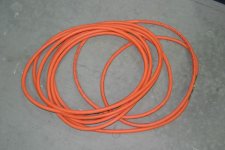
I was hoping to use the hose in the pic, have it cut & ends put on at a local hose place.
Can anyone tell me if this will work properly, is a good/bad idea?

I don't mean to hijack but I think it's the same type question.

Steve
 

Attachments

  • IMG_3857_1.JPG
    IMG_3857_1.JPG
    143.2 KB · Views: 34

Abbott

Well-known member
Joined
Apr 29, 2009
Messages
1,684
Location
U.S.A.
When I purchased my hose reel I replaced the 1/2" 50' hose that came with it for a much higher quality 1/4" hose.

I used the 50' of 1/2" hose from the hose reel to run two of my three drops. I cut the hose and clamped on fittings and I haven't had any problems with my setup.
 

tncatadjuster

Well-known member
Joined
Jan 3, 2010
Messages
1,988
Location
Memphis, TN
:+1:
I have 3 drops and I ran 1/2" rubber compressor hose to the wall mounted quick disconnects. It's working fine.

I was in a hurry and just used a quality hose from a manual shut off, plumbed about a foot off the tank with solid. Has worked for ten years.:)
 

rsanter

Well-known member
Joined
Dec 22, 2007
Messages
18,506
Location
visalia ca
no, you dont need the metal lines

I used hose from the compressor to the ceiling mounted hose reels and it has worked fine

in fact I dont understand the need/want for all the air piping. in my last house I installed some air lines and a hose reel. ended up only using the hose reel.
this garage I have 2 hose reels. done

bob
 

R6 Racer

Well-known member
Joined
Feb 21, 2010
Messages
1,632
Location
Northern Ontario Canada
For those who used air line/hose, did u have proper hose ends installed professionally, did u install proper hose ends yourself, or just use some kind of clamp? If u clamped ... what type of clamp?

Thanks
Steve
 

Kevin54

MEMBER EMERITUS
Joined
Jan 12, 2005
Messages
29,341
Location
Urbana, Ohio
For those who used air line/hose, did u have proper hose ends installed professionally, did u install proper hose ends yourself, or just use some kind of clamp? If u clamped ... what type of clamp?

Thanks
Steve

I've always made all of my own hoses up. You can get the barbed fittings, and the clamps go around the hose and have two tabs on them. You crimp the tabs down and are good to go. Here is a pic of the clamps and the tool to clamp them although you really don't need the tool. You can use various tools to improvise.

earclamp1.jpg


earclamp3.jpg
 

Dragster Racer

Well-known member
Joined
Feb 9, 2008
Messages
1,891
Location
Morrison, IL
Is that kit just PEX tubing? I was in a very nice shop recently that used 3/4" pex for the main lines,,pretty long runs. I didn't know HF had those kits. Maybe just online. I am picking up a compressor from them tonight, so I will look at them.
 

krooser

Well-known member
Joined
Jun 3, 2005
Messages
2,377
Location
Waupaca, Wisconsin
Iron helps cool the air and allows the moisture to drop out of the system... copper is right behind it. Keep your air tank and the drop legs drained and you'll have good, clean air... rumors of "rust flakes" are mostly just that... I've worked in shops with 30 year old black iron lines without any rust issues. I'm not saying it can't be a problem... but it won't be with a little maintenence.

My black iron pipe system is 9 years old... when I did my system I even used some used pipe that I had removed from a shop... no rust problems at all even without a filter.

As far as PVC goes...
 

Stuart in MN

Well-known member
Joined
Sep 8, 2005
Messages
23,075
Location
Minneapolis
For the short distances you're talking about (3 feet in one direction and 10 feet in the other), do you really need to plumb in hard lines? Just hook up a hose to the compressor and be done with it.
 

rsanter

Well-known member
Joined
Dec 22, 2007
Messages
18,506
Location
visalia ca
For those who used air line/hose, did u have proper hose ends installed professionally, did u install proper hose ends yourself, or just use some kind of clamp? If u clamped ... what type of clamp?

Thanks
Steve


I did the cheap and easy
barbed end and a hose clamp

bob
 

bdog

Well-known member
Joined
Oct 17, 2007
Messages
227
As said in the other posts it is all about cooling the air and removing moisture. At my old shop I was renting the place so I just used rubber hoses. I had them ran along the walls to various locations. It worked ok but I got a lot of water in the lines. I remember one day when I was using air tools a lot that my 1/2 impact was like a spray gun. A spray of water was coming out of the exhaust every time I pulled the trigger. Aside from being annoying it would be very difficult to do things like painting.

At my new shop I ran copper lines with drip legs, air outlets coming off the top of the pipes, etc and I get zero water at the tools. Another plus is I ran 3/4" copper and it runs about 150' around my shop and I get virtually no pressure drop even at the end of the run. I can tap into it at mutiple locations with a 25' hose and not have to deal with a long hose or pressure drops.

I guess the bottom line is whatever you use you will get air where you want it but you need to use metal lines if you want dry air.
 

Ex-Pat

Active member
Joined
Oct 29, 2009
Messages
43
Location
Mebane NC
For the short distances you're talking about (3 feet in one direction and 10 feet in the other), do you really need to plumb in hard lines? Just hook up a hose to the compressor and be done with it.

+1 on that That is how my barn has been for 10 years However in my Garage I used the blue RapidAir tubing kit that looks remarkably similar to the HF kit as my compressor is in the Attic space and I am happy with both setups
 
To avoid these ads, REGISTER NOW!

Abbott

Well-known member
Joined
Apr 29, 2009
Messages
1,684
Location
U.S.A.
As said in the other posts it is all about cooling the air and removing moisture.

I guess the bottom line is whatever you use you will get air where you want it but you need to use metal lines if you want dry air.

I haven't had any problems like that at all using rubber hose.

Barbed fittings and hose clamps here.
 

krooser

Well-known member
Joined
Jun 3, 2005
Messages
2,377
Location
Waupaca, Wisconsin
I used a rubber hose for a few months, too... until I got tired of using my good air tools with an air/water mixture. Maybe it won't matter if you only have HF air tools...
 

bdog

Well-known member
Joined
Oct 17, 2007
Messages
227
I haven't had any problems like that at all using rubber hose.

Barbed fittings and hose clamps here.

It really depends on how much you use the air and how much your tools consume. If it is ocassional light use you may not generate much moisture. If you are doing something where your compressor is continously running for a long time it is going to generate moisture.

If it is not a high volume use the air might have time to cool and the moisture condense out inside your tank.
 

dfndr

Well-known member
Joined
Jul 8, 2008
Messages
373
Location
Fresno, CA
I am no expert at all. My buddy who is an expert mechanic and LPG gas engineer uses 1/4 inch yellow flex tubing with quick couplers for his large collection of air tools AND a HF sand blast cabinet with 125 psi HF compressor and short run distances. NO PROBLEMO AT ALL. When I bought my compressor he wired and plumbed it the same way. The only problem is all my other friends telling me my tubing is too small--but it works just fine. That's my experience, for what little it's worth. Rick
 
Last edited:

benjamming

Well-known member
Joined
Jun 29, 2009
Messages
899
Location
Alabama
dfndr,

Well, with a 125 cfm compressor I wouldn't think he would have any problems running a multitude of tools. Obviously, it's a 3 phase unit as well - 50 HP?
 
OP
R

radelow

Active member
Joined
Oct 11, 2009
Messages
39
Location
La Jolla, CA
Thanks everyone for the advice. The only true answer seems to be there are multiple answers!!!!

I am going to research the cost to implement black pipe and do that if it isn't too difficult. If not I am going to go with the soft piping setup.
 

MrMark

Well-known member
Joined
Jan 25, 2010
Messages
4,626
Location
Southern Cal.
It really depends on how much you use the air and how much your tools consume. If it is ocassional light use you may not generate much moisture. If you are doing something where your compressor is continously running for a long time it is going to generate moisture.

If it is not a high volume use the air might have time to cool and the moisture condense out inside your tank.

This makes a lot of sense.

I am considering either an aftercooler or a refrigerated dryer and I am trying to go thru all the questions of which would work best for me.

I can't run cooper line all over the place to create a cooling system because it doesn't make sense for me. I only want one drop. I want a filter/regulator on the wall and a quick connect to plug in an air hose. That's it. But I need to get the water to condense out of the air before it hits that filter and a length of rubber hose isn't going to get that done. I imagine a coil of cooper would get it done but it would have low spots in it that would not drain.

Even if you could rig a coil of cooper without low spots, like in a spiral vertical spring configuration, you are still going to need cooling fins and a fan to make the most of it. Of course, you could mount it in an ice chest and fill it with ice and have the baddest *** water separator of all time. Maybe for the home mechanic to paint a car this would be the best ever. But for occasional air tool use, impractical.

There is a device called the Astrocooler that would be ideal for my application, but it is ridiculously overpriced.

This leads me to the refrigerated dryer which can be obtained more cheaply, but need to be run for a while before use and consume too much electricity to leave running when not in use, which will be 99 percent of the time. The other problem I see with the refrigerated dryer is that the inlet air temp is usually limited to around 120 degrees. I would be feeding the dryer almost straight out of my compressor tank and I am concerned about the temp. It seems to me that the temp of the air out of the tank would be quite high on a high demand application and that is where you really need the cooling and water separation post tank.

If low demand, I am thinking that most of the water will condense out at the tank and not be a problem for most applications. After all the tank is a giant expansion vessel and the air will rapidly expand and cool as it hits the tank. I would be interested in any information on the temperature drop of the air at the tank.

I would also be interested in anyone who has an IR temp gun and a metal piped system to take a temp reading on the air coming out of the compressor tank and then again at a remote metal piped air drop. I would like to see how much the metal pipe system you have drops the temp as this is its measure of efficiency. Might as well take the temp out of the pump head as well for a total picture of what is going on.

So what is the best way to deal with this situation, where I just want a short whip hose to some sort of device, to cool the air and then to the filter/regulator? I mean the people that run the cooper all over their garage are essentially creating a poor man's aftercooler is all, so my thinking is that for those that do not need the drops located all over the place, let's use a real aftercooler or dryer and not the cluge cooper piped aftercooler.

Does this make sense?

Comments?
 
Last edited:

MrMark

Well-known member
Joined
Jan 25, 2010
Messages
4,626
Location
Southern Cal.
Maybe where I am going with this is that I would need some form of an aftercooler (either real or cluge pipes running on the wall) to get the temp down for the refrigerated dryer. If that is the case, it leads me to think that the aftercooler (radiator with fan) is basically what I need and to ditch the refrigerated dryer idea (with its attendant cost of operation and problem of starting it ahead of actual use) and just go with the aftercooler and a point of use dessicant when doing some painting?

I just can't find a decent and reasonably priced aftercooler. And if I were to try to make one out of an oil cooler and a fan by the time I got done I would probably have as much in it as a manufactured unit at much lower efficiency. So if anyone knows of something like that Astrocooler that is reasonable that would be great.

I really like the aftercooler because it would be cheap to run (just a fan motor) and I could rig it to come on and off with the compressor IF mounted between the pump and tank OR if it was installed post tank I could just switch it on when I wanted to use air.
 
Last edited:

tncatadjuster

Well-known member
Joined
Jan 3, 2010
Messages
1,988
Location
Memphis, TN
I used a rubber hose for a few months, too... until I got tired of using my good air tools with an air/water mixture. Maybe it won't matter if you only have HF air tools...

It won't matter if it's not producing moisture either. I've never had a problem, I do drain the tank every friday at noon though.:beer:
 

MrMark

Well-known member
Joined
Jan 25, 2010
Messages
4,626
Location
Southern Cal.
Another thing I want to discuss with the aftercooler setup where the aftercooler is mounted between the pump and the tank, an ideal setup IMO, is does it make the most sense to separate out the condensate BEFORE it goes into the tank, so as to keep the tank dry, or to just let the water run into the tank and use an auto drain.

If separating out the water BEFORE it hits the tank, what is the best approach. Just a water separator or filter OR a drip leg/filter combination and the drip leg would probably have to have some sort of auto drain if the bulk of the water went in the drip leg, or if the bulk of the water flew over the drip leg and into the filter then the filter would have to have some autodrain. Probably only experimentation would reveal the answers here. Right?
 

swharris

Well-known member
Joined
Jan 10, 2010
Messages
403
Location
So. Cal.
People need to remember that if water is a concern, the heat the compressor generates is really the first issue you need to address. A larger SLOWER running compressor will produce less heat and therefore less water (relative to the ambient humidity) condensed out of the compressed air.
 

MrMark

Well-known member
Joined
Jan 25, 2010
Messages
4,626
Location
Southern Cal.
Very true. That is certainly an important design criteria. But, I am trying to deal with a situation where we might have a compressor that is occasionally called upon to work hard. In my case, it doesn't make sense to buy a huge compressor when it isn't going to be needed for my applications. I just want to create a setup where when it does get pushed, that the water issue is taken care of.

Typical usage would be air tools of good quality that I want to last a lifetime and not just toss them when moisture laden air ruins them, and maybe a small paint job.
 

Abbott

Well-known member
Joined
Apr 29, 2009
Messages
1,684
Location
U.S.A.
It really depends on how much you use the air and how much your tools consume. If it is ocassional light use you may not generate much moisture. If you are doing something where your compressor is continously running for a long time it is going to generate moisture.

If it is not a high volume use the air might have time to cool and the moisture condense out inside your tank.

Yeah, mine is intermittent personal use.
 

tncatadjuster

Well-known member
Joined
Jan 3, 2010
Messages
1,988
Location
Memphis, TN
Now to think of it I have never used the air hose for painting, I have a separate HVLP rig that I use around the shop for painting.

I do have a cheap regulator/separator that is at the end of the hose. I have never had moisture at a tool to where it was an issue.

Go with pipe and know that it is the best.:thumbup:
 

MrMark

Well-known member
Joined
Jan 25, 2010
Messages
4,626
Location
Southern Cal.
I just moved my questions/comments to a new thread more appropriately titled. Please put any comments re the air dryers over in that new thread. Thanks.
 

mad57

Well-known member
Joined
Jan 30, 2009
Messages
1,698
I just returned the black pipe i bought for my garage and got the copper pipe, after wasting one 10ft lengh of pipe its from the homie depot and was out of round and thin walled then thick , cut for **** even with new cutters, so i bought the copper. even that was bent to hell but work able. just my 2 cents.
 

MrMark

Well-known member
Joined
Jan 25, 2010
Messages
4,626
Location
Southern Cal.
Yeah, the black pipe never made sense to me. The stuff you can buy is all made overseas and the pipe does not thread well. I have been told by a plumber that I respect that the reason is the pipe hardness is not uniform. In other words, it's not the threading machine, it's the pipe. In any event, black pipe is harder to work with, looks bad, rusts internally, and will be difficult to get to seal well enough to withstand high pressures. It is also difficult to deal with a mid point leak obviously and it is just as difficult to add to it in the middle. Not much reason to use to in my opinion. Cooper is much cleaner and nicer to install if you can solder well. I would suggest practice and reading the soldering section of the Copper Handbook. It explains the proper technique for troublefree joints.
 
To avoid these ads, REGISTER NOW!
Top Bottom