To avoid these ads, REGISTER NOW!

Do they make an open circuit finder?

atikovi

Well-known member
Joined
Feb 14, 2009
Messages
2,103
Location
Suburban Washington DC
I remember seeing a primitive analog short circuit finder years ago that you move along the wiring harness and the needle would move right or left at the short. Is there a modern electronic tool for finding open circuits?

I'm working on the electronic suspension of a car and there is an open circuit in the harness between a front wheel position sensor and the control module all the way back in the trunk.
 
To avoid these ads, REGISTER NOW!

short4stuff

Well-known member
Joined
Dec 7, 2014
Messages
108
I always use a multimeter....

Does the same thing, you'l know when you pass the open the meter will show continuity
 

short4stuff

Well-known member
Joined
Dec 7, 2014
Messages
108
... an ohm meter, check the resistance of the circuit.


I know this isn't what you were asking for, but I've never heard of anything else.
 

bushmechanic

Well-known member
Joined
Mar 17, 2014
Messages
4,820
With the master combo kit, the Power Probe III can pinpoint just about anything.

It's not super cheap, but as a diagnostic tool, it's fast, easy and generally outstanding all around.

You don't need the ECT-2000 kit included here, but you'll have that fancy capability you want; without having to probe the wire length to find the fault location; even if that's fairly easy.

This just makes it faster and more convenient.

http://www.amazon.com/Power-Probe-PPKIT03-Master-Test/dp/B003QHDLEQ
 

SantaAna12

Well-known member
Joined
Mar 1, 2012
Messages
1,091
Yes bcradio.

AFAIK...reading footage to that close of an open.....nope.
You can use a tone generator and a probe.
 

shawhite

Well-known member
Joined
May 28, 2014
Messages
1,519
in the electronics world we use TDRs to find opens. You can just as easily find one with a tone and amplifier. Put the tone one one side follow the wire with the amplifier until you loose the tone.
 

DonPowers

Well-known member
Joined
Dec 7, 2014
Messages
4,398
Location
On The Hair At The End Of The Dog's Tail
Last edited:

Beemer533

Well-known member
Joined
May 9, 2014
Messages
2,057
Location
Syracuse, NY
I can verify , but I seem to recall testing it out when I first got it using pretty short (<10') lengths..
 
Last edited:

bushmechanic

Well-known member
Joined
Mar 17, 2014
Messages
4,820

That's a similar setup as the 2000, but the Power Probe kit includes that, as well as the Power Probe, and pretty much every accessory they offer for only $60.00 more, give or take a few bucks.

I'd take the setup I linked any day. I've got a Power Probe III, and it's about the best thing for general diagnostics I've ever used; very versatile, and operates via vehicle power, so it's usable anywhere in the world, regardless of how screwed you are.

As long as you've got a functional battery, it'll help you find pretty much anything in far less time than a multi-meter, and that matters when you're up to your ankles in mud or snow somewhere remote, either freezing your *** off or sweating bullets.

Now that I've got one, I wouldn't go without it.
 
To avoid these ads, REGISTER NOW!
OP
A

atikovi

Well-known member
Joined
Feb 14, 2009
Messages
2,103
Location
Suburban Washington DC
I can verify , but I seem to recall testing it out when I first got it using pretty short (<10') lengths..

I'm looking at their users manual http://www.psiber.com/pdf/ct50_b_user.pdf and on page 3 under OPERATION it says, Clip one test lead to each of two conductors of the cable to be tested. Well that wont work if I'm checking just a single wire.
 

Beemer533

Well-known member
Joined
May 9, 2014
Messages
2,057
Location
Syracuse, NY
Really I think you just need 2 wires of the same length and type. You would just use the broken wire and another wire in the same harness.

As an example I grabbed a length (about 18') of cat5 and stripped 2 wires (grn and w/b) and the meter read 17'.. Then I picked a random spot and cut the w/b wire.. The meter dropped to 4'.

I didn't put a tape on it, but it is within a few inches.

This post edited by the NSA
 
Last edited:

SantaAna12

Well-known member
Joined
Mar 1, 2012
Messages
1,091
Nice!

The use of a similar known good conductor as a stand in is a good one to pick up.

Thanks for that link. I am going to look at it at length later.
 

afbrian13

Well-known member
Joined
Nov 23, 2014
Messages
163
We use TDRs at work over hundreds of feet of wire. They'll get you close, but not the exact spot. On a car just use a meter.

For shooting continuity, just disconnect both ends and put a jumper between the suspect wire and a known good wire. You dont need an extra wire that runs the distance.

Open the circuit at different points and shoot it both directions, one way will be good, the other wont. Split the bad side and do it again, you'll narrow it down. Just check suspect chaff areas first.
 

SantaAna12

Well-known member
Joined
Mar 1, 2012
Messages
1,091
Yes....that kind of isolation method is one way to do it.

Amplifier and probe is another.

Being able to measure footage.....reliably......to an open blows both other methods away.
 
OP
A

atikovi

Well-known member
Joined
Feb 14, 2009
Messages
2,103
Location
Suburban Washington DC
Really I think you just need 2 wires of the same length and type. You would just use the broken wire and another wire in the same harness.

Here is what I'm working on, the right front suspension position sensor circuit as circled. The center wire 1213 is open somewhere between the sensor connecter X180 by the wheel and the module connector in the trunk over 10 feet away. (Module connector not illustrated in diagram.) Would this tool help find the break?

large.jpg
 

Fretters

Well-known member
Joined
Jan 25, 2014
Messages
4,217
Location
South Yorkshire, England
When you pass the open, the meter won't show continuity as an open circuit is not continuous.

I think the method he's referring to is hooking one probe to one end of the wire and then probing backwards along the length from the other end until continuity is found. It's horses for courses which way you do it. Backwards, forwards, continuity or loss of, it all ends up at the same point.
 

Beemer533

Well-known member
Joined
May 9, 2014
Messages
2,057
Location
Syracuse, NY
Here is what I'm working on, the right front suspension position sensor circuit as circled. The center wire 1213 is open somewhere between the sensor connecter X180 by the wheel and the module connector in the trunk over 10 feet away. (Module connector not illustrated in diagram.) Would this tool help find the break?

I don't see why not. I would hook up to 1212 and 1213 and you should be good.

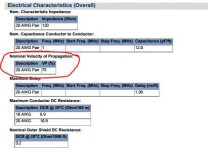
Keep in mind, the way these devices work is that they need the Velocity of Propagation (http://en.wikipedia.org/wiki/Velocity_factor) of the wire to determine the length to an open/fault.

What this means is that you will need to get as close as you can, either with a manufacturers data sheet (see the photo), or at least a similar wire. The unit has a library of cable types in it so that might work fine.

The other thing is that if you hook it up to the known good wires and you have a good idea of their length, you can just tweak the settings until it reads the correct distance. Then hook up to the broken wire and you should see the length reduced to the fault...

If you were a bit closer, I'd be happy to give you a hand!
 

Attachments

  • Vp of belden wire.JPG
    Vp of belden wire.JPG
    31.5 KB · Views: 25
Last edited:
OP
A

atikovi

Well-known member
Joined
Feb 14, 2009
Messages
2,103
Location
Suburban Washington DC
I picked up a used Cable Tool off Ebay from a local seller and bought a Power Probe Master set from a tool warehouse. Going to start with the Cable Tool. What NVP category they list should I use for automotive wiring? I'm guessing speaker wire at 67 would be close?
 

short4stuff

Well-known member
Joined
Dec 7, 2014
Messages
108
what year and model is this vehicle your working on? looks like a gm diagram.
Alot of times its quicker to run a new circuit.
 
OP
A

atikovi

Well-known member
Joined
Feb 14, 2009
Messages
2,103
Location
Suburban Washington DC
Found the problem with the Cable tool. Started with the module connector in the trunk and all 3 wires showed 21 feet. Figured that meant the problem was all the way at front. Tested the sensor connector and got 21 feet on 2 wires and just 1 foot on the third one. After peeling back the cover on the harness, it looks like someone put on a replacement pigtail connector without even soldering the wires. Cleaned up and soldered the wires and I get 21 feet on each one.

Cool tool but as I understand it, you need at least 2 wires in the harness both going to the same place for it to work. Might not be ideal in an automotive environment where one of the wires may branch off.
 

toplessHO

Well-known member
Joined
Oct 20, 2014
Messages
14,146
Location
central florida
in a pinch you can get some of the good self healing piercing probes for a multimeter
and do as other have said. Only difference is theres no cutting and splicing.PVC covered
wire can be sealed with PVC glue.
 
OP
A

atikovi

Well-known member
Joined
Feb 14, 2009
Messages
2,103
Location
Suburban Washington DC
in a pinch you can get some of the good self healing piercing probes for a multimeter
and do as other have said. Only difference is theres no cutting and splicing.PVC covered
wire can be sealed with PVC glue.

Wiring harness is behind panels, under carpets, above headliners. Not possible without hours taking car apart just to expose the harness. Then you have find the exact wire out of 50 others in the bundle.
 
To avoid these ads, REGISTER NOW!
Top Bottom