
You are using an out of date browser. It may not display this or other websites correctly.
You should upgrade or use an alternative browser.
You should upgrade or use an alternative browser.
do we still need 220/240 volts any more?
- Thread starter Jim1932
- Start date
Lassen Forge
Well-known member
Twice the current for much les penetration. And without 220 my heater wouldn't work, my compressor would be dead in the water, and, face it, if we were in europe, I wouldn't have lights or a coffee maker.
The 110 units work if you do nothing more than minor household repair type, sheet metal and thin steel work. If you plan on doing anything more than that, then you need the extra voltage.
The 110 units work if you do nothing more than minor household repair type, sheet metal and thin steel work. If you plan on doing anything more than that, then you need the extra voltage.
American Locomotive
Well-known member
The modern inverter units can stretch 120v power further than the old transformer welders could, but if you want to do any heavy cutting with a plasma cutter, or thicker sustained welding, you will absolutely need 240v.
The 125-140A class 120v MIG welders can do decent work, but they will trip 20A breakers like clockwork if you try welding with them at max power.
The 125-140A class 120v MIG welders can do decent work, but they will trip 20A breakers like clockwork if you try welding with them at max power.
dcg9381
Well-known member
The 120V welders are not worth a darn. I'd assume the same for plasma. Yes, they are that much better. If you're planning on doing any sort of work, don't bother with 120v.
Gunfixr
Well-known member
I have a 120 volt welder and plasma cutter. Having used 240 volt industrial welders and plasma cutters, I can tell you they are not the same.
The 120 volt stuff is fine for light work, but that's it.
The 120 volt stuff is fine for light work, but that's it.
theoldwizard1
Well-known member
I wish 240v was more common. Do the folks in EU have the wide array of outlets we have ?
American Locomotive
Well-known member
More or less. They have 16/32/63A industrial plugs, available in a wide variety of voltages and phase configurations.

 en.wikipedia.org
IEC 60309 - Wikipedia
Terry D
Well-known member
120 volt welders are limited. Sheet metal and thin steel. If that's all you plan on doing, then 120 volt will work. But anything over 3/16 to 1/4, and that may be pushing it, your going to need 240 volt. Run a 240 circuit, and get a multi voltage welder. If you ever had to take it out to a job, it will still run on 120 volt
Last edited:
Lassen Forge
Well-known member
My Miller 211 will run 120 or 240, and switches automatically... it seems to hum along a LOT smoother and sweeter on 240 than 120.
For me the 120 option was in case I had to power it off a generator... but it also makes it kind of plug and play around the property when needed. But it's much happier digesting the higher voltage.
For me the 120 option was in case I had to power it off a generator... but it also makes it kind of plug and play around the property when needed. But it's much happier digesting the higher voltage.
Wrench97
Well-known member
I had a old 120v Miller mig at work, it worked great for what I wanted it for, welding roll up dock doors and track, trailer door track, truck body sheet metal. It great because of the portability of existing 120v outlets and light duty work for anything heavier we had the 240/440v stick welder in the shop. If I had to choose only one machine it would be a 240v model.
rburke65
Well-known member
You can picture voltage like water pressure. There are times when you need more pressure for a given task.
Innovate1
Well-known member
Who says "house current" is 120V? Seems like an odd, made up association. Just saying... But it sounds like you are on the right track.
Mr_fixit
Well-known member
my compressor, plasma cutter, lift and welder require 240 volts . So, for me 240 is an absolute requirement. For you, who knows... I'm welding or cutting 1/4 to 1/2 inch steel or aluminum. And a small compressor won't power most automotive air tools.
Gunfixr
Well-known member
I'm gonna need 240 in the garage, unless I never want to use the compressor, lathe, or tig welder again.......
Syberia
Well-known member
Can't run a 24k mini split on 120v, and our two cars would charge awfully slowly...
It's always better to have and not need, than to need and not have.
It's always better to have and not need, than to need and not have.
nadogail
Well-known member
Given the choice, you will be much better off having 220/240 available.
An S-10 Chevy will haul freight, but a Kenworth will haul more.
An S-10 Chevy will haul freight, but a Kenworth will haul more.
marinusdees
Well-known member
Is this a real question??Given the choice, you will be much better off having 220/240 available.
An S-10 Chevy will haul freight, but a Kenworth will haul more.
Is this a real question??I am looking at wiring my garage. I see a lot of welders and plasma cutters running on house current. Are the 220 that much better?
mrjaw14
Well-known member
Decent compressors are 240 also once you get into the 60+ gallon ones
Right, that was the other item I was missing. I am obviously not a welder or a body man, but I believe in planning ahead. I am hoping to have a number of car builds in my future....Decent compressors are 240 also once you get into the 60+ gallon ones
bad_idea
Well-known member
I wired my garage last year with plenty of spare slots in the panel. I also still have open studs, so it is easy to run new circuits. I find 240v is better for any tool that gives the option of 120v or 240v, as I can get away with smaller wire.
SilverJimmy
Well-known member
You also want to make sure you have enough amperage. My contractor cheated out and only wired my shop with 30 amp 220v outlets, now when I want to do something heavy duty, like weld some 3/8” thick aluminum with my Miller TIG welder, I have to run a 50 amp extension cord. Would have cost nothing during construction, now will cost big $$$$ to fix after the fact!
Chapter21
Well-known member
If you take away nothing from this thread at least take away this:
Do not ever say "house current" or "220" again. Those are not things. Those are not terms. That is not a thing people say. That is not how electricity works. 220 volts is not available at your house. If you hear anybody using those words do not let them touch your wires.
That's like saying "tree wind" or "road rocks" or "toothpaste eats the chicken I want to go to Arby's"....it makes no sense. This is like asking what tires to get for your first car...when you're 9 and you don't know how tires work.
Do not ever say "house current" or "220" again. Those are not things. Those are not terms. That is not a thing people say. That is not how electricity works. 220 volts is not available at your house. If you hear anybody using those words do not let them touch your wires.
That's like saying "tree wind" or "road rocks" or "toothpaste eats the chicken I want to go to Arby's"....it makes no sense. This is like asking what tires to get for your first car...when you're 9 and you don't know how tires work.
If you take away nothing from this thread at least take away this:
Do not ever say "house current" or "220" again. Those are not things. Those are not terms. That is not a thing people say. That is not how electricity works. 220 volts is not available at your house. If you hear anybody using those words do not let them touch your wires.
That's like saying "tree wind" or "road rocks" or "toothpaste eats the chicken I want to go to Arby's"....it makes no sense. This is like asking what tires to get for your first car...when you're 9 and you don't know how tires work.
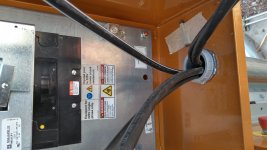
I'll just leave this here...
Attachments
American Locomotive
Well-known member
This gets beaten to death multiple times per week.
Yes, technically North America uses a 240v split-phase system. However, it was originally 110/220v until the 1930s. As a result, tons and tons of installed equipment had data-plates identifying their system voltage as 110v, and all of the electricians of the day would identify it as 110/220. Some of that equipment is still in operation today! While most of the electricians of that era have since long died, their children, and their grand children are still alive. Those people would have grown up hearing dad and grand-dad call it 220v - even as system voltages crept upwards to first 230v, and then later 240v.
"110/220" is an established colloquialism for our "120-240v split-single-phase three-wire system". Likewise "household current" is a colloquialism that usually means standard 120v AC power. Every single time one of these threads comes up (which is multiple times per week), the OP always gets corrected. We clearly ALL know what the OP is talking about, and 110/220 shows up so frequently that it CLEARLY is an established colloquialism. We have multiple people post pointless diatribes every single time someone utters the phrase "110/220". A simple "FYI: 110/220 is now technically 120/240" at the end of a post would be more than sufficient
This is not an IEEE, IEC or NFPA/NEC industry technical discussion forum where being that precise would matter. It's a garage and tool forum. Use the language that garage and tool people use - which clearly includes a ton of people that use the phrase "110/220".
Yes, technically North America uses a 240v split-phase system. However, it was originally 110/220v until the 1930s. As a result, tons and tons of installed equipment had data-plates identifying their system voltage as 110v, and all of the electricians of the day would identify it as 110/220. Some of that equipment is still in operation today! While most of the electricians of that era have since long died, their children, and their grand children are still alive. Those people would have grown up hearing dad and grand-dad call it 220v - even as system voltages crept upwards to first 230v, and then later 240v.
"110/220" is an established colloquialism for our "120-240v split-single-phase three-wire system". Likewise "household current" is a colloquialism that usually means standard 120v AC power. Every single time one of these threads comes up (which is multiple times per week), the OP always gets corrected. We clearly ALL know what the OP is talking about, and 110/220 shows up so frequently that it CLEARLY is an established colloquialism. We have multiple people post pointless diatribes every single time someone utters the phrase "110/220". A simple "FYI: 110/220 is now technically 120/240" at the end of a post would be more than sufficient
This is not an IEEE, IEC or NFPA/NEC industry technical discussion forum where being that precise would matter. It's a garage and tool forum. Use the language that garage and tool people use - which clearly includes a ton of people that use the phrase "110/220".
Worsedog
Well-known member
 Thank you.
Like it or not, the use of 110, 220, 440, is ignorant as they are obsolete voltages & if you don't know what you are working on, you really have no business doing electrical.
As to dropping 120 volts, you can blame that on Edison's 110V, DC, when Tesla, & Westinghouse were introducing alternating current, Edison's DC was only supplying lighting & incandescent lamps did not care if if it was AC, or DC, they had to match the 110V being supplied by Edison's grid, so when the rest of the world was ready to electrify, 110V was a legacy system here, & they went with AEG's 220V system, 415Y/240V would be much simpler, but that ship sailed long ago.
As to dropping 120 volts, you can blame that on Edison's 110V, DC, when Tesla, & Westinghouse were introducing alternating current, Edison's DC was only supplying lighting & incandescent lamps did not care if if it was AC, or DC, they had to match the 110V being supplied by Edison's grid, so when the rest of the world was ready to electrify, 110V was a legacy system here, & they went with AEG's 220V system, 415Y/240V would be much simpler, but that ship sailed long ago.
Chapter21
Well-known member
220 vs 240 is a common (but very ignorant) thing to say. "House current" is not a thing people say. Or that exists. If somebody says that, they shouldn't even be plugging something in. They aren't referring to "current", and I've never in my life seen something rated for "house volts", because that is not a thing, and never was. Pretty much every home has both 120v and 240v things inside, and your garage and house always use the same electricity. None of this of course has anything to do with the current. You could make the argument 220 was a thing, "house current" never, ever, ever was...
Do you call the stuff in the garage "garage current"? Of course not, that would be stupid...
Stop saying that! It's not OK just because somebody else said it wrong. If you don't want the electrician to rip you off, or the guy at Home Depot to think you are a complete *****, at least use roughly the correct terminology. This isn't even close. With the availability of google, ignorance is not an excuse. 220 is roughly close, house current is another planet.
I have a feeling anybody asking about "house current" has no need for a welder - first they need to know what amps and volts and DC vs AC is. As I said, this is a learning experience, now you know, now you can stop saying that.
Not everybody needs to be perfect, you don't need to know how a 3 phase panel works or how to wire a transformer...but for god sake stop saying house current unless there happens to be a river flowing through your house.
Do you call the stuff in the garage "garage current"? Of course not, that would be stupid...
Stop saying that! It's not OK just because somebody else said it wrong. If you don't want the electrician to rip you off, or the guy at Home Depot to think you are a complete *****, at least use roughly the correct terminology. This isn't even close. With the availability of google, ignorance is not an excuse. 220 is roughly close, house current is another planet.
I have a feeling anybody asking about "house current" has no need for a welder - first they need to know what amps and volts and DC vs AC is. As I said, this is a learning experience, now you know, now you can stop saying that.
Not everybody needs to be perfect, you don't need to know how a 3 phase panel works or how to wire a transformer...but for god sake stop saying house current unless there happens to be a river flowing through your house.
Last edited:
TractorJeff
Well-known member
This is where a Thread goes down the Toilet!
23 Posts till the 110/220 Rant started!
The Correct Police must have been busy someplace else!
LOL!
23 Posts till the 110/220 Rant started!
The Correct Police must have been busy someplace else!
LOL!
bob15
Well-known member
240 in the garage can be used for: air compressor, welder (stick, mig, tig, plasma), drill press, table saw, lathe, etc
bob15
Well-known member
For those who get complaining about 220/240, let it go.....
Now 110v is 120......but 30 years ago it was 117v (and 234vac) and yet motors still are posting 115vac on their plate.
Is is black steel pipe or black iron? We know it is steel, but many old-timers (including myself) will still call it black iron and the person I'm buying the pipe knows exactly what I want.
And besides who can forget this voltage debate:
Now 110v is 120......but 30 years ago it was 117v (and 234vac) and yet motors still are posting 115vac on their plate.
Is is black steel pipe or black iron? We know it is steel, but many old-timers (including myself) will still call it black iron and the person I'm buying the pipe knows exactly what I want.
And besides who can forget this voltage debate:
Terry D
Well-known member
This is not a electrical forum that only has professional electricians, It is for DIY people also There are some electrical forums out there that really only want electricians on it, no DIYers. Don't get me wrong, there are some people that has posted on here that has no business messing with electric. You can just tell by the questions that they ask. This is why we try to have them hire a professional for their problem. They could seriously get hurt or die. A lot of questions here are for common household problems, and some get more involved with sizing feeders for sub panels and such. I know as a professional electrician to say 120/240. But if I hear someone say 110/220, that is not going to determine to me if they know what they are talking about. If someone hires me, and asks me to run a 220 circuit for a mini split, I know what they are talking about. I'm not going to install a buck/boost transformer to actually give them 220 volts, hell, I might even slip and say 220 sometimes
Chapter21
Well-known member
Once again, it's not about the number, it's about the term "house current". That is not a term. Period. It never was at any time in history. If you say that you are wrong every time. Stop saying that. This is an electrical forum to learn things, now you have learned not to say that and make a fool of yourself.
Also, this thread was already clearly dead and clearly not going anywhere...this guy does not need a welder.
Also, this thread was already clearly dead and clearly not going anywhere...this guy does not need a welder.
American Locomotive
Well-known member
Doing a custom Google Search for only the term "house current" or "household current" yields nearly 700,000 references to that term - including a reference from a Berkeley electronics engineering course.


It's a very, very common colloquialism - just like "110". It's absolutely absurd, and frankly downright disrepectful to insinuate a person isn't capable of doing something because of the colloquialisms they use. I've talked to more than one professional electrician who said the "220 dryer outlet should measure around 240 volts". 220 at this point is just a name.
My buddy that's been a profesional diesel mechanic for a better part of a decade frequently calls the accelerator pedal in a diesel truck, a "gas pedal". Should I inform him he must have no idea what he's doing, and shouldn't be allowed to work on diesel trucks?
Do you call secretary at work incompetent when she says she's going to "Xerox" something on the company's Minolta copy machine?
Do you scream at the pharmacy employees when they say "Kleenex are in aisle 5" when you asked for "facial tissue, soft"?
Did you fire your wedding officiant when they asked "When are you planning to tie the knot?", and then berate them for 20 minutes about how there aren't even any knots involved in most weddings?
It's a very, very common colloquialism - just like "110". It's absolutely absurd, and frankly downright disrepectful to insinuate a person isn't capable of doing something because of the colloquialisms they use. I've talked to more than one professional electrician who said the "220 dryer outlet should measure around 240 volts". 220 at this point is just a name.
My buddy that's been a profesional diesel mechanic for a better part of a decade frequently calls the accelerator pedal in a diesel truck, a "gas pedal". Should I inform him he must have no idea what he's doing, and shouldn't be allowed to work on diesel trucks?
Do you call secretary at work incompetent when she says she's going to "Xerox" something on the company's Minolta copy machine?
Do you scream at the pharmacy employees when they say "Kleenex are in aisle 5" when you asked for "facial tissue, soft"?
Did you fire your wedding officiant when they asked "When are you planning to tie the knot?", and then berate them for 20 minutes about how there aren't even any knots involved in most weddings?
Last edited:
Firebrick43
Well-known member
I am going to say just to say it.  220v is definitely relevant. In 2035 or whenever your required to buy an electric car you won't be going anywhere fast unless you have a 40 amp 220v circuit in your garage. If you have a significant other well you probably should have (2) 40 amp circuits in there. And if you have teenage kids, well you will need two or three post out at the drive with 40 amp circuits as well.
  How is this EV thing going to work?
220v is definitely relevant. In 2035 or whenever your required to buy an electric car you won't be going anywhere fast unless you have a 40 amp 220v circuit in your garage. If you have a significant other well you probably should have (2) 40 amp circuits in there. And if you have teenage kids, well you will need two or three post out at the drive with 40 amp circuits as well. How is this EV thing going to work?Chapter21
Well-known member
LOL! You're all getting your ******* in a bunch about a number and that wasn't even the point...
Stop encouraging incorrect terminology. There is absolutely no reason to keep saying ignorant things now that you know better! It's not 1940 anymore. What is wrong with learning you are saying it wrong, learning something, and moving on with your life? It's wrong to just keep letting somebody ignorantly say that...
If this was about ANYTHING else you all would have jumped on every word that wasn't exactly perfect...
And I stand by what I said...you don't need a welder until you understand the difference between amps and volts.
Stop encouraging incorrect terminology. There is absolutely no reason to keep saying ignorant things now that you know better! It's not 1940 anymore. What is wrong with learning you are saying it wrong, learning something, and moving on with your life? It's wrong to just keep letting somebody ignorantly say that...
If this was about ANYTHING else you all would have jumped on every word that wasn't exactly perfect...
And I stand by what I said...you don't need a welder until you understand the difference between amps and volts.
Last edited:
finn
Well-known member
Not sure who’s getting their ******* in a bunch here.
110/220, and household current are all common colloquial terms in every day use.
Remember, it’s not a 2x4 you use to frame a building with, either, is it.
Just let it go. You’re not going to change it with your rant. Move on and you will save yourself a lot of grief and distress.
110/220, and household current are all common colloquial terms in every day use.
Remember, it’s not a 2x4 you use to frame a building with, either, is it.
Just let it go. You’re not going to change it with your rant. Move on and you will save yourself a lot of grief and distress.