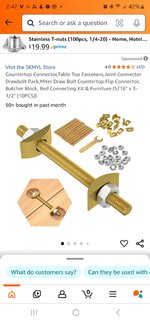
...The reduced diameter of the drive shaft section provides clearance for many of the chips...
No, it doesn't. Drilling horizontally, once the auger flites are buried more than an inch or two, that hole's going to completely clog. If you can somehow contrive a way to drill UP with this, getting gravity to pull the chips out, you'll get a few inches deeper, but even then auger chips are so large that they'll eventually clog the hole without active assistance. There's a reason ship augers are fluted all the way back, but even 36" ship augers only have the capacity to drill a little beyond their 24" of flutes. You're not getting through 42" like that.
And all that's forgetting about staying centered in the wood (NOT happening with something so flexible you have no way to guide it, and even if you could, it would be damned near impossible to stay that straight), and don't hit any nails (also not likely).
For a hole that deep, you could turn the wood on a lathe (that'll guarantee you stay in line) and use a gun bore (these have a port for compressed air to be sent to the tip to force chips out), but that's probably out of your reach tooling wise (and most of us for that matter), plus that still wouldn't react well to the dozens of nails you'll find on the way through.
My suggestion would be to forget this through bolting idea anyway. It's passe. I have an old-school butcher's block in my kitchen, and in the original construction method the maple was assembled with sliding dovetails and then through bolted. Today, they eschew the bolts in favor of glue, all on foot long long-grain joints that are repeatedly subjected to moisture from one end alone (this is a worst case scenario, so if it works for Boos, it's got to work for you too). Bowling lanes are much thinner, so getting sufficient clamping pressure for a good glue-up should even be within the reach of most hobbyists. Half a dozen pipe clamps should provide enough force to close a few inches of gap. Alternate them top-bottom-top-bottom to keep from warping. Titebond III has the thinnest consistency of the Titebond series of wood glues, plus offers the longest working time, so I'd go for that. Use something like a piece of aluminum cut from a soda can to drag glue down (or the vacuum).
And when you're done gluing it, it'll stay together. The metal support underneath isn't to hold the sides together, it's to keep it flat.