To avoid these ads, REGISTER NOW!

Does anyone de-bounce their contactor coil's?

eriksalo

Well-known member
Joined
Nov 29, 2007
Messages
184
Location
Colorado
I've been told the main source of contactor failure is arc'ing of the contacts when the circuit is turned on.

The mechanical switch in the system has what's called, "bounce" which means there's voltage instability in the system while the contacts are closing. This bounce causes arcing. Some contactors have things called arc quenchers to keep this from happening on the high voltage contacts.

I've always taken the step of installing a "de-bouncing" circuit into the contactor coil, which is just a simple capacitor/resistor system that buffers the input signal.

I don't know if I'm acutally solving a real problem by adding a de-bounce circuit. I've never had one fail but that doesn't mean I'm doing any good.

My question is, does anyone have any words of wisdom on de-bouncing contactors?
 
To avoid these ads, REGISTER NOW!

mrb

Well-known member
Joined
Dec 31, 2008
Messages
3,734
switch bounce is an issue in digital circuits and i dont think it is slow enough to affect operation of a contactor. Furthermore your capacitor isnt going to store enough energy to affect operation of the coil. The contacts are going to arc under load no matter what you do to the circuit controlling the coil.
 

ForceFed70

Well-known member
Joined
Apr 27, 2010
Messages
3,441
Location
BC, Canada
switch bounce is an issue in digital circuits and i dont think it is slow enough to affect operation of a contactor. Furthermore your capacitor isnt going to store enough energy to affect operation of the coil. The contacts are going to arc under load no matter what you do to the circuit controlling the coil.

I agree. De-bouncing is something you do on a digital circuit, and it's usually an input that needs to be de-bounced.

Personally, I can't think of an easy way to reduce the arcing. Probably the simplest way to get around this would be to go to a SSR (Solid State Relay). But SSR's typically need pretty good cooling (heatsink).
 

mrb

Well-known member
Joined
Dec 31, 2008
Messages
3,734
I agree. De-bouncing is something you do on a digital circuit, and it's usually an input that needs to be de-bounced.

Personally, I can't think of an easy way to reduce the arcing. Probably the simplest way to get around this would be to go to a SSR (Solid State Relay). But SSR's typically need pretty good cooling (heatsink).

i wonder if you could determine the time it takes the contactor to open, then release the coil at the appropriate place in the AC waveform so the contacts seperate as close as possible to the zero crossing. it would be interesting to see if thats been done. At that point i think you would just go solid state -SSR or IGBT....
 

foolishpride

Well-known member
Joined
Mar 21, 2009
Messages
343
Location
Southwestern Ohio
switch bounce is an issue in digital circuits and i dont think it is slow enough to affect operation of a contactor. Furthermore your capacitor isnt going to store enough energy to affect operation of the coil. The contacts are going to arc under load no matter what you do to the circuit controlling the coil.

Correct. That's why vacuum bottles were developed with the contacts inside of them. Used extensively in newer medium voltage switchgear applications.
 

ForceFed70

Well-known member
Joined
Apr 27, 2010
Messages
3,441
Location
BC, Canada
i wonder if you could determine the time it takes the contactor to open, then release the coil at the appropriate place in the AC waveform so the contacts seperate as close as possible to the zero crossing. it would be interesting to see if thats been done.

I like your thinking. However, my gut feeling is that the contactor won't open and close (open especially) fast enough. If a whole cycle takes 1/60th of a second and you need to open/close the contact in a fraction of a cycle (let's say we have 1/10th of a cycle to work with) you'd need a contact that can open/close in 1/600th of a second or 0.16 milliseconds.
 
Last edited:

mrb

Well-known member
Joined
Dec 31, 2008
Messages
3,734
I like your thinking. However, my gut feeling is that the contactor won't open and close (open especially) fast enough. If a whole cycle takes 1/60th of a second and you need to open/close the contact in a fraction of a cycle (let's say we have 1/10th of a cycle to work with) you'd need a contact that can open/close in 1/600th of a second or 0.16 milliseconds.

i think it comes down to timing. if you (with a high speed camera for example) can find the point at which the arc breaks for a given current and voltage you could in theory release the coil at the appropriate time to reach that arc point break close to the zero crossing. I bet repeatability would be an issue. probably wouldnt work
 

mrb

Well-known member
Joined
Dec 31, 2008
Messages
3,734
Correct. That's why vacuum bottles were developed with the contacts inside of them. Used extensively in newer medium voltage switchgear applications.

and contacts inside vessels full of SF6 for high voltage. Those (i forget what its called) are able to keep the circuit off long enough to open a mechanical switch.
 

ForceFed70

Well-known member
Joined
Apr 27, 2010
Messages
3,441
Location
BC, Canada
i think it comes down to timing. if you (with a high speed camera for example) can find the point at which the arc breaks for a given current and voltage you could in theory release the coil at the appropriate time to reach that arc point break close to the zero crossing. I bet repeatability would be an issue. probably wouldnt work

I get your thinking and agree that you could probably time the contact to happen at exactly the zero crossing point. But that's not good enough to prevent an arc. You have to look at when is happening just before that contact is made. The contacts would be "nearly closed" but the AC cycle would be far from the 0 crossing point.. thus resulting in an arc.

Let's take the example of the contacts closing. An arc happens in the time when the potential energy is high enough to jump the gap between contact points. Once the contact is fully closed there is no arc. Thus, to avoid an arc you need to have the contacts go from being open to being closed while the potential energy is low (zero crossing point). It is not enough to simply have the contact close at the zero crossing point as a split second in time earlier that contact was "nearly closed" and the potential energy was high and thus you have an arc.

In reality, the contact points will take at least 1/60th of a second (or more) to go from open to closed. In that 1/60th of a second you have a full AC cycle and the potential energy will at some point be high enough to cause an arc.

If you had some sort of magical "instant contact" which takes 0 time to open and close, you wouldn't need to bother with having it open/close at the 0 crossing point as you wouldn't have an arc in the 1st place.

I hope I've explained this well enough as otherwise I've got to start making diagrams and that's a bunch of work ;)
 

Worldpowerlabs

Well-known member
Joined
Jul 3, 2011
Messages
73
switch bounce is an issue in digital circuits and i dont think it is slow enough to affect operation of a contactor. Furthermore your capacitor isnt going to store enough energy to affect operation of the coil. The contacts are going to arc under load no matter what you do to the circuit controlling the coil.

You are correct about switch bounce (I designed embedded hardware and software for a number of years). This is mainly an issue in digital systems.

A circuit on the input side of the contactor really won't make a noticeable difference. However, if you are breaking the current to an inductive load, a snubber network on the OUTPUT side of the contactor may help. If you have a resistive load, however, there's not much you can do short of changing the environmental conditions around the contactor.

Be careful about designing snubbers, or any other device that connects to the AC line... things can fail spectacularly.
 

foolishpride

Well-known member
Joined
Mar 21, 2009
Messages
343
Location
Southwestern Ohio
and contacts inside vessels full of SF6 for high voltage. Those (i forget what its called) are able to keep the circuit off long enough to open a mechanical switch.

Sulfur Hexafluoride. I believe anything higher than 34,500 Volts uses this insulating gas instead of vacuum. SF6 Breakers have replaced the old oil circuit breakers, which aren't manufactured any longer. One Electric Power Engineer I know thinks SF6 will be the next PCB's.
 

ForceFed70

Well-known member
Joined
Apr 27, 2010
Messages
3,441
Location
BC, Canada
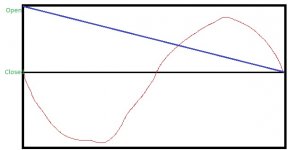
OK, I broke down and drew a very basic diagram of what I am trying to explain.

The red line represents your AC cycle.

The blue line represents your contact points moving from open to close.

In this diagram I assume that the contact opens/closes in 1/60th of a second (which I still think is faster than what you would see in the real world)

As you can see, the contacts close at the 0 crossing point. But look what happens at the 3/4point in the cycle. The contacts are nearly closed, but you have full potential between the contacts and thus a spark.

The only way to make this work would be to have contacts that open and close VERY fast which wouldn't be possible for a mechanical contact.

attachment.php
 

Attachments

  • ACcontactor.jpg
    ACcontactor.jpg
    27 KB · Views: 285
To avoid these ads, REGISTER NOW!

W-Cummins

Well-known member
Joined
Jan 9, 2006
Messages
1,639
Location
Iowa
I've been told the main source of contactor failure is arc'ing of the contacts when the circuit is turned on.

Ok

eriksalo said:
I don't know if I'm acutally solving a real problem by adding a de-bounce circuit. I've never had one fail but that doesn't mean I'm doing any good.

Your not

eriksalo said:
My question is, does anyone have any words of wisdom on de-bouncing contactors?
Why bother ???

Lets assume your not switching high voltage here, as this is not the Electrical substation journal!

Even a **** contactor's ( SqD, GE, etc.) contacts are good for over 50k cycles at their rated capacity. I supose there are some cheep china made contactors that may be lower rated but I would never use one let alone try to de-bounce one.

A Good contactor ie. AB 509 is rated for over 1 million cycles and is also FULLY rebuild-able.

Most things you might be switching with an AB contactor will be in the scrap heap long before the contactor will need new contacts!

William....
 

theoldwizard1

Well-known member
Joined
Feb 22, 2011
Messages
43,114
Location
SE MI
Lets assume your not switching high voltage here, as this is not the Electrical substation journal!

Even a **** contactor's ( SqD, GE, etc.) contacts are good for over 50k cycles at their rated capacity. I supose there are some cheep china made contactors that may be lower rated but I would never use one let alone try to de-bounce one.

A Good contactor ie. AB 509 is rated for over 1 million cycles and is also FULLY rebuild-able.

Most things you might be switching with an AB contactor will be in the scrap heap long before the contactor will need new contacts!

William....

Excellent answer !

What William is saying is yes, contactors bounce (and arc), but they are designed to survive that for many, many cycles !

As long as there is no issue with the the load seeing the bounce, forget it. If there is, then you don't need a debounce circuit, you need some kind of a "soft start/soft shutdown" circuit.
 

jdieter

Well-known member
Joined
Nov 17, 2007
Messages
320
Location
Northern Indiana
In the aluminum industry I retired from, we used a zero-crossing circuit on 3000A contactors feeding 460vac induction heating coils. Before the zero-crossing install the contacts would cheese over in a couple of months, after the install we got 6-8 months contact life. When vacuum contactors became available at that size we replaced the mechanical contactors and left the zero-crossing circuit intact. Vacuum bottle life was measured in years.
An extreme example for sure, but empiracal evidence illustrates zero-crossing does impact contact life. For a small current application there are numerous off-the-shelf solutions with soft-starts and vfd's
 

nehog

Well-known member
Joined
Jan 2, 2010
Messages
7,935
Location
Jaffrey, NH
...
Personally, I can't think of an easy way to reduce the arcing...

There is a way to reduce arcing on contact points, using a resistor and a capacitor (in series.) These are wired across the contacts to be protected.


The most difficult part is simply computing the correct values, and realizing that the solution is a compromise.
 

ForceFed70

Well-known member
Joined
Apr 27, 2010
Messages
3,441
Location
BC, Canada
There is a way to reduce arcing on contact points, using a resistor and a capacitor (in series.) These are wired across the contacts to be protected.


The most difficult part is simply computing the correct values, and realizing that the solution is a compromise.

All that a resistor and capacitor would do is increase the load and if anything, result in more arcing. The circuit you describe is just a way of reducing EMI/Noise on the output caused by the arc. It makes for a cleaner arc, but doesn't reduce the arc in anyway.

Plus, you are now introducing leakage current across the contacts which also isn't a good thing.

This would be an OK circuit for a DC contact. But not very useful for AC.
 
Last edited:
OP
E

eriksalo

Well-known member
Joined
Nov 29, 2007
Messages
184
Location
Colorado
I've suspected it's not a problem at all but didn't know.

It's one of those things where the smart old guys who taught me how to build complex contactor circuits many years ago always did it a certain way and said I should too.

It's occurred to me the Arc Quenchers on modern contactors do their job and it's not a problem. Maybe long ago this was an issue.

Based on everyone's replies, I'll become a "reformed de-bouncer."

Thanks; Erik
 

ddawg16

Well-known member
Joined
Jul 11, 2008
Messages
21,005
Location
S. California
Ok
Even a **** contactor's ( SqD, GE, etc.) contacts are good for over 50k cycles at their rated capacity. I supose there are some cheep china made contactors that may be lower rated but I would never use one let alone try to de-bounce one.

A Good contactor ie. AB 509 is rated for over 1 million cycles and is also FULLY rebuild-able.

Most things you might be switching with an AB contactor will be in the scrap heap long before the contactor will need new contacts!

William....

Accurate.....and Wizard is right too....

'Many' years ago I was desigining and maintaining In Coming Test Equipment at a electronics firm......I have a lot of experience with relay debounce....I developed a test fixture using a GenRad tester to test relays....it tested Make time, Break time, Debounce, coil resistance, and Hi Pot.

Debounce is really nothing more than the mechanical bouncing of the relay contacts....I was measuring bounce in the 3-5 ms range....but that is for a DC reed relay.....

Like ForceFed said, an AC powered relay is at the mercy of the power line cycle....so your stuck with a worse case time of 16 ms + the debounce time of the contacts.

But by now I guess you have figured out that there is not really a problem....

Just so you know....contacts are designed to take into account the arcing.....it's called contact swipe....as the contacts make, they slide which 'wipes' the carbon from the contact surface.

Additionally, the contact material is designed to reduce the arcing....that is why you have different relays for different voltages...
 

Joe92GT

Well-known member
Joined
Jan 2, 2009
Messages
88
As said earlier by everyone in residential power its a non-issue.

We build and sell contactors that make and break up 3000A, DC at up to 1k or more Volts. With DC there is no way to time a zero crossing (obviously), so the contactors are designed to pull the arc magnetically via a blow out coil into an "arc chute" to quench it.

Even with DC, and full load make/break, the contact tips last 50-100k cycles, or more if special tips.

However, you should see what happens when one fails to open or close all the way (mostly due to external circumstances). Its a pretty neat site to see, luckily I've only see the aftermath. I would never want to be anywhere near one of these during a rare failure.
 

sberry

Banned
Joined
Jun 18, 2005
Messages
35,747
Location
Brethren, Michigan
I don't know anything about it other than general vague principle but just figure that a set of contacts say for a comp in my shop can go 30 yrs, several cycles a day, say maybe 5K cycles a year or so, as I recall it stuck maybe once 20 yrs ago and I clean or flip them, I cant recall but any less than that would last the home brew garage type a lifetime or more?
If its failing then obviously there is a problem but basically until then I ain't losing any sleep over it or trying to engineer some idea to improve it.
All the theory discussion is great though, good learnin stuff. I don't have the smarts to understand or absorb it all but its worth noting, even some rudimentary understanding aids in basic trouble shooting.
Now,,, will all this help if a beetle crawls in a contactor and prevents it from closing a leg????? ha,, I cleared it out and it worked,,, noisy though so I take it back out, apart on the bench and another bug in the magnet, clear 2 bugs, works like it always did. Remember to spray killer in and around cabinets, ha
 

sberry

Banned
Joined
Jun 18, 2005
Messages
35,747
Location
Brethren, Michigan
Had 2 recent events with wells, one I figure out start cap was out, this one sound ALMOST the same but I didn't jump to conclusions, didn't trip the reset breaker instant but groan, I shut off and find the bug problem.
 
To avoid these ads, REGISTER NOW!
Top Bottom