ishiboo
Well-known member
He's thinking in a different paradigm than you. That's why you're not getting it.
You're thinking within the lines of electrical/building code (which is completely reasonable, since codes exist for good reason), which provide a rigid structure for the "right" way to do things. They provide safe boundaries which can accommodate many ends, but are not the only means.
i.e. you're thinking in Erector Set, and the OP is thinking in Lego.
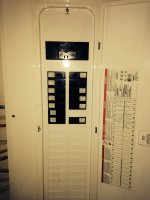
Here's are some examples of why you might want an outlet in your panel:
Say you wanted to test voltage at different points on the bus. An outlet on the panel would allow you to access this without removing the cover.
Or to power a work light for work in the panel (or a night light, status indication, safety warning, who knows what else...).
But the OP (and I) are not advocating to wire an outlet into a conventional panel (and I'm not saying that the above uses are useful to ME, but perhaps they are useful to someone, which is why providing the option makes some sense to me).
He's suggesting that as an example, a manufacturer could make a circuit breaker module with an outlet built in that you could plug into a more universally modular panel system.
I don't see how this is any different than putting an outlet attached to a steel junction box next to the panel.
You want to test the voltage at "different points on the bus"? How would you do this if the outlet is outside the panel without opening the panel to change its location? Unless something is mechanically clusterfucked the bus has the same voltage at all points. Thus an outlet *right next to* the panel is the same as one on the panel.
And for a work light, night light, etc... I don't see any advantage (and only disadvantages) to having it in the panel itself.
This is a solution looking for a problem.