To avoid these ads, REGISTER NOW!

Does it get easier?

Big Daddy Chop Shop

Well-known member
Joined
Jan 13, 2016
Messages
233
Location
Hope, Indiana
The other piece of advice I would give is once again contrary to what you may read here.

Do not trust the internet. Period. Here is why- pick a topic, like "what size wire is good to run to a 100 amp sub panel?" Now, start looking. There are soooo many opinions, out dated info, info that does not apply (i.e. EU standards) and, here is the really sad part- people who intentionally give bad info.

If you have no idea, not a clue what you are doing, find a mentor. Someone local. Family, neighbor, friend, who is at the top of their craft- and latch on to them. Be their shadow. Do anything you can to learn from them.

However, I will stick by my earlier statement- you either have it or you don't. My father in law doesn't have it. However, he was very smart, wise, and knows money. He can write a check to get stuff done, and no matter what anyone tells you- there is no shame in that.
 
To avoid these ads, REGISTER NOW!

slow

Well-known member
Joined
Feb 26, 2006
Messages
2,596
Location
near Orlando
Being willing to try something I have found helps. I was fortunate that my dad was very handy, so between doing 60+ sheets of drywall, building a shed and painting out old house, and so much more, I have been involved in a lot of different projects growing up. (owned an old house and had to fix it up).

I now feel comfortable trying most things, I recently had to replace a slave cylinder in my 2006 GTO, I knew what needed to be done, but I have only done a clutch on a 5.0 mustang before. I google search found a video of a girl doing the job and details of what needed to be done. I found a friend of mine, who had never done it before but was willing to help and we knocked it out in one night. a $1600 repair at the dealer, done for about $80 (I already had a LS7 clutch from another build) I plan on taking some of the money saved and put it towards a couple of tools to make the next job easier to "pay yourself" first.

There is an old dilbert cartoon that I find funny
about "the knack" some people are more mechanically inclined but take your time, spend time around people doing the kinds of things you are interested in and you will build confidence.
 

stsmytherie

Well-known member
Joined
Dec 16, 2005
Messages
171
Location
VT
Some good advice here. If you aspire to get better and work at it, you will.

My only suggestion is to learn how to set appropriate expectations. Your first workbench will be less polished than your 10th or 100th.

If you expect expert results on zero experience, you're going to be disappointed. Don't do that.
 
OP
S

Sheikster405

Member
Joined
Feb 4, 2016
Messages
17
Thanks for all the advice. Unfortunately none of my family members/close friends are very mechanically inclined so I'm referring to the internet for all my lessons.

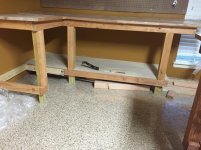
My first workbench build is almost done. I'm at the finish line trying to put a butcher block top on, but I've found my frame isn't level. It is slightly higher in the back (which I attached a ledger to the wall first and had trouble toe nailing cross sections in) and very slightly higher on the left.

I'm not sure how to fix this, besides tearing it apart, so that I can attach the workbench top to the frame securely. I've included pictures.

image1.jpg

image2.jpg
 

ScottsGT

Well-known member
Joined
Jan 1, 2014
Messages
4,883
Location
Lake Wateree, SC
ScottsGT, to answer your question, I am 28. I just inherited my first set of tools. This all started because I wanted to reorganize my garage. It turned in to me finding a passion of fixing/building things. 3 weeks ago I couldn't have told you what a miter saw is.

Thanks for all the encouragement and advice.

This says it all. As the old saying goes. Practice, practice, practice! the more you tinker around and play with practice pieces, the better you will get. keep in mind it won't happen overnight.
 

larry_g

Well-known member
Joined
Apr 28, 2007
Messages
16,861
Location
oregon
The sign of a good craftsman is how he hides his mistakes. Shimming is a time honored way to get things into level. You can shim under the front legs or between the frame and the table top. You could sand or plane down the high spots. Or if your going by the bubble in the picture call it good.

I would suggest that your remove the top and spend some time with the level on the frame and get it level. You may find that the top is unlevel because of a bad board or just one cross member being high. Like I said above measure everything 3 ways and figure out exactly what is wrong, tearing it all out and starting over you miss the learning opportunity of finding your error.

Another basic error I see in your pictures is that your measuring tape is across the board at a diagonal. You must measure perpendicularly across the two faces your trying to determine the distance between. I'm going to assume that the tape is angled because of holding it in one hand and camera in the other.

lg
no neat sig line
 
OP
S

Sheikster405

Member
Joined
Feb 4, 2016
Messages
17
The bubble in the picture is that way because I put a piece of wood between the top and the frame, which left the gap you see. I'm not sure how to attach the top if you shim between the frame and the top.

Is there any specific wood for shimming? Or just place any piece of wood the right thickness underneath?
 
Last edited:

theoldwizard1

Well-known member
Joined
Feb 22, 2011
Messages
43,076
Location
SE MI
It depends a lot on what you are working on. My son-in-law is like you, but just doesn't seem to have The Knack !

He tried to clean the carburetor bowl on a lawn mower and cut the rubber O-ring (easy to do if you are not careful). So he tried to assemble it with NO ring/gasket. Leaked like crazy. Bought a new mower.

The other week the clutch spring on his single stage snow blower broke. He found a video on line, bought the part and replaced it. Too bad the video was for a different model and the spring he bought was too long. He shortened it but there was still not enough tension so I showed him how to adjust it ("So that is what all those holes are for !" Sigh)

Most of my mechanical/electrical "ability" is from watching it being done (YouTube does help) and then DOING IT ! The more the better. (I can clean out a small engine carburetor bowl in less than 10 minutes. Disc brake still take a relatively long time even though I have done dozens.)

I am a poor "carpenter". I have trouble making things come out "square" also. The only thing I can suggest (until you get a lot more experience) is to use a "guide" when cutting lumber and make your cuts a little "fat" ("leave the line" on the piece you are cutting so that it is a bit long; if you have to, you can "clean it up" latter with a plane or a sander.) Trim covers up a lot of issues (if you are going to apply trim over a joint/edge cut to the inside of the line).

You will need a couple of different guides. Speed square and clamping straight edge to start out. Lot of clamps. Spring clamps, C-clamps, bar clamps. Pros have dozens ! You don't, but buy them in pairs (or 4s).

Don't go crazy on name brand tools and don't buy tools "just because". (Most DIYers will never need 1/2" drive sockets or ratchets.)

If you are going to be doing something a lot, buy the power tool version. A trim/brad nailer and a small air compressor will make installing trim a breeze. You don't need a power miter saw if you are only doing trim on 1 room, but you do need a GOOD non-powered miter saw.

A battery impact driver is worth it if you are going to drive a lot of screws. A 3/8" impact wrench with a 1/4" hex may be a better buy if you also plan to work on cars. A good 3/8" battery hammer drill is worth the money. You can go 1/2" but I don't know if it is worth the difference. (Drill/drivers **** at driving.)

If you are going to be doing more wood working, good wood glue (Tite-Bond 2) and constriction adhesive are invaluable. Sooner or later you will buy a Kreg pocket hole jig. This does take a little bit of use to understand how to optimally use it.
 

theoldwizard1

Well-known member
Joined
Feb 22, 2011
Messages
43,076
Location
SE MI
The other piece of advice I would give is once again contrary to what you may read here.

Do not trust the internet. Period.

Some times the best way to learn the basics is from an old fashion BOOK. All most all home centers have a rack of soft back books that cover the basics and are not too expensive. If you are cheap, like me, you can buy them used on Amazon. There are several good books about basic home wiring. Also, basic carpentry, including framing and shed and barn building.

Books tend to be more "accurate" because a publisher might get sued if the information was wrong/dangerous.
 

Citation

Well-known member
Joined
Jan 20, 2016
Messages
3,209
Location
Indy
In my opinion, yes it gets easier... but sometimes it doesn't seam that way because your ambition often grows with your experience.

Having "the knack" sure helps. Of the 5 of us kids I was far and away the one who got that. But I think much of "the knack" is related to interest rather than ability. Watching Youtube videos, reading the repair and technical threads on car forums. I've learned A LOT!!!! from the various car forums I've read. Also, sometimes you have to be willing to accept that you will screw up. There are certainly times when I SHOULD have left well enough alone. Some of those times resulted broken items that had to be replaced and money wasted on my end. However, that is more than made up for by the money I've saved fixing things on my own. So on those days when you lose, just remember, you will probably win more often than not.

Yes, it gets easier. The first time you change oil it might seem like a hard job but later you hardly give it a thought. That head gasket seams really intimidating... but then you do it a few times and it's no big deal. I guess it's like landing an airplane.

Anyway, so long as you enjoy it keep at it.

PS: Always turn a screw backwards when rethreading it into a whole. It helps prevent cross threading... important for spark plugs as well.
 
Last edited:

theoldwizard1

Well-known member
Joined
Feb 22, 2011
Messages
43,076
Location
SE MI
One thing about building things with "2by" material.

NEVER ATTACH ANYTHING TO THE **** END OF A BOARD THAT HAS TO CARRY A LOAD ! Screws and/or nails into the **** end just will not hold over time. (Except for trim pieces.)

If you can not figure any other way around it, temporarily fasten the piece together with screws. Use a Forstners bit to drill a 1/2" hole through the outer 2by and at least 3-4" into the **** end (yes, you have to be careful about drilling straight). You are going to need 2 holes so space them accordingly. By a 1/2" hardwood dowel rod an cut to just sort of your total depth. Wood glue and bang it in. That will hold a LOT of weight !
 

NUTTSGT

Super Moderator
Staff member
Joined
Sep 14, 2009
Messages
50,856
Location
Northern Central Ohio
Is there any specific wood for shimming? Or just place any piece of wood the right thickness underneath?

Depends on what you are shimming and how much it is. You can buy a pack of shims at a big box store like Lowe's, Menard's or Home Depot (HD). Shouldn't more than a couple of bucks.
 

legenddc

Well-known member
Joined
Aug 19, 2012
Messages
1,066
It gets easier the more you do and fix things. The biggest thing is to make sure you're doing something safely.

Are you just trying to organize your garage or build fine furniture? Fix cars, etc?

Loads of good beginner projects at Ana-white.com. If you're looking to do nicer furniture I'd suggest thewoodwhisperer.com.

Where are you located? I'm sure someone here would have you over to help them fix something.
 

Deej-79

Well-known member
Joined
Feb 8, 2016
Messages
502
Location
Washington
OP, How old are you? Just curious, and I could make a few comments based on my life experiences. But here's a few guidelines that have helped me develop skills over the years. I'm now 53, and still learning something new every day.

1) Remember the Clint Eastwood line, "A man's gotta know his limitations"
If something is above you, look into doing it before you leap. Don't assume you
know it.

2) As others said. YouTube, Google, etc.... All are great resources.

3) Patience. When I was younger, I did things with the knee jerk reaction. After
enough failures I learned to slow down and think things through.

4) Use your damned brain! It's a powerful tool. Think about what you are about to
do. Play the "what if" game with yourself. Ex: What if I put this screw too close to
the edge of the wood? Will it split? Will it work? Will it look like ****?

5) Never, and I mean never be afraid to ask someone else for their opinion. Even if
you think you know the answer. Someone else might have a better way of doing
things.
When I was 20-21 I had a boss that was up there in his years. He always asked me
how he should do something. One day I asked him why he as asking me with his
45-50 years of experience. He said that I might have a better way of doing things.
Doesn't mean he used them, but he not only thought about my ideas, but it made
me think of different ways.

For your projects, keep in mind that sometimes that used $10 circular saw wasn't such a bargain after all! Buy quality tools and learn to use them properly. Take your time to measure twice, cut once! Use a quality square. If things don't look right, check your tool!
One of my jobs at work at one time was to hang TV's all over campus. I always seemed to have an issue getting things level. I would put the level on the TV and the bubble would be dead on with the mount and the TV. But if you stood back, it was not level. I would usually just level it by eye. One day the Baseball coach was watching us as we were hanging a 60" TV in the new trophy room after winning the National Title. He saw the problem instantly. My level was bad. He was kind enough to throw it away for me! LOL!!
I couldn't see the trees for the forest! Check your tools! I had a problem cutting square cuts on a chop saw. Even though it said it was set on 0°, a square told me different.

Great post. I've been in a woodshop since I can remember, I'll still look at youtube to learn new things. I've been playing with cars for 25+ years, I still google repairs that I need to do.
 
To avoid these ads, REGISTER NOW!
OP
S

Sheikster405

Member
Joined
Feb 4, 2016
Messages
17
It gets easier the more you do and fix things. The biggest thing is to make sure you're doing something safely.

Are you just trying to organize your garage or build fine furniture? Fix cars, etc?

Loads of good beginner projects at Ana-white.com. If you're looking to do nicer furniture I'd suggest thewoodwhisperer.com.

Where are you located? I'm sure someone here would have you over to help them fix something.

I'm about 30 miles south of Dallas.

I started out wanting to just organize my garage. Then that turned into hanging Rubbermaid fast tracks on the walls. Then building shelves. Then a workbench. Now I'm wanting to build planters for vegetable growing and bookcases for the house. I also am trying to be more handy around the house and fixing things instead of calling someone for it.
 

Jess

Well-known member
Joined
Oct 22, 2006
Messages
430
Location
Vancouver Island, BC Canada
I was lucky to live in a family where what we needed, we learned to build or repair. Money was tight but it was more than that. We all start somewhere and as the years go by, you will get better and learn more ways to make it easier. Don't lose the passion to create something and try to pass it to you children or relatives kids. Its a gift that will last a lifetime. Even today, I was looking at a problem and thought, 'what would my dad have done with this?' After a few minutes, I had the part off and was ready to go on to the next bit. Make sure its fun, even when you think for a minute that it isn't.
 

coljar

Well-known member
Joined
Sep 26, 2010
Messages
6,243
Location
Belpre, Ohio
The simple answer is yes, it gets easier with experience and it gets even easier if you enjoy what you're working on or with. Trouble is, seems like you get to a certain age and it starts getting hard to do again.:headscrat
 

ford33

Well-known member
Joined
Feb 26, 2011
Messages
2,118
Location
Chicago, IL. USA
It does get easier. I look back at the items I built two years ago and they are not very good fitting pieces. I can create much better wood joints now after a bit more practice. My work has improved greatly by doing the task again and again. You will also improve.
 

Bill Anderson

Well-known member
Joined
Nov 9, 2011
Messages
97
Sheikster,
Can you still remove the top? And for future reference, I like to build a workbench, so its moveable, ie.not fastened to the wall. That way you can change location in the future, and when you want to reorganize your garage, you're not limited by a stationary workbench.
 

Deej-79

Well-known member
Joined
Feb 8, 2016
Messages
502
Location
Washington
A pack of cedar shims at the box stores is about $3. If you can, find the high spot of where you're working, start there and work out, shimming up to match that high point. Work along the back first and attach it to the wall, then you can start leveling the front.
 

TK-421

Well-known member
Joined
Dec 29, 2015
Messages
1,398
Location
Pflugerville, TX
If you want to get better, and actually put in serious effort, thenjoy you'll definitely get better. Don't get discouraged if you think something *****. Instead, look at it, figure out why it *****, figure out what you did wrong, and then figure out how to fix your process so that doesn't happen next time.
 
OP
S

Sheikster405

Member
Joined
Feb 4, 2016
Messages
17
Sheikster,
Can you still remove the top? And for future reference, I like to build a workbench, so its moveable, ie.not fastened to the wall. That way you can change location in the future, and when you want to reorganize your garage, you're not limited by a stationary workbench.

Yes, the top is not attached at all. Just sitting on the frame.
 

CoogarXR

Well-known member
Joined
Jan 11, 2016
Messages
6,844
Location
Ohio
I know when I was about 14, I wanted to build a pair of speakers. My dad didn't want me to use his circular saw (probably a good call, I wasn't terribly responsible at that age...). He bought me a jig saw. I attempted to make a pair of speakers with only a jig saw... It took forever, and they looked like ****. I convinced myself that woodworking is too hard, and kept away from it for years.

Now I have found that while I am still pretty untalented at woodworking, the tools make all the difference. I own lots of woodworking tools, and I can make stuff that passes for OK. Woodworking, to me, is still one of the hardest things that I do. That and auto body. I can do it, but it's kinda "meh". Woodworking and auto body both require patience and finesse... Things that I lack...

I prefer electrical/electronic and mechanical work. Those things come easy to me. it's broken or it's fixed, ones and zeros, heh.

So there is something to be said about having the knack. But even though I don't have the knack for woodworking and such, I still try, and I get a little better each time. I just don't like doing it. But my lust for tools and the feeling I get when I do something myself keeps me coming back for more.

I guess what I am saying is- knack or not, you WILL get better, and it WILL get easier. Just find a reason to keep trying. I like saving money by not hiring people, and I like buying and learning new tools. I really like buying new tools with the money I saved by not hiring somebody, and still coming out ahead! LOL!
 

legenddc

Well-known member
Joined
Aug 19, 2012
Messages
1,066
I started out wanting to just organize my garage. Then that turned into hanging Rubbermaid fast tracks on the walls. Then building shelves. Then a workbench. Now I'm wanting to build planters for vegetable growing and bookcases for the house. I also am trying to be more handy around the house and fixing things instead of calling someone for it.

That's a good place to start. Don't start with any built-ins or insanely expensive materials. Worst that happens if a planter build goes bad is you make a smaller planter or have some wood for a firepit.

Look up some old episodes of the New Yankee Workshop on bookshelves or spend some $$ on thewoodwhisperer.com/guild site for the bookshelf plans. I recently got it, worth the money to see how to avoid common mistakes.

Just attempt to fix things in your house. If you can't fix it you can resort to calling someone. You won't be out any extra money, just your time. If you do hire someone for a job that you'll likely need to do in the future observe them without being annoying.

You might find The Family Handyman magazine valuable. I get it monthly and while some things don't relate to me at all, I usually pick up a couple good tips.

Whoever said it doesn't get easier, your standards just get higher may be right for things you're building (furniture, cars, etc.) but after you replace an electrical outlet once it's easier the rest of the time.

Don't be afraid to take classes or ask the people at Home Depot or Lowes how to best fix something. Just find the old guy who was probably a contractor for 40 years and they'll help you out.
 

ilovevocs

Well-known member
Joined
Jun 26, 2009
Messages
1,966
Location
Toledo, Ohio
Learning to build square and level structures takes allot more than just good cuts. You have to understand triangulation and how it impacts the final product. The order of assembly and the design has impact on the quality of the final product.

Don't get discouraged. There is allot to learn; before you can build a museum quality piece you need to understand your materials, tools, and techniques including their idiosyncrasies.

As mentioned above good craftsman knows how to hide their mistakes; this comes from repetition, and making mistakes.

Don't set your standards so high that you get discouraged. Look at the bench you built and feel gratification; it is the first time you built one. Its unrealistic to expect to get it right the first time around. The mistakes you made you will not make again if you learned from them this time. This builds experience and makes you a better craftsman moving forward.

Best of luck, now get on to your next project!
 

Crazyjake8493

Well-known member
Joined
Sep 26, 2014
Messages
3,948
Location
Upstate NY
Having the right tools for the job can make all the difference. I believe Norm Abrams once said, "My favorite tool is the right one for the job." Or something along those lines.
 

rayra

Well-known member
Joined
Dec 1, 2014
Messages
4,724
Location
Escaped from Los Angeles
When using power tools,always remember,flesh cuts far easier than wood or metal, the power tool won't even slow down if it encounters your hands or other body parts.

Never work with power tools if your sick,tired,angry,or drunk,as mistakes can happen easily if you are.

Or distracted. Keep your eyes on the blades and keep your thumbs tucked.

OP, every trade is the same. They are ALL puzzle solving. They are all about about assembling the pieces. It helps a great deal to have good spacial perception and visualization skills. Everyone should have their kids playing with Lego and picture puzzles, it makes a huge difference in that sort of development.

Then the trick is learning the main tricks of each trade skill set. How to cleave a brick, how too many 90deg elbows slow your water flow, how concrete has an optimal window for working the surface finish, how to best place your tile so the joints fall in the right places to look nice. How to keep a wet edge while painting, how good brushes matter for some things, How wood is strongest in compression and not so much in span. What the best materials are for a given job/project.

This is all accumulated, learned knowledge. The Internet is both a boon and a curse when it comes to this stuff. Lots of info out there both good and bad. You need to learn how to tell the difference.

When it comes to woodworking, there's a few key tips -
Learn how to safely use the tools, they can be unforgiving.
learn about woods and wood product types and what they are best suited for and related to that, learn about all the various fastener types and how they are best employed.
Learn how to properly mark and properly cut. It really matters and there are several ways and just about any two people do it differently. Find a method that works for you and stick with it.
Learn the proper joints and attachments for various things, how to properly design your project for structure and vertical loads. Wood is strong in compression and much less so in span.
Learn to sketch out your ideas and solve them on paper before turning your money into sawdust and scrap.
If you are working on things with close tolerances or fit requirements, cut it long the first time and test fit and trim repeatedly to make it best.
Learn the tricks of making things square, plumb and level. Then learn all the even more important tricks of making your square, plumb and level stuff work with the real world and prior work, which is NEVER square, plumb, or level.
Learn how to be aware of and compensate for the above, to blend your work with your installation site.
And when it comes to wood especially, learn how to adjust your design to deal with water. How to shed water, prevent or mitigate its infiltration. To prevent swelling, warping or rot.
Start with small projects, your mistakes will cost less. Learn by doing. Lots and lots of doing.
 
Last edited:

Bill Anderson

Well-known member
Joined
Nov 9, 2011
Messages
97
Yes, the top is not attached at all. Just sitting on the frame.

Okay, remove your top, and crefully set it aside. You have two choices: 1. Try to remove the nails that you used to fasten the ledger board to the wall. Next, use your level to level the ledger board, and use a pencil to mark/scribe a line on the wall, across the top of the board, where it it level.

Next, you will need to get some screws, approximately 4"-4.5" long, and get #12 or #14 screws. If you can find SPAX name brand screws in your area, I like those the best. They have little serrations on the edge of the screw threads, that cut/shear the wood as the screw is driven in, so in many cases of rough carpentry, you don't have to drill a pilot hole. Fyi, you always want to drill a pilot hole when there is a chance of splittling the wood, for example, near the end of a borad.

If u can't get the SPAX, then get zinc coated screw of the same dimensions, but make sure to get a Torx 25 head (T25) or Torx 30 head (T30) on these, bc that makes driving them through the ledger, and into the wall stud, much easier, and less bit slippage in the screw head.

If you get the SPAX then you will need a #3 Phillips bit to drive those. If you get the other screws, then you will need to get a T25 bit or T30 bit to fit the screw head.

Google SPAX screws, and T25 wood screw to see what I'm talking about. Also you can pm me, to ask questions also. Also, check your Private Message inbox. I sent u a couple PMs.

Also, the bigger # of screw, the larger the diameter the screw will be, and the smaller the #, the smaller the diameter. Just the opposite for steel/alum/metal, and the opposite for wire as well including electrical wire.

Example
A #14 screw has a larger diameter than a #2 screw, and vice versa.
#10 gauge metal is thicker than #18 gauge
#10 gauge wire is thicker than #14 gauge wire.

Ask away, and remember there is no such thing as an unfixable mistake. Also remember this isn't rocket science or brain surgery, in those two fields correcting mistakes become much more problematic.

Oh, and another thing...NEVER believe/trust anything you read on the internet. The internet is a fad anyway, and will be gone in a couple of years lol :rolleyes:
 

Bill Anderson

Well-known member
Joined
Nov 9, 2011
Messages
97
Yes, the top is not attached at all. Just sitting on the frame.

Oops, forgotthe 2nd option. Take a board, 2x4 approximately 2-3 ft long, and lay it edge wise on top of the ledger board, then take a large hammer, preferably a dead-blow hammer, and 'smack'/hit the board on top of the ledger board, on the high end until its level. Then use the #12 or #14 spax screws to re-fasten the ledger board in the level spot. Nails will bend more easily than screws, screw will tend to snap or break comparatively speaking.

This option will work only if you're out of level a 1/4" - 5-16 or 6mm-8mm, or so. If you're out of level more than that, I would unfasten the ledger board, on the high end and relevel, then fasten with screws.
 
Last edited:

gahrajmahal

Well-known member
Joined
Dec 12, 2008
Messages
2,518
Location
Cincinnati, Ohio
If you picked up a musical instrument and learned to play one song in one style would you be surprised if you tried to play another song in another style that it would sound as good as the first one that you played over and over? This trade is the same way. Eventually when you have played several thousand songs, that new one you are making your way through doesn't sound too bad. An inexperienced ear might think you were pretty good.

Don't get discouraged, if you like it keep at it. You are your harshest judge.
 
To avoid these ads, REGISTER NOW!
Top Bottom