
To avoid these ads, REGISTER NOW!

Does this Bessey clamp working as intended?

vice-summer

New member
Joined
May 25, 2026
Messages
3
Hi everyone!

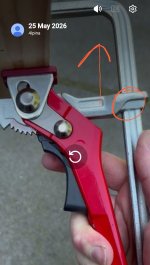
I have couple of these Bessey GTRH 160/60 clamps, and I am curious if the way it works is correct. It has these metal teeth which grab onto the thing to lock itself. However, it never grabs on the last one and instead simply slips. I asked the manufacturer and they said it's working as intended, but I have my doubts. Firstly, why is there one more tooth if it's not used, and secondly, it does feel additional level of clamping would be quite useful sometimes.

From what I understood it's a same clamp as Festool 491594, but I don't have that one to confirm.
 
To avoid these ads, REGISTER NOW!

OneEyedMan

Well-known member
Joined
Sep 4, 2015
Messages
157
Without a clamp like that in my had to verify, I’d guess the slippage keeps the clamp from getting locked in a way that there isn’t enough swing to release the pawl. If the pawl is under tension at full grip, it’s possible there wouldn’t be enough play left to give the pawl room to release.
 
OP
V

vice-summer

New member
Joined
May 25, 2026
Messages
3
Without a clamp like that in my had to verify, I’d guess the slippage keeps the clamp from getting locked in a way that there isn’t enough swing to release the pawl. If the pawl is under tension at full grip, it’s possible there wouldn’t be enough play left to give the pawl room to release.
That's actually a good point, and I see why you would say that. However, in this specific clamp you release the tension by clicking the black plastic button, which does not require to pull back at all.
 

Old tool guy

Well-known member
Joined
Apr 13, 2023
Messages
3,208
If you can’t get it tight enough with all those teeth, then there is one of a couple of issues. You didn't start with the pawl in the zero position. You didn’t snug up the jaw before starting to clamp. You took up all the gap between the objects being clamped, you should have added a second clamp to hold the material so you could release and restart the first clamp. Or you are applying way too much pressure.
 
OP
V

vice-summer

New member
Joined
May 25, 2026
Messages
3
If you can’t get it tight enough with all those teeth, then there is one of a couple of issues. You didn't start with the pawl in the zero position. You didn’t snug up the jaw before starting to clamp. You took up all the gap between the objects being clamped, you should have added a second clamp to hold the material so you could release and restart the first clamp. Or you are applying way too much pressure.
I can get it tight enough if I start from the widest position in this clamp. But sometimes I don't start with the widest position and I wish I could get one step further.
 
To avoid these ads, REGISTER NOW!

jar944

Well-known member
Joined
Jul 26, 2010
Messages
5,905
Location
Northern VA
Like any f style clamp with limited screw length this needs to be all the way up before you tighten.
Screenshot_20260525_145208_Chrome.jpg
 

tarbellb

Well-known member
Joined
Apr 17, 2011
Messages
5,743
Location
Oregon
A combo of response #2 + #6

Also, I bought a bunch of these back when they got a more popular (8yrs ago?)

Hate them, the ratchet never gets that tight, and the handle starts so far from the beam they are super awkward (even with big hands)
Ended up selling them all
 

neophyte

Well-known member
Joined
Apr 23, 2012
Messages
9,582
Location
Pennsylvannia
Hi everyone!

I have couple of these Bessey GTRH 160/60 clamps, and I am curious if the way it works is correct. It has these metal teeth which grab onto the thing to lock itself. However, it never grabs on the last one and instead simply slips. I asked the manufacturer and they said it's working as intended, but I have my doubts. Firstly, why is there one more tooth if it's not used, and secondly, it does feel additional level of clamping would be quite useful sometimes.

From what I understood it's a same clamp as Festool 491594, but I don't have that one to confirm.

“Firstly, why is there one more tooth if it's not used, and secondly, it does feel additional level of clamping would be quite useful sometimes.”

I forget whether the pawl on those clamps has one or more teeth.
If the pawl has more than one tooth, the extra tooth may simply be there for extra locking strength.
These forged clamps of this style were likely modified for Festool, from an existing clamp design Bessey already made, to fit the needs of the Festool rail system.
These clamps were originally high strength clamps possibly made for welding or steel use, with a fully forged L-design for extra strength.
Typical woodworking clamps usually have the fixed offset jaw as a separate piece that gets riveted or welded or braised onto the straight clamp bar.
 

RTM

Well-known member
Joined
May 13, 2019
Messages
13,106
Location
SF Bay Area
Just a heads up, many of these F clamps are purposely torque limiting. Round handles you can't put a wrench on, to prevent damaging the tiny teeth on the spine. Very appropriate for WW stuff. C clamps usually allow you to get much more force on things

Could be that is to prevent you from breaking the clamp from overtightening
 

neophyte

Well-known member
Joined
Apr 23, 2012
Messages
9,582
Location
Pennsylvannia
Just a heads up, many of these F clamps are purposely torque limiting. Round handles you can't put a wrench on, to prevent damaging the tiny teeth on the spine. Very appropriate for WW stuff. C clamps usually allow you to get much more force on things

Could be that is to prevent you from breaking the clamp from overtightening
I’m not sure the tiny teeth on the spine have anything to do with a torque limiting design.
There were plenty of clamps before the Bessey K-body woodworking clamps,(the expensive parallel ones), came onto the market, that did not have serrations on the bar, and which just had a smooth bar, and applying force to the end of the bar will still rack the clamp head in place.
The serrations do make the clamps easier to use, because you can stand the clamps vertical, and the serrations will make it much less likely that the mobile clamp head will slide down the bar if you let go of the mobile head without the mobile head locking against a surface, or without force being applied to the end,

A torque limitation attempt to prevent breaking the cast clamping lever would seem more likely,
As far as those clamps go, good luck actually breaking the forged steel “L” or mobile jaw.
You might be able to bend or twist either part, but it is highly unlikely you would actually break either part, without massive amounts of force.
 
To avoid these ads, REGISTER NOW!
Top Bottom