To avoid these ads, REGISTER NOW!

Does this duct work look right?

gagecalman

Well-known member
Joined
Feb 5, 2020
Messages
198
Location
MD
Hello,
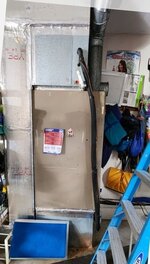
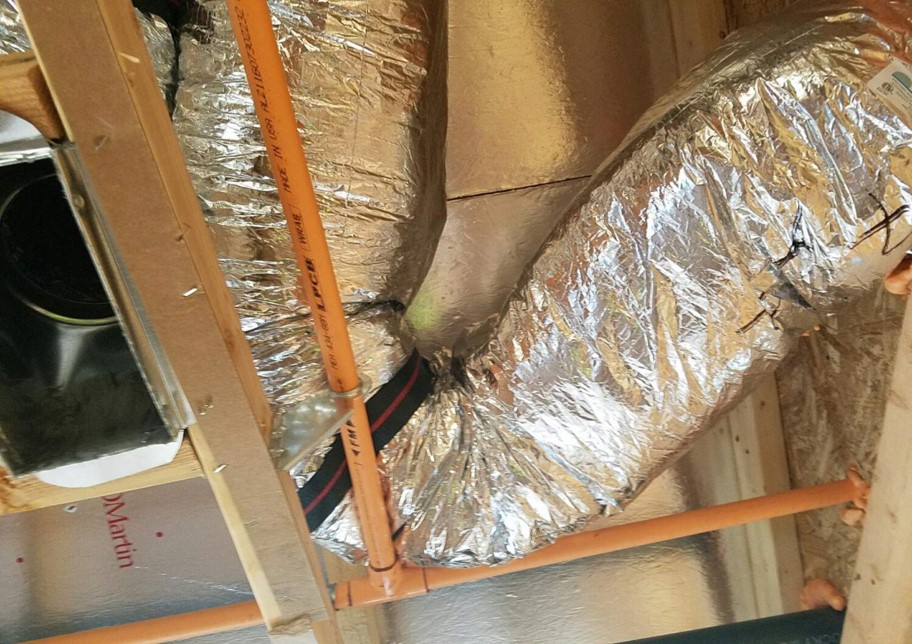
My friend just had a new heat pump installed and he said it's not any better than his old system. When I looked at the picture it looks like the air coming out of the air handler would not flow smoothly and would create pressure. It's like that at the floor as well.
Any thoughts would be appreciated.

New system


Old SystemHP-001.jpgHP-005_1.jpg
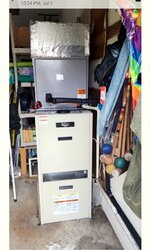
AnyConv.com__HP 004.jpg
 
To avoid these ads, REGISTER NOW!

Bert_

Well-known member
Joined
Dec 24, 2016
Messages
9,776
Location
NW Iowa
That tight 180 is definitely not doing him any favors. Both return and supply come through the floor?
 

isb cornbinder

Well-known member
Joined
Nov 3, 2010
Messages
7,073
Location
Pacific South West, BC, Canada
One of our companies is an HVAC business. I have seen and build miles of duct-work. I do not think your duct has a problem.
"it's not any better than his old system. " does not have any meaning. The system works or does not work. Has this fiend taken any flow and temperature readings at the outlets? Is his space suddenly a different temperature and not controllable?
 

fitter30

Well-known member
Joined
Jun 23, 2019
Messages
2,992
Location
Peace Valley,mo
Guess this Is a lowboy furnace that's oil fired. Supply side duct should be larger when it transitions from vertical to horizontal back to vertical even with turning vanes in the 90s the pressure drop is going to be very high with that duct. Looking at the sideview of the ac coil air through the coil is fighting itself to get out and down the duct. If the ac coil is a multi position could be moved to the supply back of furnace then the supply off the furnace could be made larger and the supply to the coil would be as turbulent. I would of used a downflow furnace then the return would enter from the top and a transition piece would be directly over the supply. Ac lines going to be a problem with the flue?
 

danski0224

Well-known member
Joined
Jan 29, 2005
Messages
13,522
Location
Near Naperville, IL
That's 100% **** ductwork.

The inside corner of the top elbow is equivalent to at least 120 x 2 lineal feet of straight duct (two 90 degree elbows w/o turning vanes), all by itself. It's extra special effed up because it's a 180. It's worse because it's right on top of the evaporator coil.

Same goes for any other 90 degree elbow within a few feet of the blower motor.

I am assuming that there are no turning vanes in those elbows.

ACCA Manual D has pictures in the Appendix :)

Looks like a low bid box swap job to me. Could be a high bid, too. Hard to get people to understand airflow and how to fix it, much less get them to pay for it.
 
Last edited:
To avoid these ads, REGISTER NOW!

danski0224

Well-known member
Joined
Jan 29, 2005
Messages
13,522
Location
Near Naperville, IL
And you know this because?
Look in ACCA Manual D, in the back... the pictures.

Any square throat elbow located near the air handling equipment is equivalent to 120 lineal feet of straight ductwork.

IF the square throat elbow has CORRECTLY installed turning vanes, OR if the elbow has a properly sized radius throat (yeah, slapping a 4" radius throat in there won't help), equivalent length goes down to 20 feet.

Replace cap and tap **** like the picture with proper fittings = YUUUUUUGE difference in airflow. The lack of a plenum on top of the coil is a problem, too.

****** all around. Sorry. Not sorry.

The store bought/supply house bought elbows with the radius heel (back side) and square throat do NOT help airflow. They do use a tiny bit less metal and are therefore cheaper to make... and look like they do something... but don't.
 
OP
G

gagecalman

Well-known member
Joined
Feb 5, 2020
Messages
198
Location
MD
****** all around. Sorry. Not sorry.

The store bought/supply house bought elbows with the radius heel (back side) and square throat do NOT help airflow. They do use a tiny bit less metal and are therefore cheaper to make... and look like they do something... but don't.
Thanks for the replies. I'm always trying to learn.

I didn't understand your info about the elbows so I looked it up.
I assume this is what you're talking about in Exhibit 9:


Thanks again.
 

FredWanaker

Well-known member
Joined
Mar 27, 2021
Messages
1,470
Location
NorCal
unless you test it to see what the pressures are, and compare it to the manufacturer's specs, you are wasting your time. We all know that a bumblebee is not shaped properly to be able to fly.
 

danski0224

Well-known member
Joined
Jan 29, 2005
Messages
13,522
Location
Near Naperville, IL
unless you test it to see what the pressures are, and compare it to the manufacturer's specs, you are wasting your time. We all know that a bumblebee is not shaped properly to be able to fly.
Have you measured airflow?

It would be difficult to get accurate and repeatable airflow measurements on that ductwork. Static pressure would be ok, but that by itself won't necessarily tell the whole story.

However, I can tell by just looking at it that the airflow is quite bad.

There's an old bubble video on YouTube that shows airflow in ductwork.

This science isn't new, the properties were established a long time ago.
 

fitter30

Well-known member
Joined
Jun 23, 2019
Messages
2,992
Location
Peace Valley,mo
One of our companies is an HVAC business. I have seen and build miles of duct-work. I do not think your duct has a problem.
"it's not any better than his old system. " does not have any meaning. The system works or does not work. Has this fiend taken any flow and temperature readings at the outlets? Is his space suddenly a different temperature and not controllable?
We have no idea what problems their ac and the furnace had had with terrible air flow. Just because it was originally installed like that doesn't mean it's correct and can't be improved. Read my post #5. Bad duct design cost money in repairs and electric. High static take more blower hp to get the same cfm.
 

FredWanaker

Well-known member
Joined
Mar 27, 2021
Messages
1,470
Location
NorCal
and my point was that until someone tests static pressures they don't know what they are. A system can look awesome and have poor static pressures. Another system can look funky and have good pressures. That said. 180 square turns aren't the way air likes to flow. I used to port heads and manifolds for winning racing teams, and I have done static pressure testing on HVAC systems. A very reputable Carrier dealer installed my ducting using all their sophisticated software and charts, and when they were done, I was still able to improve on it significantly.
 
To avoid these ads, REGISTER NOW!
Top Bottom