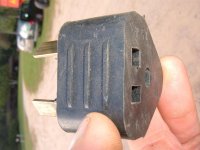
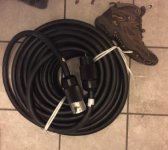
So I have a bunch of free time and am building a pretty neat small welding table/welder cart that's on caster wheels with electrical plug-ins built in. I want to not have extension cords running everywhere on my floor.
What I want to do is primarily have it hooked up to a 220v 50a outlet on the wall to power my welder, also I want to take one leg of 110v and power a row of outlets for my angle grinders and whatnot. To me that's simple and easy to do, but what I want to incorporate and am not sure about is the ability to just plug my table into 110v input power to use only my power outlets and not my welder.
I see a problem with this idea though, when the table is plugged into 220v I will have a live 110v male plug (and a live 110v leg on my 220v male plug with 110v plugged in) and that seems a bit unsafe to me. What I want to do is have a switch (I'm imagining an old swinging contact type of switch) that can disconnect the 110v imput while 220v is plugged in and disconnect the 220v when 110v is plugged in.
Does a switch like that exist?
Hopefully that description is easily pictured without a diagram. Picture for attention
FYI the voltage is 120/240v not 110/220v
There are several problems here with your idea. The first is there is no neutral in a 6-50p, which has already been pointed out to you.
The second is the outlet is breakered @ 50a and you cannot use one of the legs to power some 5-15 receptacles even if you did have a neutral. You would need secondary overcurrent protection. Otherwise, you can have big problems if the 5-15r and wiring was overloaded.

Maybe instead fab up a short pigtail to plug the welder plug into a standard outlet and power the one leg to your 110 outlets on the cart?
say what?
how would he power a 240v welder from a 120v outlet?


So I'll never be able to run a 110v outlet from a 220v leg because there is no neutral? Tangent question but what does the neutral do in a circuit?
Hard stop.
Since you dont know the basic fundamentals of electricity such as what a neutral is, you really shouldnt be doing any wiring at all.
Go grab an intro book on electricity and educate yourself first.
The neutral aka grounded conductor is used in tandem with an ungrounded conductor to provide 120v. 2 ungrounded conductors provide 240v. This is on a split phase single phase service.
Like I said I have lots of time, and why? Because I guess. Adding a small breaker for 20a wasn't out of the question, but it sounds like the no neutral thing prevents this working. Unless there is some way to get around this?
And this is just my garage, so as long as I don't mess my tools up or catch fire and it looks decent I'm happy with it. Not really a code kinda guy.
If you have lots of time go checkout some electrical 101 books and read them.
What you propose to due here WILL create a potential for fire...
It may be hard to believe but the electric code guys didn't come up with it because they didn't have anything better to do. Some of it been in place for over 100 years. I do a few service calls, one might be amazed at how many issues caused by seemingly minor code violations.
On top of the breaker, the wire there is also the gfci. I worked with a guy, company owner "hates" gfci. Also not a "code kinda guy" but reason he does is that his stuff is junk, type who intentionally rips ground pin out of a new cord, ratty old cords, just junk, I am amazed osha ain't ran him out. Doesn't believe in box connectors, Rome thru sheet metal holes and proud of it, can't be troubled to tighten a ground screw.
wow
Ok that's fine and all that, I'm under advisement. Check the box thank you.
Thinking about my neutral wire situation, I've had several welders in the past that have had 110v outlets built in to run water coolers, I've even seen one run a little grinder for tungsten sharpening. How does that work, is the second leg of the 220v plug acting as a neutral wire in this case?
remember its 120v/240v
An ungrounded conductor can never be a neutral so no its not acting as a neutral wire.
What is going on in those welders is there is a step down transformer along with secondary overcurrent protection for those outlets on the welder.
To be blunt, youve spent more time thinking and typing about how to do this than the time it wouldve taken to grab an extension cord and plug it into a bench mounted power strip. *facepalm*