That1Guy
Well-known member
OK, my question is about my house boiler/furnace. It's a weil McLane "boiler" but water temp is right at 180*F so... no boiling in this boiler. My issue, or question, is about the air separator (or lack thereof) on this home boiler. It does technically have a separator but it is basically useless because of where they located it in the system. Again, keep in mind these are my NONPROFESSIONAL opinions so whatever that's worth. And yes, I did try the search option but didn't really come up with anything usable....
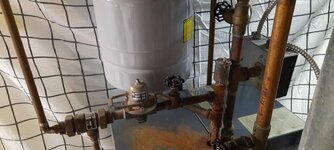
You can see in the pictures below that the air eliminator is between the fresh water valve and the rest of the boiler. As new water is introduced to the boiler, it passes the combo check valve / pressure relief valve, past the pressure reducing valve, past the shut-off valve and into the Tee where the air separator is. Unless I'm mistaken, the water will only pass by this separator one time - as it first enters the boiler - and never again.
It seems like there should be a big ol 4900 series eliminator installed in the 1" pipe coming out of the top of the boiler, past the Tee for the control box, past the valve and elbow where it turns horizontally. In the short horizontal section of pipe, I'm seriously considering tucking an air eliminator right there. The small OE eliminator has been sticking open and causing a lot of corrosion. I dropped the ball this past Spring and didn't clean and grease the boiler when I took it out of service - my bad. As I was looking it over it occurred to me that it's no wonder there is always air in the system since the water only passes over it once with this current setup.
I am replacing 3 of the zone valves because our water is so hard and mineral dense, these valves don't last but maybe 10 years if I'm lucky. Since I'll be sweating new valve housings on, maybe it'd be a good time to introduce a real air eliminator to this system while I'll have it apart anyway. Again, I'm no professional and I know just enough to be dangerous - but I do enjoy doing the DIY thing whenever possible - whether it saves me money or not. I just like DIY. I just wanted to hear from others to see what all ya'll thought. Maybe there's a reason for such a poorly placed eliminator - I dunno. On some of the slat-finned registers, the elbows have a tiny bleeder valve that is all but useless. Of the countless times I've used these bleeders, seldom has there ever been any noticeable air bled off from these bleeders. Even so, I drain them every year - very frustrating.
So, looking at the pictures, can anyone explain this setup for me? Maybe it's nothing, but maybe it's something after all. I just dont want to add an air eliminator if it's going to either reduce the efficiency or have no effect at all. Either of those situations is a big waste of time and money.
Maybe it's not supposed to have an eliminator - I dunno. Any input is appreciated.
You can see in the pictures below that the air eliminator is between the fresh water valve and the rest of the boiler. As new water is introduced to the boiler, it passes the combo check valve / pressure relief valve, past the pressure reducing valve, past the shut-off valve and into the Tee where the air separator is. Unless I'm mistaken, the water will only pass by this separator one time - as it first enters the boiler - and never again.
It seems like there should be a big ol 4900 series eliminator installed in the 1" pipe coming out of the top of the boiler, past the Tee for the control box, past the valve and elbow where it turns horizontally. In the short horizontal section of pipe, I'm seriously considering tucking an air eliminator right there. The small OE eliminator has been sticking open and causing a lot of corrosion. I dropped the ball this past Spring and didn't clean and grease the boiler when I took it out of service - my bad. As I was looking it over it occurred to me that it's no wonder there is always air in the system since the water only passes over it once with this current setup.
I am replacing 3 of the zone valves because our water is so hard and mineral dense, these valves don't last but maybe 10 years if I'm lucky. Since I'll be sweating new valve housings on, maybe it'd be a good time to introduce a real air eliminator to this system while I'll have it apart anyway. Again, I'm no professional and I know just enough to be dangerous - but I do enjoy doing the DIY thing whenever possible - whether it saves me money or not. I just like DIY. I just wanted to hear from others to see what all ya'll thought. Maybe there's a reason for such a poorly placed eliminator - I dunno. On some of the slat-finned registers, the elbows have a tiny bleeder valve that is all but useless. Of the countless times I've used these bleeders, seldom has there ever been any noticeable air bled off from these bleeders. Even so, I drain them every year - very frustrating.
So, looking at the pictures, can anyone explain this setup for me? Maybe it's nothing, but maybe it's something after all. I just dont want to add an air eliminator if it's going to either reduce the efficiency or have no effect at all. Either of those situations is a big waste of time and money.
Maybe it's not supposed to have an eliminator - I dunno. Any input is appreciated.