To avoid these ads, REGISTER NOW!

Don’t complain about your garage wiring

Shiftless

Well-known member
Joined
Mar 9, 2014
Messages
14,579
Location
East Bay SFO
I was in an old timer’s garage this afternoon.
I first noticed his forgotten ‘37 ? Chevy
But soon after, I looked up and saw his garage lighting.
Hey...coulda been worse...way better than just ONE bulb! :)
 

Attachments

  • B70ED602-2AA6-4D34-A69A-D0024CB4F706.jpg
    B70ED602-2AA6-4D34-A69A-D0024CB4F706.jpg
    154.9 KB · Views: 933
  • 30085229-D1CC-458C-9992-CC0C30A56FE7.jpg
    30085229-D1CC-458C-9992-CC0C30A56FE7.jpg
    116.8 KB · Views: 1,069
To avoid these ads, REGISTER NOW!

rooster4321

Well-known member
Joined
Jan 22, 2018
Messages
62
So the lighting and wiring was from 1937 also sweet car

Sent from my KYOCERA-E6560 using Tapatalk
 

Bert_

Well-known member
Joined
Dec 24, 2016
Messages
9,775
Location
NW Iowa
It's actually pretty safe as long as nobody has screwed around with it to much. I think it's kind of neat to see.
 
OP
S

Shiftless

Well-known member
Joined
Mar 9, 2014
Messages
14,579
Location
East Bay SFO
It's actually pretty safe as long as nobody has screwed around with it to much. I think it's kind of neat to see.

Thanks for saying that Bert. And I agree with you about relative safety.
I knew a few of you guys would appreciate seeing that blast from the past.
 

Citation

Well-known member
Joined
Jan 20, 2016
Messages
3,223
Location
Indy
On Saturday I looked at a house with that type of wiring... no idea if parts were still active but it did have a lot of 2 pron outlets.

I hate (owning) old houses.
 

checkthisout

Well-known member
Joined
Sep 5, 2008
Messages
5,232
It looks awesome. Imagine the step up that was from having to carry a candle or lantern.
 

mm08822

Well-known member
Joined
Jan 13, 2012
Messages
6,045
Location
NJ
Some years back, I did a couple of wiring upgrades in older homes that were originally knob and tube. While it sure didn't seem to compare to bx of the day, it was pretty durable if left alone. I wish I had kept a few insulators and sleeves instead of smashing each one gone. The taps were so meticulously twisted and wrapped.

Only time it ever concerned me was finding 30a fuses in the panel or when someone had modified it.
 

MrDeerHunter

Well-known member
Joined
Nov 19, 2017
Messages
110
Some years back, I did a couple of wiring upgrades in older homes that were originally knob and tube. While it sure didn't seem to compare to bx of the day, it was pretty durable if left alone. I wish I had kept a few insulators and sleeves instead of smashing each one gone. The taps were so meticulously twisted and wrapped.

Only time it ever concerned me was finding 30a fuses in the panel or when someone had modified it.
You mean copper tube fuses?

Sent from my Moto Z (2) using The Garage Journal mobile app
 
OP
S

Shiftless

Well-known member
Joined
Mar 9, 2014
Messages
14,579
Location
East Bay SFO
You mean copper tube fuses?

Sent from my Moto Z (2) using The Garage Journal mobile app

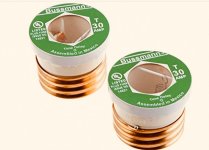
I have seen Edison base 30 amp fuses (protecting 14 ga. wire) screwed into old fuse panels. That’s what’s scary.
In my opinion, 30 amp Edison base fuses should not be readily available to clueless consumers in hardware stores. How many legitimate uses are there for 30 amp screw in fuses? It’s a public safety issue. Especially in cities, if my stupid neighbor sets his house on fire, my house might catch too.
 

Attachments

  • 4078D49A-D641-420D-A469-E1D3076B2CBB.jpg
    4078D49A-D641-420D-A469-E1D3076B2CBB.jpg
    89.8 KB · Views: 83
Last edited:

JRC3

Well-known member
Joined
Jun 30, 2014
Messages
12,481
Location
Southwestern OH
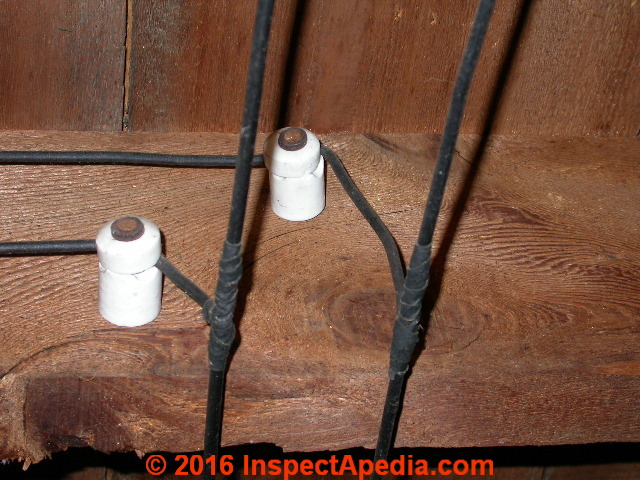
Knob_and_Tube_Wiring438-DFs.jpg


Only problem with old wiring is people plugging space heaters and window a/c units and other big devices into it. Back then all the branch connections were made by stripping a little insulation, then twisting the branch wire around and then wrapping it with friction tape. No wire nuts or screws...And certainly no box to contain it when things get overloaded.

In rental properties with old knob and tube I've ran new dedicated circuits near windows with instructions to use them for things like window units or space heaters.

In a friend's rental they had some grow lights in a bedroom closet and it started a fire in the attic. Of course they contained it and didn't call the FD. They also didn't report it to the landlord and we didn't discover it til they were evicted. There are obvious reason why. I'll see if I can find a pics of the damage and the wires that started it.
 

pancho400cid

Well-known member
Joined
Sep 26, 2014
Messages
4,527
Location
Austin, TX
Very interesting. When did that knob&tube stuff go out of vogue?

I have a house built in the 50's (long after knob an tube) and have found "rag" insulated 2-conductor with no ground in lots of places (whole house a t one time I assume). What amazed me was that the joints were made with solid porcelain wire nuts. The nuts did not have metal teeth.
 

AntonLargiader

Well-known member
Joined
Nov 20, 2016
Messages
1,372
Location
Charlottesville, VA
K&T isn't all rosy nostalgic wonderfulness. As mentioned, it's hard (not impossible) to modify well and modification is common in electrical systems. I've never seen grounded K&T, and the fabric insulation doesn't withstand abrasion well. Fabric-wrapped wires rubbing against those tiny steel wall boxes isn't a great mix. And because the conductors are separated so far, it's terrible for EMI.

Yes, it was usually done with good workmanship. That's not really a K&T thing, it's a good workmanship thing same as elaborate piping for air-operated HVAC dampers.
 

Bert_

Well-known member
Joined
Dec 24, 2016
Messages
9,775
Location
NW Iowa
Here's an old one I pulled a couple years ago. This was nailed right to the floor joists of the basement ceiling, exactly as you see it. These three circuits powered the whole house except for the range, water heater, and dryer which were served by another 60A disconnect.
47997469107_73a37ca155.jpg

47997462788_e0fa3f4fe8.jpg


If you look carefully you can read "To plant, #10 wire" Plant meaning lightplant or generator. That means this was installed prior to rural electrification in the late '30's, I would guess in the '20's. It was still working fine until about 3 years ago. Almost felt bad taking it out, if it had been my own house I probably would have left it as a piece of history. I know of one other local house that still has a service like this screwed to the siding in a porch about 6 1/2' high.
 

Bert_

Well-known member
Joined
Dec 24, 2016
Messages
9,775
Location
NW Iowa
I have seen Edison base 30 amp fuses (protecting 14 ga. wire) screwed into old fuse panels. That’s what’s scary.
In my opinion, 30 amp Edison base fuses should not be readily available to clueless consumers in hardware stores. How many legitimate uses are there for 30 amp screw in fuses? It’s a public safety issue. Especially in cities, if my stupid neighbor sets his house on fire, my house might catch too.

I know what you mean, most of the fuse panels I change are full of 30A fuses. Legitimate uses are common though, electric water heater, dryer, air conditioner, well pump, just to name a couple.
 
OP
S

Shiftless

Well-known member
Joined
Mar 9, 2014
Messages
14,579
Location
East Bay SFO
Thanks, Bert
That’s a great memento.

To address pancho’s question...

Very interesting. When did that knob&tube stuff go out of vogue?

I have a house built in the 50's (long after knob an tube) and have found "rag" insulated 2-conductor with no ground in lots of places (whole house a t one time I assume). What amazed me was that the joints were made with solid porcelain wire nuts. The nuts did not have metal teeth.

....................................................................................................

My first house was built in 1941. It had knob and tube wiring all up in the attic and true plaster walls...no Sheetrock. And galvanized iron water pipes. (And in the dining and living rooms original random width oak plank flooring with walnut pegs) definitely old school.
Sold that one for the one we’re in now..much newer...1951 :)
2 conductor NM cable with soldered wires and friction tape, Sheetrock, copper pipes, plywood floors.
 
Last edited:
To avoid these ads, REGISTER NOW!

roll_the_dice

Well-known member
Joined
Apr 23, 2017
Messages
69
Location
Savannah, GA
...

My first house was built in 1941. It had knob and tube wiring all up in the attic and true plaster walls...no Sheetrock. And galvanized iron water pipes. (And in the dining and living rooms original random width oak plank flooring with walnut pegs) definitely old school.
Sold that one for the one we’re in now..much newer...1951 :)
2 conductor NM cable with soldered wires and friction tape, Sheetrock, copper pipes, plywood floors.

I'll take plaster walls and random width oak plank flooring every day over sheetrock and plywood floors...
 

roll_the_dice

Well-known member
Joined
Apr 23, 2017
Messages
69
Location
Savannah, GA
except for good sound deadening, no screws or seams popping .
granted drywall is nice & flat and square corners, and easier to work with in reno's and repairs.
I'd take a nice plaster home over an equal drywall home any day

Also I don't care if the walls are 100% flat...I'll take a house with character over a cookie cutter house any day.
 

roll_the_dice

Well-known member
Joined
Apr 23, 2017
Messages
69
Location
Savannah, GA
There is nothing good about plaster and lath. Nothing.

Drywall was invented in 1916. The United States Gypsum Corporation, a company that vertically integrated 30 different gypsum and plaster manufacturing companies 14 years prior, created it to protect homes from urban fires, and marketed it as the poor man's answer to plaster walls.

Much like what my mom would say about today's brick homes...they are not real brick...but brick clad. A real brick house has multiple layers of brick or solid brick....how times have changed things and the "poor man's answer" has become the standard. I will take my project house in upstate NY with 12" thick stone walls over any brick/stone house built today.
 

Citation

Well-known member
Joined
Jan 20, 2016
Messages
3,223
Location
Indy
There is nothing good about plaster and lath. Nothing.

Having lived in houses with drywall, drywall over plaster and plaster (current) I don't agree.* Plaster walls are solid and durable. I'm less concerned with my kids poking a hole in a plaster wall vs drywall. I also believe they are better at blocking noise. Also, if you are brave, you can do fancy transitions with plaster.

*I hate having plaster walls in my house and I never want to live in a house with such walls again. Pain in the *** to fix/modify anything. Drilling dulls drill bits as if you were drilling concrete. Nails don't reliably go into the walls and it's impossible to find the stud behind the wall if you want to attach something to the structure. To be fair, part of why I never want a house with plaster in the future is because houses with plaster typically come with other issues like old wiring, old plumbing etc. Also, my comment about plaster stopping sound is typically a mute point since often the same house has hardwoods vs carpet and large gaps under doors (which are often older doors that have flat center panels that don't stop noise) results in a house with poor noise control. My wife loves the character of older homes. I would rather have a home that works and that I can fix when it doesn't.
 

checkthisout

Well-known member
Joined
Sep 5, 2008
Messages
5,232
I agree that plaster is more solid and has better sound deadening.

The bad thing is the lack of insulation that generally goes hand in hand with such wall systems from era.
 

Dh3256

Well-known member
Joined
Mar 19, 2018
Messages
1,145
Drywall was invented in 1916.


Rocklath was invented in 1888 - basically 2' x 4' plaster panels that were installed instead of wood lath and a base coat of plaster. The brown and finish coats were then applied over the rocklath "drywall".
 

bwringer

Well-known member
Joined
Jan 1, 2013
Messages
10,318
Location
Indianapolis
Our office is a house built in 1906 in an old neighborhood in Indy; that old plaster and lath with horsehair is a stone cold ***** to work with when you need to wire up a network and add a couple dozen network boxes. We wore out several carbide bits in a Rotozip.

Before we moved in, we had all the plumbing redone with pex and replaced the last of the old knob and tube wiring. That stuff was downright scary.

On the plus side, century-old oak framing is incredibly strong and hard (a pain if you need to drill to run wiring, though), and we reconditioned most of the original oak and pine floors. The plaster walls don't really carry sound, but they do create echoes similar to concrete. So noise doesn't get in, but every little noise bounces around inside those stone-hard walls.
 

Jim greengo

Well-known member
Joined
Sep 3, 2018
Messages
7,415
Location
Behind my house
Nothing wrong with original unmolested knob and tube wiring,its when people start butchering stuff into it that you have to worry
 

dutchgray

Well-known member
Joined
Sep 28, 2014
Messages
6,469
Location
Dorset. England.
I have seen Edison base 30 amp fuses (protecting 14 ga. wire) screwed into old fuse panels. That’s what’s scary.
In my opinion, 30 amp Edison base fuses should not be readily available to clueless consumers in hardware stores. How many legitimate uses are there for 30 amp screw in fuses? It’s a public safety issue. Especially in cities, if my stupid neighbor sets his house on fire, my house might catch too.

You should see the old rewireable fuse holders we used to use here in the UK, still plenty in service as well, the holder might say 5, 10, 15 or 30 amp but could have any size of wire in it, or nails, paper clips, hair pins or anything else, also if the wire was installed badly and left long you can have a nice live 240v stub sticking out right where you grab the holder to pull it, they also liked to arc to the fuse panel case when they blew if the fuse holder cover was left off (which they often were) which would take out the main incoming 100A cartridge fuse.
 

acer66

Well-known member
Joined
Dec 4, 2010
Messages
4,418
Location
Western North Carolina
The problem I see often with knob and tube wiring is that people put insulation around it but as said before if it is in good condition it is okay.
 

rlitman

Well-known member
Joined
Oct 18, 2010
Messages
24,651
Location
Long Island
...I have a house built in the 50's (long after knob an tube) and have found "rag" insulated 2-conductor with no ground in lots of places (whole house a t one time I assume). What amazed me was that the joints were made with solid porcelain wire nuts. The nuts did not have metal teeth...

My house is from 1929, and had a lot of 12 gauge armored cable with those porcelain wire nuts. The copper was tinned its entire length, and splices in boxes were twisted and soldered before being capped by the porcelain nuts and then wrapped in friction tape.

FYI, they still make and sell those porcelain wire nuts. They're now used in high heat applications. A replacement range ignitor will come with them for example.
 

jetnow1

Well-known member
Joined
Jun 27, 2016
Messages
511
Location
CT.
Just do not bury Knob and tube in insulation, it can start fires if you do.
 

sberry

Banned
Joined
Jun 18, 2005
Messages
35,747
Location
Brethren, Michigan
It might work, it could be safe but it really isn't ok. Lots of original stuff tapped on those circuits, that wire has been obsolete for decades, its not grounded. In this scenario looks like the lights which are usually off are on it but looks like newer cable in the pictures which I suspect is for outlets. This really doesn't look like a working shop.
I was in an old house recently, one of the original circuits went all over the place with all kinds of splices added to it. Other circuits had been added but lots of now random outlets connected to this 1 old circuit.
 
Last edited:

bwringer

Well-known member
Joined
Jan 1, 2013
Messages
10,318
Location
Indianapolis
Nothing wrong with original unmolested knob and tube wiring,its when people start butchering stuff into it that you have to worry

Father Time molests everything. Even if the K&T is untouched, it's at best a huge potentially disastrous unknown after 70-80 years.
 

TractorJeff

Well-known member
Joined
Dec 8, 2013
Messages
3,309
Location
Elkhorn, WI
Some years back, I did a couple of wiring upgrades in older homes that were originally knob and tube. While it sure didn't seem to compare to bx of the day, it was pretty durable if left alone. I wish I had kept a few insulators and sleeves instead of smashing each one gone. The taps were so meticulously twisted and wrapped.

Only time it ever concerned me was finding 30a fuses in the panel or when someone had modified it.

Good Edison splices (twisted, soldered, wrapped) are actually better than anything else!
Problem is all the added modern splices that create the hazard!
Remember these were for a few Lights, Radio and the Clothes Iron! :thumbup:
 

sberry

Banned
Joined
Jun 18, 2005
Messages
35,747
Location
Brethren, Michigan
Heck,,, I am already replacing cable I installed in a couple cases.
But I agree totally about the stuff added to KT, found some on a job rather recently.
 

38Chevy454

Well-known member
Joined
Dec 26, 2006
Messages
4,036
Location
Cincinnati, OH
Interesting to see the old K&T wiring still in place and functioning.

BTW, that is a 34 or 35 Chevy coupe I believe, hard to see exactly in the pic. Not a 37, as no such thing as a 3W style coupe in 37, plus different body lines started in 37.
 

Bert_

Well-known member
Joined
Dec 24, 2016
Messages
9,775
Location
NW Iowa
Interesting to see the old K&T wiring still in place and functioning.

There is tons of it still out there. All the lights in my upstairs and at least one room downstairs are still knob and tube. I had a section of the travelers (knob and tube) for the 3 way switch in the stairway exposed a while back. They were in good shape and I didn't want to make more holes to replace them so I covered it back up. Doesn't worry me in the least.
 
To avoid these ads, REGISTER NOW!
Top Bottom