To avoid these ads, REGISTER NOW!

Doorbell Wiring: 2 Buttons, 2 Chimes, 2 Transformers

Steve933

Member
Joined
May 29, 2023
Messages
5
I'm awaiting delivery of a Eufy wired video doorbell so I'm planning the installation. My home currently has front and rear doorbell buttons (one will be replaced by the Eufy), and 2 mechanical chimes. Pressing the front door button causes both chimes to "ding-dong" while pressing the back door button results in just "ding" from both.

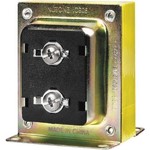
I needed to check the transformer amperage to determine whether I'd need to replace it with one of higher amperage. I expected to find only one transformer. Instead, I found one behind each chime. BTW, this is all original wiring. The transformers are identical (Broan C905, 16V 10VA). My rough guess is the chimes/transformers are about 75 feet apart.

The only thing that makes sense to me is that a single 10VA transformer would have been insufficient to power both chimes over the distance, so the electrician wired two 10VA transformers in parallel. Are there any other possibilities? Is there a way I can confirm using a multimeter without running a 75' wire to test continuity?

If they are in parallel, am I correct in assuming that I can replace one of the transformers with a new 30VA and remove the other 10VA entirely? I know I shouldn't wire two dissimilar transformers in parallel.

Thanks!
 
To avoid these ads, REGISTER NOW!

Zeke

Well-known member
Joined
Aug 13, 2009
Messages
17,176
Location
Long Beach CA, the sewer by the sea.
The 'transformers' in the chimes act on the plunger assuming you have mechanical chimes. And they are coils, not transformers. They don't produce current. Well, they do, but it doesn't run the system.

Sounds like you don't know your volts from amps. I came back to edit my post. Coils, not transformers.
 
Last edited:

dogdog

Well-known member
Joined
Nov 15, 2011
Messages
12,711
I say upgrade to a 24v 40VA. as long as your wiring supports it. 24v are common on hvac stuff as well.

as far as a ding instead of ding dong... it might be the door bell as well... the ding can either be too week VA when it reach the door bell with the voltage drop or defective rubber isolation piece (had that happen)

as far as testing the wire to make sure... bring the door bell closer at the transformer and check if it works well ? if it does work then you can reason out something.
 

Innovate1

Well-known member
Joined
Jul 28, 2014
Messages
4,299
Location
Illinois near St. Louis, Missouri
Front ding-dong and back ding is standard - that's how you know which door they are at so nothing wrong with your current system. There are coils in the bell - solenoids that move the part that makes the sound - but the number you gave is for a transformer so I think your description is fine too and not referring to the coils for the bell. Two transformers with two chimes with the same buttons seems a bit strange but since both are the same it could be parallel connection of both at the push buttons - I think that is the most likely case. You could replace both with a single bigger transformer but then you would need to feed that to both chimes so you need to trace out the existing wiring to see if you can do that without adding wires. If not you should be able to replace both with the same model transformer of at least 20 watts since both feed to the doorbell buttons and that would give you a total of 40 watts.
 
OP
S

Steve933

Member
Joined
May 29, 2023
Messages
5
Front ding-dong and back ding is standard - that's how you know which door they are at so nothing wrong with your current system. There are coils in the bell - solenoids that move the part that makes the sound - but the number you gave is for a transformer so I think your description is fine too and not referring to the coils for the bell. Two transformers with two chimes with the same buttons seems a bit strange but since both are the same it could be parallel connection of both at the push buttons - I think that is the most likely case. You could replace both with a single bigger transformer but then you would need to feed that to both chimes so you need to trace out the existing wiring to see if you can do that without adding wires. If not you should be able to replace both with the same model transformer of at least 20 watts since both feed to the doorbell buttons and that would give you a total of 40 watts.
Yes, that's exactly what I was trying to explain. I didn't mean to imply that the existing configuration wasn't working correctly. I was just trying to give the details as background info. I apologize for "over-explaining." I'm simply preparing to install the new video doorbell which requires more amperage, and was surprised to find two transformers in the same circuit.

I like your suggestion of using two higher-rated transformers. That's the way I'll go.

Thanks very much!
 

dave*99

Well-known member
Joined
May 5, 2009
Messages
4,286
Location
Coastal NJ
The 'transformers' in the chimes act on the plunger assuming you have mechanical chimes. And they are coils, not transformers. They don't produce current. Well, they do, but it doesn't run the system.

Sounds like you don't know your volts from amps. I came back to edit my post. Coils, not transformers.
Yet the OP said
The transformers are identical (Broan C905, 16V 10VA)
Hmmm. Sounds like they are in fact transformers.

1685464951806.png
 
Last edited:
To avoid these ads, REGISTER NOW!
OP
S

Steve933

Member
Joined
May 29, 2023
Messages
5
Yet the OP said

Hmmm. Sounds like they are in fact transformers.

1685464951806.png
Yep, that’s it. I’m guessing there was one in a kit with each chime so the electrician just wired them in parallel rather than use one larger one.

I’m going to follow the advice above and replace the two 10 amp transformers with two 30 amps of the same voltage. Should be the easiest solution and give me plenty of power.
 

dogdog

Well-known member
Joined
Nov 15, 2011
Messages
12,711
Yep, that’s it. I’m guessing there was one in a kit with each chime so the electrician just wired them in parallel rather than use one larger one.

I’m going to follow the advice above and replace the two 10 amp transformers with two 30 amps of the same voltage. Should be the easiest solution and give me plenty of power.
VA is not amp... you don't need two unless you wanted to... one 40VA one at 24V is good for both.
 

FredWanaker

Well-known member
Joined
Mar 27, 2021
Messages
1,470
Location
NorCal
as I recall, many chimes have two different connections - a front and a back screw. The back connection produces a different sound than the front connection. I am guessing that the connection screws on the chimes are (1) common (2) front (3) back.

With the transformers wired in parallel the voltage does not increase but the ability to put out more current does. So if one transformer is 16V 10VA then two in PARELLEL are 16V 20VA. VA is another way of saying watts. The camera requires 16 volts to 24 volts at 40 VA (watts). You can put in one 16V - 24V 40VA transformer or two 16V - 24V 20VA transformers in parallel. If you use two you will have to verify the phasing of the two, which your electrician did for you on the other two.

Some cameras have a device that has to go in the circuit for the camera to work right, or damage can result. I THINK that goes between the ground screw and the front screw on the chime, but you will need to refer to the installation instructions on that. You will also need to have WI-FI available in the house, with a wi-fi router capable of DHCP, for the camera to be able to pass the signal to you.
 
OP
S

Steve933

Member
Joined
May 29, 2023
Messages
5
dogdog: Right. Don't know what I was thinking, I meant VA instead of amps--thanks for the correction.

Fred: My chimes are exactly as you described. I don't have the camera yet, but I do recall reading somewhere about using a jumper for an existing chime. I'll make sure to read up on that.

Thanks for all the comments. Appreciate the help!
 

dogdog

Well-known member
Joined
Nov 15, 2011
Messages
12,711
What he meant was that some cameras short them self when the button on the door cam is pressed. Acts like a button when pushed. So it needs a load at the end like a door bell or a big watt rated resistor, or the transformer die of very young age, possibility the door cam too. There was a thread here about this way back 2020 or 2021 if you search. Don’t remember the thread but pretty sure it shows up if you search for door cam or transformer.
 

FredWanaker

Well-known member
Joined
Mar 27, 2021
Messages
1,470
Location
NorCal
The device is called a power regulator. Some are used on mechanical chimes, some on digital and some on both. They are all sort of like this https://support.ring.com/hc/en-us/a...ing-Pro-Power-Kit-with-your-Existing-Doorbell

I cheated - we have an ADT alarm and the dealer tech, who is really good, was responsible to figure it out. I do the networking stuff but he knew which wire to put where since he has done so many of them. In fact, we left Ring when Amazon bought them and created neighborhood networks where other nearby devices can use your wifi to send thru the Ring camera. We went to EZVIZ but the doorbell camera failed after about a year. The dealer replaced it without charging us. The only downside to cameras is that they use the same frequencies as 7 - 10 year old garage door openers so once all the neighbors added cameras and we added them, we had to replace the opener too.
 
Last edited:
OP
S

Steve933

Member
Joined
May 29, 2023
Messages
5
What he meant was that some cameras short them self when the button on the door cam is pressed. Acts like a button when pushed. So it needs a load at the end like a door bell or a big watt rated resistor, or the transformer die of very young age, possibility the door cam too. There was a thread here about this way back 2020 or 2021 if you search. Don’t remember the thread but pretty sure it shows up if you search for door cam or transformer.
I downloaded the manual for the camera. It shows the jumper being used on the existing chime to short the TF (transformer) and Front terminals. I take that to mean the Eufy wants a direct "no-load" path to the transformer. Even so, I'll search for the posts you referenced and read up. Thanks!
 
To avoid these ads, REGISTER NOW!
Top Bottom