To avoid these ads, REGISTER NOW!

Double nut

bluedog225

Well-known member
Joined
Jan 31, 2012
Messages
3,323
Location
Texas
Is there any advantage to two nuts? šŸ˜‚

Seriously, I know that two nuts is a bad way to try to lock something in place. I’ll use locktite.

I’m specifically wondering where threaded rod fails. Does the rod fail randomly in its length or does the nut fail?

The application is 5/8 threaded rod with heavy hex nuts used to tie rafters to the foundation. With a straight pull, where does rod fail? Im sure the engineers have worked this out. And thought you guys may have run across it.

Thanks
 
To avoid these ads, REGISTER NOW!

mcbane

Well-known member
Joined
Jul 23, 2017
Messages
794
Location
California
Like anchor bolts, quality threaded rod is designed to stretch plastically before it snaps. This is why threaded rods and bolts used in structures sometimes appear loose after an earthquake. With enough cyclical loading it can fail in a brittle manner and you would expect that failure point to be where it is restrained, at an anchor point, where both tension and incidental bending forces might be present.

Ungraded threaded rod from China will suffer a brittle fracture even when subjected to design loads.
 

Firebrick43

Well-known member
Joined
May 12, 2015
Messages
14,230
Location
West central Indiana
Is there any advantage to two nuts? šŸ˜‚

Seriously, I know that two nuts is a bad way to try to lock something in place. I’ll use locktite.

I’m specifically wondering where threaded rod fails. Does the rod fail randomly in its length or does the nut fail?

The application is 5/8 threaded rod with heavy hex nuts used to tie rafters to the foundation. With a straight pull, where does rod fail? Im sure the engineers have worked this out. And thought you guys may have run across it.

Thanks
Adjustability. Many double nut applications on industrial equipment need adjusted from time to time especially, loctite would be a really poor choice in those situations.

Aircraft commonly use double nuts on push pull tubes for flight controls for the same reason

There is nothing inherently wrong with using double nuts anywhere, it’s just cost more and takes up more space. They are better than lock washer, especially the spring split ones
 

nadogail

Well-known member
Joined
Jan 23, 2009
Messages
32,061
Location
Coronado, CA
When weight is a consideration, Double Nuts will have about twice the weight of a single nut and Lock Tight.

This assumes that the weight of the Lock Tight is negligible.
 

Zeus36

Well-known member
Joined
Oct 1, 2016
Messages
814
Location
Ventura, California
Is there any advantage to two nuts? šŸ˜‚

Seriously, I know that two nuts is a bad way to try to lock something in place. I’ll use locktite.

I’m specifically wondering where threaded rod fails. Does the rod fail randomly in its length or does the nut fail?

The application is 5/8 threaded rod with heavy hex nuts used to tie rafters to the foundation. With a straight pull, where does rod fail? Im sure the engineers have worked this out. And thought you guys may have run across it.

Thanks
Two nuts create a mechanical lock vs. a polymer chemical lock with Loctite for fasteners. You also can use the locking nut to drive the threaded rod in or the locked nut to back the threaded rod out. If using Loctite, you would have to destroy the bond then reapply. If vibration was a concern, then the use of two nuts plus Loctite would be a better solution than using either alone. If you really want to be certain, then you can employ aviation safety wire in the mix.
 

strutaeng

Well-known member
Joined
Dec 12, 2011
Messages
2,295
Location
Dallas, TX
No advantage in that application that I can think of.

The only time I specify double nuts is in structural steel construction. Sometimes you want to attach a post to a structure on the ground level but don't want the post to carry unintended load from above (if second floor beams deflect, they will induce load into the post.) So to avoid that, the connection is with a vertical slotted hole on the top of the post to the steel structure.

That detail says something like "hand tighten, back 1/4 turn and..." Options are: tack weld nut, damage threads or double nut. These are usually 5/8 or 3/4 structural bolts.

I specify double nut personally.
 
Last edited:
OP
B

bluedog225

Well-known member
Joined
Jan 31, 2012
Messages
3,323
Location
Texas
Thanks all. It sounds like the rod fails, not the nut. That being the case, a single seems sufficient in this application.
 

finn

Well-known member
Joined
Mar 27, 2005
Messages
16,393
Location
The UP, God's country
Like anchor bolts, quality threaded rod is designed to stretch plastically before it snaps. This is why threaded rods and bolts used in structures sometimes appear loose after an earthquake. With enough cyclical loading it can fail in a brittle manner and you would expect that failure point to be where it is restrained, at an anchor point, where both tension and incidental bending forces might be present.

Ungraded threaded rod from China will suffer a brittle fracture even when subjected to design loads.
I don’t think China, or any other country for that matter, enters into the calculations.

At least that wasn’t a constant or variable in any of the calculations in courses I took in engineering school.
 

WNYflyer

Well-known member
Joined
Sep 13, 2009
Messages
2,124
Location
Lockport, NY
In my world of engineering structures I just make sure that the ASTM grade of nut is one of those recommended in the ASTM specification for the actual bolt/rod material. If I am using the correctly matched nut and bolt/rod per ATSM I doubt the nut is going to fail before the body of the bolt/rod. Double nutting for purely strength purposes only may do something for you but if the nut and bolt/rod are correctly matched double nutting is not required for strength purposes. For anchor bolts for vibration, cyclic loading, etc , using a second nut as a lock nut, staking/damaging the bolt/rod threads and such to keep the first nut from backing off is done. Though I haver done it I have seen anchor bolt nuts wired together in an "S" pattern to the nut of an adjacent anchor bolt such that if the nut tries to back off it can't because the wire is trying to tighten the other anchor bolt's nut. Now structural bolts subjected to vibrations, fatigue cycling we just have them get torqued as required to pre-load them and thus induce a clamping force which resists vibrations, etc.

I have papers on the nut versus rod/bolt thing but seldom have used it since someone has already done the work for the materials I'm typically specifying, i.e matching nut and bolt/rod material.
 

rancherbill

Well-known member
Joined
Oct 18, 2007
Messages
5,336
Location
Foothills County, Alberta, Canada
The application is 5/8 threaded rod with heavy hex nuts used to tie rafters to the foundation. With a straight pull, where does rod fail? Im sure the engineers have worked this out. And thought you guys may have run across it.

Thanks
Assuming you are following a plan or code speced by a technologist or engineer neither will fail in the intended application.

But for the GJ discussion the potential weak spot is the rod. IIRC hardware store rods are grade 2 and their performance characteristics are low. It is used widely to tie down buildings. I gets down to the spec for your application.

https://www.engineeringtoolbox.com/us-bolts-tensile-proof-load-d_2066.html
 
OP
B

bluedog225

Well-known member
Joined
Jan 31, 2012
Messages
3,323
Location
Texas
It’s an engineered structure but this detail is not specified. I’ve got 36ā€-7/8ā€ Simpson SSTB anchor bolts embedded in the foundation with hdu’s to anchor posts at various points.

I’m using coupling nuts and where needed shackle and cable/chain to tie the rafters down to the anchor bolts with additional hdu’s. . I got ā€œgoodā€ 5/8ā€ threaded from American bolt company. From memory, I think it was a193-b7.

All in an effort to secure the roof against extraordinary winds. I just don’t have faith in the specified (tiny) Simpson rafter ties in the spf top plate. [edit-the h2.5]

 
Last edited:
OP
B

bluedog225

Well-known member
Joined
Jan 31, 2012
Messages
3,323
Location
Texas
Great info. Thanks.

It’s got to be a bit frustrating for the engineers how much information is lost between the engineering specifications and what the counter guy gives the client.
 

mcbane

Well-known member
Joined
Jul 23, 2017
Messages
794
Location
California
I don’t think China, or any other country for that matter, enters into the calculations.

At least that wasn’t a constant or variable in any of the calculations in courses I took in engineering school.
Lots of things changed since I went to school in the 1980s. Counterfeit bolts are commonplace these days. I have seen 1" supposedly high strength bolts snap off when being snugged up with a hand wrench. The counterfeits are house blend alloy with the specified bolt grade stamped on the head to look like the real thing. Why inspection and testing have become so important.
 
To avoid these ads, REGISTER NOW!

strutaeng

Well-known member
Joined
Dec 12, 2011
Messages
2,295
Location
Dallas, TX
It’s an engineered structure but this detail is not specified. I’ve got 36ā€-7/8ā€ Simpson SSTB anchor bolts embedded in the foundation with hdu’s to anchor posts at various points.

I’m using coupling nuts and where needed shackle and cable/chain to tie the rafters down to the anchor bolts with additional hdu’s. . I got ā€œgoodā€ 5/8ā€ threaded from American bolt company. From memory, I think it was a193-b7.

All in an effort to secure the roof against extraordinary winds. I just don’t have faith in the specified (tiny) Simpson rafter ties in the spf top plate. [edit-the h2.5]

Have you seen those full-scale model lateral tests they have on their website (Simpson Strong-Tie)?

I want to say the controlling failure mechanism appears to be the wood fibers crushing, hardware deforming and/or hardware fasteners deforming. I don't recall ever seeing the actual threaded rod fails. I'm thinking of the holdowns at the shearwall ends.

Can you post of photos of what you are doing? What was the structure designed for as far as wind? You can PM if you'd like.
 
OP
B

bluedog225

Well-known member
Joined
Jan 31, 2012
Messages
3,323
Location
Texas
I’d have to go check the plan notes regarding wind. The PE and I did not specifically discuss it. He was pretty well seasoned and I’m sure it is appropriate for the area.

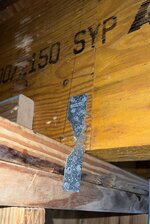
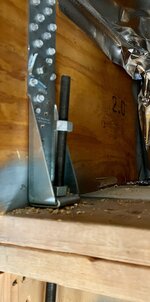
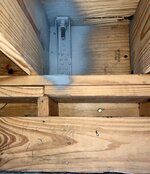
A couple of samples below. Simply connecting the rafters to lower down on the structure. This particular one runs down to a point above a door. Otherwise to the foundation. This spans a joint in the exterior 3/4ā€ ply.

I will remove the double nuts.

Edit-and I’ll look for the lateral tests. Thanks
FD052397-F0C9-45E6-A5D7-1380026B886B.jpeg62849F56-5DC9-4728-ADAD-B9A29C45F512.jpeg60B10F06-ABAF-4E5A-9B21-D137623FD208.jpeg
 

larry_g

Well-known member
Joined
Apr 28, 2007
Messages
16,899
Location
oregon
Is there any advantage to two nuts? šŸ˜‚

Seriously, I know that two nuts is a bad way to try to lock something in place. I’ll use locktite.

I’m specifically wondering where threaded rod fails. Does the rod fail randomly in its length or does the nut fail?

The application is 5/8 threaded rod with heavy hex nuts used to tie rafters to the foundation. With a straight pull, where does rod fail? Im sure the engineers have worked this out. And thought you guys may have run across it.

Thanks

If your dealing with wood then the fastener can loosen as the wood shrinks. In this case double nuts have the advantage of holding position on the rod as the wood shrinks and loosens the tension that keeps the nut in place. I'm not sure if Loctite will hold on an untensioned fastener as well as a double nut.

lg
no neat sig line
 
  • Like
Reactions: kwb

Zeus36

Well-known member
Joined
Oct 1, 2016
Messages
814
Location
Ventura, California
I’d have to go check the plan notes regarding wind. The PE and I did not specifically discuss it. He was pretty well seasoned and I’m sure it is appropriate for the area.

A couple of samples below. Simply connecting the rafters to lower down on the structure. This particular one runs down to a point above a door. Otherwise to the foundation. This spans a joint in the exterior 3/4ā€ ply.

I will remove the double nuts.

Edit-and I’ll look for the lateral tests. Thanks
Why remove them?
 

CraigStu

Well-known member
Joined
May 22, 2014
Messages
4,060
Location
Blacksburg, Va
In custom automotive applications I use double nuts. I much prefer nylocks but, when access to the nut is difficult, I often spin one nut on by hand so I only need 1-3 more turns w/ a wrench to tighten it. Then I spin on a second nut and tighten it. The advantage is it can be much faster than having to manually wrench a nylock. Sometimes I just can't find the nut I'd really like to use so a double nut to the rescue.
 
OP
B

bluedog225

Well-known member
Joined
Jan 31, 2012
Messages
3,323
Location
Texas
As far as I can tell, they add no strength to the overall system. I’ll locktite and or spray the exposed threads with rustoleum to keep them from creeping back.
 

Drill Sergeant Arc

Well-known member
Joined
Jan 7, 2017
Messages
486
Location
Ore-gun
Locking two nuts together was one of the first things I learned about as a kid in my dad's shop. And there were usually two situations where I would use it. The most common was not for compression. For example, any situation where movement was wanted, but kept to a specific tolerance, like say the handle on my wagon. I could have it tight enough to stay vertical and not fall down or loose enough that it would. We had many types of lock washers of all sizes in our shop but they never were as capable of maintaining a specific tolerance as a double nut assembly. Trial and error taught that certain flat washers would extend the life of the connection and a little drop of oil could provide added performance satisfaction. We did have a few of those lock nuts that were dimpled or slightly misshaped to produce friction immediately as it was started on the thread but I preferred what seemed the quicker two nut solution. The other application of the two nut solution would be any place you could have a wide variety of dynamic loading like the U-bolts on a axil connection to the leaf springs or the spring's shackle's themselves, they were a place we could have added an extra nut to a questionable friction nut or just did the double up with two regular ones. But it was always in consideration of a dynamic load and not specific to just a static, compression or tension force/load.
 
OP
B

bluedog225

Well-known member
Joined
Jan 31, 2012
Messages
3,323
Location
Texas
If your dealing with wood then the fastener can loosen as the wood shrinks. In this case double nuts have the advantage of holding position on the rod as the wood shrinks and loosens the tension that keeps the nut in place. I'm not sure if Loctite will hold on an untensioned fastener as well as a double nut.

lg
no neat sig line
You bring up a good point. I wonder how tight I should make these? How much will 20’ of 5/8ā€ rod or chain or wire rope contract from say 115F to 15F?

It would be a little tragic to ovettighten them on a warm day and have significant shrinkage/contraction. I guess same deal with humidity.

Thanks
 

larry_g

Well-known member
Joined
Apr 28, 2007
Messages
16,899
Location
oregon
You bring up a good point. I wonder how tight I should make these? How much will 20’ of 5/8ā€ rod or chain or wire rope contract from say 115F to 15F?

It would be a little tragic to ovettighten them on a warm day and have significant shrinkage/contraction. I guess same deal with humidity.

Thanks
Your beyond my area of expertise. I would tighten them till tight on the wood without crushing any of the fibers in the wood that gives it strength. This is why you have engineered drawings and unless you have experience and information beyond what the designer has then build it as designed.

lg
no neat sig line
 
OP
B

bluedog225

Well-known member
Joined
Jan 31, 2012
Messages
3,323
Location
Texas
Hmmm. I was thinking of tightening them very gently on a cold day. Expansion will create slack and though not ideal, should not cause an issue.
 
To avoid these ads, REGISTER NOW!
Top Bottom