

You are using an out of date browser. It may not display this or other websites correctly.
You should upgrade or use an alternative browser.
You should upgrade or use an alternative browser.
Drill driver and drill - the same or different
- Thread starter mmsheb
- Start date
neophyte
Well-known member
If you’re referring to cordless drills?
Drill/Driver, is generally the currently used term, since most are designed with multiple speed gears, and a variable speed trigger, and a clutch system, sll to help the drill both drill well, and driver screws well.
I’m not sure when the terminology came about, but probably when manufacturers started adding the clutch to help prevent overdriving screws.
There are also Impact Drivers,(note, this is not the same as an “impact drill”).
Impact drivers have an impact hammer/anvil system built into the driver, like a mechanics impact wrench, which drivers screws using a rotary impact, which allows screws to drive better into tough materials, as well as being more affective at loosening tight corroded or stuck fasteners.
Mostly though, a drill driver is a drill with more than one speed range, and a clutch system( sometimes electronic, sometimes mechanical) abd a variable speed trigger.
Some, though not all, also have a hammer drill function( this is not an impact hammer function for turning stubborn fasteners)
The hammer drill function is for drilling into brick and stone, and hammers a drill bit frontward/backward.
There are also impact drivers, which mostly have one speed range, and are designed for driving screws with a rotary hammer acting, similar to an impact hammer.
This design started out in Japan, and usually has a 1/4 quick change chuck bit screwdriver bits.
There adapter three jaw ckucks you can get for these from Dewalt and Makita.
A few drill/drivers also have an impact function of one sort or another as well.
Metabo for instance, has an electronic function on some drills, which drives the drill with an electrical surge technique similar to what an impact driver will do(although not as quick and hard), the Metabo system was built into Some their regular drills, but not all.
Generally, at least in the past, cordless kits would come with a drill/driver, and a separate impact driver, since building the impact function into the drill mostly didn’t work well, and the Metabo system was patented.
Sorry if this is still confusing, I just woke up.
Drill/Driver, is generally the currently used term, since most are designed with multiple speed gears, and a variable speed trigger, and a clutch system, sll to help the drill both drill well, and driver screws well.
I’m not sure when the terminology came about, but probably when manufacturers started adding the clutch to help prevent overdriving screws.
There are also Impact Drivers,(note, this is not the same as an “impact drill”).
Impact drivers have an impact hammer/anvil system built into the driver, like a mechanics impact wrench, which drivers screws using a rotary impact, which allows screws to drive better into tough materials, as well as being more affective at loosening tight corroded or stuck fasteners.
Mostly though, a drill driver is a drill with more than one speed range, and a clutch system( sometimes electronic, sometimes mechanical) abd a variable speed trigger.
Some, though not all, also have a hammer drill function( this is not an impact hammer function for turning stubborn fasteners)
The hammer drill function is for drilling into brick and stone, and hammers a drill bit frontward/backward.
There are also impact drivers, which mostly have one speed range, and are designed for driving screws with a rotary hammer acting, similar to an impact hammer.
This design started out in Japan, and usually has a 1/4 quick change chuck bit screwdriver bits.
There adapter three jaw ckucks you can get for these from Dewalt and Makita.
A few drill/drivers also have an impact function of one sort or another as well.
Metabo for instance, has an electronic function on some drills, which drives the drill with an electrical surge technique similar to what an impact driver will do(although not as quick and hard), the Metabo system was built into Some their regular drills, but not all.
Generally, at least in the past, cordless kits would come with a drill/driver, and a separate impact driver, since building the impact function into the drill mostly didn’t work well, and the Metabo system was patented.
Sorry if this is still confusing, I just woke up.
Here's my understanding:
Drill - strictly for drilling
Drill Driver - has an adjustable clutch so you can drive screws/etc. with it and not strip it at the end.
Hammer Drill - Drill with a mode optimized for drilling into brick/concrete
Impact Driver - primarily for driving fasteners (I've used mine for light drilling without problems)
Impact Wrench - for automotive/etc. - uses sockets
As a DIY guy for home and cars, my impact driver gets the most overall work by far (Milwaukee Surge - love it).
When my eldest spawn moved across the country, I created a basic tool kit, and the only power-tool I put in there was a (Surge) impact driver with a bit set and a drill set).
Drill - strictly for drilling
Drill Driver - has an adjustable clutch so you can drive screws/etc. with it and not strip it at the end.
Hammer Drill - Drill with a mode optimized for drilling into brick/concrete
Impact Driver - primarily for driving fasteners (I've used mine for light drilling without problems)
Impact Wrench - for automotive/etc. - uses sockets
As a DIY guy for home and cars, my impact driver gets the most overall work by far (Milwaukee Surge - love it).
When my eldest spawn moved across the country, I created a basic tool kit, and the only power-tool I put in there was a (Surge) impact driver with a bit set and a drill set).
Thank you neophyte and M635 Guy. I understand this much better.
Regarding the adjustments - do I use a lower number for driving a screw and a higher number for drilling? Or does it vary with the material you use it on? Or just trial and error?
Regarding the adjustments - do I use a lower number for driving a screw and a higher number for drilling? Or does it vary with the material you use it on? Or just trial and error?
Thank you neophyte and M635 Guy. I understand this much better.
Regarding the adjustments - do I use a lower number for driving a screw and a higher number for drilling? Or does it vary with the material you use it on? Or just trial and error?
The clutch is really for driving screws/fasteners to make sure you don't punch it deep in the wood and/or torque the drill out of your hands. There's a drill setting on the clutch that is essentially "off" - most have a second speed for drilling also.
Honestly, I'm mad at myself for how long I used a drill driver before getting an impact driver. Probably not worth two tools if you don't drive a lot of fasteners, but totally worth it if you do.
Thank you neophyte and M635 Guy. I understand this much better.
Regarding the adjustments - do I use a lower number for driving a screw and a higher number for drilling? Or does it vary with the material you use it on? Or just trial and error?
You use the drill setting (which disables the clutch) for drilling, and the numbers for driving fasteners. Lower numbers are lower torque, but there's no universal meaning. Exact settings are trial and error, but you can set it too low, and the clutch will slip before the screw is driven home.
For something like assembling flat pack furniture, you need very little torque, so a drill/driver is vastly superior to an impact driver, which has no torque control other than your trigger finger. For driving screws into a wall, you need higher torque, so you'd set the torque higher. It's pretty obvious, and with a little experience you can pick the right setting first time.
ChevyEFI
Well-known member
In HVAC, everyone used drills 20+ years ago and just swapped from mag. hex screw drivers to drill bits.
Fast forward a couple decades. I have a Milwaukee M18 Fuel set with the 1/2" hammer drill and the Surge 1/4" hex driver. The Surge has really good finesse on driving fasteners (into wood) and will tend not to go crazy with ripping phillips drivers out of screwheads. The Surge part of it takes away from brute impact, but makes for less harsh impact to your hand / arm.
I wanted something that would have more hit, with less concern of it being rough to use. I wanted a hex driver that would act like an impact gun, without going "big." The Bosch 18v 1/2" hammer drill and driver set was at Lowe's. The top driver is called the Freak. The more I looked into it, the driver compared favorably with the non-Surge Milwuakee on reviews, and has a 1/2" square drive built into it. It will take M14 lugs off my truck, and that's as far as I need it to go.
I think I have the "bad" drill chuck on the Milwaukee, but it hasn't been an issue yet. They're both capable hammer drills.
If I had to have a single driver between the two, doing mechanical and fastener work, I'd go with the Bosch. The Surge wins for smooth use on wood fasteners.
Looking back, the use of a drill-only made sense at the time. But now, a set of hex drive drill bits and a 1/4" driver with other bits / sockets would be a better, more versatile option to carry around to get work done.
Fast forward a couple decades. I have a Milwaukee M18 Fuel set with the 1/2" hammer drill and the Surge 1/4" hex driver. The Surge has really good finesse on driving fasteners (into wood) and will tend not to go crazy with ripping phillips drivers out of screwheads. The Surge part of it takes away from brute impact, but makes for less harsh impact to your hand / arm.
I wanted something that would have more hit, with less concern of it being rough to use. I wanted a hex driver that would act like an impact gun, without going "big." The Bosch 18v 1/2" hammer drill and driver set was at Lowe's. The top driver is called the Freak. The more I looked into it, the driver compared favorably with the non-Surge Milwuakee on reviews, and has a 1/2" square drive built into it. It will take M14 lugs off my truck, and that's as far as I need it to go.
I think I have the "bad" drill chuck on the Milwaukee, but it hasn't been an issue yet. They're both capable hammer drills.
If I had to have a single driver between the two, doing mechanical and fastener work, I'd go with the Bosch. The Surge wins for smooth use on wood fasteners.
Looking back, the use of a drill-only made sense at the time. But now, a set of hex drive drill bits and a 1/4" driver with other bits / sockets would be a better, more versatile option to carry around to get work done.
seber
Well-known member
Drill drivers have been around far longer than clutches for the same. It just means variable speed.
banjopete
Well-known member
The other part not mentioned about the surge impacts is that they're much quieter.
matt_i
Well-known member
Back in the day I used a cordless Dewalt to drive thousands of deck screws. That eventually wore out the brushes in it and speed control was non existent, either zero or WOT.
That said, now, I use a drill for drilling holes and a 1/4" hex impact driver for any kind of screw. Imo its so much easier on the drill. Rather than low speed max torque trying to control set-height, the impact driver happily puts them and larger screws that the drill could not even do in with a considerably smaller powerplant.
That said, now, I use a drill for drilling holes and a 1/4" hex impact driver for any kind of screw. Imo its so much easier on the drill. Rather than low speed max torque trying to control set-height, the impact driver happily puts them and larger screws that the drill could not even do in with a considerably smaller powerplant.
Impact driver was the best innovation in the last twenty years.*
Its very rare I use the drill driver to drive screws.
As mentioned impact drivers will drill, especially fast swap with 1/4 drive drills.
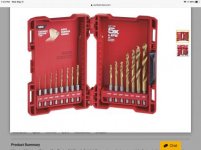
* When it became available wide spread with multiple brands.
Its very rare I use the drill driver to drive screws.
As mentioned impact drivers will drill, especially fast swap with 1/4 drive drills.
* When it became available wide spread with multiple brands.
Attachments

alfazer
Well-known member
Thanks Showkey. "Impact driver was the best innovation in the last twenty years.*" That is a big statement. I guess I have really been missing out!
Mike
I'd agree. You'll totally understand when you try one.
Gunfixr
Well-known member
A drill is a drill, always full power, end of story.
A drill/driver will have a torque adjustment, a clutch. You can set it to max, and it's the same as a drill. You can set it lower, and it will only apply so much power, and start slipping.
The difference is in driving screws. With a drill, you have to closely pay attention, to not strip them out, or set them too deep.
With a drill/driver, you can adjust the clutch to where it sets the screws the way you want them. While things like wood vary a bit, it's not perfect, but better than full power all the time. It has a tiny bit of impact effect, so will seat a screw that stopped barely off where you wanted.
An impact driver is just that, it impacts whatever you are driving until it reaches the max of the particular setting. My impact driver has three settings. So, you just stop when the screw is where you want it. It is a high torque driver, so it will drill, but is not very good with larger bits, since drilling with impact doesn't work well. With smaller bits, it won't impact, just turn.
A drill is great at drilling, kinda ***** at driving.
A drill/driver does both drilling and driving fairly well.
An impact driver drives very well, drills ok.
A hammer drill is a different beast. I do have a hammer drill/driver, you can turn off the hammer part. The hammer part is good for drilling into concrete.
A drill/driver will have a torque adjustment, a clutch. You can set it to max, and it's the same as a drill. You can set it lower, and it will only apply so much power, and start slipping.
The difference is in driving screws. With a drill, you have to closely pay attention, to not strip them out, or set them too deep.
With a drill/driver, you can adjust the clutch to where it sets the screws the way you want them. While things like wood vary a bit, it's not perfect, but better than full power all the time. It has a tiny bit of impact effect, so will seat a screw that stopped barely off where you wanted.
An impact driver is just that, it impacts whatever you are driving until it reaches the max of the particular setting. My impact driver has three settings. So, you just stop when the screw is where you want it. It is a high torque driver, so it will drill, but is not very good with larger bits, since drilling with impact doesn't work well. With smaller bits, it won't impact, just turn.
A drill is great at drilling, kinda ***** at driving.
A drill/driver does both drilling and driving fairly well.
An impact driver drives very well, drills ok.
A hammer drill is a different beast. I do have a hammer drill/driver, you can turn off the hammer part. The hammer part is good for drilling into concrete.
Milton Shaw
Well-known member
- Joined
- Feb 11, 2011
- Messages
- 4,868
One thing I would add. A hammer drill is not the right tool to drill concrete and brick. A SDS Plus drill will drill about 6 inches deep in the time a hammer drill takes to just start the hole. Most SDS drills come with a depth rod to stop you before you get too deep, you will never need one with a hammer drill as you will wear out before the drill gets deep enough. And a hammer drill will dull the bits long before the hole is through, where the SDS bits don't seem to get dull in the first 50 or so holes in concrete.