To avoid these ads, REGISTER NOW!

Drill press - Atlas vs Craftsman

xbartx

Member
Joined
Sep 7, 2025
Messages
10
Location
So. Oregon
New member here, I retired a few years ago and teaching myself metal work & machining.
The vintage bench top mill I found doesn't have a quill so I started looking for a drill press.
I found 2 locally and very inexpensive so I bought them both. Both have issues and looking for opinions, suggestions as to what direction to go.
The Craftsman is a floor standing 150, issue is the wrong 3450 RPM motor is on it. Looks in good shape.
The Altas 1470 was originally part of multi spindle setup, issues are no base or table and short column. Looks in good shape.

Here are the specs on the Atlas 1470
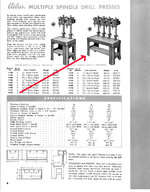

AtlasDrillPress2.jpg

To me, here are the two obvious choices, I could rob the Atlas motor and put it on the Craftsman or
I could use the Craftsman base, table and column with the Altas motor and head.
-Brad
 
To avoid these ads, REGISTER NOW!

FrankLee

Well-known member
Joined
Sep 13, 2010
Messages
3,577
Location
seMI, 48317
Welcome Brad!

New member here, I retired a few years ago and teaching myself metal work & machining.
The vintage bench top mill I found doesn't have a quill so I started looking for a drill press.
I found 2 locally and very inexpensive so I bought them both. Both have issues and looking for opinions, suggestions as to what direction to go.
The Craftsman is a floor standing 150, issue is the wrong 3450 RPM motor is on it. Looks in good shape.
The Altas 1470 was originally part of multi spindle setup, issues are no base or table and short column. Looks in good shape.

Here are the specs on the Atlas 1470

To me, here are the two obvious choices, I could rob the Atlas motor and put it on the Craftsman

I could use the Craftsman base, table and column with the Altas motor and head.
-Brad
I would transplant the Atlas motor to the Craftsman machine.

Transferring the Atlas head to the Craftsman column will work, but in my experience, the Craftsman head will not fit on the Atlas column. Both columns are referred to as "2-3/4 inches", but neither are 2.7500". The Atlas is larger.

The Atlas has the morse taper spindle. The Craftsman has a Jacobs 633C chuck, which is more desirable (to me).

The Atlas has a flat, clock-style feed return spring. The Craftsman has a coil torsion spring, which is more desirable (to me).

If you plan to refurbish either, IME, the Craftsman is easier.

Did the Atlas come with the head lift?

What is your location?
 

FrankLee

Well-known member
Joined
Sep 13, 2010
Messages
3,577
Location
seMI, 48317
Yes, I was thinking I could use it on the Craftsman column, but maybe not if they are different diameters?
I do have it off the column and will check and see if it is usable

So. Oregon
The Atlas components, including the head lift, will fit on the Craftsman column.
 

Beerhippie

Well-known member
Joined
Oct 13, 2023
Messages
9,714
Location
Far NE Oregon
Yes, I was thinking I could use it on the Craftsman column, but maybe not if they are different diameters?
I do have it off the column and will check and see if it is usable

So. Oregon
There's an awful lot of Southern Oregon... Unless you mean that little town, So, between Brothers and Ridley?
 

Beerhippie

Well-known member
Joined
Oct 13, 2023
Messages
9,714
Location
Far NE Oregon
I hope y'all weather the fires well.

BTW: So is something I made up. But, given the weird Oregon town names... maybe?

Nope--even Google AI doesn't get any hits for So, Oregon.
 

RoninB4

Well-known member
Joined
Jul 22, 2020
Messages
3,511
Location
Under My House
The Craftsman is a floor standing 150, issue is the wrong 3450 RPM motor is on it.
-Is there something wrong with this motor? Do you even know the RPM range for the drill press spindle? Is the 3450 RPM the motor speed or the spindle speed? If your intended purpose for this DP is for metal working 3450 RPM is too fast for steel and can burn up larger drills. I would really suggest two things to avoid wasting time/money/effort.

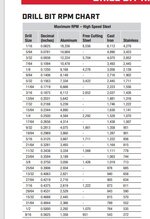
1) Find a speed chart for size of drill per material and print it out (or make your own) for reference or tape it to the DP. Plenty of them on the internet. These are the speeds you'll need to follow or you'll ruin the drill bits and possibly the material too.

2) Get a hand held tachometer so you have real numbers to work with. There are many types out there from electronic to mechanical and several I saw were under $20. The electronic ones may/may not last long but are easily read. The mechanical ones, particularly the used ones, are reliable but may be more difficult to read if your eyes are failing.

-Now you'll know what your spindle speeds currently are and compare that with what they should be. If the motor on the Craftsman allows low enough speeds for what you're doing then there's no need to change anything. A hand held tachometer is a good device to have when present or future machinery is either missing the speed chart or has been wiped out from cleaning, both common on used machinery with motor substitutions. If you're newish at learning metal working your speed/feed calculations per a given material are critical for any type of cutting operation. The chart below is an example of what you need to find and learn. I've plenty more to say about metal working but will keep this short for now. Hope it helps.
RPM.jpg
 
To avoid these ads, REGISTER NOW!
OP
X

xbartx

Member
Joined
Sep 7, 2025
Messages
10
Location
So. Oregon
-Is there something wrong with this motor? Do you even know the RPM range for the drill press spindle? Is the 3450 RPM the motor speed or the spindle speed? If your intended purpose for this DP is for metal working 3450 RPM is too fast for steel and can burn up larger drills. I would really suggest two things to avoid wasting time/money/effort.
The motor it came with has a RPM of 3450, from the inside of the spindle housing it looks like it was used for woodworking in its previous life.
I work mostly in metal and require lower speed range that the Atlas motor would give.


I spent a few days cleaning up the Craftsman drill press and the Atlas motor and table lift and got it put back together and running.
The Atlas lift wasn't for lifting the original table, as it didn't have a table when sold but for lifting the head.
The lift handle is mot in the ideal place but work just fine.


AtlasDrillPress.jpg
Here is the Atlas unit as a bought it, minus the work bench.

IMG_1989.jpg
Here is the Craftsman 150 with the Atlas motor and lift unit.
 

RoninB4

Well-known member
Joined
Jul 22, 2020
Messages
3,511
Location
Under My House
The motor it came with has a RPM of 3450, from the inside of the spindle housing it looks like it was used for woodworking in its previous life.
-Very likely it was used for woodworking, especially of there's sawdust present.
I work mostly in metal and require lower speed range that the Atlas motor would give.
-Yes you do need lower speeds. A lot could be done with different pulleys but that's a lot more effort and expense. I'd probably want to simply use what I had for the present like you did, it would be nice if you had 2 working presses. Maybe try to hunt/scavenge a used motor.
I spent a few days cleaning up the Craftsman drill press and the Atlas motor and table lift and got it put back together and running.
-Looks like you did a nice job of cleanup.
The Atlas lift wasn't for lifting the original table, as it didn't have a table when sold but for lifting the head.
The lift handle is mot in the ideal place but work just fine.
-The location of the lift is a bit awkward but at least it works, you'll get used to it. I wouldn't want a DP that didn't have one.
Here is the Atlas unit as a bought it, minus the work bench.
-Yep, seen plenty of gang drills in factories, not so much any more.
Here is the Craftsman 150 with the Atlas motor and lift unit.
-So did the Atlas motor mount and provide the lowered RPM? Have you used a tach for a real RPM reading?

-I don't want to be critical or beat you up but I spotted your grinder and the metal (aluminum?) imbedded in the wheel in the photo below. As tempting as it may be aluminum, brass, and any other non-ferrous material should NEVER be held to a grinding wheel not made specifically for non-ferrous (non-magnetic) materials. It clogs up the wheel and present the very real possibility of cracking the grinding wheel when the metal heats/expands. You really need to get an inexpensive means for dressing the wheel, there's several types. Dressing the wheel now and then also ensures less heat while grinding and a much better finish when sharpening cutting tools. Just a suggestion.

Grinder.jpg

-An expensive dresser isn't needed for a bench grinder like this. When I don't need a diamond (surface grinder) I use something like the photo below. Easy to control, inexpensive, and doesn't wear out like the "star" dressers.

Dresser.jpg
 
Last edited:
OP
X

xbartx

Member
Joined
Sep 7, 2025
Messages
10
Location
So. Oregon
-So did the Atlas motor mount and provide the lowered RPM? Have you used a tach for a real RPM reading?

-I don't want to be critical or beat you up but I spotted your grinder and the metal (aluminum?) imbedded in the wheel in the photo below. As tempting as it may be aluminum, brass, and........
Yes the Atlas motor mounted without issue. I didn't use a tach but seems like about 600 rpm at the lowest speed. I do have a very old mechanical tachometer that I have never used, I might try using it.

I don't know what is on the grinding wheel, I have only used it for steel. But thanks for the info, I was not aware of this.
I was moving it around my shop and it might have pushed it up against the drywall in the move,
 

RoninB4

Well-known member
Joined
Jul 22, 2020
Messages
3,511
Location
Under My House
Yes the Atlas motor mounted without issue. I didn't use a tach but seems like about 600 rpm at the lowest speed. I do have a very old mechanical tachometer that I have never used, I might try using it.
-If you've got an old mechanical tach it would allow you to make a speed chart (y)
I don't know what is on the grinding wheel, I have only used it for steel.
-Wasn't trying to be critical, your post stated you were learning and I thought maybe you didn't know.
I was moving it around my shop and it might have pushed it up against the drywall in the move,
-The judges will allow ONE session of drywall grinding. :beer:
 

Cruzan80

Well-known member
Joined
Jul 22, 2015
Messages
4,195
Location
Denver, CO
I would check the diameter of the Atlas pulley against the sizes listed in the CM manual. My guess is that they are very similar, and would give you a pretty good guess of each speed.

@RoninB4 both the Atlas and the CM were suggest to run with a 1750rpm motor, and the instruction manual had a speed chart for each (assuming original motor pulley). If the motor pulley was swapped, a calculator could be used (just a simple ratio).

If you really need to slow it down further, I would look for either a Vari-Slow (Reeves drive setup) or a MSA (Middle Speed Adapter) that adds a third pulley on top of the column. Both originals are fairly pricey when located, but @JZiggy makes replacement MSA (the pullies don't match height exactly, but not a huge deal if you leave it slow for metal all the time).

Alternatively, if you don't see using the table lift, that is usually as expensive or more than either speed option (if you choose to sell it). I would look at @FrankLee instructions on swapping the location of one of the bearings to make it work better for tables.
 

FrankLee

Well-known member
Joined
Sep 13, 2010
Messages
3,577
Location
seMI, 48317
I would look at @FrankLee instructions on swapping the location of one of the bearings to make it work better for tables.
As @xbartx mentioned above, his lift is a head-only lift. It is designed for the production table version of the drill press. It has a somewhat different construction compared to the head & table lift. Brad mounted his lift upside-down and is why the crank is in an awkward position.

Moving the entire assembly under the table would also be awkward for cranking, but it would allow the table to be moved side-to-side for some drilling operations.

1757585230347.jpeg
1757585281516.jpeg
 
OP
X

xbartx

Member
Joined
Sep 7, 2025
Messages
10
Location
So. Oregon
I would check the diameter of the Atlas pulley against the sizes listed in the CM manual. My guess is that they are very similar, and would give you a pretty good guess of each speed.

@RoninB4 both the Atlas and the CM were suggest to run with a 1750rpm motor, and the instruction manual had a speed chart for each (assuming original motor pulley). If the motor pulley was swapped, a calculator could be used (just a simple ratio).
I got out one of the mechanical tachometers, something I got in a large lot of stuff and mostly didn't know what a lot of the tools were used for. It was me using google image search to figure what many items were.

It took me a couple seconds to start the stop watch after turning on the motor. I think it would be pretty close to the 580 RPM that is listing in the specs.

Tach.jpg
 
To avoid these ads, REGISTER NOW!
Top Bottom