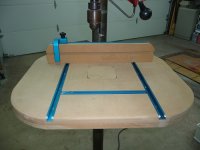
There are various drill press tables. The square variety accommodate a little, with a X slot and through hole, some tilt for angle drilling. Cannot recall one
ever put to use. Horizontal or swung vertical is sufficient; too few are able to layout and produce an angular or compound work.
Machines with slotted tables are often 'lay out' drills, that have X-Y positioning; nearly mill size they are not prevalent. A flat table without holes or slots are production equipment. Operator moves along bank of 2-6 heads conducting different operations; they are usually in a
jig, positioned manually while tools are guided by bushings, often a 'First Operation' task.
They are great for second op too, reaming, counter bores, spotfacing, countersinking, tapping. The part commonly mounted now in a
fixture, securely holding the part, tools guided by hand to previous hole.
Sometimes a rail 'steers' a jig or fixture, when the work is in a straight or narrow line to minimize random movement. There certainly have been tooling incorporating both jig & fixture, depending on part involved. Some are 'box' or 'tumble' jigs to set hole positions, then a lid removed to run 2nd operations.
80 years ago, such relatively simple methods turned housewives into at least semi-skilled workers practically overnight, supplying Allies
world-wide. Was it effective? Are we not still speaking English?
Do not discount gang drills. They still command a good price at auction and used market. In the right hands, correctly tooled, applied to the right job, turn out a lot of parts quickly, within a compact footprint. There are CNC's with fast toolchangers, but lag behind a dedicated person moving to a spindle just inches to the right.
(edit in) There are production tables that owners have mounted sub-plates, usually a matrix of drilled and tapped locations,
sometimes including dowels for even faster set-ups.
(edit in) Below, "dutchgray" mentions Arboga; there are several Northern European drill presses with serious capabilities, though my favorite 'big compact'
used to be the Johansen, but has very insubstantial ways to support the large table, then Wells-Index #125 radial (looks like a Bridgeport and fixed table) I decided consumed excess footprint; both replaced by Veet Radial, made in Detroit no less.
The design is great, speed and feed ranges are appropriate, well powered, #4 Morse taper, built-in knock out, power column and perfect operator ergonomics. For scale, I've included vise that on the table, bought at auction in the east. That is not boot of a danseur, but my 11-1/2, so the body alone exceeds 24" in length, and about 38" long. Now to be my 2nd op machine awhile, located between two vertical mills #40 & R8. Not visible, but there is flood coolant, and a vertical position on back side of the table. I'm sure, first tool to build is going to be a big Vee block for center drilling round and square stock