To avoid these ads, REGISTER NOW!

Drill Press - Treadmill motor conversion

doan

Well-known member
Joined
Sep 25, 2012
Messages
585
Location
Frisco, TX
Drill Press - Treadmill motor conversion (UPDATED)

The wife was going to sell the old treadmill for $50. I said "that's less than a new drill press motor, I'll take it appart."

1.5 HP motor - 0 to 6700 RPM

IMG_1368.JPG


MC-60 PWM controller

IMG_1369.JPG


Test bench

IMG_1372.JPG


The old treadmill control has 10 discrete speeds from 1 MPH to 10 MPH. This is about 550 to 5500 RPM. Although I'd like to keep the digital control, its a one piece board, and I don't need the rest of it. I'll probably just replace it all with a 10K ohm pot.

Is there any advantage to leaving the flywheel on? Mine is setup for a poly-V belt, I could just put a poly-V pulley on the drill press (Craftsman 1500
 
Last edited:
To avoid these ads, REGISTER NOW!

zkling

Well-known member
Joined
Jan 23, 2007
Messages
16,939
No grand advantage to leaving the flywheel on but unless you are tapping, there is no great disadvantage either. You are lucky it had the older MC60 controller, most of the newer machines use a more complex PMW controller.

How do you replace the control board with a 10K Ohm pot? I'm intrigued.

You replace the control panel (user interface) not the driver board which in this case is the ever so common MC-60
 

WallynSC

Well-known member
Joined
Feb 6, 2011
Messages
152
Location
South Carolina
I have looked for simple explanations of how to do this and never found a good source, thanks for posting. Where does AC power go into the control board?
 
OP
D

doan

Well-known member
Joined
Sep 25, 2012
Messages
585
Location
Frisco, TX
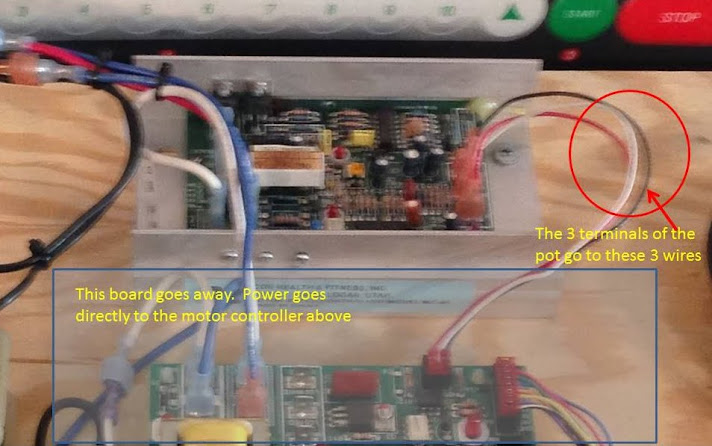
Here's some better pics:

MC-60%2Bwiring.jpg


MC-60%2Bzoom.jpg


The blue wire is optional, It's a switched line that stops the motor if it gets to hot.

In the lower left of the schematic, it describes the speed control input. If wiring in a potentiometer, the outer legs go to L and H, and the center one goes to W
 

nine4gmc

Well-known member
Joined
Mar 24, 2012
Messages
14,357
Location
Dallas
Hmmm, off to find an abandoned treadmill...

keep an eye on the free section of CL, they show up ever so often. :beer:

I tried this on a planer and it works somewhat but I didn't care for it. With it wired like above, when you turn it on, you have to have the speed up high at first, then turn down to adjust speed. If you turn it on with the pot low, it will not start. You'll have to crank the knob up then adjust back down. Minor inconvenience but just saying... I didn't like it.
 

zkling

Well-known member
Joined
Jan 23, 2007
Messages
16,939
Hmmm, off to find an abandoned treadmill...

Just a heads up, unless you are ready to tinker, it would be much easier to buy a standard universal dc motor and basic controller. Granted, some are easier to convert than others . Odd sized (metric mostly) non keyed or flat shafts, odd mounting plates, safety controllers, etc. For bandsaws, grinders and the like they are ok but for lathes, mills and especially drill presses they aren't the best. Especially when you need a fast reverse cycle.

Nine, you can disable the soft start control on the m60s, or just buy a standard dc board for ~$60.
 
OP
D

doan

Well-known member
Joined
Sep 25, 2012
Messages
585
Location
Frisco, TX
I tried this on a planer and it works somewhat but I didn't care for it. With it wired like above, when you turn it on, you have to have the speed up high at first, then turn down to adjust speed. If you turn it on with the pot low, it will not start. You'll have to crank the knob up then adjust back down. Minor inconvenience but just saying... I didn't like it.

Treadmills require "softstart" as a safety feature. You can disable that. you can also wire a switch into the speed control circuit to start/stop the motor without having to change the speed. I will write that up after I've tested.

As others have suggested, you can just go buy all the right parts and skip the tinkering, but where's the fun in that?
 

bubinga

Well-known member
Joined
Jul 26, 2014
Messages
12,744
Location
Bridgeport Ohio. (Across River From Wheeling WV)
keep an eye on the free section of CL, they show up ever so often. :beer:

I tried this on a planer and it works somewhat but I didn't care for it. With it wired like above, when you turn it on, you have to have the speed up high at first, then turn down to adjust speed. If you turn it on with the pot low, it will not start. You'll have to crank the knob up then adjust back down. Minor inconvenience but just saying... I didn't like it.
depending on the needed DC voltage uses a KBIC 120 110 volt input, 0r there KBIC 240 l think it's cal;led, 220 volt input.
It will start where you last shut it off.
 

bubinga

Well-known member
Joined
Jul 26, 2014
Messages
12,744
Location
Bridgeport Ohio. (Across River From Wheeling WV)
Treadmills require "softstart" as a safety feature. You can disable that. you can also wire a switch into the speed control circuit to start/stop the motor without having to change the speed. I will write that up after I've tested.

As others have suggested, you can just go buy all the right parts and skip the tinkering, but where's the fun in that?
yeah, l understand you can wire a on off switch into the center wire ot the speed control pot, and turn it on and off here, and resume the speed you left it at. (shut it off at_)
I have not tried,it.
My DP, you have to either dial the pot down, and dial it back up, or shut the ac power, and dial down the pot, AC power back on, and dial up pot.
My DP is like that, but I don't mind it.
 
OP
D

doan

Well-known member
Joined
Sep 25, 2012
Messages
585
Location
Frisco, TX
Tonight I disconnected all the digital stuff and wired it up with just a 5k pot and a switch

NewSchematic.PNG


The 5k pot provides continuous speed control and the switch in line with the "W" signal on the speed control allows starting and stopping without changing the speed.

Here's a pic of the test setup:

DSC_2747.JPG


The 120v light switch is a little getto, but all I had around

DSC_2754.JPG


Using an optical tach, I plotted input voltage vs. RPM

InputVoltageRPM.tif


The response is very linear. The red line is the actual data and the blue line is the calculated values I backed into from the measured data.

90 RPM is the slowest it would smoothly run. The next step is to make the control circuit slightly more sophisticated so the minimum voltage is 2.5V instead of zero. At low speeds the motor has amazing torque. You can't grab it and make it stop.
 
Last edited:

G_P

Well-known member
Joined
Jul 11, 2010
Messages
7,135
Location
Central CT
Excellent!

I did basically the same thing to make a wet tumbler for doing brass for reloading. I used the motor and controller from a 24v electric mobility scooter. Having the infinitely variable speed to work with any amount of weight in the drum is great.
Guess its time to scrounge up an old treadmill and convert a drill press.
 

paulsomlo

Well-known member
Joined
Jul 16, 2013
Messages
3,866
Location
Northern Colorado
Umm... not to rain on your parade, but how much do you suppose that motor weighs? Reason I ask, is that I have a Leeson 3/4 hp DC motor and it weighs 34 pounds. The 1.5 hp one shown here appears to be about the same size as your DVM.
 
OP
D

doan

Well-known member
Joined
Sep 25, 2012
Messages
585
Location
Frisco, TX
Umm... not to rain on your parade, but how much do you suppose that motor weighs? Reason I ask, is that I have a Leeson 3/4 hp DC motor and it weighs 34 pounds. The 1.5 hp one shown here appears to be about the same size as your DVM.

Horsepower = Torque X RPM / 5252

My motor (allegedly) makes 1.5 HP at 6000 RPM = 1.3 ft-lbs torque

Yours probably turns much slower (guessing 1800)

3/4 * 5252 / 1800 = 2.2 ft-lbs torque

So the Leeson is half the HP but about twice the torque.


Kinda like comparing a big block V8 that makes 200 HP @ 1700 RPM to a 4 banger that makes 300HP at 7000 RPM. They will both go fast but geared different and different noises.

My existing drill press motor is 1/3 HP at 1800 RPM.

1/3 * 5252 / 1800 = ~1 ft-lbs torque

If I use a smaller drive pulley, I should easily have more torque than before AND variable speed.
 

404

Well-known member
Joined
Aug 23, 2014
Messages
3,463
Location
Mass
The rib pitch on that pulley is unfortunately not the same as Automotive rib belts.
 

Doug Arthurs

Well-known member
Joined
Dec 1, 2012
Messages
1,137
Location
Ontario
For a drive press you could easily wire a reversing switch. This would be great if you have any power tapping needs I would think. I do it regularly in my Bridgeport and it really makes quick work of it.
 
To avoid these ads, REGISTER NOW!

zkling

Well-known member
Joined
Jan 23, 2007
Messages
16,939
For a drive press you could easily wire a reversing switch. This would be great if you have any power tapping needs I would think. I do it regularly in my Bridgeport and it really makes quick work of it.

You can, but the best way to do it is with a 4 quadrant regenerative DC drive. That way you don't have to basically hot swap the polarity to the motor and worry about the breaking power needed for the motor to slow down. For a drill press, mill or any application where low speed, numerous start stops and quick reverse cycles are needed the basic controllers, let alone the treadmill versions are a nuisance IMHO.
 
OP
D

doan

Well-known member
Joined
Sep 25, 2012
Messages
585
Location
Frisco, TX
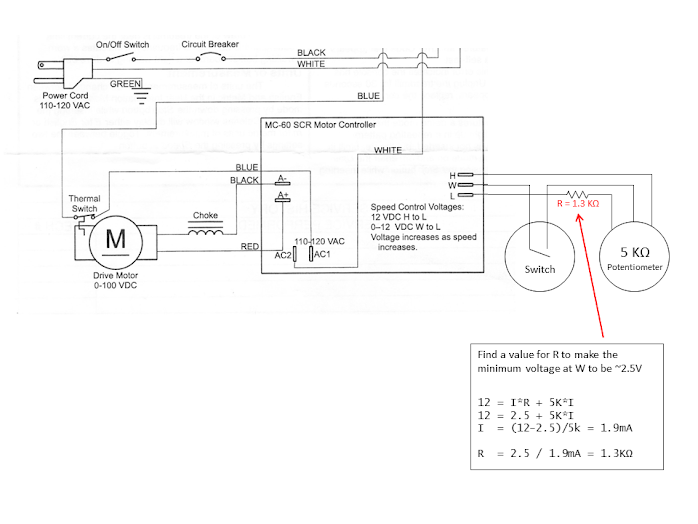
Added an extra resistor so that it will always run regardless of the pot setting. Operating range is 2.5V (~90 RPM) to 12V (~7300 RPM). The Extra resistor sets the minimum voltage to 2.5, so the full range of the pot is usable.

NewSchematic-with-R.png
 
OP
D

doan

Well-known member
Joined
Sep 25, 2012
Messages
585
Location
Frisco, TX
Ok, so I mocked everything up and it works. I have 1.9" pulley on the motor and using the 5" pulley on the spindle, I get a decent speed range without have to change pulleys.

It drills good at slow speeds with forstner bits and hole saws.

The big question now is how to house the controller that it can dissipate heat and be protected from metal shavings.
 

nine4gmc

Well-known member
Joined
Mar 24, 2012
Messages
14,357
Location
Dallas
Re: Drill Press - Treadmill motor conversion (UPDATED)

I just finished hooking my treadmill motor up to a squirrel cage fan to get some air flowing in my shop. Just need to do the switch mod now! Thanks for posting!
 
OP
D

doan

Well-known member
Joined
Sep 25, 2012
Messages
585
Location
Frisco, TX
Re: Drill Press - Treadmill motor conversion - COMPLETE

PROJECT COMPLETE

DSC_2768.JPG


I ended up using a old (1945) Sun Dwell/Tach meter for the control box. This was my grandfather's and I had set it aside for restoration, but it was too far gone. The Dwell meter was beyond repair. I repurposed it instead - another cool old box saved from a landfill.

IMG_1398.JPG


Two switches went in the hole where the dwell meter was. One for AC power and one to the motor drive. The selector switch on the far right get replaced by a 5k ohm 3-turn pot for speed control.

DSC_2774.JPG


I calibrated the tach to match the actual spindle RPM, including using the 1000/5000 RPM switch. With the current pulleys, I have a usable range from about 40 RPM to 2700 RPM. The meter is active whenever power is on, so I can see what the speed is before turning on the drive.

DSC_2801.JPG


DSC_2797.JPG


DSC_2802.JPG


I used a piece of about 1" thick hard rubber to mount the motor. The eliminated a lot of vibration from the DC motor.

DSC_2778.JPG


Played with it yesterday drilling holes in angle iron for 1/4-20 flat-head screws. Being able to slow down to about 200 RPM to drill the counter-sinks worked really well. I am very happy with this conversion.
 
Last edited:
OP
D

doan

Well-known member
Joined
Sep 25, 2012
Messages
585
Location
Frisco, TX
Thanks, I put in what I had for switches, I do want to find something more period correct.

What's a ball switch?
 

Sam'sAutoParts

Well-known member
Joined
Aug 27, 2013
Messages
2,075
Location
Northeast PA
Re: Drill Press - Treadmill motor conversion (UPDATED)

That is a cool project. I especially like the use of the sun box for the controls.
 

Fluxion

Well-known member
Joined
Apr 9, 2013
Messages
171
Location
Topeka. Kansas
Way cool! I missed out on the exact same dwell/tach at an auction a few weeks ago. I was talking to my Dad and not paying attention what they were trying desperately to get a bid on. Sold for $1 just to get the auctioneers to move on. After I realized what it was I tried to find out who bought it but never did.
 
OP
D

doan

Well-known member
Joined
Sep 25, 2012
Messages
585
Location
Frisco, TX
op was the motor shaft an odd ball size, or did an off the shelf pulley fit it, or did you bore a pulley out?

The end of the shaft is threaded with left-hand threads that are just shy of 1/2".

I used a couple wraps of metal shim tape and a 1/2" bore pulley with a set screw.
 

bubinga

Well-known member
Joined
Jul 26, 2014
Messages
12,744
Location
Bridgeport Ohio. (Across River From Wheeling WV)
a lot of guys say these tread mill motors aint no good, and this and that, and no low sp. torque, and all this and that, mine works pretty damn good.
It's like anything else, there are better motors, and there are worse motors.
There are better controllers, there are worse controllers.
If ya get one, esp if it's free, Try it, Y'a just might like it.
The set up is not popular because it *****.
 

bubinga

Well-known member
Joined
Jul 26, 2014
Messages
12,744
Location
Bridgeport Ohio. (Across River From Wheeling WV)
The end of the shaft is threaded with left-hand threads that are just shy of 1/2".

I used a couple wraps of metal shim tape and a 1/2" bore pulley with a set screw.
that was quick....LOL
So it runs pretty true?
I was lucky, the TM motor l used bolted right up to the old motor mount, and the shaft was 5/8" with key way.
Kind of like a baby 56 frame motor.
 
Last edited:

Rick M

Banned
Joined
Apr 18, 2015
Messages
184
Location
North Carolina
Added an extra resistor so that it will always run regardless of the pot setting. Operating range is 2.5V (~90 RPM) to 12V (~7300 RPM). The Extra resistor sets the minimum voltage to 2.5, so the full range of the pot is usable.

Just so I understand, raising the minimum voltage makes the motor run very slowly at "0" rather than stop, but does it affect the high end speed? I'm using a treadmill motor on my wood lathe, lower speeds are always nice but I don't want to sacrifice much on the high end to get it. Nice schematics, btw. Here is my setup.
 
OP
D

doan

Well-known member
Joined
Sep 25, 2012
Messages
585
Location
Frisco, TX
Just so I understand, raising the minimum voltage makes the motor run very slowly at "0" rather than stop, but does it affect the high end speed? I'm using a treadmill motor on my wood lathe, lower speeds are always nice but I don't want to sacrifice much on the high end to get it. Nice schematics, btw. Here is my setup.


Correct. The usable range on my motor was 2.5-12 volts. The extra resistor to set the minimum to 2.5 and only affects the low end. The max is still 12. This design keeps the motor in an operating range of about 100 to 7000 RPM.

If yours is using the MC60 and a 5k pot, then a 1300 ohm resistor will be about right. Or just use another pot to set the minimum to whatever you want. For a lathe it's unlikely that you will need the super slow speeds.

I also used a 3-turn pot to make the knob less sensitive. 3 turns from slow to fast instead of 3/4 turn.
 
Last edited:
To avoid these ads, REGISTER NOW!
Top Bottom