bubinga
Well-known member
Rick M, was that set up on You tube also?
I think I ran across it before.
I think I ran across it before.


Correct. The usable range on my motor was 2.5-12 volts. The extra resistor to set the minimum to 2.5 and only affects the low end. The max is still 12. This design keeps the motor in an operating range of about 100 to 7000 RPM.
If yours is using the MC60 and a 5k pot, then a 1300 ohm resistor will be about right. Or just use another pot to set the minimum to whatever you want. For a lathe it's unlikely that you will need the super slow speeds.
I also used a 3-turn pot to make the knob less sensitive. 3 turns from slow to fast instead of 3/4 turn.
Rick M, was that set up on You tube also?
I think I ran across it before.
Okay, I was wondering what effect a pot other than 5k would have. The first treadmill I got was a very old one and had a 5k pot so that's what I used on all my motors. I don't really need slower speeds on my Craftsman, current range is ~240 - ~3000. Motor for the Delta will use an MC60. Motor on the Craftsman is using some other PWM, can't remember the model (it's the red one in the link I gave).
In the case of the MC-60, the pot is just a voltage divider. "H" is always 12v and "L" is always ground (0V). "W" is connected to the wiper of the pot. When the pot is turned, the voltage at "W" will change to some value between 0 and 12.
With a 5k pot the current will be 2.4mA. Changing that value of the pot will not change the speed range since the highest will always be 12 and the lowest will always be 0. A larger total resistance will lower the current and smalerl will raise the current. So, it doesn't have to be exactly 5k, but if you vary too much it will cause problems.
PROJECT COMPLETE
I ended up using a old (1945) Sun Dwell/Tach meter for the control box. This was my grandfather's and I had set it aside for restoration, but it was too far gone. The Dwell meter was beyond repair. I repurposed it instead - another cool old box saved from a landfill.
Two switches went in the hole where the dwell meter was. One for AC power and one to the motor drive. The selector switch on the far right get replaced by a 5k ohm 3-turn pot for speed control.
I calibrated the tach to match the actual spindle RPM, including using the 1000/5000 RPM switch. With the current pulleys, I have a usable range from about 40 RPM to 2700 RPM. The meter is active whenever power is on, so I can see what the speed is before turning on the drive.
.
l think dwell is the % of time the points are closed?
Can you explain how you hooked yours up and the principle behind the dwell meter/tach?

The wife was going to sell the old treadmill for $50. I said "that's less than a new drill press motor, I'll take it appart."
1.5 HP motor - 0 to 6700 RPM

MC-60 PWM controller

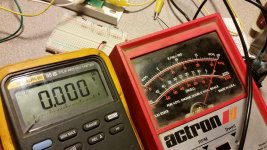
Test bench

The old treadmill control has 10 discrete speeds from 1 MPH to 10 MPH. This is about 550 to 5500 RPM. Although I'd like to keep the digital control, its a one piece board, and I don't need the rest of it. I'll probably just replace it all with a 10K ohm pot.
Is there any advantage to leaving the flywheel on? Mine is setup for a poly-V belt, I could just put a poly-V pulley on the drill press (Craftsman 1500
Macgee, there is not a week that goes by that I don't see a treadmill on the curb for free. Keep an eye out when you are driving around, also check the free section on CL.
Two switches went in the hole where the dwell meter was. One for AC power and one to the motor drive. The selector switch on the far right get replaced by a 5k ohm 3-turn pot for speed control.

I calibrated the tach to match the actual spindle RPM, including using the 1000/5000 RPM switch. With the current pulleys, I have a usable range from about 40 RPM to 2700 RPM. The meter is active whenever power is on, so I can see what the speed is before turning on the drive.