First I have a question on corded drill speeds. I read that a 1/2" drill is rated for 0-850 rpm's. I see a 3/8" corded drill rated for 0-1200 rpms and a corded 1/4" rated for 0- 4000 rpm's no load speed. Can 4000 rpm's no load speed be right? What would it be used for? I know slow speed for bigger bits in steel. Also, I never have used the high speed range on my cordless drill, what should I use it for? Thanks!


You are using an out of date browser. It may not display this or other websites correctly.
You should upgrade or use an alternative browser.
You should upgrade or use an alternative browser.
Drill speed question Corded and cordless
- Thread starter johninct
- Start date
Alchymist
Well-known member
The smaller the drill bit the faster you have to run it. Most drill speeds are predicated on the maximum size bit it will hold, hence the faster speeds on the smaller drills. Turning a 1/2" bit at 4000 RPM, for example, is an invitation to disaster. Another reason most drills are now variable speed.
espyking83
Well-known member
^^Truth. You try 1/2" @ 4,000 rpm you better ******* have a vise and combat helmet
Alchymist
Well-known member
^^Truth. You try 1/2" @ 4,000 rpm you better ******* have a vise and combat helmet
Truer words were never spoken! Life insurance better be paid up also.

Roberts210
Well-known member
Ditto that. I was using my Milwaukee Magnum last summer to drill a 4" hole-saw hole through a 2X6 and subfloor for a toilet vent... I was using the side handle. Thank goodness the M.M. only had a 850 rpm top speed cause when the bit caught it threw me over on my side and screwed up my hand that had ahold of the side handle. That was in July... my hand is finally pain free. If the drill had been spinning at a faster rpm who knows what it would have done to my hand.
George in Rancho Cordova
Well-known member
- Joined
- Mar 15, 2011
- Messages
- 741
For mild steel, I believe the cutting speed is around 100 surface feet per minute.
The formula, as I recall is:
4 times the cutting speed divided by the diameter.
In the case of a 1/2" drill bit, four times the cutting speed would be 400; dividing by 1/2 (same as multiplying by two) would give 800 RPM as a starting point.
That was by memory from a long time ago;speeds for hand held drill may be lower.
My experience with hand-held drills is this:
I was pretty disappointed in the set of Viking drill bits I bought through the deal here on GJ. I was using 1/4 to about 3/8 bits in a Craftsman battery 3/8 drill and a corded 3/8 drill.
When I used my 1/2" DeWalt with much more torque, the material drilled "like buttah".
The Viking bits are fine.
The formula, as I recall is:
4 times the cutting speed divided by the diameter.
In the case of a 1/2" drill bit, four times the cutting speed would be 400; dividing by 1/2 (same as multiplying by two) would give 800 RPM as a starting point.
That was by memory from a long time ago;speeds for hand held drill may be lower.
My experience with hand-held drills is this:
I was pretty disappointed in the set of Viking drill bits I bought through the deal here on GJ. I was using 1/4 to about 3/8 bits in a Craftsman battery 3/8 drill and a corded 3/8 drill.
When I used my 1/2" DeWalt with much more torque, the material drilled "like buttah".
The Viking bits are fine.
theoldwizard1
Well-known member
I was using a 3/4" Silver & Demmings bit on ,y 1/2" drill to make holes in some 2x4s without the assist handle. I was not going full speed, but is "caught" and just about broke my wrist.
Triple gear reduction is the secret to more torque at low speed.
Triple gear reduction is the secret to more torque at low speed.
sberry
Banned
Cordless is the best thing that ever happen for safety
thymer
Well-known member
^^Truth. You try 1/2" @ 4,000 rpm you better ******* have a vise and combat helmet
'bout spit my coffee out on that one. funny
I think everyone is missing my question. I know 4000 rpm's isn't for a 1/2" bit but is there a use for a drill with 4000 rpm free speed or is that a misprint? Also, I have never used the high speed on my cordless drills and what would speed 2 be used for?
Doug Arthurs
Well-known member
well if you apply George's formula 100 x 4 = 400 divided by .125 for a 1/8 bit and voila 3200 rpm. So a 4000 rpm drill is used for 1/8 and down. Of course most drills are variable so if you are running a 1/4 bit run it at half speed.
Doug Arthurs
Well-known member
I almost always run my drills slower then recommended in a hand held drill. I want to see a chip being formed. On many materials it is hard to put enough cutting pressure to maintain the chip load so slower means the tool will be cutting and not just rubbing and dulling. The mill and lathe are different stories.
I think everyone is missing my question. I know 4000 rpm's isn't for a 1/2" bit but is there a use for a drill with 4000 rpm free speed or is that a misprint? Also, I have never used the high speed on my cordless drills and what would speed 2 be used for?
Read and comprehend this entire thread, including all links.
http://www.garagejournal.com/forum/showthread.php?t=321979
Speed is inversely proportional to drill bit diameter. Meaning as the drill bit size decreases, the speed needed increases. You select the speed based on the size of the drill and material to be drilled type. Drill manufactures produce drills with this guideline in mind. Thus 1/4" chucked drills will be optimal for 1/4" and smaller drill bits. 3/8" drill will be optimal for ~1/8-3/8" drill bits, and 1/2" drill will usually do all the way up to a ~5/8" bit with a bit of compromise on the bottom end.
^^Truth. You try 1/2" @ 4,000 rpm you better ******* have a vise and combat helmet
Ever seen high speed machining? Drills will push into the 5digit RPM range with high feed rates.
Last edited:
spongerich
Well-known member
4000 RPM is just about right for an 1/8 drill in Aluminum, Brass or Bronze as long as you're wearing your safety glasses.
Leaflessshadetree
Well-known member
Modern dental drills can rotate at up to 400,000 rpm.
Not sure why but I want one in my shop.
IMO slower is usually better. I don't think I've ever had a problem turning a small bit at low speed. I have however seem a lot of bits overheated from too high of RPM and low pressure.
Not sure why but I want one in my shop.
IMO slower is usually better. I don't think I've ever had a problem turning a small bit at low speed. I have however seem a lot of bits overheated from too high of RPM and low pressure.
First I have a question on corded drill speeds. I read that a 1/2" drill is rated for 0-850 rpm's. I see a 3/8" corded drill rated for 0-1200 rpms and a corded 1/4" rated for 0- 4000 rpm's no load speed. Can 4000 rpm's no load speed be right? What would it be used for? I know slow speed for bigger bits in steel. Also, I never have used the high speed range on my cordless drill, what should I use it for? Thanks!
drilling into wood
First I have a question on corded drill speeds. I read that a 1/2" drill is rated for 0-850 rpm's. I see a 3/8" corded drill rated for 0-1200 rpms and a corded 1/4" rated for 0- 4000 rpm's no load speed. Can 4000 rpm's no load speed be right? What would it be used for? I know slow speed for bigger bits in steel. Also, I never have used the high speed range on my cordless drill, what should I use it for? Thanks!
4000 rpm is great, and I use them often. Even higher rpm can be useful. My corded 1/4" drill is rated at 4800 rpm. It is an old Steele brand, perhaps now defunct, and is a copy of a Makita drill of the same specifications. I use it at the workbench where it is ideal for small drill bits used to drill pilot holes.
My recently acquired Metabo BE 18 LTX 6 High Speed Drill 18V High Speed Drill is variable speed up to its 4000 rpm top speed. I use it for any small hole when I am not at the work bench. Most recently, 6 April 2018, yesterday as I type, I used it to drill pilot holes near the top of my shop wall. I then installed an air conditioner hanger for a mini split. I have also used it with an 3/8" drill bit to drill 4x4 stock where it performed admirably.
For very small holes, 1/8" and under, I use a 12 volt Milwaukee 2460 M12 12-Volt Rotary Tool which has much higher rpm than my two more powerful high speed drills.
dutchgray
Well-known member
drilling into wood
This is mostly what I use mine for, piloting for wood screws, got a heavy duty corded 1/4" mains drill, runs at 2300 rpm, could go faster but its what I have
Most cordless drills are too slow really for small holes in wood or metal, but slower dosent cause a problem, just means drilling takes a little longer. I dont actually like drilling metal with a cordless drill, the safety clutch is nice for the bigger drills but If I had 50 5mm holes to drill I would use a corded drill if I had a choice.
theoldwizard1
Well-known member
IMHO, most serious DIYers need 2 drills. A good, cordless 3/8" and a corded triple gear reduction 1/2". The triple gear reduction is what get you the torque to twist those big bits.
Mohawk Dave
Well-known member
I didn't read all the posts, but I kept my corded 1/4 high rpm drill for sheet metal when doing rivet work...it's a Dewalt DW217 4k rpm.
Last edited:
Ole Slewfoot
Well-known member
High speed also works great if you use strip discs and several other drill accessories.
with how drills are today, why wold you limit yourself to 3/8 on a cordless? for example, I'm pretty sure all the M12 fuel drills are 1/2", let alone the 18V offerings.IMHO, most serious DIYers need 2 drills. A good, cordless 3/8" and a corded triple gear reduction 1/2". The triple gear reduction is what get you the torque to twist those big bits.
Last edited:
There is also a consideration of the type of bit, and what you are drilling. I have a wall chart next to my drill press with bit size, type and material being drilled. Very useful. There is no real harm drilling slower with those small twist drills. It just takes a little longer. With metal, if the waste comes out on a nice continuous coil, you are at the right speed.For mild steel, I believe the cutting speed is around 100 surface feet per minute.
The formula, as I recall is:
4 times the cutting speed divided by the diameter.
In the case of a 1/2" drill bit, four times the cutting speed would be 400; dividing by 1/2 (same as multiplying by two) would give 800 RPM as a starting point.
That was by memory from a long time ago;speeds for hand held drill may be lower.
My experience with hand-held drills is this:
I was pretty disappointed in the set of Viking drill bits I bought through the deal here on GJ. I was using 1/4 to about 3/8 bits in a Craftsman battery 3/8 drill and a corded 3/8 drill.
When I used my 1/2" DeWalt with much more torque, the material drilled "like buttah".
The Viking bits are fine.
Sent from my SM-G900V using Tapatalk
bczygan
Well-known member
Dumore "Sensitive" Drill Press.
0-17,000RPM 5/32 chuck.
I have an older model.
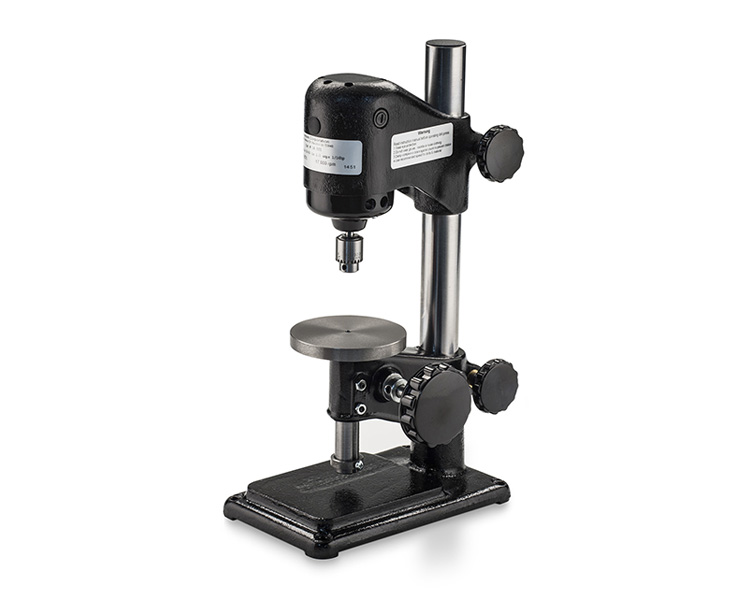
Bill
0-17,000RPM 5/32 chuck.
I have an older model.
Bill