To avoid these ads, REGISTER NOW!

Drilling straight (into crankshaft gear)

peejay75

Well-known member
Joined
Sep 4, 2017
Messages
312
Greetings.

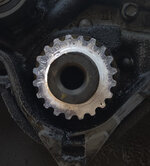
Alrighty, not looking forward to drilling and tapping this crankshaft gear to remove it, but that seems to be the preferred method (or splitting it) but if I'm gonna do it, I'd like to do it as close to right as my means will allow! What's the best way for a shadetree to make sure the holes are straight/perpendicular to the gear face? Perhaps using something like flange bushings to guide the drill bit(s)? Thanks in advance!
gear_levels_crop.jpg
 
To avoid these ads, REGISTER NOW!

Jgaz

Well-known member
Joined
Dec 16, 2016
Messages
1,661
Location
AZ
Is the face of the gear ”proud” (sticking out past) the snout of the crankshaft?
Can you see a way to use something like this?

If I was doing this job I’d probably take a piece of maybe 3/8” flat stock, scribe a circle on it the diameter of where you want the holes and drill a couple of appropriately size holes at 12 and 6 o’clock.
After drilling the tap drill holes, enlarge the holes to accept the tap you need.
Then drill on your circle center mark a hole that will accept your crankshaft bolt.
Presto. Homemade drill guide.

I had bread loaf pan about 2/3 full of homemade drill/ tap guides when I retired
 
OP
P

peejay75

Well-known member
Joined
Sep 4, 2017
Messages
312
Amazon.com
I've got one of those, but it's too big to fit on the gear face.

Is the face of the gear ”proud” (sticking out past) the snout of the crankshaft?
Nope, the gear is recessed onto the snout of the crankshaft, apologies for that poor pic that doesn't show the depth.

I like your circle-scribe method.

My personal preferred method would be a torch though.
I saw that that could potentially warp the crank?

The gear obviously can't be reused once drilled into, but for satisfaction, and ease of threading in bolts for the puller, getting the holes as "straight on" as possible would be nice, but not critical. I'll mull over you all's suggestions before committing1

Oh, any recommendations on drill bit type for the crank gear material, and best to prevent walking?
 

Jgaz

Well-known member
Joined
Dec 16, 2016
Messages
1,661
Location
AZ
and best to prevent walking?
Transfer punch thru your drilled holes in the guide.
You might have to remove the drill guide and use a real center punch to make a centering divot
 
OP
P

peejay75

Well-known member
Joined
Sep 4, 2017
Messages
312
(Just thinking out loud...this is overkill, but a 3D printed "jig" would probably be ideal, and I'm going to hafta repeat this process on a similar vehicle, so that might be work looking into down the, ahem, road.)
 

dcg9381

Well-known member
Joined
Jun 20, 2018
Messages
11,757
Location
Austin, TX
Why not weld something on this - the heat may help free it up and yank it with an impact-puller?
 

Spareparts

Well-known member
Joined
Mar 12, 2010
Messages
2,042
Location
Lansing Ks.
Will a bearing seperator fit behind the gear, if not drill a 3/16" hole between the root of the gear and crank
and directly across to the other side, increase the size of the bit until it almost through both sides, smack it
with a chisel it should split. You said shadetree.
 
OP
P

peejay75

Well-known member
Joined
Sep 4, 2017
Messages
312
Will a bearing seperator fit behind the gear
Nope, not much clearance. The "paperback" repair manuals suggest using pry bars, but others have said that will destroy both the shim/guide (behind the gear) and the soft aluminum oil pump.

Will be busting out the drill and puller or drill and chisel!
 

Jehannum

Well-known member
Joined
May 3, 2012
Messages
1,363
Location
Albuquerque, NM
Nope, not much clearance. The "paperback" repair manuals suggest using pry bars, but others have said that will destroy both the shim/guide (behind the gear) and the soft aluminum oil pump.

Will be busting out the drill and puller or drill and chisel!
It's all fun and games until you bust the oil pump casting behind the timing cog with your prybar.

Heat and penetrating oil, and then if that doesn't work in a sufficient amount of time, dremel a spot for your chisel to crack it between two of the teeth.
 

BTL-A4

Well-known member
Joined
Feb 28, 2018
Messages
1,252
Location
Santa Clarita
I vote for cutting it off as @Jehannum suggests. Cut it with a hacksaw, then tap the kerf with a chisel and the gear will likely break off. You can twist it with a screwdriver as well. Just don't cut into the shaft.
 

Jehannum

Well-known member
Joined
May 3, 2012
Messages
1,363
Location
Albuquerque, NM
I vote for cutting it off as @Jehannum suggests. Cut it with a hacksaw, then tap the kerf with a chisel and the gear will likely break off. You can twist it with a screwdriver as well. Just don't cut into the shaft.
I've done it before (on a 300ZX from 1996), and a dremel with a cutoff wheel is as close as I would get to the crank nose with an abrasive tool. I can't imagine the angle would work out to get a hacksaw in there.

All I did was notch out a bit between the two top teeth so my chisel wouldn't run the risk of slipping off and nailing the crank.
 
OP
P

peejay75

Well-known member
Joined
Sep 4, 2017
Messages
312
Alrighty, just bear with me, please, this could be bordering on "excessive"...(too much "free" time!)

Had this jig printed to help me drill the holes straight...the holes are the diameter of the center punch, to help guide it straight...now, do I even need the center punch, if the jig is "supposed" to do the work of keeping the bit (1/8 to start) straight? Who's to say that the punch mark is gonna be straight, and then when I put the bit in, it may not actually be starting on the punch dimple? Ditch the punch? Use 'em both?

Thanks!

holes.jpg

punch.jpg
 
Last edited:
OP
P

peejay75

Well-known member
Joined
Sep 4, 2017
Messages
312
Use the Center punch. It will keep the drill bit from skating. Then it is time to just send it.
Well, "one" question...if the jig holes are 1/8", and the drill bit is 1/8", should the bit not skate?
 

jessesandy

Well-known member
Joined
Apr 8, 2016
Messages
3,549
Location
Upper California
Just eye ball it.
Have a buddy look from the side.
You look down from the top.
When both of you see the drill bit is at a right angle to the face of the gear, start drilling.

Shadetree.
 

claymont

Well-known member
Joined
Oct 26, 2010
Messages
435
Location
CLAYMONT, DE
Greetings.

Alrighty, not looking forward to drilling and tapping this crankshaft gear to remove it, but that seems to be the preferred method (or splitting it) but if I'm gonna do it, I'd like to do it as close to right as my means will allow! What's the best way for a shadetree to make sure the holes are straight/perpendicular to the gear face? Perhaps using something like flange bushings to guide the drill bit(s)? Thanks in advance!

gear_levels_crop.jpg
I'd drill a hole above the keyway and just into it some. Drill size about key width. Then I'd remove the rest of the metal above the keyway with a die grinder with a bit sized to fit between the gear teeth. Drive a wedge in there and pull it off.
 
To avoid these ads, REGISTER NOW!

Brianf60

Active member
Joined
Mar 9, 2024
Messages
35
you will get better results with the Center punch. You can use the guide for the drill bit as well if you like. There are multiple ways to accomplish this task. Just pick one and don’t spend too much time overthinking it. You got this!
 
OP
P

peejay75

Well-known member
Joined
Sep 4, 2017
Messages
312
Thanks, all! Will do something tomorrow (weather permitting) and report back!
 

jessesandy

Well-known member
Joined
Apr 8, 2016
Messages
3,549
Location
Upper California
Well, "one" question...if the jig holes are 1/8", and the drill bit is 1/8", should the bit not skate?
True.
However, we always used jigs for locating and spotting. (Just drill a dimple.)
Then remove the fixture and drill the hole.
Otherwise, the fixture would trap chips/cuttings while drilling the hole.
Tends to chew up the fixture.
 
OP
P

peejay75

Well-known member
Joined
Sep 4, 2017
Messages
312
Update...

Well, several test prints and a 3D printer later, finally got the jig to satisfactory results. I learned about "heat set inserts" during this process, but couldn't find a suitable size for this jig, so I went with brass bushings. Not sure if they'll spin on me, or get chewed up, haven't tried drilling yet, because now i HAFTA buy that right-angle drill I've been "needing". Been getting by with a right-angle adapter lo these many years, but that was BEFORE the days of GJ, and now I know better!
 

Attachments

  • jig.jpg
    jig.jpg
    365 KB · Views: 29
  • jig_mounted.jpg
    jig_mounted.jpg
    410 KB · Views: 42

no704

Well-known member
Joined
Apr 27, 2016
Messages
5,217
Well, I thought I over thought things. Can’t u just use a puller on it?
 
OP
P

peejay75

Well-known member
Joined
Sep 4, 2017
Messages
312
Well, I thought I over thought things. Can’t u just use a puller on it?
"Over"??? No such thing, only "additional"! :)

From my understanding, the best approach is to drill holes so you can then use a steering wheel/harmonic balancer puller. There's not enough room behind the gear for a jaw-type puller.
 

cannuck

Well-known member
Joined
Nov 30, 2021
Messages
4,631
Location
Rural SK
"Over"??? No such thing, only "additional"! :)

From my understanding, the best approach is to drill holes so you can then use a steering wheel/harmonic balancer puller. There's not enough room behind the gear for a jaw-type puller.
I have a shelf full of pullers made for specific jobs such as this. There may not be room for a leg-type puller jaw, but there WILL be room for something a lot smaller. Start of with gear OD less amount of actual room at the rear and select a piece of pipe or tubing with enough wall thickness to machine an increased diameter to fit the gear. The little lip at the back is a 360 degree "hook" to pull the gear. Leave enough length at the outer end to put the crank bolt back in and cut another increased diameter at the outer end to fit a round "nut" with fine thread hole. Put the puller into your saw and slit in half along axis. The two halves make a split sleeve that will pick up the gear at one end and the pulling nut at the other. Use gear clamp or vice grip chain wrench if uber tight around the outer "stickout" and lube a pulling bolt thread with EP grease and run it into the nut. You gear will be off with no damage in a few turns.
 
Last edited:

larry4406

Well-known member
Joined
Jan 27, 2006
Messages
19,257
Location
Northern Virginia
I’m still having difficulty understanding the objective.

Make / model of engine and what is being done?

Pretty poor of an OEM to pocket a gear in a case with no chance of extraction.
 

ez-duzit

Well-known member
Joined
Jun 24, 2013
Messages
5,099
Location
Marina del Rey
Update...

Well, several test prints and a 3D printer later...
It really sounds like you're more focused on weeks of playing with a 3D printer, than with actually removing this gear. :) A drill press and some steel plate is all you need to create a more than adequate drill jig. But splitting it might not be so bad either.
 

no704

Well-known member
Joined
Apr 27, 2016
Messages
5,217
At a previous employer I happened upon a puller situation. Guy was trying to pull a steering wheel and had managed to strip the factory pulling holes. He had gotten a couple ratchet straps hooked to the steering wheel thru the rear hatch and attached to a forklift boom. The van was sliding on the smooth concrete. So he had about 5 more guys loaded in the van for extra weight.
I shut this activity down immediately! Drilled and tapped a couple new holes in the hub and had the wheel off in 5 min.
 
OP
P

peejay75

Well-known member
Joined
Sep 4, 2017
Messages
312
It really sounds like you're more focused on weeks of playing with a 3D printer, than with actually removing this gear. :) A drill press and some steel plate is all you need to create a more than adequate drill jig. But splitting it might not be so bad either.
busted!
 
OP
P

peejay75

Well-known member
Joined
Sep 4, 2017
Messages
312
I have a shelf full of pullers made for specific jobs such as this. There may not be room for a leg-type puller jaw, but there WILL be room for something a lot smaller. Start of with gear OD less amount of actual room at the rear and select a piece of pipe or tubing with enough wall thickness to machine an increased diameter to fit the gear. The little lip at the back is a 360 degree "hook" to pull the gear. Leave enough length at the outer end to put the crank bolt back in and cut another increased diameter at the outer end to fit a round "nut" with fine thread hole. Put the puller into your saw and slit in half along axis. The two halves make a split sleeve that will pick up the gear at one end and the pulling nut at the other. Use gear clamp or vice grip chain wrench if uber tight around the outer "stickout" and lube a pulling bolt thread with EP grease and run it into the nut. You gear will be off with no damage in a few turns.
This sounds interesting...how is the lip/360 degree "hook" created?
 
OP
P

peejay75

Well-known member
Joined
Sep 4, 2017
Messages
312
I’m still having difficulty understanding the objective.

Make / model of engine and what is being done?

Pretty poor of an OEM to pocket a gear in a case with no chance of extraction.
HORRIBLE design, as are most things on this engine. It's a 1994 Nissan Pathfinder V6. Replacing the water pump and timing belt. And I will hafta repeat this process on a 2002 Nissan Frontier, same engine. Seems that most (all?) who do this repair go into it knowing they will hafta destroy the gear and buy a new one.

And @no704 , lol @ "I shut down this activity immediately!" :ROFLMAO:

(Sorry, I'm still trying to figure out the multi-quote, to combine in one response!)
 

cannuck

Well-known member
Joined
Nov 30, 2021
Messages
4,631
Location
Rural SK
This sounds interesting...how is the lip/360 degree "hook" created?
you select or bore the ID to what will fit behind the gear, then chuck up the complete tube/pipe and open a "pocket" that fits the gear OD and length. the minor ID forms the ring that does the pulling. Will take some pics in shop tomorrow.
 
Last edited:

Jehannum

Well-known member
Joined
May 3, 2012
Messages
1,363
Location
Albuquerque, NM
HORRIBLE design, as are most things on this engine. It's a 1994 Nissan Pathfinder V6. Replacing the water pump and timing belt. And I will hafta repeat this process on a 2002 Nissan Frontier, same engine. Seems that most (all?) who do this repair go into it knowing they will hafta destroy the gear and buy a new one.

And @no704 , lol @ "I shut down this activity immediately!" :ROFLMAO:

(Sorry, I'm still trying to figure out the multi-quote, to combine in one response!)
ah, the VG33E.

All of my experience on Nissan timing belts is with the VG30DETT in my 300ZX and the VG30E in my friend's 300ZX, which are largely the same in that department, so my notch + chisel advice goes pretty much straight to the heart of it.
 
To avoid these ads, REGISTER NOW!
Top Bottom