To avoid these ads, REGISTER NOW!

Drinking well water?

walta

Well-known member
Joined
Jan 13, 2017
Messages
2,309
Location
Dutzow Missouri
I'll tack this on here; Is there a company or agency that tests water samples for carcinogens specifically? I have a sob story/conspiracy theory that you guys would probably get too hung up on but I'm really wanting to send someone a sample for the express purpose of finding carcinogens. Who does that?

Carcinogens? There are test for hundreds of chemicals. Some are known carcinogens other may be suspected but testing for the unknown carcinogens is not possible. If you know what you are expecting to find I am sure it could be measured

51 different analyses = $149
111 different analyses = $250
182 different analyses = $660


I did send a sample to this lab

https://mytapscore.com/


Walta
 
To avoid these ads, REGISTER NOW!

Slednut

Well-known member
Joined
Dec 20, 2012
Messages
2,550
Location
Washington state
Sorry I don't have much input on this but I do have a story. We had some neighbors (his name was Dutch) that lived in the house for over 50 years before they went into assisted living. The people that bought their house freaked out that the well was only 30 feet deep and had a new one drilled.

Dutch died a few years ago, he was 101.

Oh yes, your local health department will usually test your well water.
 

nadogail

Well-known member
Joined
Jan 23, 2009
Messages
31,928
Location
Coronado, CA
Sorry I don't have much input on this but I do have a story. We had some neighbors (his name was Dutch) that lived in the house for over 50 years before they went into assisted living. The people that bought their house freaked out that the well was only 30 feet deep and had a new one drilled.

Dutch died a few years ago, he was 101.

Oh yes, your local health department will usually test your well water.
Do you think that drinking from that well shortend Dutch's life?
 
OP
H

Hobby_Man22

Well-known member
Joined
Nov 16, 2020
Messages
3,581
Location
tx
I ain't drinking from my well because some genius put a drainage ditch running from the septic to just passed the well to help drain the property. It's probably 120 feet away, but I don't care.
 

nadogail

Well-known member
Joined
Jan 23, 2009
Messages
31,928
Location
Coronado, CA
Sorry I don't have much input on this but I do have a story. We had some neighbors (his name was Dutch) that lived in the house for over 50 years before they went into assisted living. The people that bought their house freaked out that the well was only 30 feet deep and had a new one drilled.

Dutch died a few years ago, he was 101.

Oh yes, your local health department will usually test your well water.
Most folks don't live to see 101, if you doubt me, check the obituary listings in your local paper. Surviving to 101 is exceptional, there must have been something in his well water
 

Pen & Wrench

Well-known member
Joined
Jan 12, 2015
Messages
658
Location
Huron, SD
In my state, the State Department of Health will test water, including hydrocarbons, pesticides, herbicides and other chemicals. I'm assuming each state has a similar function. Like Ricky Joe, I grew up on well water, drank artesian water till I left the farm to go to college. It was high in sulphur and high in Fluorides, I had one cavity in my life, and it was in a wisdom tooth that was removed, so I still have yet to have a cavity that I ever had to deal with.
 
To avoid these ads, REGISTER NOW!

Stuart in MN

Well-known member
Joined
Sep 8, 2005
Messages
23,038
Location
Minneapolis
This is from today's Minneapolis newspaper. Andover is one of the northern suburbs.
----
Residents in an Andover neighborhood with well water contaminated by a cancer causing chemical are hoping to get answers as to what is causing it and what state officials plan to do about it.

The north metro city will host a virtual meeting Thursday with officials from the Minnesota Department of Health and the Minnesota Pollution Control Agency to give an update on the situation after high levels of 1,4-dioxane were found in several private wells in the Red Oaks neighborhood in August.

Betsy Berg, who has lived in Red Oaks for 35 years, said she's been trying to get answers for nearly two months after she was notified her water was contaminated and tested above state guidelines for safe drinking water.

"There has been no communication," Berg said. "This is important. Be honest and tell us so there is not this hysteria over this."

At least 40 wells in the neighborhood have 1,4-dioxane concentrations above 1 microgram per liter, according to a fact sheet produced by the state's Health Department. Anything above 1 microgram per liter creates health concerns. Berg's well tested at 9.6 micrograms per liter. Her neighbor, Monika Dipert's, registered at 2,000.

The chemical 1,4-dioxane was used as a stabilizer for the chlorinated solvent that was often used for industrial purposes. Groundwater contaminated with 1,4-dioxane is largely caused by the historical use and disposal of chlorinated solvents, the MPCA said. Drinking contaminated water is the primary way people are exposed to the chemical, the MPCA said.

The source of the contamination remains under investigation, according to a statement from the MPCA. But it was discovered during water sampling affecting private residential wells near Bunker Lake and Crosstown boulevards and near the former Waste Disposal Engineering Landfill.

In 2019, Gov. Tim Walz declared the defunct landfill, now managed by the MPCA, one of the most toxic sites in the state. More than 6,600 barrels of hazardous waste were disposed of there in the 1970s. The 2019 bonding bill included $10 million to begin cleaning it up.

The contamination is limited to private wells and has not a ffected those hooked up to the city's water system, which has been declared safe, the MPCA said.

A spokesman for the state Department of Health said staff at the agency have fielded "many phone calls and e-mails" from residents in the area. Doug Schultz said people can reach the Health

Department at health.hazard@state. mn.us or can get a call from the agency by leaving a message at 651-201-4897. Some answers may be found on the Health Department's fact sheet a bout the water contamination.

Residents like Berg with contaminated wells have been receiving bottled water. For the past two months, Berg has not used her tap water.
"We do everything out of the cooler, washing fruits, rinsing noodles, cooking, brushing teeth," she said. "We were told not to consume it."
But she said that's about all she has been told. "Send us a letter and there would be a lot less frustration," Berg said. "Tell us what is going on. I just want safe water."

The virtual meeting is at 6 p.m. Thursday. Those without access to a computer can view the meeting at City Hall.
 

tonyciambrone

Well-known member
Joined
Nov 4, 2015
Messages
1,152
Location
Northern Illinois
And your point is? Is the piping of the RO system stainless? Your kettle, pasta pot, and even the tap for the most point have comparably little time in contact with the water compared to the full time exposure that the system and valve have.

also you won’t see any sign until one day you have a leak.

I have seen stainless pipe erode in about 4 years with an industrial RO system I maintained.

And the real point was not the cost, but the powerful action of water molecules trying to reestablish ionic bonds.
This must be news to all the manufacturers of stainless and powdercoated mild steel RO storage tanks. Tens of millions in this country alone I would think. Have you contacted anyone about this?
 

Firebrick43

Well-known member
Joined
May 12, 2015
Messages
13,998
Location
West central Indiana
This must be news to all the manufacturers of stainless and powdercoated mild steel RO storage tanks. Tens of millions in this country alone I would think. Have you contacted anyone about this?
None of the large systems I have seen have either.

I highly doubt that their is any steel tanks powdercoated in the interior, maybe glass lined? Powder coating cant keep exterior steel from rusting in my experience.

Every RO and DI system I have seen in industry has been either HDPE plastic(unpressurized) or glass filament wound reinforced plastic for pressurized tanks.

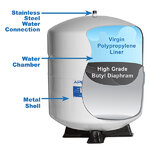
But I did go and look on google, and behold there are a lot of smaller "pressure tank" ro tanks made of stainless steel.

Water doesn't touch the metal however

inside-the-tank-text-ed.jpg

As you can see they have a plastic liners in them.

Larger stainless RO tank are mainly an alibaba item and I am sorry, I don't trust the chinese in truth of advertising.
 

rburke65

Well-known member
Joined
Nov 10, 2007
Messages
12,349
Location
Canfield, Ohio
We have a well and a softener and the softener meters the usage. On average we ….wife and I….use 75 gallons a day.
 

fuggle

Well-known member
Joined
Apr 9, 2013
Messages
83
Location
Way North in California
Yes but it’s also exposed to air. RO water is looking to re establish ionic bonds. In an enclosed system it’s the metal of the pipes that will be stripped to make these bonds. It looks like acid erosion (and maybe in copper is partially) but 316 SS is generally immune to weak acids. Removing the minerals out of the water will make RO water slightly acidic btw.

However in air (as in your tap) the RO water starts absorbing carbon dioxide rapidly. This makes the water acidic within just a few hours. Down to 5.5 or so in ph.

Again this acidity probably will not hurt good SS and the ionic bonds have been satisfied by the carbon dioxide. It’s the enclosed metal piping that is at risk from RO water.
Do you have source for this information? No way RO water in air will magically become 5.5 ph. Not possible. Period.
 

rlitman

Well-known member
Joined
Oct 18, 2010
Messages
24,582
Location
Long Island
Do you have source for this information? No way RO water in air will magically become 5.5 ph. Not possible. Period.
Stepping in here, it actually IS possible. Remember that pH is a logarithmic function, so the difference between 5 and 6 is 10x the difference between 6 and 7. 5.5 is actually not all that acidic, and warm and flat club soda has a pH of 4.99, so 5.5 isn't implausible at first glance to me.

Here's my source:
 

fuggle

Well-known member
Joined
Apr 9, 2013
Messages
83
Location
Way North in California
Stepping in here, it actually IS possible. Remember that pH is a logarithmic function, so the difference between 5 and 6 is 10x the difference between 6 and 7. 5.5 is actually not all that acidic, and warm and flat club soda has a pH of 4.99, so 5.5 isn't implausible at first glance to me.

Here's my source:
Nice article. Thanks. I like data and charts. I also like that she was making fun of some media headlines. lol. It doesn't talk about the RO water is 5 pH question though.

My wife is a huge seltzer fan. And she doesn't like to pay for it. So we've tried a few ways to carbonate water. It's not as easy as it seems. It depends on a number of variables. Such as temperature, surface area to volume, pressure etc. And yes pH is logarithmic which means 5 is 100 times 7. So quite a bit. Forcing pure CO2 through an aerating stone is definitely the best and fastest way. I'm going to calibrate my pH meter and take a few measurements. :)
 

rlitman

Well-known member
Joined
Oct 18, 2010
Messages
24,582
Location
Long Island
Nice article. Thanks. I like data and charts. I also like that she was making fun of some media headlines. lol. It doesn't talk about the RO water is 5 pH question though.

My wife is a huge seltzer fan. And she doesn't like to pay for it. So we've tried a few ways to carbonate water. It's not as easy as it seems. It depends on a number of variables. Such as temperature, surface area to volume, pressure etc. And yes pH is logarithmic which means 5 is 100 times 7. So quite a bit. Forcing pure CO2 through an aerating stone is definitely the best and fastest way. I'm going to calibrate my pH meter and take a few measurements. :)
I force carbonated for a while using SodaStream bottles with a carbonation cap. With refrigerator chilled water and 35PSI of CO2, I could get a really good tongue stinging beverage. I was aiming for 4 volumes of carbonation. I have a McCann carbonator and really want seltzer on tap, but other projects have prevailed for over the last decade.

As for RO, what I was getting at was that flat soda water at room temperature has pretty much reached equilibrium with the environment, and the article says it's pH is 5, which I'll take for granted. Perhaps it will rise, as flat soda still has more dissolved CO2 than RO will absorb from the partial pressure in air, but how far.

Also, most tap water is buffered to keep the pH above the point where it damages plumbing, but RO water is not buffered so the pH can easily take these sort of wild swings.

I've had some lab experience with pH meters, and don't put much faith in them. In the best of conditions, stored in buffer solution, washed in fresh buffer, then rinsed in DI water, then 2-point calibrated against fresh calibration solutions with triple DI rinses in between, I could still hardly get better results than from hydrion paper, and never could come close to titration results. Readings taken in the DI water would frequently be tainted by the previous solution, simply because it's SO easy to get DI water to shift from 7 with the most miniscule contamination. I guess that for wide-range work (fish tanks or hydroponics), where lots of readings are needed (or perhaps even continuous results), they make more sense, but for the issue in question, I'm not so sure.
 

fuggle

Well-known member
Joined
Apr 9, 2013
Messages
83
Location
Way North in California
As for RO, what I was getting at was that flat soda water at room temperature has pretty much reached equilibrium with the environment, and the article says it's pH is 5, which I'll take for granted. Perhaps it will rise, as flat soda still has more dissolved CO2 than RO will absorb from the partial pressure in air, but how far.


I've had some lab experience with pH meters, and don't put much faith in them.
Comparing the diffusion rate of CO2 into RO water at 1 atm to force carbonated water from IGA is ridiculous.

This last line is comical. You don't put faith in pH meters? They are worse than pH papers? Wow. What about the paper you presented? lol

You've made quite a few outrageous comments in this thread. All of which are not based on any science. Carry on.
 

laser3kw

Well-known member
Joined
Nov 17, 2012
Messages
7,276
Location
northen IL
"Most folks don't live to see 101, if you doubt me, check the obituary listings in your local paper. Surviving to 101 is exceptional, there must have been something in his well water"
the "something in his well water" was probably Jim Beam

Groundwater contaminated with 1,4-dioxane is largely caused by the historical use and disposal of chlorinated solvents, the MPCA said. Drinking contaminated water is the primary way people are exposed to the chemical, the MPCA said.
1,4 dioxane was a popular "mystery ingredient" in many home brewed race fuels thru the 80's and 90's. The organizations came up with a test for it and, if you were caught, you were banned for life. I know a few teams that regularly used it (even saw the cans in their shops).
 
To avoid these ads, REGISTER NOW!
Top Bottom