To avoid these ads, REGISTER NOW!

Driveway expansion joint repair

elcom

Well-known member
Joined
Apr 15, 2012
Messages
195
Location
Houston, TX
The wood in my driveway expansion joints rotted.

I had no trouble removing the rotted wood (looks like 1 x 4). Cleaned the joint with a wire brush on a die grinder (low speed) and then vacuumed the joint.

The joint is 1” wide and 3-4” deep.

I am planning to use Sikaflex self leveling sealant. The joint is pretty level; concrete slab was recently leveled.

Question: Do I need to fill with sand under the backing rod? Or is backing rod (2 3/4 inch rods twisted together fits well) sufficient?

I see some online articles/videos advise sand, some don’t mention it.

The twisted rods fit tightly and I can easily ensure that the rod ~1/4-1/2 inch below the slab edge. If I fill with sand, it may be a bit trickier to ensure correct depth.

Thanks!
 
To avoid these ads, REGISTER NOW!
OP
E

elcom

Well-known member
Joined
Apr 15, 2012
Messages
195
Location
Houston, TX
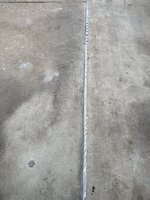
So I applied 6 29 oz tubes of Sikaflex ($96 + tax) and it seems to just be running through the “rope”. I suspect that using pipe insulation would have been a better option.

See attached picture.

What is the best option now?

1) keep pouring Sikaflex until it fills the voids. Perhaps wait a bit between applications to build thickness
2) wait for it to cure, rip out; start over with pipe insulation.

Advice?

Thanks!
 

Attachments

  • image.jpg
    image.jpg
    1.5 MB · Views: 79

cretedog

ALLIANCE MEMBER
Joined
Mar 27, 2012
Messages
232
Location
North Dakota USA
The wood in my driveway expansion joints rotted.

I had no trouble removing the rotted wood (looks like 1 x 4). Cleaned the joint with a wire brush on a die grinder (low speed) and then vacuumed the joint.

The joint is 1” wide and 3-4” deep.

I am planning to use Sikaflex self leveling sealant. The joint is pretty level; concrete slab was recently leveled.

Question: Do I need to fill with sand under the backing rod? Or is backing rod (2 3/4 inch rods twisted together fits well) sufficient?

I see some online articles/videos advise sand, some don’t mention it.

The twisted rods fit tightly and I can easily ensure that the rod ~1/4-1/2 inch below the slab edge. If I fill with sand, it may be a bit trickier to ensure correct depth.

Thanks!
I've usually had a tough time getting a nice looking job with the self leveling products. Will run through and sag almost anywhere water will.
I have foamed joints with expanding foam and scraped it off and down 1/2" after curing and then poured in the sealant. Much prefer using Sikaflex 15LM from a caulking gun with the proper diameter backer rod and tooling the joint.
 

strutaeng

Well-known member
Joined
Dec 12, 2011
Messages
2,290
Location
Dallas, TX
The purpose of the backer rod is to create an hourglass profile so there's more area bonded to the sides, and no bond to the bottom. For the self leveling the top of the sealant will obviously be pretty level. There's also some geometry suggestions. I think it's 2:1. See sketch.
 

Attachments

  • IMG_20221218_182007379.jpg
    IMG_20221218_182007379.jpg
    311.4 KB · Views: 73
OP
E

elcom

Well-known member
Joined
Apr 15, 2012
Messages
195
Location
Houston, TX
I was only able to find 3/4” backer rod at the local Home Depot. My gap is 1”. The instructions suggested winding two rods “like a rope” if the gap was larger than 3/4. That’s what I did, but clearly not well enough.

The question is: now what?

I can just keep pouring in Sikaflex, but it is getting expensive (~$100 just for the Sikaflex for the 19 foot joint).

I would prefer not to start over, unless I really must.

Is there a more viscous compound that I can use to fill the gaps and then cover with more of the self leveling Sikaflex?
 

crguy

Well-known member
Joined
Jan 24, 2016
Messages
2,659
Location
SW Washington
I redid an area of my driveway that started out with multiple wood strips. Those had rotted out after years and I used the Sikaflex. I filled the bottom of the gaps with sand, then fitted foam backer rod. A few of the gaps were wider than the backer so I put thin wood strips in the sides as needed to make a good fit. Has been a few years now, and everything looks good.
 
To avoid these ads, REGISTER NOW!

strutaeng

Well-known member
Joined
Dec 12, 2011
Messages
2,290
Location
Dallas, TX
Try using the non self leveling (also called non-sag in the industry) down there to seal it up. Followed by the self leveling. Probably should let it cure about the 7 days they recommend. Is it cold there?...oh, Houston.

Or just use the non-sag altogether if you can finish it to make it look good. I see guys at the jobsites using some spoon-like stainless steel spatulas. On the little jobs I've done in my house, I've used disposable plastic spoons.
 
Last edited:

cretedog

ALLIANCE MEMBER
Joined
Mar 27, 2012
Messages
232
Location
North Dakota USA
I was only able to find 3/4” backer rod at the local Home Depot. My gap is 1”. The instructions suggested winding two rods “like a rope” if the gap was larger than 3/4. That’s what I did, but clearly not well enough.

The question is: now what?

I can just keep pouring in Sikaflex, but it is getting expensive (~$100 just for the Sikaflex for the 19 foot joint).

I would prefer not to start over, unless I really must.

Is there a more viscous compound that I can use to fill the gaps and then cover with more of the self leveling Sikaflex?
I would agree with StrutA- Buy a tube of Sika 15LM in the same color as the self-leveling and patch and tool in the dips.
 

cretedog

ALLIANCE MEMBER
Joined
Mar 27, 2012
Messages
232
Location
North Dakota USA
Never played with that one- can't say. It's a one part polyurethane like I believe 15LM is, so maybe worth a try. I don't know what 'textured' will look like vs the self leveling...
 

NuthinFancy

Active member
Joined
Jun 24, 2015
Messages
27
Location
SE Wisconsin
I was only able to find 3/4” backer rod at the local Home Depot. My gap is 1”. The instructions suggested winding two rods “like a rope” if the gap was larger than 3/4. That’s what I did, but clearly not well enough.

The question is: now what?

I can just keep pouring in Sikaflex, but it is getting expensive (~$100 just for the Sikaflex for the 19 foot joint).

I would prefer not to start over, unless I really must.

Is there a more viscous compound that I can use to fill the gaps and then cover with more of the self leveling Sikaflex?

For larger backer rod, i've had good results with this outfit: https://www.bestmaterials.com/caulk_sealants.aspx?source=adwords&gclid=CN-AqYeisZICFQL1PAodsmGuKw

Don't forget to 'plug' the ends, or the caulk will run out. Ask me how I know...

HTH
 

madpear

Member
Joined
Jan 9, 2023
Messages
5
Sorry for resurrecting an old thread, but I had the exact same problem as OP: self-levelling stuff would just seep through the rod. After the first pass, I had your same problem and had to pull up all the "twisted rope" and re-do. On the second pass, I used two layers: one was the twisted rope of the thinner backer material and I stuffed it in way deep. On top of that, I put a single straight tube of the thickest backer foam I could find, then poured the self-leveller. What I found was that, stuffed in tightly, the twisted rope seeped slowly enough when combined with the larger rod above it to allow the sealant to set completely level. I presume some still leaked underneath, but the combination of the two backers allowed it to be slow enough as not to stop the setting process.

This could be hit or miss, I had a gap which was really quite large and varied across the breadth of the joint (3-car garage) to be wider or narrower or even deeper/shallower at various points, but it worked for me. No more snakes making that gap, and the interior of my garage, their home!
 

tester19

Well-known member
Joined
Apr 25, 2021
Messages
225
Location
chigago
I had all this done professionally and one additional tip I found out is to place sand into the top surface of the filler before it drys. Much nicer surface and it blends in color wise better too. My driveway guys used foam backer rods to fill the gaps.
.
.
.
 
To avoid these ads, REGISTER NOW!
Top Bottom