To avoid these ads, REGISTER NOW!

Driveway paver choices

eljay

Well-known member
Joined
Mar 14, 2014
Messages
208
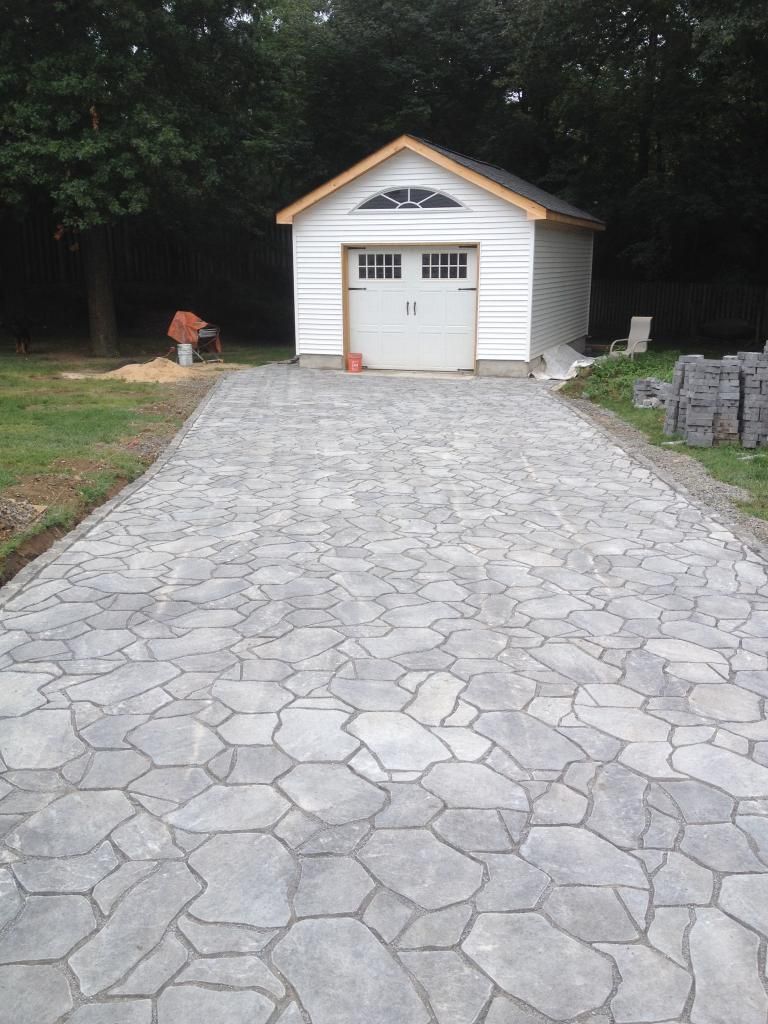
So, we have decided to go with pavers for the driveway. My wife prefers the large format patio-like stones that are 24x24" and 1.75" high:
http://shawbrick.ca/coll/?page.id=6&product-subtype.id=2&collection.id=52

When we stopped by the manufacturer store and mentioned these, they recommended against them because being so large, they may crack under the weight and tension of a vehicle. I know they also come in a 16x16 size, which may help.
I would be quite happy even with the standard brick size pavers like these, which are 2.75" high:
http://shawbrick.ca/coll/?page.id=6&product-subtype.id=1&collection.id=14

Has anyone here used the "patio" style pavers for the driveway? Would they hold up well to vehicle traffic with proper base preparation?

On another note, would I be able to put a car on jackstands on a paver driveway or is that dumb thing to do since the pavers are small and can shift easily?

Another option we both like is a poured exposed aggregate driveway, but it may be the most expensive option.

Thanks!

Location: Nova Scotia, Canada. Coastal weather with lot of snow and rain.
 
Last edited:
To avoid these ads, REGISTER NOW!

Captain America

Well-known member
Joined
Mar 5, 2015
Messages
57
Location
TEXAS
What about stamped concrete, the look of pavers and the strength of concrete driveway?
 

Attachments

  • ashlerdriv.jpg
    ashlerdriv.jpg
    75.1 KB · Views: 212

xtremek

Well-known member
Joined
Apr 13, 2012
Messages
11,603
Location
St. Johns, Mi
I've helped build many a patio with the smaller pavers. I think I'd agree the store. I've seen a few paver driveways here in Michigan and they all use the small pavers. If the prep is done right, the pavers shouldn't shift. Finally, if you want to use jackstands, I'd find a way to attach a board to the bottom of them, so you don't have to be concerned hitting the crack. The paver driveway in general will be stronger than any type of poured concrete.
 

maxpower_hd

Well-known member
Joined
Apr 17, 2015
Messages
2,230
Location
Massachusetts
I'm not sure where you live but keep winter in mind if you get snow. Pavers can shift a little in winter making shoveling more of a PITA and plowing can easily damage a paver driveway.
 

Kaizen

Well-known member
Joined
Jan 9, 2015
Messages
6,948
Location
New England
op post where you are. I am in nh and there is a couple houses around that used pavers. the stoneyard parking lot also uses pavers that are plowed in the winter. you have to be very careful with them. I wouldn't use anything bigger then 6x6 or 6x9 and the thick ones. in addition to that you will need an insane amount of prep work and compaction under it. yeah it can be done but probably 2 or 3 times the price of an asphault driveway. someone above mentioned stamped concrete. we don't have too many concrete driveways around here but I have seen stamped asphalt so its dyed and stamped.
on any of the above you would seriously then consider working on a car on it? oil stains and all the mess? I'd recommend plywood under anything.
 
OP
E

eljay

Well-known member
Joined
Mar 14, 2014
Messages
208
Thanks for the quick replies.

I'm in Nova Scotia, Canada right above Maine. We do get a lot of snow and I realize that shoveling anything that's not smooth will be a pain. The driveway will be going in front of a 2-car garage, so about 600 sqft area plus the actual driveway to the road being another 200-300 sqft or so.

I plan to do any car work in the garage, but just in case I need to do something in the driveway, I'd like to know if that's possible or not an option at all.

@Captain, that driveway looks very nice! My only concern with concrete would be cracking with the crazy freeze/thaw cycles we get here. With pavers, I could just repair a small area easily, if needed.
 

kd3pc

Well-known member
Joined
Aug 10, 2013
Messages
3,630
Location
Northern Neck
LJ,

unless you have a really sold base to install them on, these pavers will heave with the weather cycles and may crack or chip as they do so.

Smaller pavers will likely work better, but you still need a really well done, sold base with effective edgers and the proper sand to lock things in place.
 

Justind97

Well-known member
Joined
Oct 6, 2014
Messages
691
Location
Ottawa, Canada
Depending on the company you use. Permacon and Techobloc have an 80mm thick slab block that will work fine.
24x24 is not a good idea. They will eventually move and crack. Plus at that size it's a royal pain to lay them and have them perfect the first time. Lift and relaying a 50+lb stone *****. Been there, done that, and never again.

Personally, I will be going with a mixed batch size from Permacon called Trafalgar which has the largest stone of 12x12.
I'm in Ottawa for reference, so we get awfully cold weather
 

Captain America

Well-known member
Joined
Mar 5, 2015
Messages
57
Location
TEXAS
That's not my driveway, it was a quick Google search pic, but it does look nice! I have a washed aggregate driveway which I really like and doesn't leave any tire marks. However, living in central Texas I never shoveled snow off it, but I'm sure a shovel will slide smoothly across it.
 

volleyball

Well-known member
Joined
Aug 29, 2011
Messages
4,127
Location
NY, not NYC
Stamped concrete will be a fair bit of maintenance to keep them together. I saw one that the kid inherited the dads house and didn't do much. The concrete flaked off all over.
They make pavers for roads and they hold up. You will want that kind. They won't slip if they are installed correctly. Only worry if they start heaving. You can set your snowblower or plow blade up a bit and you won't have to worry about edges. Surprisingly, the snow that you think would stay usually goes away along with what is being cleared.
Everything will be work. But some people find some easier than other. Pavers will shift, concrete will crack. I don't like stamped asphalt. Did a patio with it, well I removed the old and dug down. compacted several times. Brought in several more inches of compacted base and things would leave marks in it, the paint doesn't last that long and you have black where ever it does get scraped. Recoating is expensive.
 

02camaro86

Well-known member
Joined
Dec 20, 2014
Messages
310
Location
New Jersey
we went with Rinox pavers. super beefy and heavy, we are happy. PITA to lay though

2014-08-23113517_zps47a98980.jpg
 

92GreenYJ

Well-known member
Joined
Jun 9, 2012
Messages
488
Location
San Diego, CA
I used the 12x12x 1.5" thick ones to widen my driveway over a patch of dirt to enable me to park my 20 foot trailer with my Jeep parked on it. Most of the ones the trailer tires have driven over have cracked on the first pass. I guess 3,000 lbs of trailer and 4,000 pounds of Jeep is just a bit too much for these things. They were fine when it was just the Jeep alone though.

A775565C-6647-4DF5-ACD1-6573215CFFBD_zpsm0zgzwyp.jpg
 
Last edited:

Captain America

Well-known member
Joined
Mar 5, 2015
Messages
57
Location
TEXAS
You can pour a driveway,l layer of sand, and put pavers on top,then you know they won't shift on you. That's how some homebuilders are doing here, if I'm in a neighborhood today,I'll snap a pic.
 

ssdave

Banned
Joined
Apr 11, 2015
Messages
2,913
Location
Eastern Oregon
Pavers work excellent for driveways, in many ways they perform better than placed concrete. The key is in a good base course.

I have an extensive amount of paver, and live in heavy snow and extreme winter environment in South Dakota. Paver really shines in one respect: It does not ice in the winter if properly designed. It does not heave, or become displaced, or irregular, and is very close to concrete in ease of shoveling/plowing. Again, proper installation is critical.

The key to good paver is a good base, properly compacted, and properly drained. 6 to 12 inches of good well graded base course gravel, compacted with good moisture to a hard, unyielding base. Then, 1 to 2 inches of fine sand as a drain course, this needs to be screeded flat, wetted thouroughly, and then troweled with a hard steel concrete trowel. Then, start the paver against a rigid, straight edge and lay them in a good interlocking bond pattern, tapping each into place with a rubber mallet. After they are all set, then dig around the edge a few inches deep, and place a bit of wet concrete to lock the edges. Then, cover the pavers with a half inch or so of fine sand, and use a plate compacter to go over them and seat them firmly in the base sand, and vibrate sand between the pavers to lock them into place.

The result of this is a flat, unyielding surface, that will stay in place. One important feature is that as snow and ice melt, the water that doesn't run off drains into the cracks between the pavers, and dissipates into the sand and is carried away to the edges or down into the soil. This is different from concrete, that holds a film of water on the surface, and freezes into glaze ice that puts you down on your *** when you walk on it.

The paver is quite easy to shovel, as long as you have good flat surface to start with to lay them on. The edges are beveled down, so that the shovel or plow rides on the surface, and the edges are recessed a 1/8" or more below the plane of the tops. Laying the pavers in bond pattern staggers the joints so that the blade edge doesn't fall into a crack.

The larger pavers are suitable only for paths, they are too thin for vehicle traffic, and the larger size makes keeping them flat and not tipping harder to maintain. The best are the square pavers in 2 or 3 sizes, that can be laid random pattern to interlock and stagger joints best.
 
To avoid these ads, REGISTER NOW!

Trey T

Well-known member
Joined
Aug 3, 2011
Messages
3,749
Location
Houston, TX
If I were to create a driveway with paver-stones, I would reinforce the base with geotextile.

geotextile are commonly used to reinforce unpaved roadways. I believe paver-stone driveway acts very similar to unpaved roadways as they tend to shift over the years by cyclic loads; having the geotextile under the base (crushed rock or some-sort) will minimize the shift.

profile of driveway:

-paver stone
-top layer (1/4" to 1" gravel/crushrock)
-base layer (3/4" to 2" gravel/crush-rock)
-geotextile
-dirt
 

ssdave

Banned
Joined
Apr 11, 2015
Messages
2,913
Location
Eastern Oregon
If I were to create a driveway with paver-stones, I would reinforce the base with geotextile.

geotextile are commonly used to reinforce unpaved roadways. I believe paver-stone driveway acts very similar to unpaved roadways as they tend to shift over the years by cyclic loads; having the geotextile under the base (crushed rock or some-sort) will minimize the shift.

profile of driveway:

-paver stone
-top layer (1/4" to 1" gravel/crushrock)
-base layer (3/4" to 2" gravel/crush-rock)
-geotextile
-dirt
I would not recommend using geotextile under the structure unless you have a specific problem that you are trying to fix, and the geotextile is selected for that problem and is designed correctly. For instance, you have a saturated clay subbase and want to keep it from intruding into the gravel layer, while also draining it to the gravel layer. In that case, you would provide drainage out of the gravel layer to carry away the water, and pick a specific needlepunched random fiber geotextile to act as a filter layer and drain water while containing the fine soil.

The use of geotextile "just because" can actually lead to failures that wouldn't have occurred otherwise. After 35 years working in the civil engineering/geotechnical field, I use geotextiles much less than I did when I started my career, and they were being pushed as the answer for most anything.

In the way that you recommended above to use geotextile, you are using it as a support fabric, with the intention of spreading the weight out over a wider area to keep the load from deforming the subgrade and causing rutting in the surface. To do this, the geotextile essentially acts like a "bag" to hold pressure in the deforming soil in. The soil behavior in the loaded area under the geotextile then becomes more or less like an incompressible liquid, and applies hydraulic pressure evenly in all directions around the contained area. Repeated cycles of this can liquify the soil, and cause localized heaving of the adjacent surfaces outside the loaded area. If you have inadequate subgrade, you are much better off putting in a thicker layer of gravel than using geotextile. The thicker layer of gravel spreads the weight out over a cone of about 45 degree sides, so the thicker the layer, the larger the base of the cone that the weight is spread out over. The gravel has the benefit of weight, which the geotextile does not. So, hydraulic pressures in the subgrade from the load are resisted by the weight of the gravel and heaving does not occur as easily.

I have seen spectacular failures under pavement where geotextile was used. In one parking lot where the owner used geotextile to try to avoid extra gravel over a heavy saturated clay soil, I saw a mud volcano form, that came up through the asphalt and formed a mushroom shaped, geotextile wrapped extrusion that came up about 3 feet out of the asphalt. This formed about 10 feet away from the highly traveled traffic lane, (that had thicker gravel and asphalt) and was direclty caused by hydraulic pressure contained by the fabric and transmitted, until it came to a weaker part of the structure, where the overlying gravel and asphalt was thinner. Once it started heaving up the gravel/asphalt, the weight resistance got smaller and smaller as the asphalt/gravel was replaced by clay, and it continued until we tore the pavement up, dug out the liquified clay, and replaced it with sound fill.

One of the real strengths of paver is that if you do have an excess load and deform the surface, you can pry out a few pavers, level the gravel underneath, and replace them. If you overloaded concrete and deformed it, you would have cracking and tipping and no good way to repair it other than repaving. I did several roadways over 30 years ago at a university to change the core of campus to a walking system. Those paver roads still need to handle emergency vehicles and semi truck deliveries at night, as well as garbage trucks. They have held up for that time, and look as good today as when they were first built. Asphalt would have been overlayed and/or replaced once or twice in that time. There have been a few minor areas of repair where the pavers rutted, were removed, the base repaired, and reset.

dave
 
OP
E

eljay

Well-known member
Joined
Mar 14, 2014
Messages
208
Thanks for the detailed insights Dave! Good points on varying the pattern to achieve a good lock. Sounds like brick pavers are in my future!
 

RickP

Well-known member
Joined
Jan 15, 2013
Messages
1,555
Location
Annapolis, MD
If you go with the pavers, there are slight color variations to choose from. Some manufacturers make them with a color seal that has a refined look, or you can get tumbled concrete for a little more rustic look.
 

retfr8flyr

Well-known member
Joined
Mar 7, 2013
Messages
756
Location
Providence Forge, VA
I have pavers for my drive and if I were to do it over I would use stamped concrete. The big drawback to pavers, for me anyway, is the constant battle with the stuff that will grow between them. In the warm months, I have to spray about once a week to keep the junk down. They are great for being able to pull a section up to run a line or such but the constant growing stuff problem make them a real pain. If you decide to stay with pavers, I would also recommend the smaller ones to keep them from cracking.
 

retfr8flyr

Well-known member
Joined
Mar 7, 2013
Messages
756
Location
Providence Forge, VA
I was new to pavers and didn't know about the sand. The sub contractors did the job when I built the house. I'm sure they used the cheapest sand they could find. I use the extended clearing type of control spray but I live in the country and stuff will pop up all the time. By the end of the growing season I have usually covered about all the area but it will start over again the next year.
 

boobag

Well-known member
Joined
Aug 15, 2010
Messages
397
I have a little over 3700 sqft of pavers. I'll just buy the roundup.

and continue to complain??

get a power washer and wash out the old sand, and then broom in polymeric sand. wet, then done for years.
 

boobag

Well-known member
Joined
Aug 15, 2010
Messages
397
I have a little over 3700 sqft of pavers. I'll just buy the roundup.

and continue to complain??
at least you can fix your issue. get cracks or settling with concrete, and you're stuck with it, unless you tear it out.

get a power washer and wash out the old sand, and then broom in polymeric sand. wet, then done for years.
 

volleyball

Well-known member
Joined
Aug 29, 2011
Messages
4,127
Location
NY, not NYC
The beauty of pavers is you don't have to do the entire thing at once. Do 1 or more 10 x 10 sections until you are done.You can even hire soon to be out of school kids to help you. Or maybe you learn to love the power of nature.
I have a relative that bought a house with a paver driveway and walkway.
There are so many waves in the pavers it will make you sea sick and the paver step is a tripping hazard.
Bothers me more then them. Just glad they are far enough away, I don't just fix it for them.
 

Trey T

Well-known member
Joined
Aug 3, 2011
Messages
3,749
Location
Houston, TX
Dave: Yes, what I was referring to was the felt-type geotextile fabric (needle-punched fabric) that are commonly used around here (clay soil in this region). These felt fabric allows for good permeability for infiltration.

As far as heaving goes, heaving is only cause by some sort of force, not simply by trapped water and cyclic load. If the water is trapped, the gravel grade/course isn't designed properly for side drainage. However your description reference to concrete structure/slab, not paver stone. To me paver system (using traditional sand grout, not polymeric sand) behaves differently than concrete slab, it's more like unpaved roadway; therefore, you'll always see it shift. I believe geotextile for paver driveway is a good idea, especially down in my area.

When we talk about water problem, we need to look at the bigger picture, not just the paver system or driveway, the whole site drainage. Drainage issue is comprised on many things but primarily how the house lot is graded. I made assumption that homes are graded properly where backyard is sloped down to the front curb. If you can't control your overland flow, you'll have problem with any type of foundation or with concrete structure. The projects you and I deal with in civil engineering is quite different, different scale, different system, and different effects.
 

zable9

Well-known member
Joined
Dec 4, 2014
Messages
78
Location
Greater Seattle area
I would not recommend using geotextile under the structure unless you have a specific problem that you are trying to fix, and the geotextile is selected for that problem and is designed correctly. For instance, you have a saturated clay subbase and want to keep it from intruding into the gravel layer, while also draining it to the gravel layer. In that case, you would provide drainage out of the gravel layer to carry away the water, and pick a specific needlepunched random fiber geotextile to act as a filter layer and drain water while containing the fine soil.

The use of geotextile "just because" can actually lead to failures that wouldn't have occurred otherwise. After 35 years working in the civil engineering/geotechnical field, I use geotextiles much less than I did when I started my career, and they were being pushed as the answer for most anything.

In the way that you recommended above to use geotextile, you are using it as a support fabric, with the intention of spreading the weight out over a wider area to keep the load from deforming the subgrade and causing rutting in the surface. To do this, the geotextile essentially acts like a "bag" to hold pressure in the deforming soil in. The soil behavior in the loaded area under the geotextile then becomes more or less like an incompressible liquid, and applies hydraulic pressure evenly in all directions around the contained area. Repeated cycles of this can liquify the soil, and cause localized heaving of the adjacent surfaces outside the loaded area. If you have inadequate subgrade, you are much better off putting in a thicker layer of gravel than using geotextile. The thicker layer of gravel spreads the weight out over a cone of about 45 degree sides, so the thicker the layer, the larger the base of the cone that the weight is spread out over. The gravel has the benefit of weight, which the geotextile does not. So, hydraulic pressures in the subgrade from the load are resisted by the weight of the gravel and heaving does not occur as easily.

I have seen spectacular failures under pavement where geotextile was used. In one parking lot where the owner used geotextile to try to avoid extra gravel over a heavy saturated clay soil, I saw a mud volcano form, that came up through the asphalt and formed a mushroom shaped, geotextile wrapped extrusion that came up about 3 feet out of the asphalt. This formed about 10 feet away from the highly traveled traffic lane, (that had thicker gravel and asphalt) and was direclty caused by hydraulic pressure contained by the fabric and transmitted, until it came to a weaker part of the structure, where the overlying gravel and asphalt was thinner. Once it started heaving up the gravel/asphalt, the weight resistance got smaller and smaller as the asphalt/gravel was replaced by clay, and it continued until we tore the pavement up, dug out the liquified clay, and replaced it with sound fill.

One of the real strengths of paver is that if you do have an excess load and deform the surface, you can pry out a few pavers, level the gravel underneath, and replace them. If you overloaded concrete and deformed it, you would have cracking and tipping and no good way to repair it other than repaving. I did several roadways over 30 years ago at a university to change the core of campus to a walking system. Those paver roads still need to handle emergency vehicles and semi truck deliveries at night, as well as garbage trucks. They have held up for that time, and look as good today as when they were first built. Asphalt would have been overlayed and/or replaced once or twice in that time. There have been a few minor areas of repair where the pavers rutted, were removed, the base repaired, and reset.

dave

Good info. Thx for the share
 

ssdave

Banned
Joined
Apr 11, 2015
Messages
2,913
Location
Eastern Oregon
Dave: Yes, what I was referring to was the felt-type geotextile fabric (needle-punched fabric) that are commonly used around here (clay soil in this region). These felt fabric allows for good permeability for infiltration.

As far as heaving goes, heaving is only cause by some sort of force, not simply by trapped water and cyclic load. If the water is trapped, the gravel grade/course isn't designed properly for side drainage. However your description reference to concrete structure/slab, not paver stone. To me paver system (using traditional sand grout, not polymeric sand) behaves differently than concrete slab, it's more like unpaved roadway; therefore, you'll always see it shift. I believe geotextile for paver driveway is a good idea, especially down in my area.

When we talk about water problem, we need to look at the bigger picture, not just the paver system or driveway, the whole site drainage. Drainage issue is comprised on many things but primarily how the house lot is graded. I made assumption that homes are graded properly where backyard is sloped down to the front curb. If you can't control your overland flow, you'll have problem with any type of foundation or with concrete structure. The projects you and I deal with in civil engineering is quite different, different scale, different system, and different effects.

I agree with you to some extent, pavers act like an aggregate surface instead of a rigid pavement that concrete is. That's why it's important to design the subbase to drain, and of adequate strength to not allow the pavers to shift. It is critical to compact the gravel subgrade to maximum density with adequate moisture, so that the gravel will not yield under the wheel weight.

I'm getting off the original topic some here, but this whole geotextile business has become of particular interest to me in the past few years. The reason I'm getting away from using it as much is that both my own observations, and failure analysis in the literature after the 30 some year history of fabric use shows that it does not act long term like we thought it would 30 years ago.

The reason it acts like a confining layer and can build and transfer hydraulic pressures is that the nature of the fabric causes a clogging surface to form at the geotextile. This results in an abrupt pressure gradient across the geotextile, and of course, a resulting lifting force, and where seams, weaknesses or holes in the fabric form, migration of fluids and plastic soil materials. In the area where I work, fabric was used extensively for the past 20 years as a separation layer under aggregate surfacing over silt and clay soils to cure pumping subgrade failures. What we are seeing is widespread failures, where localized "bubbles" of the fabric are pumping up through the gravels, and the bubbles are always filled with plastic clays, that "pump" under load. By the time the first "bubbles" surface, they are prevalent in the entire area, and the only real cure is to remove the contaminated gravel and rebuild the entire roadway.

A person can look at it as that it has been successful for 5 to 20 years, and has reached the end of it's design life, or can look at it as a failure. Matter of perspective. What we haven't seen is similar failures in is a properly designed aggregate sub-base. Of course, the fabric at $0.50 per sf is a lot cheaper than 18 inches of rock at $2.25 per square foot. But, if the rock is a more or less permanent fix, and it works better, it might be a better investment. I do know that where we are seeing geotextile failures, we're not repeating the experiment, we're replacing it with rock fill, and we're not seeing re-failures occuring.

I have entirely quit using geotextile as a filter layer, particularly in chimney drains and toe drains and such. The high hydraulic gradients formed across the clogging layer on the fabric definitively cause catastrophic failures, particularly in levees and embankments. I'm using graded sand/gravel filters instead. They develop a much less abrupt hydraulic gradient, and are self-adjusting as a clogging layer forms; the resulting pressures simply re-arrange the finer particles into the spaces in the larger particles, and the filter continues to function instead of breaching and failing as a geotextile will.

My apologies for the boring lecture to those that are more interested in pavers than in geotechnical engineering!

dave
 
Last edited:

volleyball

Well-known member
Joined
Aug 29, 2011
Messages
4,127
Location
NY, not NYC
I am more interested in the substructure issue. Paver installation is only a small portion of the job.
Thanks Dave
 
To avoid these ads, REGISTER NOW!
Top Bottom