To avoid these ads, REGISTER NOW!

Drywall around pipes

cyberguypr

Well-known member
Joined
Mar 15, 2012
Messages
49
Location
Indiana
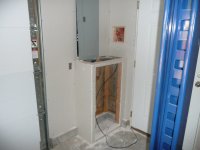
Not being a drywall expert I was wondering if anyone has any tips or ideas for drywalling around these conduits.

img1915x.jpg
 
To avoid these ads, REGISTER NOW!

35mm

Well-known member
Joined
Apr 6, 2011
Messages
180
I would do this in three pieces. I would hang the top piece around the box and down to lowest point of the large conduit, cutting a slot in the bottom of the drywall for it. Second piece straight at the bottom of the large conduit and cut outs for the other conduits and the lower piece straight on top and bottom.

The top piece I would make as long as possible. The other two I would only have 16 inches wide.
 

Erampu

Well-known member
Joined
Mar 18, 2012
Messages
862
Location
Waterford NY
I'm assuming that's a breaker box above the conduit. I'd leave that area open, or just put a piece in until it comes to the bends in the conduit.

A second option is to frame that area with furring strips thick enough to enclose the conduit, and screw a plywood sheet over it for access.
 

Big-Foot

Well-known member
Joined
Jan 30, 2005
Messages
1,951
Location
Midlothian, TX
I'm assuming that's a breaker box above the conduit. I'd leave that area open, or just put a piece in until it comes to the bends in the conduit.

A second option is to frame that area with furring strips thick enough to enclose the conduit, and screw a plywood sheet over it for access.

This is the way I have done it and recommend...
 

Outlawmws

Well-known member
Joined
Aug 9, 2011
Messages
39,274
Location
The Badlands
I'm assuming that's a breaker box above the conduit. I'd leave that area open, or just put a piece in until it comes to the bends in the conduit.

A second option is to frame that area with furring strips thick enough to enclose the conduit, and screw a plywood sheet over it for access.

This ^^^
 
OP
C

cyberguypr

Well-known member
Joined
Mar 15, 2012
Messages
49
Location
Indiana
Yes, that's the breaker box on top. My educated guess it is was either intended like that or a general oversight. Every single house in my subdivision has the same ugly setup.

I am extremely **** and since I'm going for a clean look I am reluctant to leave it open. I'm liking the idea of furring strips and access panel. Furring strips and access panel may definitely be the way to go about this. I have a 5" strip coming right below the breaker box (another reason why I don't want to leave it open) but since there's at least a foot until the bend of the biggest conduit I don't think it would be a problem.
 

70redbee

Well-known member
Joined
Dec 31, 2008
Messages
494
Location
Knoxville,Md
Frame it out like a closet and install a full sized
louvered door in front. This closes it off and gives you complete access.
 

darkk

Well-known member
Joined
Dec 24, 2009
Messages
3,361
Location
Willimantic, Ct.
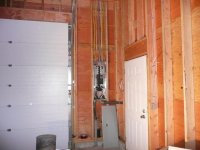
I had the same problem. Mine is in a wasted area next to the outside door. We're making a small 17"x27" counter on top of it to put a laptop on for internet access .
 

Attachments

  • box.jpg
    box.jpg
    95.1 KB · Views: 99
  • box2.jpg
    box2.jpg
    101 KB · Views: 100
  • box4.jpg
    box4.jpg
    75.1 KB · Views: 90
To avoid these ads, REGISTER NOW!

RECox286

Well-known member
Joined
Apr 11, 2012
Messages
1,399
Location
South Joisey (yeah, that is part of the USA)
When ever I am opening up a wall or ceiling to gain access to some sort of utility that

has been well hidden for years and years, but finally becomes a problem child, as, it

seems is inevitable, I wonder why the (heck) this particular item was covered up in the

first place. I know you have to bury some things for mechanical protection, but I for

one would like to see a lot of what is buried show up behind access panels, or in the

open from the git-go. Sure would make some of the messes that I get into that much

easier.

Uncle Bob
 

Kevin54

MEMBER EMERITUS
Joined
Jan 12, 2005
Messages
29,341
Location
Urbana, Ohio
Yep, leave the stud bay open to where the conduits are flush and box it out all the way to the slab.

^^^^This^^^^

Or box it out all the way to the floor and cover it. Maybe put a bench over in that area if feasible to help hide it.

Another way would take a little longer to do, but disconnect the five pieces of conduit then add some 90's and short pieces of straight at the bottom to run them directly into the wall, then 90 them back up. That way you'll only have to drill five holes through the drywall for a cleaner look
 
OP
C

cyberguypr

Well-known member
Joined
Mar 15, 2012
Messages
49
Location
Indiana
Thanks all for the ideas. Darkk's setup is awesome and definitely achieves the clean look I'm going for. And I totally agree with RECox286, definitely needs some sort of access panel. Makes no sense destroying something in the future.
 

Nelson58

Well-known member
Joined
May 29, 2010
Messages
278
Location
New York, New York
In NYC, the code requires a 3 foot open access around the main panel. I was going to frame it in a small utility closet, and the inspector made me remove it. I am not sure if the NEC requires something similar. I am bringing it up so that you don't have to remove it later like I did.

If code allows, I would put PT plates on the floor around it in a square and frame it in to the floor using 2x4s. Then sheetrock the sides. Put a hinged (piano hingo works well here) access door out of plywood on the front. You can run it top to bottom if you like to cover the panel and conduit if you like.

I would not put a laptop near a main electrical panel as there might be interference.

Just my .02


Nelson
 

signcrafter

Well-known member
Joined
May 9, 2012
Messages
12,365
I had the same problem. Mine is in a wasted area next to the outside door. We're making a small 17"x27" counter on top of it to put a laptop on for internet access .

I'm not sure but I think this is against NEC and OSHA rules. From what I understand they require 36" in front, under, and both sides of the panel to be clear for access. So I believe that little box out would be against code. I may be wrong but you might want to check with your inspector before you do it so it doesn't create problems in the future. Like if you ever decide to sell your house or something.
 

MoonRise

Well-known member
Joined
Nov 5, 2010
Messages
4,030
Location
NJ
I had the same problem. Mine is in a wasted area next to the outside door. We're making a small 17"x27" counter on top of it to put a laptop on for internet access .

As mentioned, the 'shelf' in front of the panel fails NEC requirements for clear space in front of panels.

That said, the big conduit coming up from the slab and in front of the wall makes it look rather f'd-up with the panel then set back into the stud wall. Mostly an aesthetic point, may also be a 'fail' on the 'protect wiring from possible physical damage' Code requirements. If drywall is planned/required there, I'd probably say an elbow/box going from the vertical conduit and then the wires going through that elbox/box and back 'into' the stud cavity would be the way to go. YMMV.
 

darkk

Well-known member
Joined
Dec 24, 2009
Messages
3,361
Location
Willimantic, Ct.
I'm not sure but I think this is against NEC and OSHA rules. From what I understand they require 36" in front, under, and both sides of the panel to be clear for access. So I believe that little box out would be against code. I may be wrong but you might want to check with your inspector before you do it so it doesn't create problems in the future. Like if you ever decide to sell your house or something.

The panel does not have 36" to the right or left because of doors so that's out, the front panel is just sitting on the shelf below it and will be slightly higher, plenty of room, and the biggest factor is it has already passed inspection. That conduit in the floor is under the slab to the existing house to the left and the little cubby protects the conduit coming up through the floor as it is double 2x4. there are 3 lines to be added to the right side because that panel is going to feed my other garage next door (25' away) and the outside power is also to the right on the wall. Besides, I think those rules only apply to commercial installs here.
 

MoonRise

Well-known member
Joined
Nov 5, 2010
Messages
4,030
Location
NJ
CT electrical Code, referencing NEC/NFPA 70 2005 Code version, 110.26 (A) (1), minimum required space in 'front' of the panel is 36 inches. Clear width requirement is 30 inches or width of the panel/equipment, whichever is greater. 110.26 (A) (3) does 'allow' "equipment associated with the electrical installation" to be "no more than 6 inches beyond the front of the electrical
equipment".

Inspector 'passed' it? You are lucky. Cause it doesn't meet the 36 clearance in 'front' of the panel and the little knee-wall juts out waaaay more than 6 inches so doesn't really 'get by' using the '6 inch allowance'.

And yes, clearance in front of the panel applies for residential as well as commercial/industrial applications. High(er) voltage commercial/industrial applications call out bigger clearances and other conditions, but ALL service panels are supposed to have that minimum 36 inch clear space in front of the panel. :beer:

And your have 'plain' 2x lumber in contact with concrete (floor slab and stem wall)? All wood in contact with concrete (which is or can be wet/damp and thus is supposed to be considered wet/damp for all general purposes with respect to wood) is supposed to be treated wood. Termites and mold/rot, ya know.
 
Last edited:

darkk

Well-known member
Joined
Dec 24, 2009
Messages
3,361
Location
Willimantic, Ct.
See! learned something new today. But, you made me run out and check the bottom coarse of wood! The pictures don't look it but there is a foam insulator on the foundation walls under the 2x6's and the bottom coarse IS PT. The front board of the little bump out on the slab covered in drywall dust is also PT. The clearance however is 17" wide front to back. So I guess I got lucky there.:rocker:
 
To avoid these ads, REGISTER NOW!
Top Bottom