To avoid these ads, REGISTER NOW!

Drywall/mold question

TravisT

Well-known member
Joined
Oct 22, 2011
Messages
156
Location
NoVA
Got a question on how to tackle a project that I’ll bet someone here could offer some advice. Just picked up a investment townhouse that had some mold on the ground level. The majority of the damage is in the kitchen and half bath. In the half bath, there is a layer of drywall, the framing, then another layer of drywall, foam insulation, then the cinder block wall (hope this makes sense). Both layers of drywall have some mold damage.

Any recommendations on how best to deal with this? First layer of drywall is removed, but only thing I can think is to remove the studs to replace the second layer of drywall, then reinstall the studs.

Almost feel it is redundant to have two layers, but I don’t honk it’s there for fire purposes only.
 
To avoid these ads, REGISTER NOW!

SALIV8

Well-known member
Joined
Dec 11, 2008
Messages
2,114
Location
chicago and s/w michigan
I was doing this earlier.

I used my Dremel with the rotobit and standoff attachment and it worked amazingly well with little dust. Get some earplugs it was loud tho. I set it to max rpm on mine.

I’d remove the front sections, then cut out the backside sections, then tap the thin pieces left on the studs with a hammer to break them up.

If fire code dictates 2 layers of drywall just double up the inside.
 
OP
T

TravisT

Well-known member
Joined
Oct 22, 2011
Messages
156
Location
NoVA
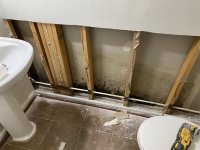
Not sure if I was as clear as I could have been the first time. It was difficult to explain, but a picture is worth 1000 words:

In the below picture, you can see the drywall behind the studs. This drywall is the exterior wall in the townhouse. Behind it is foam insulation and a brick wall, then the unit next door. This wall extends from front to back, and is the visible wall in the kitchen, the utility room and continues upstairs.

As you can see, because of the plumbing required in the half bath, that room was framed out in front of the exterior wall. Now getting the drywall out won't be that much of a problem, but getting new drywall in is. Additionally, this wall extends behind the HVAC and the water heater, with no clearance to get back there. Again, getting the drywall out is probably doable, but getting it back in will be almost impossible.

I could pull the drywall and not replace it, especially in the bathroom, but seems like this would leave a void that for fire purposes would not be ideal. Does this make more sense with the pictures?

The only "right" way that I can think to replace this drywall (if that's necessary) is to remove the HVAC unit, the hot water heater and potentially the framing for the half bath wall (shown in attached image), replace the drywall, then reframe and replace water heater and HVAC.

What are you guys' thoughts?
 

Attachments

  • IMG_4910.jpg
    IMG_4910.jpg
    148.5 KB · Views: 174

rlitman

Well-known member
Joined
Oct 18, 2010
Messages
24,657
Location
Long Island
A lot of this doesn't make sense. Like how did they screw the drywall to the studs in the first place? And why do you have four (+1) adjacent studs? I hope you don't go removing that framing, because it sure looks structural to me.

Also, that mold appears to be from water wicking up from the sill. Locate that problem first.
 
OP
T

TravisT

Well-known member
Joined
Oct 22, 2011
Messages
156
Location
NoVA
There is a staircase that is just above this half-bath, so yes, the wall is structural. My guess is that the outside walls were drywalled prior to the interior framing being done. Not ideal, not now at least. Kind of like the auto engineers not having to do maintenance on the car after it's initial build.

As for the water, that problem has been fixed. The previous owner had a busted pipe in the kitchen that they fixed. Problem is they didn't do any cleanup besides fixing the leak. Now it's my problem, but I knew that going into it.
 

Cypress

Well-known member
Joined
May 2, 2020
Messages
141
Location
Colorado
It's certainly odd that there's two layers of drywall there. I would think the brick / CMU and foam gives you the fire separation required between the other townhome unit. Also, my first guess is that is just a furring wall to bury the plumbing but there's a structural stud pack in there that makes me scratch my head a bit...

I would answer these 2 questions before doing any more work in the area:

1. Diagnose what's causing the water infiltration.
2. Understand what fire separation is required for the interior partition.

Once you diagnose those two issues, you will be able to make a much more informed decision on your next course of action.

ETA: missed your last post. Sounds like you have the water issue solved. just need to understand if that drywall is required by building code. If not, just rip it out and be done with it.
 
OP
T

TravisT

Well-known member
Joined
Oct 22, 2011
Messages
156
Location
NoVA
Cypress: Agree with your assessment. Correct, water issue is fixed. Only problem I see is that there is a potential for fire spread upward (within this unit, not extension into next unit over) if there is an opening in the drywall that covers the CMU wall.

I'll have to dig into that next.
 

Cypress

Well-known member
Joined
May 2, 2020
Messages
141
Location
Colorado
Cypress: Agree with your assessment. Correct, water issue is fixed. Only problem I see is that there is a potential for fire spread upward (within this unit, not extension into next unit over) if there is an opening in the drywall that covers the CMU wall.

I'll have to dig into that next.

You could pack the stud cavity with some mineral wool or rockwool insulation. Also, fire separation in the vertical sense is almost always done at the floor line above or below, not within the actual wall itself. Maybe I'm missing something though.
 

johnnyradiant

Well-known member
Joined
Mar 27, 2017
Messages
833
Location
Vancouver, BC
Given the 'behind' drywall appears to be fastened to the wall behind and not the studs I wonder was it originally built as an unfinished basement and then finished afterwards, perhaps as the developer finished and the first owner took possession even as part of the purchase? If neither of those layers are not 5/8" I would tend to think it wasn't initially put in as fire separation, but only ways to know would be check original plans, and or code. Paying attention to fire separation and installing additional measures above code minimum is never a bad thing except maybe when your trying to fish a wire without cutting up a wall.

Given that it is a ground floor issue I'd want to be really sure that the pipe was the only contributor to that problem. The picture tells alot but not all, and at first glance it really looks like there could be more going on, but if it was a pipe that started slow and was ignored for awhile I guess it could be the only reason. I feel it looks like that drywall has wicked up a lot of its moisture from the cmu as the studs don't really look like they've been fighting moisture.

If that is a cold water pipe running horizontally you could put some insulation on it so that won't be a contributor to humidity in the wall.
 

rayra

Well-known member
Joined
Dec 1, 2014
Messages
4,724
Location
Escaped from Los Angeles
saturate with a bleach-water spray to kill the mold. Dry. Encapsulate with a primer like Kilz. Close that **** back up.

The LAST thing you want to do is dremel, saw or otherwise disturb or turn loose all that mold into the air.
 
OP
T

TravisT

Well-known member
Joined
Oct 22, 2011
Messages
156
Location
NoVA
Johnnyradiant: Don't think this was an after-the-fact finishing, it's on the ground floor/main level of a 3-level townhome. There is room for air circulation between the outer layer of drywall in the inner, so I don't think the pipe being uninsulated is of much concern. Wouldn't hurt to shove some in there though. From what I understand, the leak was a massive one (apparently the sink came unglued from the bottom of the countertop and broke a water line). Apparently the leak was so bad it penetrated through to the neighbor's side. Not sure how they thought repairing water damage in this unit was not necessary. I can't imagine all the water that was not cleaned up, but given how water likes to wick, I'd imagine it went all the way down wall in between both layers of drywall/framing and just sat there.

rayra: This actually sounds like it may be a viable option for areas I can't get to. I've already opened the walls up where accessible to bleach-bomb them. I hate leaving known mold in the wall, but the only other option is to remove the HVAC to get to it, and I'm not sure if it's even worth that.
 

dogdog

Well-known member
Joined
Nov 15, 2011
Messages
12,711
Those drywalls are best to be replaced even the ones on the other side if possible. Treat it remove it, bag it and run...

If not. treat them with a solutions but not Bleach unless you are strap for cash and take your chances.

either concrobium.. spray in mist form. I have a ULV fogger to treat apartment size and works IMO. Read the instructions and watch a few youtube videos... also sold in HD / Lowes about the same price.

https://www.amazon.com/dp/B009AN7Y2U/?tag=atomicindus08-20

Or this Chlorine salt stuff "MOLD Armor".. not just chlorine bleach.... it also works, used that on a rotted and mold garage header replacement this past Summer, but Don't MIX the types, they are different chemicals... I used the rapid remediation. All the rotted wood are treated then removed and remaining wood are treated few times. since I don't want the spores to spread. My mom touched them by accident and triggered some skin conditions that was really bad. Yea.. 1000's of spore type, black could be the most dangerous one...

https://www.homedepot.com/s/mold%20armor?NCNI-5
 

rlitman

Well-known member
Joined
Oct 18, 2010
Messages
24,657
Location
Long Island
saturate with a bleach-water spray to kill the mold. Dry. Encapsulate with a primer like Kilz. Close that **** back up.

The LAST thing you want to do is dremel, saw or otherwise disturb or turn loose all that mold into the air.

Bleach is fairly good at killing active mold, but is lousy at killing spores. Plus it adds a lot of water to the party, and once the chlorine evaporates (which it ALWAYS evaporates before the water), it is no longer active.. Basically, bleach can cause mold to flare up later.

Mold Armor Mold Control leaves behind a mold killing residue that continues to kill mold for several months after the water has dried up.

Personally, I'd clean with bleach or pinesol (physically brushing off the mold), and then apply a borate solution that kills mold permanently (like Tombor or better yet, since you're also treating the wood, Bora-Care) to both the wood and the drywall. And skip the encapsulation step, since you don't want to form a vapor barrier where one doesn't belong.

I would be more afraid of noise issues from removing the drywall than of fire issues. You could probably come up with some way to put it back in pieces without removing the framing, but it's going to be an awful job with minimal payback, and removing the framing is super risky.

And regarding encapsulation, you just need to stop airflow in the cavity to keep the mold from being a headache. I would fill it with Safe-n-Sound and call it a day.
 
To avoid these ads, REGISTER NOW!

rayra

Well-known member
Joined
Dec 1, 2014
Messages
4,724
Location
Escaped from Los Angeles
yes, anything that greatly alters the ph will hinder further mold growth. Sometimes straight vinegar is used. Sure there are lots of costly specific chem treatments available.

I know it won't kill the spores, that's why I recommended encapsulating it by painting over it with a sealer / primer.

Lastly, whatever you do, do not mix ammonia and chlorine bleach solutions.
 

dogdog

Well-known member
Joined
Nov 15, 2011
Messages
12,711
yes, anything that greatly alters the ph will hinder further mold growth. Sometimes straight vinegar is used. Sure there are lots of costly specific chem treatments available.

I know it won't kill the spores, that's why I recommended encapsulating it by painting over it with a sealer / primer.

Lastly, whatever you do, do not mix ammonia and chlorine bleach solutions.

If you can physically remove it, you really don't want to encapsulating it though. It is still alive inside even after years of encapsulating it... just needed moisture/water.
 

LS6 Tommy

Well-known member
Joined
Dec 27, 2013
Messages
26,162
Location
Northern NJ
Used to be you couldn't keep anything porus like studs that had grey or brown water damage, let alone mold. Fortunately, the rules and treatments have changed and improved. I'm also for treating and removing as much as possible, then encapuslating anything left behind.

Tommy
 

johnnyradiant

Well-known member
Joined
Mar 27, 2017
Messages
833
Location
Vancouver, BC
Johnnyradiant: Don't think this was an after-the-fact finishing, it's on the ground floor/main level of a 3-level townhome. There is room for air circulation between the outer layer of drywall in the inner, so I don't think the pipe being uninsulated is of much concern. Wouldn't hurt to shove some in there though. From what I understand, the leak was a massive one (apparently the sink came unglued from the bottom of the countertop and broke a water line). Apparently the leak was so bad it penetrated through to the neighbor's side. Not sure how they thought repairing water damage in this unit was not necessary. I can't imagine all the water that was not cleaned up, but given how water likes to wick, I'd imagine it went all the way down wall in between both layers of drywall/framing and just sat there.

rayra: This actually sounds like it may be a viable option for areas I can't get to. I've already opened the walls up where accessible to bleach-bomb them. I hate leaving known mold in the wall, but the only other option is to remove the HVAC to get to it, and I'm not sure if it's even worth that.

Got it. I read ground floor and stairs and got off assuming you were meaning below main living floor. Still the drywall looks like it would receive a fail for the bottom 3' if left.

I wonder what the other side of that drywall looks like. If it was sandwiched agaisnt the cmu it might look even worse on the other side.
 
OP
T

TravisT

Well-known member
Joined
Oct 22, 2011
Messages
156
Location
NoVA
Great info being shared here... I'm definitely learning a thing or two.

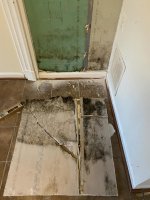
As for the amount of mold in the walls, here is what I found in other more accessible areas:

attachment.php


This is in the kitchen, and just behind the wall to the right is the utility room with the water heater and HVAC. That's starting to become my biggest concern because without removing the HVAC, I can't get to any of it to tear out/treat.

I plan to cut out the foam and inspect and replace, as I don't know what it looks like behind it yet. I think there is some more damage in the kitchen, but not sure the extent of it. The worst parts seem to be the above area and just to the right of the wall shown to the right here, but can't get good pictures because of the lack of space in the utility room.

I'm definitely going to look into some of the treatments suggested.
 

Attachments

  • IMG_4901.jpg
    IMG_4901.jpg
    102.4 KB · Views: 165

tj675

Well-known member
Joined
Apr 9, 2019
Messages
905
Location
The Mitten
There is a product that you can purchase at HomeDepot and other box stores called concrobium mold control. It does a great job and can be applied with a sprayer or fogger. Bleach only kills the mold on the surface and does not kill anything below the surface, so the mold will come back.

attachment.php
 

Attachments

  • 69628838-2428-49A0-B1CB-27E55AA8C1FF.jpeg
    69628838-2428-49A0-B1CB-27E55AA8C1FF.jpeg
    93.9 KB · Views: 153

dogdog

Well-known member
Joined
Nov 15, 2011
Messages
12,711
HD also rents them (ULV fogger) for $50 a day or something here... buy one is only about$200 though.
from the look of that last pic... you might have to remove some adjacent walls to the left and right. until you can't see any more.... Those molds really spread and grow fast and nasty..
 

pcmeiners

Well-known member
Joined
Aug 13, 2009
Messages
7,952
Location
In the only town in Pennsylvania, Bloomsburg.
"saturate with a bleach-water spray to kill the mold. Dry. Encapsulate with a primer like Kilz. Close that **** back up. "

Would not bother with the bleach, absolutely saturate it with Kilz, if you have a sprayer use that, let dry and spray it again in a couple days. I would spray it as far up the studs as you can, to encapsulate the spores. As to the mold type, very common, worked around it for years, no ill affects. Boric acid would be a much better mold killer... pharmacy, hardware store or Ebay.

As to the "Mold Control" it is just a weak solution of everyday cheap, common household chemicals , ...

https://www.concrobium.com/wp-content/uploads/2012/05/Concrobium-Mold-Control-MSDS-US-2013.pdf

"Concrobium Mold Control is a patented solution comprised of purified water, sodium carbonate (washing soda), sodium bicarbonate (baking soda), and trisodium phosphate. Together, this unique, tri-salt (three salts) polymer is intensely alkaline (not acidic), which holds great advantage over mold."

As J.C. Fields would have remarked, this product is a "dazzle them with ********" product
For $10, you could make a 1000 gallons of this stuff.
 
Last edited:

dogdog

Well-known member
Joined
Nov 15, 2011
Messages
12,711
"saturate with a bleach-water spray to kill the mold. Dry. Encapsulate with a primer like Kilz. Close that **** back up. "

Would not bother with the bleach, absolutely saturate it with Kilz, if you have a sprayer use that, let dry and spray it again in a couple days. I would spray it as far up the studs as you can, to encapsulate the spores. As to the mold type, very common, worked around it for years, no ill affects. Boric acid would be a much better mold killer... pharmacy, hardware store or Ebay.

As to the "Mold Control" it is just a weak solution of everyday cheap, common household chemicals , ...

https://www.concrobium.com/wp-content/uploads/2012/05/Concrobium-Mold-Control-MSDS-US-2013.pdf

"Concrobium Mold Control is a patented solution comprised of purified water, sodium carbonate (washing soda), sodium bicarbonate (baking soda), and trisodium phosphate. Together, this unique, tri-salt (three salts) polymer is intensely alkaline (not acidic), which holds great advantage over mold."

As J.C. Fields would have remarked, this product is a "dazzle them with ********" product
For $10, you could make a 1000 gallons of this stuff.

Not sure if you have used that in person. I did in an apt that was heavily mold. The tri sodium salt (the actively ingredients) absolutely worked. There was another brand that also contains the same active ingredients and it is 2x more of those same salts that is advertised as disinfectant on eBay and it is on the list of federally approved disinfectant. Which is marketed by one of those industrial supply places.
 

CraigStu

Well-known member
Joined
May 22, 2014
Messages
4,053
Location
Blacksburg, Va
7 yrs ago we sold a house in Md on a crawl space. Mold was found on the underside of some of the floor joists so we had to have it professionally fixed to satisfy the buyers. I am not sure what they sprayed to kill the mold but the encapsulating paint looked just like thick latex when done. I would try the various cleaners/removes mentioned here but then do a bunch of research on the encapsulating paint. Maybe Kilz is good enough, maybe they have a paint specific for this use. I don't know but, since it is obvious you will not be able to remove all the mold, encapsulating is going to be extremely important. One other issue to think about is reporting this to potential buyers/renters. I am pretty sure there are some legalities here so I would look into this first. If your county finds out about this, I have heard (3rd or 4th hand admittedly) of some horrendous requirements like gutting to the framing.
 
OP
T

TravisT

Well-known member
Joined
Oct 22, 2011
Messages
156
Location
NoVA
That all makes sense. Today, I sprayed the undisturbed remains of mold, and intend to try to remove as much as possible through scrubbing/vacuuming as possible after the Mold Control sits a bit, hoping it will neutralize any spores before they are kicked up any more.

I will likely kilz everything possible for good measure before buttoning things back up. Appreciate all the advice - can always count on GJ for that!
 

dogdog

Well-known member
Joined
Nov 15, 2011
Messages
12,711
If you are using Mold Armor, you can spray and let dry and repeat. With concorvium you are suppose to mist it and not let it get all wet. Yes you will have to read those fine instructions.
 
To avoid these ads, REGISTER NOW!
Top Bottom