To avoid these ads, REGISTER NOW!

Drywall screw pops

nate379

Banned
Joined
Feb 2, 2009
Messages
7,279
Location
Palmer, AK
What causes drywall screws to pop the mud on top?

I have been fighting this since I moved in my new house about a year ago. Seems like everytime I get a few fixed I find a few more.

Have been fixing by tightening the offending screw/screws and then running some 1 5/8" or 2" long screws either above or below depending where it is.

I did a few yesterday and it seems like the drywall wasn't stuck to the studs. I got one 2" screw in and boom, another screw head popped the mud. Get that one, put another 2" screw... and went down the line for about 3ft.

The drywall is standard 1/2" with 1.25" screws used.
 
To avoid these ads, REGISTER NOW!

Crash913

Well-known member
Joined
Mar 4, 2010
Messages
173
Location
Ohio
If you are using long enough screws, which you are, and they are course thread, you will probably have to continue with your repairs. Unless you want to re-drywall. Any of your repairs popping?
 

scooby074

Well-known member
Joined
Oct 26, 2008
Messages
5,229
Location
Nova Scotia
You said its your new house, but Is it new construction?

It it is new, then settling can cause nail pops as the framing dries and moves around.

Your repairs will likely last , once any shrinkage has taken place
 
OP
N

nate379

Banned
Joined
Feb 2, 2009
Messages
7,279
Location
Palmer, AK
My repairs are holding fine, but I'm trying to figure out why the other screws are doing it.
I don't know how many I've fixed, since I've lost count, but I would guess 25-30 screws in a 1400 sqft house.
 

usmc_noma

Well-known member
Joined
Mar 9, 2009
Messages
1,219
Location
virginia
i have some areas in my home that do this too. i never noticed it when we were doing our walk through. it became more noticeable when i started painting different areas of the house. all of mine are nail pops.
 

woodbutch

Active member
Joined
Jan 29, 2009
Messages
25
In all the years that I have been around drywall screws, rarley do they back out and pop. Most likley the screws were not pulling the drywall tight to the studs. This can be from crooked framing or screws missing studs and not removing them. On truss roofs, a problem called truss-uplift causes movement during season change ( warm to cold in fall is most significant) which will create ceiling pops and cracks. I'm guessing you have already figured the fix.
 

MasterBlaster

Well-known member
Joined
Mar 15, 2010
Messages
123
Location
Granite City,Illinois
Whenever i drywall anything i use 2 screws about 2-3 inches apart at regular intervals.It pulls the screws to the drywall tight to prevent shifting of the screw depth.
 

trbomax

Well-known member
Joined
Mar 21, 2010
Messages
2,556
Location
starvation lake,mi.
useing adhesive when drywalling works . When you glue it,the screws only hold the board in place untill the glue sets, so you only need half as many to start with. I tested this in my own home 3 yrs ago and went so far as to take all the screws OUT of two of the walls a few days later,no cracks or movement so far. Also,dont use any screws within 12" of a wall/cieling joint,let it float there. This is all sop when building habitat for humanity homes and as far as I know weve never had a call back in over 10yrs of doing it this way.
 

Kevin54

MEMBER EMERITUS
Joined
Jan 12, 2005
Messages
29,341
Location
Urbana, Ohio
If it is a new house, chances are that after moving in, running a furnace, air conditioner etc, the wood is shrinking somewhat and causing it. When they frame a house, components can swell from humidity, and rain. Over a period of time they will shrink back to where they should be.
 

Crash913

Well-known member
Joined
Mar 4, 2010
Messages
173
Location
Ohio
useing adhesive when drywalling works . When you glue it,the screws only hold the board in place untill the glue sets, so you only need half as many to start with. I tested this in my own home 3 yrs ago and went so far as to take all the screws OUT of two of the walls a few days later,no cracks or movement so far. Also,dont use any screws within 12" of a wall/cieling joint,let it float there. This is all sop when building habitat for humanity homes and as far as I know weve never had a call back in over 10yrs of doing it this way.

I had read about this method a few months ago and was curious how well it would actually work since drywall crumbles so easily. Glad to hear it works :beer:
 

1984GMC

Banned
Joined
Jan 2, 2010
Messages
625
Location
Gum Spring,Va.
well I really don't think new construction is nearly as well built as it should be, Just due to contractors trying to slap houses up just as fast as they can, the attention to details really suffers.
 

trbomax

Well-known member
Joined
Mar 21, 2010
Messages
2,556
Location
starvation lake,mi.
Its hard tobuild a structure "right" anymore because the lumber is sooooo crooked. Add to that the moisture in it from rapid,incomplete drying,and when you pop the banding theres nothing left to keep it straight.When we glue the drywall we dont use drywall adhesive,instead we use subfloor adhesive. Reason is, it has a longer grab time when working on cielings,and it sticks to wet wood.Ive had to go back a week or two later and change ducting or electrical, and there is no easy or pretty way to get the board off the frameing.
 

Cuda

Well-known member
Joined
Apr 13, 2010
Messages
244
Location
Utah
useing adhesive when drywalling works . When you glue it,the screws only hold the board in place untill the glue sets, so you only need half as many to start with. I tested this in my own home 3 yrs ago and went so far as to take all the screws OUT of two of the walls a few days later,no cracks or movement so far. Also,dont use any screws within 12" of a wall/cieling joint,let it float there. This is all sop when building habitat for humanity homes and as far as I know weve never had a call back in over 10yrs of doing it this way.

:thumbup: I would agree with this. I noticed when my home being was built the drywall sub used screws only around the perimeter of the sheetrock and adheisive in the field. I raised hell with my general who assured me that was the way they did it now days for the reasons pointed out with the OP. I assured him I'd be knocking on his door if this became a problem. (my G.C. is a good friend and next door neighbor btw).
Anyway, that's been 10 years ago this month and nary a problem. I hope that remains the case for 30 more years.
BTW, only the walls were done this way. The ceiling was screwed in conventional.
 
OP
N

nate379

Banned
Joined
Feb 2, 2009
Messages
7,279
Location
Palmer, AK
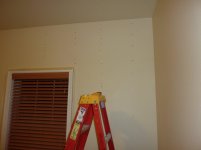
I have had to screw down almost this whole wall. It started with one day I was vacuuming and I saw 1 screw coming through on the middle left of the wall. Pulled it out and put in a 1 5/8" screw above it and... huh.. pops all the way up and down. :mad:

Then I notice over the window there are a couple too.

I get that all fixed and repaint the wall, as I'm painting I see another. Well that one turned to what you see in the photo.

The fawking drywall isn't against the studs I guess, I'm not sure. You know how if you rap against the wall you can tell where the stud is? Couldn't do that on this corner. The WHOLE thing sounded hollow.


The master bath was ugly as well. It's only ~5x10ft and there was a row behind the toilet, 2 over the door, 2 on the wall in front of the toilet, several behind the mirror (pulled it down so I could paint the wall after fixing the ones in back of the toilet) and just found another 2 over the light.

Oh yeah... I pull the light over the sink down to paint and the thing is "mounted" to the wall with 2 drywall screws in drywall. Not in any stud or anything like that! The light is 4 bulbs with globes so it's got a bit of weight to it.
Then they cut a 4" round hole to run the wire for it.

I feel like on Holmes on Homes where he says tear it all down! Start with a small issue and next thing you know the house is down to studs!

I wish I had kept a log with photos of all the screws I've fixed because I would be sending them to the building along with a fawking bill!


The other issue I have is the Rodda paint I'm using. It is pretty much impossible to not have roller marks or repairs to show through the paint. I put a coat of Kilz, 2 coats of the paint of the repair and then a coat over the whole wall and you can still see it! It's an eggshell paint.

I'm thinking of switching to something else in the morning from Lowe's and just color matching. I have to paint the whole bathroom and that one wall anyhow.
 

Attachments

  • P1000132.jpg
    P1000132.jpg
    113.6 KB · Views: 88
  • P1000130.jpg
    P1000130.jpg
    152.1 KB · Views: 68
Last edited:
To avoid these ads, REGISTER NOW!
OP
N

nate379

Banned
Joined
Feb 2, 2009
Messages
7,279
Location
Palmer, AK
Don't need one for this type of light. The back plate of the housing serves as the box. There is a plate that screws into the wall, you run the wire through that, connect everything and then the light housing attaches to that back plate. I am going to cut a piece of drywall to fill the hole though.
 
OP
N

nate379

Banned
Joined
Feb 2, 2009
Messages
7,279
Location
Palmer, AK
I have never done that, but also have never put drywall on studs. Always have put OSB up before and then drywall over that. My Dad works at an OSB mill so it's about $1 a sheet shis cost.

Been gluing/screwing drywall for 10+ years and never had to go back to do repairs.
Using only about 1/3 the screws I use to.
 

tcianci

Well-known member
Joined
Feb 7, 2009
Messages
4,242
Location
Walpole, Ma
The reason you see more pops when you attempt to repair one is that you're drawing the wallboard tight to the stud and its not very tight to the stud along the rest of the line of screws. You would do better to simply hand tighten the offending screw and re-mud it. Remember that the installation tool for drywall screws (screwgun) relies on the surface of the sheet as the "trigger" to disengage the bit, thus setting the heads of the screws uniformly below the surface of the sheet without tearing through the paper. Unfortunately, sometimes the screws will set before the sheet is drawn up to the stud resulting in a void between the sheet and stud, which can lead to the type of popping mentioned in the article in the link supplied by another poster. My guess is that you're installing additional screws with a cordless drill or power screwdriver of some sort, making the uniform setting of the heads a matter of skill and practice. Note that if you tear through the paper on the sheet, the screw is just sitting in powdered drywall and isn't holding much of anything.
 
OP
N

nate379

Banned
Joined
Feb 2, 2009
Messages
7,279
Location
Palmer, AK
Just using a cordless impact driver, but I have hung plenty of drywall without using a fancy screwgun.

Yeah I know the sheet isn't tight against the studs. From what I have found the screws that have come out either aren't in a stud or the sheet is loose. I may as well fix them all if I'm fixing one cause it's going to pop the rest of the screws at some point. Go to hang something on the wall, lean against it or whatever.

I was at a friends new rented place about a month ago and as soon as I walked in I knew it was drywalled by the same crew. Sure enough when I asked him, same builder had built the house. I know that sub-contractor was fired a few months ago, not sure if it was for work quality or what.

There was a spot in my kitchen that the drywall had a "bubble" in it about 3/4". I had to cut near that spot to put in a light switch and there were a couple nails in the studs that someone didn't pound in all the way and the drywall guys just went right over it. :lol_hitti

Just chaps my *** when I pay over 200k for a new place and I'm having to fix stuff like this. It's not even worth fighting with the builder over it, it's like talking to a wall.
 
Last edited:

Red05GT

Well-known member
Joined
Mar 29, 2010
Messages
438
Location
ohio
Try a dimpler attachment for the cordless drill, this will keep from tearing the drywall
paper. I once saw an estimate of how many gallons of water vapor has to evaporate
from the average house in the first year and it was unbelievable. From the basement
walls and floors, to the lumber that gets rained on during framing, to the drywall mud
and texturing. Add to this the natural settling and shrinkage of the lumber and you
have a lot of issues at play.
 

Ironcrow

Well-known member
Joined
Sep 30, 2005
Messages
1,169
Location
Arizona
I'm getting ready to do drywall in my addition. Lot's of glue and little screw sounds like a plan. What kind of adhesive do you use? Liquid Nails?
 

1969

Well-known member
Joined
Jan 8, 2010
Messages
1,412
Location
East Coast
Biggest problem with most new construction and the popping of screws is ... the moisture content of the framing timbers could be anywhere from 10%-35% and quite possibly be worse than that. When these dry out, guess what. If you have ever taken apart an old house or even a wall, the studs are twisted and have shrunk. With the quality of the lumber available today, you will notice a constant move toward engineered lumber and steel. BTW, if the screws are over torqued and brake the surface paper, that can also cause problems.
 

Torque1st

MEMBER EMERITUS
Joined
Sep 14, 2008
Messages
5,668
Location
KC Metro, Kansas


useing adhesive when drywalling works . When you glue it,the screws only hold the board in place untill the glue sets, so you only need half as many to start with. I tested this in my own home 3 yrs ago and went so far as to take all the screws OUT of two of the walls a few days later,no cracks or movement so far. Also,dont use any screws within 12" of a wall/cieling joint,let it float there. This is all sop when building habitat for humanity homes and as far as I know weve never had a call back in over 10yrs of doing it this way.

Great Info from both of you! :thumbup:
 
OP
N

nate379

Banned
Joined
Feb 2, 2009
Messages
7,279
Location
Palmer, AK
I have not had an issue with tearing the paper, just whoever put the drywall up did. Gun wasn't set right I guess.

Sure once in a while I hit the trigger on the cordless drill a sec too long and it goes through, but out of 10lbs of screws that is maybe 3 or 4.

Try a dimpler attachment for the cordless drill, this will keep from tearing the drywall
paper. I once saw an estimate of how many gallons of water vapor has to evaporate
from the average house in the first year and it was unbelievable. From the basement
walls and floors, to the lumber that gets rained on during framing, to the drywall mud
and texturing. Add to this the natural settling and shrinkage of the lumber and you
have a lot of issues at play.
 

aabirdman

Well-known member
Joined
Dec 1, 2009
Messages
100
Location
So Cal
I would'nt use 2" screws. You run the risk of hitting a electrical line (romex) or even a water line. If the holes for the lines are drilled correctly there will not be any protector plate on the studs. If they are off by just a little bit you could hit them with the 2" screw. Use 1-5/8 max. 1-1/4 screws are mainly use for steel studs
 

Tool Pants

Well-known member
Joined
Oct 4, 2008
Messages
1,249
Location
San Jose CA
When I bought a house in 1988 it was about 4 year old, I noticed this in the stairway. I then got into woodworking and learned something about wood. I bought wood studs to make things around the hose. Some had so much moisture they would squirt at me. I think it is called green wood. As the wood drys it moves around.
 
OP
N

nate379

Banned
Joined
Feb 2, 2009
Messages
7,279
Location
Palmer, AK
If you drill a 1" hole for Romex in the center of the stud that gives 2 1/4" on either side, so should be fine. With 5/8" drywall only have 1 3/8" of the screw in the stud.

No reason to run that long of a screw for drywall IMO though.


I would'nt use 2" screws. You run the risk of hitting a electrical line (romex) or even a water line. If the holes for the lines are drilled correctly there will not be any protector plate on the studs. If they are off by just a little bit you could hit them with the 2" screw. Use 1-5/8 max. 1-1/4 screws are mainly use for steel studs
 
OP
N

nate379

Banned
Joined
Feb 2, 2009
Messages
7,279
Location
Palmer, AK
I tried that at first and often there wasn't enough screw in the stud and it would strip out in it's hole as I was tightening it. The drywall in some places was probably 1/4" or more away from the stud.

Oddly enough, a 1 and 1/4 inch screw is less likely to pop than an 1 and 5/8 screw, and will hold just as well. That is a substantiated fact, BTW.
 

byrd

Well-known member
Joined
Mar 6, 2008
Messages
175
you should have a warranty with your new house. when i bought mine i just lived with all the nail pops untill the last year of my warranty, and then had the builder come out and take care of all of them at the same time. havnt had a problem in the last 5 yrs.
 
To avoid these ads, REGISTER NOW!
Top Bottom