To avoid these ads, REGISTER NOW!

Dual Function GFCI/AFCI breaker

threeputt

Well-known member
Joined
May 18, 2012
Messages
607
Location
Next to a very busy 4 lane
Two months ago I installed a GE 20 amp Dual Function FGCI/AFCI ( THQL1120DFP) breaker in my Cutler Hammer service panel . I did this because I don't want to rewire my 1958 home which don't have the third ground wire .
Its just too much trouble to install a 20 amp GFCI outlet in those small outlet boxes on the first run closest to service panel .
It was also the easiest way even for me to do this.
I understand the ground wire in a 12-2 romax would be the safest way to go but it would be a pain to do this and this should keep me safe in case of a ground fault using my old craftsman block grinder in my basement and anything else I might use. Trips at 5 ma's in case of a fault or arc according to what I read.
I plan on adding more of this brand and wanted to get any opinions on this brand ? It does have the braided curley white wire instead of the solid wire that goes into neutral panel on this model .
Thoughts on this appreciated.
Here is my 120 amp panel with breaker installed. It fit great .
 

Attachments

  • service panel.jpg
    service panel.jpg
    600.1 KB · Views: 50
  • S panel with breakers.jpg
    S panel with breakers.jpg
    175.5 KB · Views: 46
Last edited:
To avoid these ads, REGISTER NOW!

sparky 1971

Well-known member
Joined
Oct 9, 2018
Messages
7,991
Location
Central Iowa
First things first. Cutler Hammer panels are supposed to have Cutler Hammer breakers. Next, AFCI breakers are a joke. If you want to be protected, a GFCI breaker is all you need. As far as an opinion of GE breakers, they are fine in GE panels even if they fit in other brands.
 

PCustoms

Well-known member
Joined
Jul 23, 2011
Messages
23,276
Location
VT
What the hell is an fgci?

Is a GE breaker listed for use in a Cutler hammer panel? I doubt it, but maybe...

I see some other potentially incorrect breakers there too.
 
Last edited:

wyliesdiesels

Well-known member
Joined
Aug 14, 2012
Messages
20,061
Location
Modesto, CA
Two months ago I installed a GE 20 amp Dual Function FGCI/AFCI ( THQL1120DFP) breaker in my Cutler Hammer service panel . I did this because I don't want to rewire my 1958 home which don't have the third ground wire .
Its spelled GFCI not FGCI
GE breakers are not made for nor listed for use in cutler hammer panels. you used the wrong breaker.

Its just too much trouble to install a 20 amp GFCI outlet in those small outlet boxes on the first run closest to service panel .
It was also the easiest way even for me to do this.
I understand the ground wire in a 12-2 romax would be the safest way to go but it would be a pain to do this and this should keep me safe in case of a ground fault using my old craftsman block grinder in my basement and anything else I might use. Trips at 5 ma's in case of a fault or arc according to what I read.
I plan on adding more of this brand and wanted to get any opinions on this brand ? It does have the braided curley white wire instead of the solid wire that goes into neutral panel on this model .
Thoughts on this appreciated.
I wouldnt bother with AFCI for that. just get a CH GFCI breaker and be done with it.
Here is my 120 amp panel with breaker installed. It fit great.
fit is not the only prerequisite....
 
Last edited:

Norcal

Well-known member
Joined
Mar 16, 2008
Messages
13,767
Two months ago I installed a GE 20 amp Dual Function FGCI/AFCI ( THQL1120DFP) breaker in my Cutler Hammer service panel . I did this because I don't want to rewire my 1958 home which don't have the third ground wire .
Its just too much trouble to install a 20 amp GFCI outlet in those small outlet boxes on the first run closest to service panel .
It was also the easiest way even for me to do this.
I understand the ground wire in a 12-2 romax would be the safest way to go but it would be a pain to do this and this should keep me safe in case of a ground fault using my old craftsman block grinder in my basement and anything else I might use. Trips at 5 ma's in case of a fault or arc according to what I read.
I plan on adding more of this brand and wanted to get any opinions on this brand ? It does have the braided curley white wire instead of the solid wire that goes into neutral panel on this model .
Thoughts on this appreciated.
Here is my 120 amp panel with breaker installed. It fit great .
Unless you have paperwork that UL has classified a GE breaker for a competitive panel, they cannot be used, just because a breaker fits does not mean it is OK to use it, the only breaker that is kosher for BR panel is a Eaton BR, Eaton does make a CL breaker that is UL classified for competitive makes of panels, but are more expensive then the OEM UL listed BR breakers.
 

wyliesdiesels

Well-known member
Joined
Aug 14, 2012
Messages
20,061
Location
Modesto, CA

Packard V8

Well-known member
Joined
Mar 16, 2009
Messages
7,380
Location
Spokane, WA
. . . . this should keep me safe in case of a ground fault using my old craftsman block grinder in my basement and anything else I might use. Trips at 5 ma's in case of a fault or arc according to what I read.
You gotta do you, but today, as for the past seventy years, I'll be using metal housing, uninsulated, ungrounded power tools in the basement and the garage. So far, so good.

Not saying it's never happened, but in all the years in and around building and automotive trades, I've not seen or heard of a fatality from operating a 120-volt power tool. (Yes, your google search will come up with some incident somewhere; but the first 100 years of power tools were all that way and somehow humanity survived.)

jack vines
 
OP
T

threeputt

Well-known member
Joined
May 18, 2012
Messages
607
Location
Next to a very busy 4 lane
somebody may be dislexic

nope

looks like T&B/ thomas and betts... those are fine in an Eaton panel as they came out when challenger/westinghouse was transitioning to Eaton
It was late and I put the F before the G therefore calling it a fgci which might stand for something. :) but I could be dyslexic :) lol
I do appreciate y'all calling me out of this . I made a mistake and now that is corrected. :)

I am the one who installed the T&B breakers .

The story goes like this.

In 2006 I hired an electrician to replace my old fuse type service panel to a 125 amp breaker type and add two new runs. One to our washing machine in my basement and the other to my computers upstairs. They are ground fault protected .

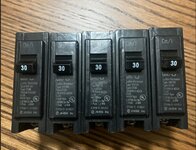
About three years ago I was adding a new 12/2 wire so my golf cart battery charger and air compressor would be on a circuit by itself and noticed that the electrician that did this work had installed five 30 amp fuses . All were on 12 gauge wire. I didn't want the higher amp fuses on the # 12 wire so I bought the T&B breakers 20 amp breakers and installed them myself. I had checked back then and I was told they would work in the Cutler Hammer panel .

Now fast forward to 2025. I have several outlets that needed changing in our home. I bought the 20 amp HD ones but they are the three prong and I didn't want to add them unless I added a GFCI on that run . Of course I put the labels on outlet covers showing they are GFCI protected but no equipment ground. This is only for the next person . We have lived in this house for 51 years and never any issues.

I couldn't fit a GFCI outlet in old smaller box closest to the panel so I decided the breaker would be best for me. My wife didn't want to put the outlet box extender on where a GFCi would work.

I picked up the incorrect breaker . It is now removed and a plain old 20 amp Eaton one stuck in its place for now . Home Depot didn't have the one I needed today. Tomorrow I will see if I can find the correct one . I plan on rewiring the basement part with new 12-2 wire also. Only one run but it will be protected with a GFCI outlet closest to the panel as I can fit a GFCI outlet in the new box I will be adding.

Again thanks for the help on this . Here is a picture of the breakers the pro I hired ( lol ) way back in 2006 and updated panel since I got the correct breaker back in the panel today.
 

Attachments

  • 30 amp breakers.jpg
    30 amp breakers.jpg
    147.4 KB · Views: 33
  • Correct breaker back in place.jpg
    Correct breaker back in place.jpg
    211.9 KB · Views: 23
Last edited:
To avoid these ads, REGISTER NOW!

Steve_P

Well-known member
Joined
Sep 15, 2010
Messages
5,185
It was late and I put the F before the G therefore calling it a fgci which might stand for something. :) but I could be dyslexic :) lol
I do appreciate y'all calling me out of this . I made a mistake and now that is corrected. :)

I am the one who installed the T&B breakers .

The story goes like this.

In 2006 I hired an electrician to replace my old fuse type service panel to a 125 amp breaker type and add two new runs. One to our washing machine in my basement and the other to my computers upstairs. They are ground fault protected .

About three years ago I was adding a new 12/2 wire so my golf cart battery charger and air compressor would be on a circuit by itself and noticed that the electrician that did this work had installed five 30 amp fuses . All were on 12 gauge wire. I didn't want the higher amp fuses on the # 12 wire so I bought the T&B breakers 20 amp breakers and installed them myself. I had checked back then and I was told they would work in the Cutler Hammer panel .

Now fast forward to 2025. I have several outlets that needed changing in our home. I bought the 20 amp HD ones but they are the three prong and I didn't want to add them unless I added a GFCI on that run . Of course I put the labels on outlet covers showing they are GFCI protected but no equipment ground. This is only for the next person . We have lived in this house for 51 years and never any issues.

I couldn't fit a GFCI outlet in old smaller box closest to the panel so I decided the breaker would be best for me. My wife didn't want to put the outlet box extender on where a GFCi would work.

I picked up the incorrect breaker . It is now removed and a plain old 20 amp Eaton one stuck in its place for now . Home Depot didn't have the one I needed today. Tomorrow I will see if I can find the correct one . I plan on rewiring the basement part with new 12-2 wire also. Only one run but it will be protected with a GFCI outlet closest to the panel as I can fit a GFCI outlet in the new box I will be adding.

Again thanks for the help on this . Here is a picture of the breakers the pro I hired ( lol ) way back in 2006 and updated panel since I got the correct breaker back in the panel today.

This surprised me, but I recently checked and my local Ace Hardware stocks Eaton breakers. My Lowes also does, or did, stock Eaton last I tried them. My two local Home Depots have never stocked Eaton AFAIK.
 

walta

Well-known member
Joined
Jan 13, 2017
Messages
2,313
Location
Dutzow Missouri
I am afraid the OP is not going to get the level of GFCI he expected and code requires to operate an ungrounded 3 prong outlet.

My arc fault breakers also say GFCI but it is at 30mA designed for equipment protection and not the same as the normal GFCI that trip at 5 mA intended to prevent electrical shocks.

Walta
 
OP
T

threeputt

Well-known member
Joined
May 18, 2012
Messages
607
Location
Next to a very busy 4 lane
I discovered I maybe could just install a 20 amp GFCI outlet located in basement just before the first junction box a few feet after it leaves the service panel. Very easy to get to. Pull wire out of junction box. Connect that wire to line side of GFCI outlet and load to the other side of the GFCI using a short piece of 12-2 back in junction box so everything on that run would be GFCI protected.

Do the same on the other two outlet boxes father away. I would have three extra outlets downstairs which I could always use. I believe there are faceless GFCI units that could also be used instead of an outlet which might be a better option.

The boxes where the GFCI would go in would be nailed above to floor joist area within easy reach.

That would cover my upstairs bath, kitchen outlets close to sink , half bath in basement plus a small room also next to that bathroom. Refrigerator is not on any of these runs and don't plan on using a GFCI on it.

Wouldn't this work ? It would be much easier than trying to install a GFCI in one of these older smaller outlet boxes upstairs. My basement is heated enough where nothing freezes . I just never put anything to hide floor joist. These GFCI breakers are too expensive also.
 
Last edited:

Cruzan80

Well-known member
Joined
Jul 22, 2015
Messages
4,281
Location
Denver, CO
Connect that wire to line side of GFCI outlet and load to the other side of the GFCI using a short piece of 12-2 back in junction box
Not sure exactly what you mean here. If the GFCI is between the incoming/outgoing wires, it will protect everything downstream.

Line->GFCI->Load

If you take a short piece of wire and Y off the Line, it will only protect that outlet. In that case, nothing is hooked up to the Load side.

Line->Y->Line
.........GFCI

Do the same on the other two outlet boxes father away.

Also not sure why you would need multiple GFCI, unless the other two outlet boxes are for two other different circuits than the first (all three are separate).

Not sure on the accessibility coderequirements for GFCI, but from a protection standpoint, this is how it would work.
 

Stuart in MN

Well-known member
Joined
Sep 8, 2005
Messages
23,146
Location
Minneapolis
You gotta do you, but today, as for the past seventy years, I'll be using metal housing, uninsulated, ungrounded power tools in the basement and the garage. So far, so good.

Not saying it's never happened, but in all the years in and around building and automotive trades, I've not seen or heard of a fatality from operating a 120-volt power tool. (Yes, your google search will come up with some incident somewhere; but the first 100 years of power tools were all that way and somehow humanity survived.)

jack vines
120VAC is the most common voltage for electrocution. Granted, that's mainly because it's the most common voltage the average person is exposed to, and yes it's really the amperage that gets you, but 120vac certainly can and has been deadly.
 

dave*99

Well-known member
Joined
May 5, 2009
Messages
4,274
Location
Coastal NJ
120VAC is the most common voltage for electrocution. Granted, that's mainly because it's the most common voltage the average person is exposed to, and yes it's really the amperage that gets you, but 120vac certainly can and has been deadly.
Yeah, but if someone has never heard of an electrocution from it it can't be real, right? :rolleyes:
 
OP
T

threeputt

Well-known member
Joined
May 18, 2012
Messages
607
Location
Next to a very busy 4 lane
Not sure exactly what you mean here. If the GFCI is between the incoming/outgoing wires, it will protect everything downstream.

Line->GFCI->Load

If you take a short piece of wire and Y off the Line, it will only protect that outlet. In that case, nothing is hooked up to the Load side.

Line->Y->Line
.........GFCI


Also not sure why you would need multiple GFCI, unless the other two outlet boxes are for two other different circuits than the first (all three are separate).

Not sure on the accessibility coderequirements for GFCI, but from a protection standpoint, this is how it would work.
The other two outlet boxes are for two different circuits. It would be easy to do what I mentioned but to be honest I probably should just install three GFCI breakers and be done with it.
We bought this house in 1974. Never any issues but things age , including me lol :)
 
Last edited:
To avoid these ads, REGISTER NOW!
Top Bottom