To avoid these ads, REGISTER NOW!

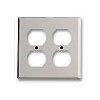
Dual receptacles or quads???

REFLEXX

Well-known member
Joined
Aug 14, 2005
Messages
913
Location
Riverside, CA
Gents,

Here's what I'm thinking. I am putting in a bunch of 115v 20amp curcuits.

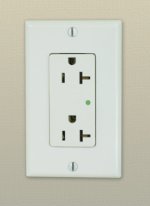
Do I install quad (four) place type receptacles (5 of them) or do I install more dual type receptacles (8-10 of them) per circuit???

The quads allow me to plug in more. But are harder to wire and cost twices as much and might never be fully used.

Duals allow me to have more locations and I can always use one of those six way splitters or power strips.

I only need 15a circuts, so the 20a is me upsizing.

Did any of this make sense???

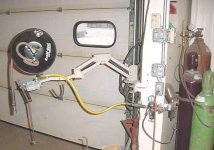
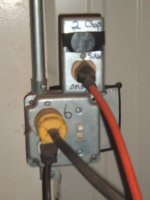
the pic are just to clarify what I'm talking about.


Thanks in advance,

REFLEXX :thumbup:
 

Attachments

  • dual.jpg
    dual.jpg
    42.1 KB · Views: 414
  • quad.jpg
    quad.jpg
    1.9 KB · Views: 516
  • outlet51.gif
    outlet51.gif
    4.1 KB · Views: 517
To avoid these ads, REGISTER NOW!

kartracer55

Well-known member
Joined
Jun 21, 2005
Messages
5,317
I already gave input on another board, but Ill repost for anybody whos watchin here.

Id say Run quad boxes all around your work area, in case you want to leave like 3 tools plugged in. Its just handier that way, because you dont have to keep plugging and unplugging tools.

Then Id install regular outlets elsewhere.

Jim
 

kal-el

Member
Joined
Aug 23, 2005
Messages
17
Location
Utah
kartracer55 said:
I already gave input on another board, but Ill repost for anybody whos watchin here.

Id say Run quad boxes all around your work area, in case you want to leave like 3 tools plugged in. Its just handier that way, because you dont have to keep plugging and unplugging tools.

Then Id install regular outlets elsewhere.

Jim


I would agree with that 100%.

One tip, I would put an outlet real close to the front opening of the garage, always nice not to have to walk all the way into the garage when you are working outside. and if U live in a wet climate U may want a GFCI...but maybe not, they are more $.

But i am just thread spaming, I ain't a pro on this stuff.
 

Cebby

Well-known member
Joined
Jul 17, 2005
Messages
310
Location
Pittsburgh, PA
kartracer55 said:
I already gave input on another board, but Ill repost for anybody whos watchin here.

Id say Run quad boxes all around your work area, in case you want to leave like 3 tools plugged in. Its just handier that way, because you dont have to keep plugging and unplugging tools.

Then Id install regular outlets elsewhere.

Jim

I second this. That's how I did mine. I have a 20 x 20 block garage. I have 5 double gang boxes (quads) and a couple of singles near the doors. It has worked out pretty good.

I also have a 220 for a 3hp shaper and then I have 2 - 220 "dryer" plugs for my welders.

All done in metal work boxes with EMT protecting the wire below the ceiling joists.
 

bmwpower

Super Moderator
Staff member
Joined
Apr 24, 2005
Messages
12,578
Location
NJ
Sounds like a good idea and it's certainly feasible. I went the cheaper route and just put more double recepts...definitely easier to wire. Whatever you do, make sure you spend the extra time and run pigtails to the recepts instead of running the power through the recept (ie, power in connected to top to screws, power out connected to bottom 2 screws). This will allow the last recept in line to get (almost) full power since other recepts before it (assuming they're using power at the time) will be taking up some power.

I did all my doubles this way so if my buddy was using the drill press on recept #1, I wouldn't be limiting my power with whatever tool I was using at recept #2.

Just a thought.

Wiring quads this way is a pain (I did wire 1-2 of them in my garage this way...pita).
 

TOO Z MAXX

Well-known member
Joined
Feb 6, 2005
Messages
54
Location
Stockton, Ca.
As far as cost goes, it should be about the same to do it either way. You might use a little more wire with the 8-10 dual receptacles. I would do the quad receptacles near the workbench on a single 20 amp circuit. 1 more 20 amp circuit for the rest of the dual receptacles around the garage. These will all have to be GFCI circuits. Do not run these in a 15 amp circuit and use #12 wire. Also make sure you buy deep boxes for everything, makes it a lot easier to wire with more room in there. You also might want to add an outlet outside of the garage if the walls are all open. This could go anywhere and you copuld add more than one outside. A lot of people have me wire an outlet outside and installed with a switch for Christmas lights.
As far as wiring the outlets with a pigtail vs using the screws, it shouldnt make a difference because the 2 screws are connected together with a piece of brass that makes the connection and do not run through the outlet.
 

bmwpower

Super Moderator
Staff member
Joined
Apr 24, 2005
Messages
12,578
Location
NJ
REFLEXX said:
Bmwpower,

can you explain better or a pic? that sounds like the way to go.

REFLEXX

When wiring an outlet you have 2 wires to deal with (ignoring grounds) on each piece of romex, a black (hot) and a white (neutral). At each box, you will have the incoming power (1 black, 1 white) and outgoing power (1 white, 1 black) which is connected to successive outlets down the line.

In normal residential installations, one would connect the incoming power wires to the terminals one end of the recept (1 brass, 1 silver) and connect the outgoing power to the other terminals of the recept (1 brass, 1 silver).

In this method, the lead recept has to carry the load of all the other recepts in line. The recept would run hotter because of this. If the lead recept fails, the other outlets down the line would also lose power.

In normal commercial installations, one would connect the incoming black and outgoing black together with a pigtail (3 wires in one wirenut). The same for the white wire. So you're left with only a white (pigtail) and a black (pigtail) to connect to the outlet. In a quad setup, you'd connect 2 black pigtails with the incoming black and outgoing black (4 wires under one wirenut) - same for the whites. Each pigtail would connect to one of the recepts.

Wiring the commercial method distributes the load more on the line. The lead recept does not carry the load of the entire circuit. The recept only sees the load of the devices plugged into it. If the lead recept fails, the other recepts still work since the power is not run through the recept. If you have 5 recepts on residentially wired circuit and one fails, how do you tell which one fails? This method lets you do just that.
 
OP
R

REFLEXX

Well-known member
Joined
Aug 14, 2005
Messages
913
Location
Riverside, CA
bmwp,

That's exactly what I'm going to do. I just read (in my three home electrical books) that it's called "parallel" wiring instead of "Series". Just like batteries.

I've decided to go with 8 duplex receptacles on each circuit, five circuits = 40 outlets in a 1,400 sq ft shop shoud do. That's not counting the 220v, the lights, the 100v for a/c, etc...

REFLEXX :thumbup:
 

trovato

Well-known member
Joined
May 10, 2005
Messages
415
Location
Putnam Valley, New York
kal-el said:
One tip, I would put an outlet real close to the front opening of the garage, always nice not to have to walk all the way into the garage when you are working outside. and if U live in a wet climate U may want a GFCI...but maybe not, they are more $.

I believe that in the US the National Electric Code requires GFCI protection for ALL garage and outdoor outlets, even if you live in the desert. Just put a GFCI breaker in for the whole circuit.
 

bmwpower

Super Moderator
Staff member
Joined
Apr 24, 2005
Messages
12,578
Location
NJ
trovato said:
I believe that in the US the National Electric Code requires GFCI protection for ALL garage and outdoor outlets, even if you live in the desert. Just put a GFCI breaker in for the whole circuit.

... or a GFCI recept on the first recept box. Much cheaper and it is designed to protect the whole circuit since it's the first device on the circuit. You'll end up paying around $30-40 per GFCI breaker (if you can even find a 20A model at the Depot) versus $7-8 for a GFCI recept.
 
OP
R

REFLEXX

Well-known member
Joined
Aug 14, 2005
Messages
913
Location
Riverside, CA
BMW,

Yep! 1st recept will be GFCI, as my local codes require!

Wanna hear another great story? I'm putting 400amp meter base /200amp panel combo on the house and running underground line to the new 200amp panel on the shop. The electric company has 1 AWG wire from the pole to my house. They claim that it's good for 190amp constant load and they don't go by NEC, just by actual load. OK, fine.

I have to run 2/0 from the house to the shop! That means I'll need 300 ft of 2/0 gauge cable!!! that's hundreds of dollars!!! I cant use the 1AWG that I got from a neighbor.

It's like the water company giving you a 1.0" water main, but I have to use 3.0" in my sprinklers! WTF.

I just don't get it.

REFLEXX :sad:
 

kartracer55

Well-known member
Joined
Jun 21, 2005
Messages
5,317
Well, some codes are just rediculous, Ill agree. The building inspector failed us when we had our 200amp service brought in, because we had the Electrician install a 35 amp breaker for the compressor, and apparantly, the town requires permits for anything above 30 amp, because they consider that to be commercial, even though some central air units draw more than that. Go figure???????

Jim
 
To avoid these ads, REGISTER NOW!

ultgar

Well-known member
Joined
Jan 11, 2005
Messages
1,119
Location
New Jersey
bmwpower said:
Sounds like a good idea and it's certainly feasible. I went the cheaper route and just put more double recepts...definitely easier to wire. Whatever you do, make sure you spend the extra time and run pigtails to the recepts instead of running the power through the recept (ie, power in connected to top to screws, power out connected to bottom 2 screws). This will allow the last recept in line to get (almost) full power since other recepts before it (assuming they're using power at the time) will be taking up some power.

I did all my doubles this way so if my buddy was using the drill press on recept #1, I wouldn't be limiting my power with whatever tool I was using at recept #2.

Just a thought.

Wiring quads this way is a pain (I did wire 1-2 of them in my garage this way...pita).

Its good to have a few dedicated receptacles for power hungry tools. I use bright colors (red or yellow...orange should be reserved for isolated ground) for receptacles on their own circuits and grey or white for the others.

ma-upc1.jpg
 

TOMWELDS

Well-known member
Joined
Jun 24, 2005
Messages
179
Location
Westchester cty., N.Y.
If im installing quads around a shop, i use 12/3 and put a circuit on the 2 outlets. Repeating on the other box's and label them "A&B". Install dedicated circuits were needed.
 

Concrete Video

Well-known member
Joined
Feb 24, 2005
Messages
52
Location
Ohio
In my current garage, I've settled on what works for me, so I'll pass it on. It's 24x24. I have quads on the workbench. 3 sets of duals on each side. 1 retractable extension cord on the ceiling. 2 outdoor duals (one behind, one by the walk in on the front). These are on 2 circuits.

The house I am getting ready to move into is not well prepared. It is a dual bay garage (a one car that had another added, essentially 2 single car garages). It has a hodgepodge of outlets layed out spuratically, all on one 15amp circuits. I tried to run my compressor today for the first time, and it wouldn't run on any of the breakers. I'm going to do 2 20 amp curcits for 5 duals each (one breaker per bay). Plus dedicated breakers for my welder and "machine shop"(the spot I place all of my heavier tools) It's a bit overkill, but I hate being ill prepared. I figure this'll be plenty for me until I get my new shop off the ground.
 

RonBou

Well-known member
Joined
Oct 17, 2005
Messages
224
Location
Farmington, CT
I only used double receptacles in my garage but if I was to do it again I would have used a couple of quads in the work bench area. I have receptacles about every 5 feet so I usually don't need extension cords to work on stuff anywhere in the garage. I have two outside outlets that come in very handy for working in the driveway and as a bit of overkill I also have 3 outlets close to the overhead doors. When I was designing the electrical I made a concious decision that more was better and I don't believe that there is even one receptacle that I have not used. I found 15 amps were sufficient for what I do but I did put in a 20 amp dedicated circuit for a two stage compressor. Remember...more is better.
 

sberry

Banned
Joined
Jun 18, 2005
Messages
35,747
Location
Brethren, Michigan
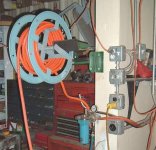
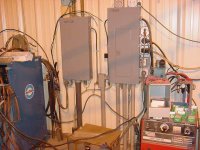
I run a lot of single circuits to outlets in shops, its good for high power tools to be on their own wire, for little stuff like tool chargers the power strips work fine. I have about 80 circuits in my garage on about 120 outlets. In a couple places there are 3 power strips one from another but the load is really minimal, couple amps at most. I have some outlets switched, nice to be able to turn them off without unplugging, those power strips are nice for that too.
 

Attachments

  • air & power station.JPG
    air & power station.JPG
    38.3 KB · Views: 165
  • desk sink p.JPG
    desk sink p.JPG
    43.5 KB · Views: 163
  • electric numbers.JPG
    electric numbers.JPG
    31.6 KB · Views: 156
  • panels power.JPG
    panels power.JPG
    45.7 KB · Views: 162
  • light switches.JPG
    light switches.JPG
    37.1 KB · Views: 158
  • air hose reel.JPG
    air hose reel.JPG
    33.7 KB · Views: 158
  • panel feed thru.jpg
    panel feed thru.jpg
    57.3 KB · Views: 158
  • circuit breakers.JPG
    circuit breakers.JPG
    38.8 KB · Views: 160
  • chop saw only.JPG
    chop saw only.JPG
    30.3 KB · Views: 159
  • shop desk.JPG
    shop desk.JPG
    43.2 KB · Views: 154

MyMopar

Active member
Joined
Sep 29, 2005
Messages
39
Location
Connecticut
banzaitoyota said:
The junction box with a feeder to the outlet is Brilliant!!!! The solution is so simple. Thanks!

I will have to second that. :bowdown: I want to install 3 quad outlets in the workshop side of the garage and was just thinking how I would run teh wire from box to box. Now I don't have to, I can run the wire from the outlets to the junction box and be done with it.
I would have only installed dual outlets but after reading about how a quad lets you leave all tools plugged in, I was sold. I can remember plugging and unpluging tools when I had a dual, NEVER AGAIN!!! I'm free! :rocker:
 

stioc

Well-known member
Joined
May 2, 2005
Messages
1,317
Location
SoCal
bmwpower said:
... or a GFCI recept on the first recept box. Much cheaper and it is designed to protect the whole circuit since it's the first device on the circuit.

Is this true even if the wiring is done as a parallel circuit like you suggested previously ?
 

Remi

Well-known member
Joined
Jan 9, 2005
Messages
83
Location
Vancouver, Canada
I wired my previous garage when I converted it from a carport to garage. I had a double outlet on the workbench wall every second stud. But the outlet I found my self using the most was a ceiling outlet for the garage door opener. Made me wish it was a quad.

I say wire mostly doubles with a couple quads where you think you will be plugging into the most.

In the new garage there are only 3 doubles for a 20x20 finished garage :(. Contemplating ripping of drywall or running new curcuits in conduit.
 

Charles (in GA)

Well-known member
Joined
Jan 11, 2006
Messages
12,489
Location
50 mi south of Atlanta
This it quite correct and the best way to do it. don't string receptacle to receptacle, but do a proper splice with a wirenut with a pig tail going to the receptacle.

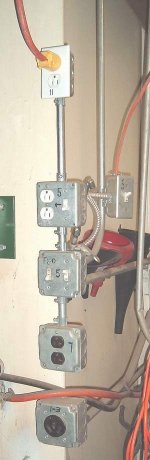
In my shop (not really a garage, its a 60x60 metal building), I ran conduit, installed 4x4 boxes on each column and up higher on the purlin, where the conduit runs, is another 4x4 box where the "pigtail" taps off running down to the receptacle. I went one better than this and installed dual duplex receptacles in each box, on separate circuits. I've got 30+ receptacles on 9 different circuit breakers. I don't think NEC allows 15 amp NEW installations for receptacles, it would be unwise to do anything less than 20 amp circuits. In my case, I had to run 10 gauge wire part of the way to some of the furthest circuits, then 12 gauge to finiish out the run.

I too installed GFCI outlets near the garage door where I expected to be doing outside work.

Charles

bmwpower said:
When wiring an outlet you have 2 wires to deal with (ignoring grounds) on each piece of romex, a black (hot) and a white (neutral). At each box, you will have the incoming power (1 black, 1 white) and outgoing power (1 white, 1 black) which is connected to successive outlets down the line.

In normal residential installations, one would connect the incoming power wires to the terminals one end of the recept (1 brass, 1 silver) and connect the outgoing power to the other terminals of the recept (1 brass, 1 silver).

In this method, the lead recept has to carry the load of all the other recepts in line. The recept would run hotter because of this. If the lead recept fails, the other outlets down the line would also lose power.

In normal commercial installations, one would connect the incoming black and outgoing black together with a pigtail (3 wires in one wirenut). The same for the white wire. So you're left with only a white (pigtail) and a black (pigtail) to connect to the outlet. In a quad setup, you'd connect 2 black pigtails with the incoming black and outgoing black (4 wires under one wirenut) - same for the whites. Each pigtail would connect to one of the recepts.

Wiring the commercial method distributes the load more on the line. The lead recept does not carry the load of the entire circuit. The recept only sees the load of the devices plugged into it. If the lead recept fails, the other recepts still work since the power is not run through the recept. If you have 5 recepts on residentially wired circuit and one fails, how do you tell which one fails? This method lets you do just that.
 

Charles (in GA)

Well-known member
Joined
Jan 11, 2006
Messages
12,489
Location
50 mi south of Atlanta
sberry27 said:
I run a lot of single circuits to outlets in shops, its good for high power tools to be on their own wire, for little stuff like tool chargers the power strips work fine. I have about 80 circuits in my garage on about 120 outlets. In a couple places there are 3 power strips one from another but the load is really minimal, couple amps at most. I have some outlets switched, nice to be able to turn them off without unplugging, those power strips are nice for that too.

I won't even comment on how insane all of this looks.

Charles
 

Charles (in GA)

Well-known member
Joined
Jan 11, 2006
Messages
12,489
Location
50 mi south of Atlanta
Remi said:
I wired my previous garage when I converted it from a carport to garage. I had a double outlet on the workbench wall every second stud. But the outlet I found my self using the most was a ceiling outlet for the garage door opener. Made me wish it was a quad.

I say wire mostly doubles with a couple quads where you think you will be plugging into the most.

In the new garage there are only 3 doubles for a 20x20 finished garage :(. Contemplating ripping of drywall or running new curcuits in conduit.

While a few well placed outlets above/on the back of, workbenches are good, the vast majority of outlets needs to be either on the front/below the work benches or in non workbench areas. You really do not want to be draping cords over work benches to power the drill/whatever you are using. Cords over workbenches tend to snag on things and knock stuff off the bench.

I have loose, freestanding workbenches. They have handiboxes/receptacles mounted to the front legs of the benches, all wired to a junction box on each bench, then a cord to a wall outlet. This is in addition to wall outlets scattered all around the building

Charles
 

Charles (in GA)

Well-known member
Joined
Jan 11, 2006
Messages
12,489
Location
50 mi south of Atlanta
Russell [quote said:
Originally Posted by bmwpower
... or a GFCI recept on the first recept box. Much cheaper and it is designed to protect the whole circuit since it's the first device on the circuit.
]Is this true even if the wiring is done as a parallel circuit like you suggested previously ?[/QUOTE]

No, Installing a GFCI receptacle in a "parallel" type situation would NOT protect the whole circuit, since you are not passing current thru it, unless you wired the first box/junction differently to pass current thru the GFCI and then went to the "parallel" type of layout for the remainder of the circuit.

But............

A GFCI circuit breaker replaces the standard CB that would have powered the circuit, so anything on that circuit would be protected, even in a "parallel" type commercial circuit.

Charles

disclaimer.......... I'm not an electrician, but I did stay at a Holiday Inn once.
 

W-Cummins

Well-known member
Joined
Jan 9, 2006
Messages
1,639
Location
Iowa
Charles A GFCI [i said:
circuit breaker[/i] replaces the standard CB that would have powered the circuit, so anything on that circuit would be protected, even in a "parallel" type commercial circuit.

Charles

disclaimer.......... I'm not an electrician, but I did stay at a Holiday Inn once.

Yes that's true, and I hope that's what you did on your setup. Because you need GFCI protected outlets in ALL of your non dedicated, ground level acessable outlets, not just by the door!
 
To avoid these ads, REGISTER NOW!
Top Bottom