I'm about ready to insulate the ceiling in the garage but I need to put ductwork in for the 20x50 upstairs. Can I just put a 6" duct in each room with a damper or is it more complex than that? I framed out for 1-10x12 bedroom, 2-10x15 bedrooms, and a 5x10 bathroom. The living room/kitchen/dining room is all open.

You are using an out of date browser. It may not display this or other websites correctly.
You should upgrade or use an alternative browser.
You should upgrade or use an alternative browser.
duct size rough in
- Thread starter ford1386
- Start date
zmaxmotorsports
Well-known member
Do you have a picture of your layout? Without seeing your actual layout and knowing where youre located id probably go with atleast 2 vents on exterior walls of bedrooms and a return in each.
Bathroom normally gets 1 vent
Id need more info on the l/r d/r area,how many doors and windows in that area?
Bathroom normally gets 1 vent
Id need more info on the l/r d/r area,how many doors and windows in that area?
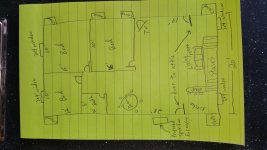
pseudorealityx
Well-known member
You can keep bumping, but until you add some more information, I'm not sure what kind of answer you're looking for.
Big picture... you determine what your overall heating/cooling load is, determine a HVAC unit size, and then run ductwork of appropriate size to each of your spaces, based on your load calculation tells you.
Big picture... you determine what your overall heating/cooling load is, determine a HVAC unit size, and then run ductwork of appropriate size to each of your spaces, based on your load calculation tells you.
volleyball
Well-known member
You should have returns in each bedroom as well as the large room. Returns near the center of the structure and your supplies on outside.
6" might be big enough for the bathroom but you want bigger for the rest of the rooms. I'd plan on several supplies in the great room.
I'd do the ductwork and not close it in for a year to see what needs to be changed.
An alternative is get a pro to design the ductwork if you want a comfortable space.
You may need some custom pieces and they will have access to who does that.
6" might be big enough for the bathroom but you want bigger for the rest of the rooms. I'd plan on several supplies in the great room.
I'd do the ductwork and not close it in for a year to see what needs to be changed.
An alternative is get a pro to design the ductwork if you want a comfortable space.
You may need some custom pieces and they will have access to who does that.
OzarkMan
Well-known member
I would think 8" would be the minimum sized flex duct to run. 6" seems kind of small as if only used for a bathroom.
volleyball
Well-known member
So you like hot and cold spots, no verbal privacy and a long running furnance
DC73
Well-known member
I'm about ready to insulate the ceiling in the garage but I need to put ductwork in for the 20x50 upstairs. Can I just put a 6" duct in each room with a damper or is it more complex than that? I framed out for 1-10x12 bedroom, 2-10x15 bedrooms, and a 5x10 bathroom. The living room/kitchen/dining room is all open.
It's much more complex than that. I'm not an expert in this field but I muddled through it recently for my workshop.
The best way is to first size the HVAC system by calculating the heat gain/loss. Then choose the equipment. The AC and furnace will have specs for air flow. Size the ducts to meet the total airflow needs and the airflow for each room or area.
It's pretty easy to estimate air flow needs for AC from the specs on the equipment. For example, the manual for the equipment I've picked out said optimal airflow for the AC was 400 CFM per ton (12,000 Btus) of cooling. This becomes the minimum airflow to be provided by the system. Divide this airflow into each area by using the ratio of the individual heat gain for the area to the total heat gain. Size ducts accordingly. See chart below.
Estimating furnace requirements is more complicated because you need to know which temperature rise will provide the optimum heating Btus. One furnace I looked at had a CFM range of 550 to 1150 depending on which fan speed provides the correct temperature rise.
I ran into a local engineer who gave me some rule of thumb advice for the workshop that I think will turn out to be good since it exactly matches how my house duct work is sized and that system works well.
He said to start by calculating the airflow for the AC system using 400 to 450 CFM per ton.
Then for the furnace, use 1 CFM per sq. ft. of area.
Increase each result by 10% if using flex duct since it is more restrictive, and increase the result by another 10% for 10' ceilings.
Then, use the higher of the AC or furnace airflow calculation to size the ducts.
He gave me some airflow numbers for round ducts.
CFM provided by round metal ducts:
6" = 100 CFM
7" = 145 CFM
8" = 210 CFM
9" = 290 CFM
10" = 390 CFM
12" = 620 CFM
This rule of thumb might not work in your area if your climate is much different but it might get you in the ball park.
Hope this helps.
DC
RacerRick
Well-known member
Those duct work CFM look published above look really low. Everything I have rad puts a 6" round metal duct at about 300cfm, with the flexible ones about 20% less.
DC73
Well-known member
Those duct work CFM look published above look really low. Everything I have rad puts a 6" round metal duct at about 300cfm, with the flexible ones about 20% less.
Although I didn't buy every size in that chart, the chart does match the stated airflow on the flex ducts I did buy and it also is very close to this chart I found before I met the engineer:
http://www.virginiaair.com/available_forms/Residential Duct Sizing Guide.pdf
DC
pseudorealityx
Well-known member
Those duct work CFM look published above look really low. Everything I have rad puts a 6" round metal duct at about 300cfm, with the flexible ones about 20% less.
Nope nope nope.
Even in medium pressure commercial systems, 6" isn't going to do 300 cfm. Certainly not in residential.
rrudd2
Well-known member
Although I didn't buy every size in that chart, the chart does match the stated airflow on the flex ducts I did buy and it also is very close to this chart I found before I met the engineer:
http://www.virginiaair.com/available_forms/Residential Duct Sizing Guide.pdf
DC
THANK YOU! That chart is a godsend! I'm trying to add a return duct and needed help with the sizing.
volleyball
Well-known member
You need at least the area of the supply for a good return unless your supplies are leaking badly.
what size system are you installing?
also, are you running ALL hard metal duct? if you are running any flex, then those cfm numbers do not work for you.
(the cfm numbers above are actually high if flex duct is used)
Also, lets say you follow your plan where you put in all 8" runs....you need to make sure everything else works with that plan (i.e; that it actually matches the load calculation, that the trunk duct is sized to move that much air, that the equipment selected will supply that much air, and that the registers selected can flow that amount of air)
also, are you running ALL hard metal duct? if you are running any flex, then those cfm numbers do not work for you.
(the cfm numbers above are actually high if flex duct is used)
Also, lets say you follow your plan where you put in all 8" runs....you need to make sure everything else works with that plan (i.e; that it actually matches the load calculation, that the trunk duct is sized to move that much air, that the equipment selected will supply that much air, and that the registers selected can flow that amount of air)
bczygan
Well-known member
For duct sizing you work from the furthest location, back toward the furnace supplying the system.
Look here to get further confused.
http://www.toolbase.org/PDF/DesignGuides/residential_duct_systems.pdf
Bill
Look here to get further confused.
http://www.toolbase.org/PDF/DesignGuides/residential_duct_systems.pdf
Bill
bczygan
Well-known member
What you need is an online or paper ductilator.
Here are some online options:
http://efficientcomfort.net/asp/ResDuct_Web/ResDuct_Web.asp
http://www.maquay.com/
https://pocketengineer2.sharepoint.com/Pages/aDuctulator.aspx
Here are some online options:
http://efficientcomfort.net/asp/ResDuct_Web/ResDuct_Web.asp
http://www.maquay.com/
https://pocketengineer2.sharepoint.com/Pages/aDuctulator.aspx
Planning on installing flex ducts on floor boots just to get out from under the floor so I can insulate the ceiling in the garage below. I'm thinking of just putting an 8" flex duct in each room and then put dampers on back at the main trunk in the crawl space.
volleyball
Well-known member
You are not getting information because you have gotten it. You don't seem to have a clue about the subject. That's fine,none of us know it all. An idiot will just do something and live with it. A smart guy will find a true expert and pay him for his time. And then enjoy the comfort.
There is no online instructions tailored to your property. Unless you have a tract place, it is unique and will need a tailored solution.
I am being firm on this because I think it is the only way it will get through to you.
There is no online instructions tailored to your property. Unless you have a tract place, it is unique and will need a tailored solution.
I am being firm on this because I think it is the only way it will get through to you.
Full Throttle
Well-known member
- Joined
- Nov 8, 2011
- Messages
- 285
As a hvac professional this makes me cringe. First you start with a manual j load calculation, that will tell what size,cfm and where. Then you size ducts accordingly. Anything but and your half assing the job
Highbeam
Well-known member
If you just damper the run to reduce CFM then your velocity will be really low and funk will accumulate in the duct. If your register matches that oversized duct then exit velocity will also be low. The heat will come out of that register like a warm fart and not mix fast enough in the room.
I got a cfm required for each room based off square footage and should be able to size my ducts off that right?
It's a little more complicated than that. For instance, you could have two rooms that are equal square foot but if one has more load walls then it's going to need more air. Direction also plays a critical role. A north facing room is going to need more heat than a south and vice versa for cooling.