To avoid these ads, REGISTER NOW!

Duct sizing help

zman33

Member
Joined
Jun 27, 2023
Messages
6
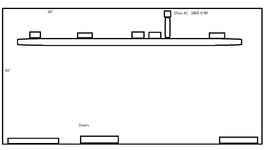
Hi everyone, I have a 40x60 shop and I could use some help sizing the duct and registers. Its pretty basic, just want to run 1 duct down the length of the shop with 5 or so diffusers/vents. What size duct and registers would give me the proper flow? The calculations I ran said 18"? I'm not sure if i'm correct or not though. Any help is appreciated, thanks. Oh, looking to use galvanized round duct by the way.Shop layout.jpg
 
To avoid these ads, REGISTER NOW!

PoorUB

Well-known member
Joined
Mar 29, 2021
Messages
11,716
Location
Fargo, ND
The supply off the air handler should be minimally 18".

Assuming all the registers are the same size so 400 CFM each, the run to the right should be 10", the run to the left comes up to 17", but you probably will not find 17" so 18" past the first register, 15" past the second, 13" past the third, and 10" to the last. You can go up a size if you can not find the odd numbers, but don't go down in size.
You could run 18" past the first two registers on the left and 15" the rest of the way if you don't want to mess with reducing the duct.
 
OP
Z

zman33

Member
Joined
Jun 27, 2023
Messages
6
Thank you very much. The place I am looking to buy the duct from uses even sizes only, so if I went 18" past first 2 to the left, then 16" for the next, and 14" for the last would that work?
 

PoorUB

Well-known member
Joined
Mar 29, 2021
Messages
11,716
Location
Fargo, ND
Thank you very much. The place I am looking to buy the duct from uses even sizes only, so if I went 18" past first 2 to the left, then 16" for the next, and 14" for the last would that work?
That would work just fine.(y)
 
OP
Z

zman33

Member
Joined
Jun 27, 2023
Messages
6
How would you suggest hooking up the 10" line? If i use a Tee, use a couple reducers in a row or should i use saddle connections off of a main 18" pipe?
 

PoorUB

Well-known member
Joined
Mar 29, 2021
Messages
11,716
Location
Fargo, ND
Get an 18" tee and a 18x10 reducer, or two.

An 18" saddle would work too. It just depends on what is easily available and your skill level.

Heck, if it was me, for one side I might just run an 18" branch across the shop with a 90 elbow pointing down at about a 45 degree angle and a 10" with a similar elbow on the other.

Several registers will distribute the air better and you will not have any large air flow blasting at any one place.

My unit in my shop is mounted horizontally on the ceiling, with maybe 18" of 14x20 duct that spits into two 14x10 ducts. One duct makes an immediate 90 degree with some shop built louvers, the other duct makes a 45 degree with some more louvers.
 

karoc

Well-known member
Joined
Dec 19, 2017
Messages
2,017
Location
Hemphill Tx
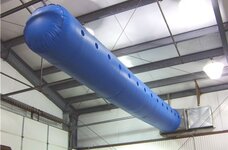
If I had place that size I might consider a duct sock. Have these in gyms, pool areas and Ag barns I see Amazon has them
 

Attachments

  • A5A434B7-25C5-474C-B11B-B409E1C70EF4.jpeg
    A5A434B7-25C5-474C-B11B-B409E1C70EF4.jpeg
    52.7 KB · Views: 42
OP
Z

zman33

Member
Joined
Jun 27, 2023
Messages
6
Don't the size of the registers matter? I may change up the plan a little bit and it would be helpful to know how you are getting your answers to duct size. Like how to calc cfm per duct based on their size and when you need to drop the duct size to compensate. Like how would it affect the size of duct if i added more registers or a larger size register on a particular duct length. Thanks guys!
 

PoorUB

Well-known member
Joined
Mar 29, 2021
Messages
11,716
Location
Fargo, ND
Yes they do. You drew in five, so 400 CFM each. You will need registers with a grill area, or duct sze around 150 square inches. 12x12 gets you 144 sqin. or 10x14 = 140 sqin. 10x16 = 160 sqin.
 
To avoid these ads, REGISTER NOW!

FredWanaker

Well-known member
Joined
Mar 27, 2021
Messages
1,470
Location
NorCal
He stated a 5 ton unit with five registers. He even stated the total CFM on the drawing. I assumed five registers of the same size. How much more information do you need?
last time I looked at a HVAC manual it lists various CFM's available for a unit based on motor wiring criteria chosen. His stated CFM may not be the optimal for the delta-t or inches WC. It is also dependent on the size and shape of the return ducting. If the return ducting is undersized then the CFM has to be recalculated allowing for that. Making a statement of 1850 CFM sounds like a guess based on 350 - 400 CFM per ton. A 5-ton unit would typically be designed to operate between 1750 CFM and 2000 CFM. He will probably need somewhere around 800 to 1200 sq inches for the return filter(s). If he can calculate the return duct, he doesn't need anyone here to do the supply duct calculations for him. I posted a link to standards used. There is also free software that will do the calculations too.
 

PoorUB

Well-known member
Joined
Mar 29, 2021
Messages
11,716
Location
Fargo, ND
last time I looked at a HVAC manual it lists various CFM's available for a unit based on motor wiring criteria chosen. His stated CFM may not be the optimal for the delta-t or inches WC. It is also dependent on the size and shape of the return ducting. If the return ducting is undersized then the CFM has to be recalculated allowing for that. Making a statement of 1850 CFM sounds like a guess based on 350 - 400 CFM per ton. A 5-ton unit would typically be designed to operate between 1750 CFM and 2000 CFM. He will probably need somewhere around 800 to 1200 sq inches for the return filter(s). If he can calculate the return duct, he doesn't need anyone here to do the supply duct calculations for him. I posted a link to standards used. There is also free software that will do the calculations too.
And I calculated using 2,000 CFM. Pretty standard number for 5 tons. The AHU he has will probably be less. His drawing states around 1,800 CFM. A typical residential AHU will not produce 2,000 CFM so I am confident my numbers are good, a bit over sized if anything.
 
OP
Z

zman33

Member
Joined
Jun 27, 2023
Messages
6
Because it wouldn't for a shop the size of the one I have. I would have to buy 2-3 full mini split units for the space. which would cost double-triple what I paid for a good 5 ton system with the same inverter type of condenser that mini splits use
 
OP
Z

zman33

Member
Joined
Jun 27, 2023
Messages
6
Why use ducting when multiple single zone minisplits units would be far more efficient ?
Because it wouldn't for a shop the size of the one I have. I would have to buy 2-3 full mini split units for the space. which would cost double-triple what I paid for a good 5 ton system with the same inverter type of condenser that mini splits use. My shop has no dividers it's just one big open area.
 

FredWanaker

Well-known member
Joined
Mar 27, 2021
Messages
1,470
Location
NorCal
so how did it work out? Did you figure out what you need or are you still trying to figure it out?
 

Shoester

Well-known member
Joined
Jan 9, 2014
Messages
318
Location
Kansas City
Because it wouldn't for a shop the size of the one I have. I would have to buy 2-3 full mini split units for the space. which would cost double-triple what I paid for a good 5 ton system with the same inverter type of condenser that mini splits use. My shop has no dividers it's just one big open area.
Bumping this, zman33 did you ever get this figured out?
 

ToolsRCool

Well-known member
Joined
Dec 28, 2024
Messages
231
Location
Plymouth, MI
Sanity check: Should heat exit low and A/C exit high for max efficiency? That way, you don't have to "fill" the room to feel it? I think so?

You guys really like and push mini-split heat. Are you sure NG is not less cost from an energy perspective? I know somebody is passing around an Excel sheet that supposedly justifies it, not sure what area that is for or the makeup of the equations and numbers on it. I still think NG is the lowest cost form of purchased energy, so when putting that through a 94% efficient furnace, is going to be a tough act to beat from a BTU/$ perspective.
 

beltfeed

Well-known member
Joined
Jan 22, 2006
Messages
226
Location
USA
I agree with ToolsRCool. In my area NG costs are .86 cents a therm with all taxes and fees rolled in. Electric is .19 a kilowatt with all taxes and fees rolled in. I'm currently building a 3200 sq ft shop with 14' sidewalls. My winters are 15-30F for 3-4 months. Not prime temps for electric heat. I will have a centrally located 5-ton NG furnace.
 

PoorUB

Well-known member
Joined
Mar 29, 2021
Messages
11,716
Location
Fargo, ND
Sanity check: Should heat exit low and A/C exit high for max efficiency? That way, you don't have to "fill" the room to feel it? I think so?

You guys really like and push mini-split heat. Are you sure NG is not less cost from an energy perspective? I know somebody is passing around an Excel sheet that supposedly justifies it, not sure what area that is for or the makeup of the equations and numbers on it. I still think NG is the lowest cost form of purchased energy, so when putting that through a 94% efficient furnace, is going to be a tough act to beat from a BTU/$ perspective.

I agree with ToolsRCool. In my area NG costs are .86 cents a therm with all taxes and fees rolled in. Electric is .19 a kilowatt with all taxes and fees rolled in. I'm currently building a 3200 sq ft shop with 14' sidewalls. My winters are 15-30F for 3-4 months. Not prime temps for electric heat. I will have a centrally located 5-ton NG furnace.
If you have natural gas it is hard to beat cost wise. We are often at 30 cents a therm and 12 cents per KWh. At those rates NG with an 80% heater is almost 1/3 the operating cost of a heat pump at 300% efficiency.

A few years back our NG price went way up, something like $3 a therm. Then a HP was a lot better, but that was the only time.
 
To avoid these ads, REGISTER NOW!
Top Bottom