To avoid these ads, REGISTER NOW!

Dug up old hatchet/hammer head

Downwindtracker 2

Well-known member
Joined
Jun 13, 2019
Messages
1,715
Location
BC
In the north it wasn't called a civil war ,merely a rebellion. To a Canuck, all Americans are yanks. I once called a southern a yank on a hunting forum. Boy did I stir up a hornets nest.chuckle.
 
To avoid these ads, REGISTER NOW!
OP
Y

yardiron

Well-known member
Joined
Oct 9, 2014
Messages
209
Location
NJ
The pieces of track look almost cast on the ends, its not cut with a saw, it looks more like its just snapped off perfectly flush, but its malleable because I can see where its mushroomed from weight. I find it odd that there's just the bits of track, nothing else railroad related. I've also not found any part of the old dam that used to be there, its as if the ground swallowed it all up. Having not been over there in all those years, seeing how much the trees had grown in just 30 years was a surprise.
After a quick web search, it looks like the 'bridge rail' is from the 1840's or there about, which would be much older than any settlement here. That makes me think it was likely brought in, or they were running used rails for what ever they were doing.
 

SeisMec

Well-known member
Joined
Aug 24, 2018
Messages
406
Location
Beryl, Utah
Some of the other things we fine regularly there are huge 5/8" square headed bolts, odd lengths with crude threads, and flat plates of iron about 11" by 8" bent slightly in the middle length wise. They're roughly 5/8" thick. I collected about 40 of them so far further back in that woods.

Decades ago, I spent a summer as a temporary hire, rail road laborer mainly replacing weathered rail road ties. Steel plates - about 5/8" thick with a shallow (1/4 inch?) channel in the middle where the rail sat - that went between the rail and the ties. The plate had square holes for the spikes that secured the rail and the plate to the tie.

You didn't mention any, but if there are holes in your plates, maybe they served the same purpose for the bridge rail?
 

Sevenhills1952

Well-known member
Joined
Aug 30, 2018
Messages
1,750
Location
Virginia
I grew up on a small farm, I mentioned part of 2500 acres neighbor had. Grandad had a 2 acre lake built in 1954. Upstream (unfortunately not on our property) is a shallow pit, about 3ft deep, 20ft across. My brother collects Indian artefacts and finding quartz arrowheads a lot. This pit is full of quartz. Around edge are piles of quartz chips.
A few years ago I had an anthropologist look at it, then he spoke with my geologist brother and we believe that's where Native Americans made arrowheads.
The unfortunate thing about history is after a couple generations it's lost, land changes, gets bulldozed, etc.
That place ought to be preserved, but won't be.
Shame better records aren't kept about what was where.
To the OP...what part of New Jersey is this? You don't have to be too specific if you don't want to.


Sent from my SM-S320VL using Tapatalk
 
OP
Y

yardiron

Well-known member
Joined
Oct 9, 2014
Messages
209
Location
NJ
I grew up on a small farm, I mentioned part of 2500 acres neighbor had. Grandad had a 2 acre lake built in 1954. Upstream (unfortunately not on our property) is a shallow pit, about 3ft deep, 20ft across. My brother collects Indian artefacts and finding quartz arrowheads a lot. This pit is full of quartz. Around edge are piles of quartz chips.
A few years ago I had an anthropologist look at it, then he spoke with my geologist brother and we believe that's where Native Americans made arrowheads.
The unfortunate thing about history is after a couple generations it's lost, land changes, gets bulldozed, etc.
That place ought to be preserved, but won't be.
Shame better records aren't kept about what was where.
To the OP...what part of New Jersey is this? You don't have to be too specific if you don't want to.


Sent from my SM-S320VL using Tapatalk

We find the arrow heads in the farm field, but never any chips or flakes or larger rocks, just arrow heads. I had taken a few to an area hunter/collector and he said they're older arrow heads and not all of there were the type that are normally common in southern NJ.
The arrow heads could very well been trucked in with dirt or top soil.
The time to have preserved it would have likely been 40 years ago, there's nothing left now but bits and pieces spread through the woods and farm field.


That bridge rail could be what the sawmill carriage rode on, back and forth.

That's possible but the saw mill itself was a quarter mile away. I'm also not sure where it actually was located, we never found anything that looked like a railway bed or any other railroad items other than the bits of track. The metal plates we keep finding are too big and too new to be from that time period. The plates are hard steel plates, each has four holes on each side. They are all nearly identical but not factory drilled or punched. The holes look like they were cut with a torch.
Its hard to tell going by the old maps where the railway actually was, only one of the roads that are there now existed then and its 1/2 mile to the west of where the sawmill was. The roads on the map then don't match up with any of the roads there now, nor does the railway on the map. The maps don't cover the outlying areas very well, only the roads in the nearby towns, which may or may not have even been there when ever that foundation was built.
When I first saw the foundation years ago, I thought it was just a moss covered concrete footing, but after looking closer as of late, I can see its made up of cut rocks, each one is about 4x6" and about 18" long or so. They appear to have been mortared together at some point but the mortar is all but gone now. A buddy pointed out that since there's no doorway opening in the foundation, it likely wasn't a dirt floor shack and likely had a raise floor of some sort. If the foundation predates the nearest town, it means it was pretty far out in the woods. If it was all before 1861, then the nearest town would have been a good 15 miles away in one direction or 20 miles in the other direction.
 
OP
Y

yardiron

Well-known member
Joined
Oct 9, 2014
Messages
209
Location
NJ
These are the plates we keep finding, I think there's about 40 of them so far. Some have bits of oak and square headed bolts still attached.
Not all have the nuts, and not all are as cleanly drilled as this one, some just have the holes torched through.

A few had round pegs hammered into the two round holes and bolts attached to wood on the other side. The few that still had wood attached had the bolts which were about 6" long. Some had just loose nuts and bolts, others welded nuts. I kept them just for the steel plate, no clue what they were using them for. Surprisingly they have very little rust but a few were coated with some sor of tar or dried grease. These were laying all over in the woods in the area of the old foundation, about 100ft from the nearest clear farm field into the woods, and spread out over a couple of acres of woods.
These don't look old and none have any markings. Each plate is scored, bent slightly, and the score is welded in.
After gathering up a few in the garage, I can see that these are made in various thicknesses, some are just over 1/2", others are somewhere between 9/16" and 5/8" thick. I've cut a few up to use on various projects, I've got a half dozen 5 gallon buckets of them yet. They're fairly hard steel, they don't bend and don't drill very easily.

I don't think these are at all related to the railroad track, or the hatchet head I found. But I can't imagine why they were strewn all over the place. None of these were really buried, they were just laying in the leaves on the ground.
I almost wonder if stuff like this wasn't spread around for security to trip up trespassers or to keep people from riding bikes or atv's back there. One of these with its studs sticking up would make one heck of an obstacle to hit at speed on a dirt bike. Or on foot for that matter. At one time they had livestock on the property, but not in numbers, maybe a few horses and a couple milk cows judging by the barn, and the perimeter has a few fence posts still standing with bits of cable still attached in spots, but you have to look hard to find the fence line in the woods these days. It gets pretty thick back that way in the summer, lots of poison ivy, knotweed, and lots of wild rose vines all around the wooded property lines, plus the fact that there's a 4ft deep trench as well.
 

Attachments

  • Plates.jpg
    Plates.jpg
    93.4 KB · Views: 26

bargainhuntingking

Well-known member
Joined
Nov 22, 2013
Messages
434
Location
The Amazing Pacific Northwest
I figured I'd post this here.

Last fall a buddy had a huge old oak tree fall over in a storm. Being its was a huge tree for this area, and deep in his woods behind his farm, I wanted the wood. The base of the tree was roughly 39" across.


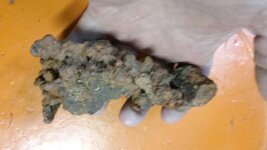
While cutting the tree clear of the root ball, I ran a metal detector over the areas where I was going to cut, and also around the roots and in the hole just out of curiosity. I found a rusty clump of dark brown dirt that was obviously iron. I've also found quite a few old horse shoes in the same area, they turn up all over the place both in the woods and in the fields.


I tossed all the bits in a bucket and forgot about them till the other day. I decided to see what the rusty clump was so I started picking at it till i realized it was a hatchet/hammer head. With no other real choice, I dropped it in a can of Evaporust for a few days.


After a good scrubbing I can see the thing is forged and the hole is parted with something sharp, the angle isn't perfect, its slightly canted to the left.

I see no markings, but a lot of surface metal has been rusted away over the years.

I am curious as to how old it may be.

The farm there now was built in the late 40's, the original home on the property, was from said to be from the turn of the last century, 1902 or so.

I have no history as to what the old foundation in the woods is, nor what was there before. This was found far back in the woods even beyond where the original house sat.


My guess is its just an old carpenters hatchet but I'm curious as to how old it could be since it was beneath the outer root ball of such an old tree.
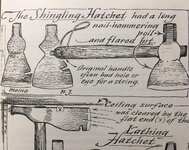

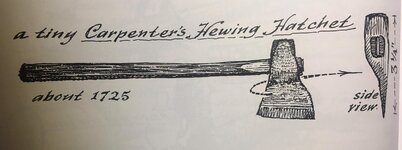
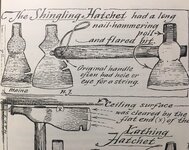
Looks like an 1800’s Maine shingling hatchet with a nail hammering head and a nail pulling notch. See this illustration from Eric Sloane’s 1964 book “A Museum of Early American Tools”:

d04b815951790b4784f2e1e781a0d1db.jpg8a09bae3659a8412df4341f71756c7c5.jpg

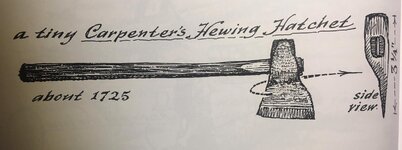
If the bit is offset to one side, it may be a hewing hatchet, to flatten the sides of a log.

f31786bc2c8c6547a214d088185206d0.jpg258e1f5122f0d184f92d4ac465bea8d7.jpg
 

Attachments

  • d04b815951790b4784f2e1e781a0d1db.jpg
    d04b815951790b4784f2e1e781a0d1db.jpg
    273.8 KB · Views: 0
  • f31786bc2c8c6547a214d088185206d0.jpg
    f31786bc2c8c6547a214d088185206d0.jpg
    238.7 KB · Views: 0
  • 8a09bae3659a8412df4341f71756c7c5.jpg
    8a09bae3659a8412df4341f71756c7c5.jpg
    219.6 KB · Views: 0
  • 258e1f5122f0d184f92d4ac465bea8d7.jpg
    258e1f5122f0d184f92d4ac465bea8d7.jpg
    102.7 KB · Views: 1
Last edited:
OP
Y

yardiron

Well-known member
Joined
Oct 9, 2014
Messages
209
Location
NJ
Good info.
The blade on this hatchet isn't offset, its rotated or twisted about 5 degrees. As if the handle hole isn't straight through the middle. The hammer head is the same way but the way its forged, it looks intentional. While the handle hole isn't perfectly straight, the hammer head flats sort of turn a bit too. If you look at the hammer end straight on, its octagonal pattern is rotated 15 degrees to the right, the same direction the blade leans.
In other words, if I put this on a straight handle the head would lean to the right on the handle. I'm not sure it was just inattention to detail by whom ever made it or if it was done for a reason.

Looking at the old pics, there's no doubt its a shingle hatchet. The middle is sort of octagonal shaped though, not round or pointed.
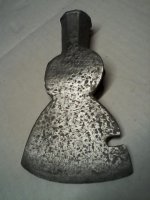
If you look a the pic of the hatchet head, the one side has some chipping where the handle goes into it, that area is tapered and very thin, knife edge thin, while the top edge on that side is thicker metal, the opposite side of the hatchet is the reverse, the top edge is very thin, and the bottom edge of the hole is thick. The hole though the middle is crude and very rough, the front and back part of the hole has many sharp tool marks made by something sharp, sort of like if you made a hole through a block of clay with a kitchen knife by jabbing and twisting it leaving the blade cuts on both ends. The surrounding metal has those same blade marks in it from where the displaced metal was just pounded back into the top of edge of the blade leaving some of the cut marks still showing.
The one thing I can't wrap my mind around is that the nail pulling slot on this is pretty wide, I considered the fact that it could have been worn out over the years or pulled through but it doesn't look like it. he slot is wider than the head of a modern 16 penny nail head and the leading edge is thick, not tapered like most nail slots I see in pictures. If a nail wasn't 3/8" proud of the surface, this wouldn't be able to get hold of it. The lead-in edge where the slot starts isn't tapered either, its the same contour as the rest of the blade. Picture if the claw end of a modern claw hammer was 1/4" thick and not tapered off, how much use would it be lifting nails?
Other than pulling a one strike missed or bent over nail, this 'nail slot' would have likely been useless for getting hold of a nail. Not to mention due to the cant of the blade, it would only be able to get even slightly close to the surface if in your left hand since the blade leans to one side.
What did the nails they used on shingle siding look like back then?

As I looked through that catalog, I recognize or at least can identify what a lot of the hardware bits were that I found near the old foundation. Mainly the iron ladles, sash locks, and shudder locks, and various latches.
I think when the weather warms I may do some more digging around out there if the owner doesn't mind. Something tells me there's more to be found that what we just stumbled on by chance. Other then just walking through an turning over a few things we haven't done any serious digging around. I ran through quick with the metal detector but it proved useless due to all the iron laying around. The place is literally littered with thousands of nails, bits of metal, and old hardware all over the place. So much so that I'm still not convinced it wasn't some sort of dumping ground but without any concrete history on the place, its all just a guess.
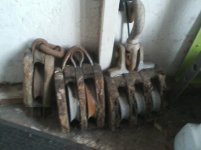
Here's a few more bits that came from the same area. The rope blocks were laying in the dirt about 100ft further into the woods, a pretty good distance from the foundation, closer to the trench and fence line that runs along the rear property line. There was one more piece that couldn't be retrieved due to it being grown into the trunk of a huge oak tree about 40 ft away with only the hook and part of the pulley still showing.
 

Attachments

  • 0119201604-00.jpg
    0119201604-00.jpg
    80.4 KB · Views: 20
  • 0119201603-00.jpg
    0119201603-00.jpg
    115.1 KB · Views: 23

Sevenhills1952

Well-known member
Joined
Aug 30, 2018
Messages
1,750
Location
Virginia
Good grief! Lots of historic stuff. Until I looked it up I didn't realize not all tracks were used for railroads, some were for horse drawn wagons through woods, etc.
The plates to me may have been used with track.
One thing maybe you'd want to do is make a sketch of area, what was found where.
My guess is that area was most likely the epicenter of the industrial revolution.
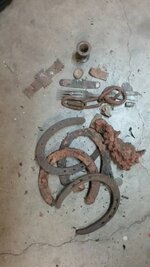
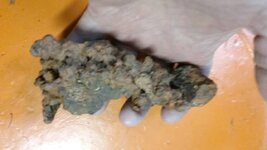
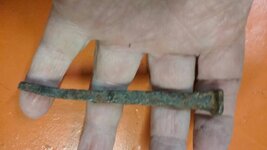
Here is some of the things I've found around here. This slag looking stuff is heavy and a civil war buff friend that was here said during the war it was common for Confederates to melt down their bullits if they knew they were going to be captured. The nail...one day I dug up about 100 or so nails. It looked like from what was left they were in something like a burlap bag...hardly anything left of the bag, but nails are very crude like they were hammered out. I'm thinking back then they would be salvaged, used on the next project.
One thing I've often thought is modern people have no clue what it means to work. Men and women worked HARD back then!
Look at old photos and people were in good shape!
To this day where I grew up there's a barn filled with old things, on back of workbench is a wooden box full of bent nails. Granddad was a Dr., born late 1800's, but he would straighten a nail and use it. When we shoveled stone he used a steel grain scoop which I still have. We used to mix concrete with a cement boat by formula by hand. I've seen my grandmother (4'11", 100#) lady dig up tree stumps in her 70's with small garden tools. People today couldn't do that.3afeeb0ed3ff098cc353e0f55f30b9df.jpgbe366575b912ecc7fa3290d13f51649c.jpg90309eb3d44ab8c0f8a9c60a6849e4bd.jpg

Sent from my SM-S320VL using Tapatalk
 

Attachments

  • 3afeeb0ed3ff098cc353e0f55f30b9df.jpg
    3afeeb0ed3ff098cc353e0f55f30b9df.jpg
    84.1 KB · Views: 1
  • be366575b912ecc7fa3290d13f51649c.jpg
    be366575b912ecc7fa3290d13f51649c.jpg
    58.2 KB · Views: 1
  • 90309eb3d44ab8c0f8a9c60a6849e4bd.jpg
    90309eb3d44ab8c0f8a9c60a6849e4bd.jpg
    54.6 KB · Views: 0
OP
Y

yardiron

Well-known member
Joined
Oct 9, 2014
Messages
209
Location
NJ
I thought about the idea of a horse drawn railway.
I think most of the horse shoes I've found are for ponies or mules, they're not big enough to be a full size horse.

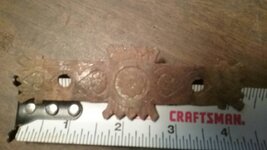
What is the bow tie shaped piece of metal in the upper left of your pic?
I found quite a few of those things lying around here, both in the woods and in the one barn.

I haven't found any Minnie balls here, just round lead balls, most look to be at least 50cal, many appear to be .69cal round balls. They're mostly embedded in the trees. I've not cut up an older tree and not found lead.
What's been really surprising is how rust free a lot of the items are considering how long they've likely laid in the woods. The last person related to the family who lived in the current house there passed away just over 10 years ago and from what I was told he didn't nothing around the property for 10 years prior to that due to his health. So even if the stuff was dumped, it spent at least 15-20 years out there, if it wasn't there all along. During the winter, walking back there is a lot easier but the woods is pretty thick surrounding the area where the foundation is. The actual area around the foundation is a lot clearer, with plenty of room to move around and very little scrub growing. Its mainly just trees, most of the trees are smaller in that immediate area except for a dozen or so huge oak trees. There's one tree that's completely hollow, its double the size of the one that I found the hatchet under. Its sitting on the edge of the pit and the last time I looked, there was a family of skunks living in or near the tree. The whole area has a large population of skunks, hawks, and long tail weasels. Twice now, while in that woods, I've had flying squirrels land on me out of nearby trees. One landed on my back, the other on my arm. Both sat there for a few minutes till I moved nearer to a tree they could escape to. I've also seen some pretty ********* snakes and a few gray ring neck snakes. There are also a few old tombstones in that woods, the combo of old tombstones and snakes has likely kept a lot of people away.
 
OP
Y

yardiron

Well-known member
Joined
Oct 9, 2014
Messages
209
Location
NJ
Any idea how long the handle should or would have been on one of these hatchets?
Just playing around it seems to 'feel' right with a longer handle, about 16" total length or so. I slid a plain 14" hammer handle into the thing and it felt okay but it feels more balanced a bit longer. I'm thinking of cutting the handle from the wood of of the tree I found it under.
 
To avoid these ads, REGISTER NOW!

Sevenhills1952

Well-known member
Joined
Aug 30, 2018
Messages
1,750
Location
Virginia
OP:
What is the bow tie shaped piece of metal in the upper left of your pic?

Few more pictures. Is it exactly like it, ornate? Third is back. I wish I knew. It seems like it has a thin (silver?) plating. My White's detector indicated it wasn't like tin.7c3affedd35fbe57382b50409f55f03f.jpg057bf15314da3f2c6f4f7826d77a54f1.jpgb5f8e79557f956b277a45b0999fc34c6.jpgd4411b6fde502125db2a8d1d43ab921f.jpg

Sent from my SM-S320VL using Tapatalk
 

Attachments

  • b5f8e79557f956b277a45b0999fc34c6.jpg
    b5f8e79557f956b277a45b0999fc34c6.jpg
    62.2 KB · Views: 0
  • d4411b6fde502125db2a8d1d43ab921f.jpg
    d4411b6fde502125db2a8d1d43ab921f.jpg
    105 KB · Views: 0
  • 057bf15314da3f2c6f4f7826d77a54f1.jpg
    057bf15314da3f2c6f4f7826d77a54f1.jpg
    55.5 KB · Views: 0
  • 7c3affedd35fbe57382b50409f55f03f.jpg
    7c3affedd35fbe57382b50409f55f03f.jpg
    80.2 KB · Views: 2
OP
Y

yardiron

Well-known member
Joined
Oct 9, 2014
Messages
209
Location
NJ
Up close those are different from what I found. Those look to be backing plates for drawer pulls or maybe window sash locks.
The pieces we were finding were think steel with no designs, they were very thin and very sharp on the edges. They were beer can thin. Someone had suggested that they may have been used in plaster walls or for stucko to help the concrete or plaster stick to the wall. The edges would be bent upward to provide grip. We probably found a few bucket of them at first, now they turn up here and there in the woods.
 
OP
Y

yardiron

Well-known member
Joined
Oct 9, 2014
Messages
209
Location
NJ
I roughed out a handle tonight, out of the wood from the tree it was under in the woods. I took a piece of straight grain wood from the upper part of the straightest part of the trunk.

Its still oversize all around but it looks like its going to work.

(When that tree went down, I was able to mill nearly 900 board/ft of wood from it, I had a buddy dry a good bit of it for me). The piece I used was left over from a hand railing I made from some 2" planks we cut. I ripped it down to the rough dimensions and then rounded it with a spoke shave. I'll finish the rest with sandpaper. Because its oak and not ash or hickory, I intend to leave the handle fairly straight with maybe a slight flare at the **** end. When its done, I dunk it in boiled linseed oil to seal it.
 

Attachments

  • 0121200107-00.jpg
    0121200107-00.jpg
    116.3 KB · Views: 16
  • 0121200106-00.jpg
    0121200106-00.jpg
    132.1 KB · Views: 13
OP
Y

yardiron

Well-known member
Joined
Oct 9, 2014
Messages
209
Location
NJ
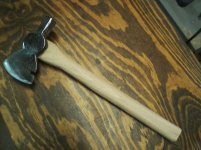
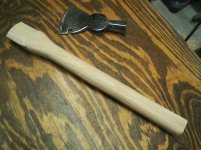
Got back to it after dinner last night, I cut the handle down to fit the hatchet head, left enough of a swell and shoulders to support the head and protect the handle a bit and just rounded out the handle a bit. Then I gave it a good soaking coat of Boiled Linseed Oil.
All I have left to do is make a steel wedge for the top. Right now its as close to a zero tolerance fit with a full width wood wedge pressed into the top with some glue on it.
I'll dig around in the stuff we found and see if I can find a wrought iron piece I can cut a wedge from to keep it looking correct, if that matters at this point.

I didn't do anything more to the head itself, I didn't see any signs of paint on it, and I didn't want to put anything on it that wasn't around back then. I'll let it patina back to natural steel, or maybe hit it with some bluing once I sharpen it a bit. So far all I've done is run the edge on some sandpaper to clean it up, surprisingly, what ever that edge is made from it wasn't rusted or pitted. I did work some oil into the pits to help rust proof it. I basically dunked the whole thing and let it drip dry wiping off the head only and letting the handle just absorb as much oil as it can.
I think it came out fairly decent for a quick handle made from a flat plank. Start to finish on the handle I only had a couple hours in it.
Since the hole through the head was crooked, I corrected that a bit with how I carved the tang, thus the head sits flat and inline with the rest of the handle. There wasn't much I could do about the direction the hole was punched at, I fixed it a bit but didn't want to cross grain and make it weak.
The hole leans forward slightly toward the hatchet side about 1/8" or so. I'm not sure if that's on purpose or not, most likely its just the way the blacksmith's parting tool went through the iron when ever it was made.
The handle is just slighly bigger around then the handle on a large framing hammer, but longer, about 17" overall. I was going to trim it down a bit but it felt better longer. Its more balanced and far more effective.

I wish I had taken a pick of it when it first came out of the ground, but I really wasn't thinking it was something so old at that point, I didn't even realize it was a hatchet head.
Here's a before and after.
 

Attachments

  • 0112200035-04 -C.jpg
    0112200035-04 -C.jpg
    74.1 KB · Views: 18
  • 0121200355-01.jpg
    0121200355-01.jpg
    94.6 KB · Views: 25

RTM

Well-known member
Joined
May 13, 2019
Messages
13,227
Location
SF Bay Area
You can put BLO on the head too. Darken it up, prevent rust.

Or a mix of 1/3 each BLO, beeswax, and turpentine. (melted together outside, don’t set the kitchen afire)
 

bargainhuntingking

Well-known member
Joined
Nov 22, 2013
Messages
434
Location
The Amazing Pacific Northwest
yardiron; said:
The blade on this hatchet isn't offset, its rotated or twisted about 5 degrees. As if the handle hole isn't straight through the middle. The hammer head is the same way but the way its forged, it looks intentional. While the handle hole isn't perfectly straight, the hammer head flats sort of turn a bit too. If you look at the hammer end straight on, its octagonal pattern is rotated 15 degrees to the right, the same direction the blade leans.

In other words, if I put this on a straight handle the head would lean to the right on the handle. I'm not sure it was just inattention to detail by whom ever made it or if it was done for a reason.


If could have been intentional if it was designed for “hewing” which is the process of turning a round log into a square beam. Often the handles for these types of axes came out at an angle to protect the hands from striking the log.

4e50239dabc9531f8cfd6ba7f9ea6720.jpge429354acff9d3939e25602ce7b9419e.jpg

Pic credit: Eric Sloane “A Museum of Early American Tools”
 

Attachments

  • 4e50239dabc9531f8cfd6ba7f9ea6720.jpg
    4e50239dabc9531f8cfd6ba7f9ea6720.jpg
    214.7 KB · Views: 1
  • e429354acff9d3939e25602ce7b9419e.jpg
    e429354acff9d3939e25602ce7b9419e.jpg
    251.3 KB · Views: 1
Last edited:

bargainhuntingking

Well-known member
Joined
Nov 22, 2013
Messages
434
Location
The Amazing Pacific Northwest
I love your restoration and the fact that you made the handle from the tree in which you found it.

Another interesting axe tidbit for me was learning about how with some axes the cheeks are folded over a harder steel wedge and forged until shaped, making the bit more durable.

700f3d518d8c192f067e557d0b64a46f.jpg

Pic credit: “A museum of early American Tools” Eric Sloane

I restored an old craftsman “boys” axe and noticed a similar pattern for the bit end. You can see the line demarcating the inserted steel wedge. It sharpened up so well. I cut my Christmas tree down in the National Forrest with it with my 6 year old; it only took about 10 blows!

dda398ba349efa5f7b1edeb4aaf43d48.jpg
 

Attachments

  • dda398ba349efa5f7b1edeb4aaf43d48.jpg
    dda398ba349efa5f7b1edeb4aaf43d48.jpg
    140.5 KB · Views: 0
  • 700f3d518d8c192f067e557d0b64a46f.jpg
    700f3d518d8c192f067e557d0b64a46f.jpg
    227.9 KB · Views: 0
Last edited:
OP
Y

yardiron

Well-known member
Joined
Oct 9, 2014
Messages
209
Location
NJ
I did wipe the head down with BLO, but didn't let it dry on the surface. I was only trying to seal the pitted areas. I still may blacken it with a bluing solution, not sure yet.
The head is on there now to stay, its a super tight fit. I was going to reduce the shoulder swell area a bit but I didn't want to mess with the balance or feel. Since the oak is likely lighter than say a hickory handle, being a bit oversized made it feel right both because of weight and my XXL sized hands. After trying this out a bit, I wish my other hammers had larger diameter handles.
I had to leave a swell below the head because the hole in the hatchet is straight through with no flare. A straight handle would eventually work loose and slide down he handle. This way the head is bottomed on the shoulders of the handle and expanded and held tight by the wedge. I'll make a steel wedge to lock it all in place once the BLO is dry.
Its hard to fit a handle to a head with such an irregular shaped hole, both sides were different shapes and both ends had spaces beyond the formed cut that were open that left gaps. All I could do is fit the handle tightly to the main hole, I didn't cut the wedge slot down as far for neck strength and I used the wedge to secure and lock the wood.
Its likely a lot tighter now than when it was first made.
The oak handle is a bit of an experiment I suppose, a web search turned up a several posts on various forums recommending not to use red oak.
I went with it for now because its what I had on hand, and it was the tree it was found under. If it don't last, I'll make one from hickory, but more than likely, this will be a conversation piece more than anything. Its lasted all these years, hopefully I gave it a few more years. I only wish I knew more about where it came from or how it got where it was. It still don't make sense to me how it got so deep in the ground.
Those who hunt artifacts keep telling me that most finds are within 18" from the surface and those items are older than this hatchet or the horse shoes we found there. If it were simply dropped or lost, I wouldn't have figured it to have sunk that deep on its own. It had to be buried or covered up in some way. Its also very well preserved for being in the ground for so long. When I first started chipping the rust and dirt away I didn't think there was any chance at all of ending up with something that had any chance of ever being made usable again. I was expecting a rusty chunk of iron too far decayed to even clean up. Something that comes to mind is some items around my own yard that I've watched rust away over the past 40 or so years. I built a gantry crane to work on tractors back in the mid 80's, I built it with some used, surplus C channel. One of the pieces I cut off as scrap got used as a door stop at the back door of my one shed back then. Its leaned against the back of the shed unpainted since around 1984. It was rusty then, but not pitted or damaged. Today, its rusted away so bad that its like swiss cheese. Its pitted, perforated and its lost the lower 6" or so that contacts the ground. It just got forgotten back there and never moved all these years. That was a much more substantial piece of metal than this old hatchet that for some reason has survived a hundred or more years buried in the woods in a wet, swampy area. My yard it dry, and with minimal exposure that piece of steel has rusted away. The gantry however, has remained painted and is still in good shape, but its been painted a half dozen times over that period and its wheels keep it off the ground. Along the same lines, I was replacing a window in my house last fall, it had held a window air conditioner for decades. Doing away with the old AC unit, I wanted to put a modern insulated window in that spot. While I was replacing the window, I found an old Craftsman 9/16" wrench trapped beneath the original window sill. While the window was original to this mid 50's house, the wrench is likely from the 70's when the wood work was refinished here. The wrench, which was inside the house, beneath a dry sill, was rusted to the point there is no chrome left. It cleaned up but its forever blackened by the years of rust with pitting along the corners of the handle lines. I wouldn't have expected something left there like that to have been that rusty. It really wasn't much different than if it were hanging on the wall inside. It wasn't outside, it was sitting on top of the frame beneath no deeper into the wall than the plaster itself. I figured it was either dropped when the woodwork was being refinished back in the late 70's. The wrench appears to be from the mid 70's and matches a set with one odd 9/16" wrench that belonged to my father who refiinished all the woodwork then.
I have little doubt that if that wrench were left under that tree it would have been long gone by now, the same with the C channel I left outback. It definitely says something to the durability of wrought iron they were using back then.
 
OP
Y

yardiron

Well-known member
Joined
Oct 9, 2014
Messages
209
Location
NJ
The head on this hatchet doesn't look 'folded' over, but there's definitely a different piece of harder metal where the cut edge is.
The hole is crude and looks like it was formed with something sharp when the metal was hot. Picture shoving a pocket knife through a bar of soap to make a birds eye shaped hole. The ends would have knife marks and there would be some twist marks where you 'open' up the hole. The presence of the hammer head also makes it seem unlikely it was a folded design. The hammer seems to have been pulled and formed off the billet.

A few local guys said I should search around for an old hearth or work area with the idea that maybe the foundation I'm seeing wasn't a home but a blacksmith shop along the railway or trail there. Maybe the chimney was the source of heat. The amount of metal all around does sort of point that way, and the huge number of clumped up horse shoes that don't look like they were ever 'fitted' or nailed.

I wish I were more of a historian on the area, and a better judge of the woods and the old trees. From what I see, the majority of the growth in the area isn't that old, only about 5% of the trees are old enough to have been there 150 years ago. The rest are smaller, many no more than 8" in diameter. But from memory, it wasn't much different in there back when it was a swamp when we rode dirt bikes through those woods in the 70's. The trees weren't all that big then either. The main thing I recall about that area was a few late 40's and early 50's cars that had been grown into the trees back then. Those are gone now, as is the water that surrounded them. There was also a small shack there that's also gone now. The area where the foundation thats there now was likely flooded or so close to the creek we never went over there on two wheels. The first time I was out there the one car was bullet ridden and it had a tree growing through the engine compartment and another one through the trunk floor. That car was about a '50 Ford. The other car was a late 40's Plymouth that had clothes spread all around inside and a ton of bullet holes. We pretty much figured that hunters had used the cars for target practice. Getting to them meant riding through a foot of water that flooded the whole area back then. The Plymouth was next to the old shack, which looked to be no more than about 15x20ft or so made of unpainted planks with a tin roof. There's no sign of it there now. That and the cars are gone, and only a few old beams and a hand painted no trespassing sign remains on an old cedar post that's now leaning over against a tree. It was a buddy who lived over that way that took me there as a kid the first time, he knew the owners there and they didn't mind us riding through there. The first time I went there it was a bit spooky to say the least. We never went in the building, I'm not sure why, but most likely because of the foot high water there. What I find the most strange is that the entire area has dried up these days, there's no sign of the creek or the old cars, and there's no sign of the old shack. The only thing that remains from back then is the old no trespassing sign and few old tires off a 40's Ford laying around on the ground.
The area that is now an adjacent farm field was still wooded back then, the edge of the woods was a lot closer to where the older farm house stood back then. Someone cleared out about 5 acres of land since then.
I really wish I had taken a camera back there back then but when your in your early teens you don't think that way. The guy who showed me the place back then was more than likely thinking of a way to get hold of those old cars, or their parts. I lost touch with most of those guys from back then over the years, not sure if any are even still around. I always wondered if any of them knew anything about what all was there long ago or how it all came to be. As a kid I sort of knew the people who lived there but only in passing, they knew who I was and didn't mind me riding through. The one son did welding and we often bummed tools to fix our bikes there but even the youngest of that family was 30 years my senior back then. The current owners bought the place and moved here from out of state. I got to know them after being hired to plow the field the first year they were there back in 2010.

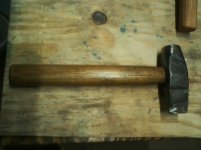
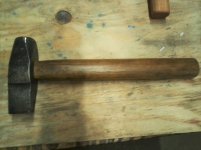
Here's another hammer I re-handled a while back, I had cut down an old broken sledge hammer handle to make this. The head came from a farm in PA I got to clean out a few years ago, the bare hammer head was sitting on a window sill in an old post and beam barn. It appears cast with one end ground into a parting tool or straight pein. Its about 2.5 lbs.
Its my most used hammer for reforming old metal.
 

Attachments

  • 0122200324-00.jpg
    0122200324-00.jpg
    80.5 KB · Views: 10
  • 0122200323-00.jpg
    0122200323-00.jpg
    87 KB · Views: 9
OP
Y

yardiron

Well-known member
Joined
Oct 9, 2014
Messages
209
Location
NJ
I also forgot to mention, when I say the blade is offset or twisted, I don't mean its flush to one side, its rotated vs. the handle hole, sort of leaning to the right a bit vs. the handle. Its most noticeable in the hammer head.
If I put it on a straight handle, and struck a blow with the hatchet, the notch would look like a forward slash mark in the wood. The hammer head leans the same direction. Sort like it was twisted when it was hot, but its perfectly in line with the cutting edge, not the handle hole.
 
To avoid these ads, REGISTER NOW!
Top Bottom