To avoid these ads, REGISTER NOW!

dumb questions about wicking pipe threads...

12three

Well-known member
Joined
Jan 8, 2016
Messages
456
so i am dabbling with an electric water heater... the ultimate answer here is that i need a new one but i want to try some things first in order to learn and i have some questions...
so i pulled the anode rod and the threads there were crusty. i got a 3/4 pipe thread tap. i asked a guy who said he was a plumber if a 3/4 plug would work as a thread chaser... he said it probably would. so i chased the threads with just the plug, put 6 passes of cheap homedepot teflon tape on the threads and let her rip.... she leaked. apparently either too much junk in the threads or the cheap tape is junk.
so then i cracked open the tap and got about 7 full turns into it before it started fighting me too hard... now i know its tapered and wasnt supposed to go in any further but i didnt realize that then (like i said, learning here)... so when i was backing the tap out i took a millimeter or so chunk out of the 2nd or 3rd thread from the top... the tap screws in/out fine now, but theres a millimeter chunk missing from that 2nd or 3rd thread. i havent tried sealing it yet. the guy at the hardware store said to try dope first but he said if its not too bad that i can try 'wicking' and he said i could potentially get a seal with wicking that i couldnt get with tape, dope, or a tape/dope combo...
i am just wondering if anyone has encountered something similar with slightly buggered threads and if you actually got it to work... does this sound like a job for wicking?? i had never even heard of wicking prior to today...
 
To avoid these ads, REGISTER NOW!

The Cobbler

Super Moderator
Staff member
Joined
Oct 24, 2013
Messages
25,895
Location
Niagara Region, Ontario, Canada
the only threads that seal on pipe is the first few on the pipe & the last few in the fitting. they are called perfect threads. if those threads are in good shape, you should have no problems sealing. over tightening fittings can stretch them, causing leaks as you've expanded the perfect threads . often leaks are caused by overtightening .
not sure if this helps or not.
 

rlitman

Well-known member
Joined
Oct 18, 2010
Messages
24,602
Location
Long Island
It's also called lampwick, but the stuff plumbers use isn't what's used in lamps, though it looks similar. It's basically a waxed cord meant to seal threads, and yeah, some plumbers swear by it.
 
OP
1

12three

Well-known member
Joined
Jan 8, 2016
Messages
456
It's also called lampwick, but the stuff plumbers use isn't what's used in lamps, though it looks similar. It's basically a waxed cord meant to seal threads, and yeah, some plumbers swear by it.
do you (or anyone) happen to have a link to the product? he sent me off with a roll of some kind of string... it will probably work but i am thinking theres likely a preferred type of 'wick' for cheap
 

rayra

Well-known member
Joined
Dec 1, 2014
Messages
4,724
Location
Escaped from Los Angeles
Last thing a noob should try is something you can't even find. Get some thick PTFE tape meant for natural gas piping, usually comes in a yellow plastic reel instead of the typical blue / white. Also get some nice goopy plumber's pipe dope.

WRAP THE TAPE ON THE THREADS IN THE CORRECT DIRECTION.
Slather the dope on both sets of threads, then hand thread the pipe / plug into the water heater and then tighten SNUG.
DO NOT OVERTIGHTEN AGAIN.

It MIGHT work. You might have screwed up the heater casing threads too badly.
 

dogdog

Well-known member
Joined
Nov 15, 2011
Messages
12,711
if you are cheap,just use a pick and run on on the threads a few time...
They also sell thicker grey or blue teflon tapes (thicker than white ones). wrap it clock wise and not counter clockwise, unless you have left hand thread odd balls.
or
go with those liquid Teflon things from Rectorseal/Permatex /Loctite read instruction and let it set first.
 

rlitman

Well-known member
Joined
Oct 18, 2010
Messages
24,602
Location
Long Island
do you (or anyone) happen to have a link to the product? he sent me off with a roll of some kind of string... it will probably work but i am thinking theres likely a preferred type of 'wick' for cheap
My local Ace sells a graphited version that's black, and is probably better. Really, any old school plumbing supply will have it, but there's a reason nobody uses it any more. It's obsolete, and was mostly popular for galvanized water lines.

As for thicker teflon tape, get the pink (technically red), or blue or gray. The yellow will confuse people.
 

Renegade1LI

Well-known member
Joined
Mar 11, 2018
Messages
4,952
Location
long island ny

nmk_61802

Well-known member
Joined
Mar 6, 2008
Messages
965
Location
Central IL
Cheap Teflon tape IS trash. With the quality of today's fittings, I never buy it. Go straight to the heavy duty pink/ blue / grey. Use 3-4 wraps, the correct direction as noted above. If that doesn't seal it, redo it and this time add pipe dope.

If none of the above works, the threads are destroyed.

Just Rlitman posted similar above...
 

ycgoat

Well-known member
Joined
Mar 28, 2020
Messages
971
Location
S.E. Va
Epoxy would probably be the most affective to seal the leak, but any of those methods mentioned are going to insulate the electrical connection and make the rod useless. You may as well replace it now.
 

rlitman

Well-known member
Joined
Oct 18, 2010
Messages
24,602
Location
Long Island
Epoxy would probably be the most affective to seal the leak, but any of those methods mentioned are going to insulate the electrical connection and make the rod useless. You may as well replace it now.
I don't think anything you put in an NPT thread is going to prevent metal-to-metal contact if sufficient torque is applied.
 

CraigStu

Well-known member
Joined
May 22, 2014
Messages
4,030
Location
Blacksburg, Va
A couple of months ago I had a thread here about similar situation where pipe dope was the fix that tape couldn't seal. Last week I had another situation where I couldn't stop a brass fitting leak w/ the dope. My final try I had two 12inch wrenches I was squeazing together to try to tighten it enough. No good. So I got a roll of the grey tape and it's instructions say use a MINIMUM of 5 wraps. So I cleaned off all the goo and used 6 wraps. Fixed.
 
OP
1

12three

Well-known member
Joined
Jan 8, 2016
Messages
456
I don't think anything you put in an NPT thread is going to prevent metal-to-metal contact if sufficient torque is applied.
thanks for posting that... it jogs my memory: i have been looking for some rough torque specs and never found anything... i know every tank would be different, but roughly how many lb-ft should i be shooting for with the anode rod?
 

rlitman

Well-known member
Joined
Oct 18, 2010
Messages
24,602
Location
Long Island
About three ugga duggas, or just use German torque and make it gud-n-tight. Really, while I've seen pipe wrench heads for torque wrenches, I cannot imagine a usable torque spec for mating tapered pipe threads. It will be far to variable, and depends a lot on what's inside the joint, because that lubricates it.
 
OP
1

12three

Well-known member
Joined
Jan 8, 2016
Messages
456
Epoxy would probably be the most affective to seal the leak, but any of those methods mentioned are going to insulate the electrical connection and make the rod useless. You may as well replace it now.
i considered that as well, i wouldnt know if its correct or not but it crossed my mind as well.
i thought about using a bernzomatic brazing stick to glob up some new metal in the threads and then using the tap to just re-tap it... theres probably 1000 ways to skin this cat but i figure i will try the dopes and tapes and stuff first.... then wicking... etc
 
OP
1

12three

Well-known member
Joined
Jan 8, 2016
Messages
456
About three ugga duggas, or just use German torque and make it gud-n-tight. Really, while I've seen pipe wrench heads for torque wrenches, I cannot imagine a usable torque spec for mating tapered pipe threads. It will be far to variable, and depends a lot on what's inside the joint, because that lubricates it.
ah thats true about the lube... yeah i see why there wouldnt be a spec now.
 

malibu101

Well-known member
Joined
Jul 1, 2005
Messages
3,908
Location
Walnutport PA
I don't think anything you put in an NPT thread is going to prevent metal-to-metal contact if sufficient torque is applied.
A side note to this- I've seen and oil pressure sensor installed on an engine that did not work properly when sealed with too much tape. I worked fine when cleaned and dope used instead.
This was not my car- I don't use tape where bits of it could cause problems like in an engines oiling system.
 
To avoid these ads, REGISTER NOW!

crazylunker

Well-known member
Joined
Sep 2, 2014
Messages
198
Location
Connecticut, Trumbull
Loctite 592

22 years of HVAC installing boilers and water heaters, 592 has been the best I found so far. If you have bad threads I recomend 30 minutes setup time before introducing pressure or water. Domestic water lines that heat cycle (domestic hot water) regularly are the toughest to seal due to the constant expansion/contraction.

I use the 592 alone on clean fittings, no tape
 

Renegade1LI

Well-known member
Joined
Mar 11, 2018
Messages
4,952
Location
long island ny
Don't over use tape or dope, get some x-pando, don't use epoxy either. If the xpando doesn't work you have bigger problems. We do thousands of threaded connections in industrial plants, if you can't rethread the parts than try xpando, it's what it's made for.
 

rlitman

Well-known member
Joined
Oct 18, 2010
Messages
24,602
Location
Long Island
A side note to this- I've seen and oil pressure sensor installed on an engine that did not work properly when sealed with too much tape. I worked fine when cleaned and dope used instead.
This was not my car- I don't use tape where bits of it could cause problems like in an engines oiling system.
Well, an oil pressure sensor is dependent on resistance (they're often variable resistors), but don't they usually have two terminals? Was this one using the block for ground? Just curious.

Anyway, for an anode, the current is so low that even a mega-ohm of resistance wouldn't make much of a difference in how it works.
 

imagineer

Well-known member
Joined
Dec 13, 2015
Messages
1,008
Location
Ohio
Maybe late to the discussion, but last week, the guys hooking up the natural gas piping to my standby generator used a blue, brush-on sealant AND wrapped teflon tape at each joint.
 

Sturgeon

Well-known member
Joined
Oct 9, 2021
Messages
272
Location
W. Mt.
Teflon tape + pipe dope + Teflon tape again. All clock wise. Not sure what brands box stores carry, but plumbing wholesale house would fix you up.
 
OP
1

12three

Well-known member
Joined
Jan 8, 2016
Messages
456
thanks for all the replies thus far.
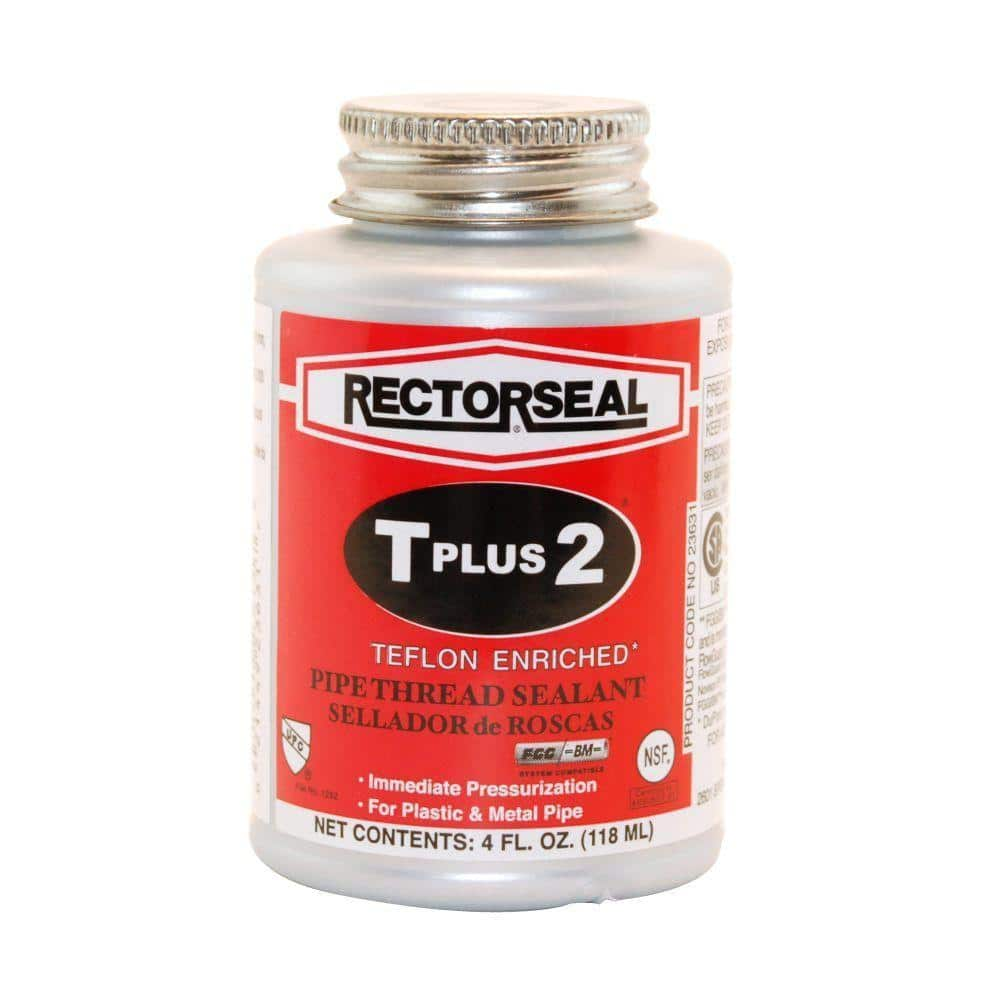
any thoughts on 'rectorseal t plus 2' dope?
it will be my first shot since i already had some laying around.

the wicking stuff the guy gave me was just a cotton twine... pretty sure thats going back and i will get something suggested above if i go the wicking route
 

malibu101

Well-known member
Joined
Jul 1, 2005
Messages
3,908
Location
Walnutport PA
Well, an oil pressure sensor is dependent on resistance (they're often variable resistors), but don't they usually have two terminals? Was this one using the block for ground? Just curious.

Anyway, for an anode, the current is so low that even a mega-ohm of resistance wouldn't make much of a difference in how it works.
Yes, it relied on the block for the ground.
 

Uncle murph

Well-known member
Joined
Jan 28, 2021
Messages
1,463
Location
Harford county
so i am dabbling with an electric water heater... the ultimate answer here is that i need a new one but i want to try some things first in order to learn and i have some questions...
so i pulled the anode rod and the threads there were crusty. i got a 3/4 pipe thread tap. i asked a guy who said he was a plumber if a 3/4 plug would work as a thread chaser... he said it probably would. so i chased the threads with just the plug, put 6 passes of cheap homedepot teflon tape on the threads and let her rip.... she leaked. apparently either too much junk in the threads or the cheap tape is junk.
so then i cracked open the tap and got about 7 full turns into it before it started fighting me too hard... now i know its tapered and wasnt supposed to go in any further but i didnt realize that then (like i said, learning here)... so when i was backing the tap out i took a millimeter or so chunk out of the 2nd or 3rd thread from the top... the tap screws in/out fine now, but theres a millimeter chunk missing from that 2nd or 3rd thread. i havent tried sealing it yet. the guy at the hardware store said to try dope first but he said if its not too bad that i can try 'wicking' and he said i could potentially get a seal with wicking that i couldnt get with tape, dope, or a tape/dope combo...
i am just wondering if anyone has encountered something similar with slightly buggered threads and if you actually got it to work... does this sound like a job for wicking?? i had never even heard of wicking prior to today...
To actually chase threads you should cut a couple of grooves length wise down your plug,threading the plug in as bought merely packed the crud even tighter.
 

mogandave

Well-known member
Joined
Nov 4, 2021
Messages
3,052
Location
Bangkok
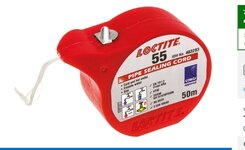
I went ahead and got a spool of the Loctite 55 wicking cord as I'm changing out a couple valves in my boy's bathroom.

I just got it, and it seems like dental floss impregnated with whatever the teflon tape is made from. The claim you can reorient the fitting/valve 45 degrees without leaking.

We'll see this weekend or next...
 
OP
1

12three

Well-known member
Joined
Jan 8, 2016
Messages
456
To actually chase threads you should cut a couple of grooves length wise down your plug,threading the plug in as bought merely packed the crud even tighter.
yep now that you mention it i forgot about those cuts on my other thread chaser tools.
the side cuts would have worked i think, but a cheap tap is probably better:
the 3/4 npt tap is about $12 at Tractor Supply... they were the best priced local place. it is a china tap by Mibro but I figured I won't be doing anything in hard or stainless at that size... Harbor freight has a smaller NPT tap/die set, but to get a 3/4"NPT you need to shell out $60 for a set... ACE wanted $30ish for a single 3/4 NPT. it was a USA tap if I recall...
I am happy I have one on hand now if nothing else.
 

fitter30

Well-known member
Joined
Jun 23, 2019
Messages
2,976
Location
Peace Valley,mo
Bad threads have used this powered pipe sealant for years. Plumbing supply houses may carry it call first. Mix in a throw away cup to a thick paste degrease threads install fitting let it set for 12 - 24 hours or put a drop light by it for heat.
 

andyvh1959

Well-known member
Joined
Feb 15, 2020
Messages
2,598
Location
Green Bay WI
the only threads that seal on pipe is the first few on the pipe & the last few in the fitting. they are called perfect threads. if those threads are in good shape, you should have no problems sealing. over tightening fittings can stretch them, causing leaks as you've expanded the perfect threads . often leaks are caused by overtightening .
not sure if this helps or not.
I think you mean the last few threads on both, more toward the major diameter of both male to female threads. The minor diameter threads of both the male threads and female threads do nothing for sealing the connection. Its the threads from the nominal to major diameter, applied with some form of sealant, that actually make the seal. But yes, leaks are caused by both undertightening AND overtightening. Pipe thread engagement is for holding durability in the connection. Pipe thread sealant, dope, tape, make the connection sealed.
 
To avoid these ads, REGISTER NOW!
Top Bottom