To avoid these ads, REGISTER NOW!

Dust collection for machines w/ 2.5" ports

ned3000

Member
Joined
Sep 2, 2019
Messages
18
Location
Massachusetts
Trying to figure out the best dust collection system for my garage wood shop. I have a Bosch 4100 table saw, Dewalt 12" miter saw, Dewalt 735 planer, Small Rikon bandsaw, router table, and assorted hand tools (ROS, belt sander, etc.)

Been using a shop vac, but looking to set up a system with installed ducts and blast gates. The problem is that, from what I've read, big dust collectors with high CFM don't work particularly well with the 2-1/2" dust ports that I have on most of my small, prosumer type machines.

Not sure if it's worth it to try to connect a duct system to the shop vac, or if I'm overestimating the problem with using a real dust collector with the small ports.
 
To avoid these ads, REGISTER NOW!

BukitCase

Well-known member
Joined
Apr 11, 2017
Messages
1,075
Location
Oregon
I have a couple of shop vacs (different areas) and have Oneida's Dust Deputy kits on both - I also modded a Jet 4" collector with one of Oneida's bigger cyclones - my ancient table saw was never meant for dust collection, only "dispersion" :=) but until that project gets to the top of my list, I hook the big collector up to the cabinet and the shop vac/cyclone up to the overarm collector; it all helps, but I REALLY need to come up with more closures for the saw to get it (almost) all -

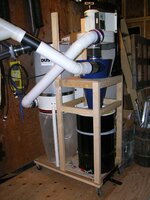
BOTH shop vacs with the dust deputy can go at least a YEAR without having to clean the filter, nearly 100% of dust ends up in the (supplied with the kit version) 5 gallon bucket. Here's the main shop version, collector is part of an OLD craftsman vac and gets emptied maybe every other year... Steve

Oh, I have the same DeWalt planer, I could just tape a garbage bag over the dust port and it'd be fine; instead, that and a couple other smaller tools just get a "reducer wye" and a separate 2-1/2" blast gate into the 4" line...
 

Attachments

  • DSCN1872.JPG
    DSCN1872.JPG
    598 KB · Views: 59
  • DSCN3387.JPG
    DSCN3387.JPG
    457.2 KB · Views: 62
OP
N

ned3000

Member
Joined
Sep 2, 2019
Messages
18
Location
Massachusetts
Would be interested to hear what kind of results you're getting with the 4" line and the reducer.

Just discovered this system: Oneida Supercell. That seems to be designed to provide relatively high CFM through more restrictive connections like my 2-1/2" ports. Expensive though. Anyone have any experience with those systems?
 

BukitCase

Well-known member
Joined
Apr 11, 2017
Messages
1,075
Location
Oregon
Not familiar with the Supercell, would be interesting to know how they "got around the physics" - I'll check it out further.

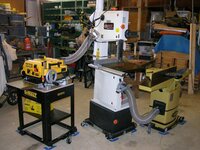
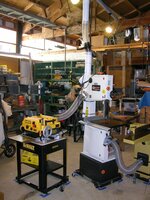
Here's a few more pics, you can see that the planer just got a 2.5 to 4" adapter right out the output, never a clog even tho the 4" went overhead back to the collector.

Note the blue tape markers on the floor, with all machines in marked places I have minimum of 10' infeed and outfeed for each machine.

I guess the woodworking DP (under the white cover) is the only 2-1/2" blast gate, with the supplementary table and fence (with 2-1/2" vac attachment it pulls most of the chips even with a 1-1/2" forstner bit. Probably doesn't hurt that the path to the DC is pretty short.

I also have the same miter saw as you (unless yours isn't a slider) - FORGET finding any commercial dust collection add-ons for that, I have one by Rouseau, goes straight into 4" system and gets MAYBE 20%. Too many projects on my list, but need to design a MUCH better, ADAPTABLE setup for the saw that can adjust to different bevels, miters, etc with movable closures...

If you're just getting started and everything needs to be mobile (multi-purpose space) I would start with one of the small dust deputy mods on your shop vac, and just move the vac from machine to machine as you use 'em - once you realize how seldom you need to clean/replace the vac's filter you'll never be without it for ANY vacuum use (exception - do NOT try to vacuum up styrofoam peanuts; it'll only take ONCE to convince you...)

Any way, here's the pics - all my 4" stuff is just non-perforated pvc drain pipe, the black adapters to 5" are Fernco rubber and the top (suction) is just 6" flex hose... Steve

BTW, just added a pic - the last one is what my DC looked like BEFORE the cyclone mod. Compare to ShopDust-4... Steve
 

Attachments

  • ShopDust-4.JPG
    ShopDust-4.JPG
    368.6 KB · Views: 54
  • ShopDust-17.JPG
    ShopDust-17.JPG
    422.9 KB · Views: 46
  • ShopDust-18.JPG
    ShopDust-18.JPG
    430.1 KB · Views: 44
  • ShopDust-19.JPG
    ShopDust-19.JPG
    401.2 KB · Views: 44
  • ShopDust-23.JPG
    ShopDust-23.JPG
    237.5 KB · Views: 49
  • JetDC-1100.jpg
    JetDC-1100.jpg
    434.8 KB · Views: 22
Last edited:
OP
N

ned3000

Member
Joined
Sep 2, 2019
Messages
18
Location
Massachusetts
Thanks for the pictures. That looks like a pretty cool setup (also envious of that jointer.) I think that's the same miter saw that I have, and you're right; that's going to be a challenge as far as DC goes.

The shop vac w/ dust deputy thing would probably work ok for my needs, but I'm moving into a bigger space where the machines will have dedicated locations and I'd really like to have everything on one loop. I move the vacuum from tool to tool now, but to be honest a lot of times I'm too lazy and just let the chips fly, which isn't ideal.

I believe the Supercell system has 3 high speed motors in series, which increases the pressure. Also, the CFM is lower than comparable systems (I think it's max 500) so it's a tradeoff. Unfortunately I don't think anyone's figured out how to "get around the physics", maybe they need to add some Heisenburg compensators.

I should probably look for ways to modify my tools to increase the size of the DC ports as well before dropping the $2500 on the expensive Supercell system.
 

Black300zx

Well-known member
Joined
Apr 8, 2019
Messages
783
Location
Elkton, Md
I have the same planer and miter saw as you, and I found the planer is what dictated my dust collection needs. My other tools work fine without dust collection, they're just not fun to use.

My planer, however, clogs up quickly without dust collection and none of my shop vacs flow enough to keep it clear. My wall mounted 4in HF collector flows enough for the planer and gets the job done OK on my other tools.
 

BukitCase

Well-known member
Joined
Apr 11, 2017
Messages
1,075
Location
Oregon
Been awhile since I've used the DeWalt planer, but IIRC the thing spit out chips like crazy with NOTHING attached; see pics, it just has an "up-sizer" , AKA a backward reducer, from 2-1/2 to 4" - then as little flex as possible into the 4" pipe. Don't remember ANY clogging problems.

I've read quite a bit on DC do's/don'ts, the short list -

1 - keep any flex lines as short (or NONE) as possible, too much turbulence

2 - NEVER use a 90 degree fitting if two 45's with a foot or so of straight between 'em will work

3 - Shortest runs you can map out; if possible it's better to centralize the collector for shorter runs (I didn't do that, too little floor space already)

4 - If only using one tool at a time (NOT a job shop) 4" will PROBABLY give higher pipe velocity (GOOd thing) than 6"
4b - Each and EVERY tool needs its own blast gate - if you're halfway gentle, the plastic ones are OK and a LOT cheaper, they can tend to come apart but usually can be edge glued back together and still work fine. Key is ONLY have ONE open at a time, esp. on a marginal DC - other end of the spectrum: metal gates, usually pneumatic, PLC control - turn on a machine, DC starts and gate opens...

5 - for joint sealing (leaks are BAD) especially if it's a work in progress, you can wrap joints tightly with saran wrap and
hold it in place with duct tape or a couple wraps of electrical tape

6 - my opinion - ALL duct work, unless you have a double floor and permanent placement for "IN-floor" runs, should be as high as you can get it - I ran mine attached to roof trusses (10' headroom) and ALL DROPS are seperable just above head height, so if the machine isn't there I won't keep hitting my head on the DC stuff - same with drops for power, air - I make ENOUGH messes without adding OTHER tripping hazards.

And yeah, that really WAS the short version; want more? Check out Bill Pentz's site :eek: ... Steve
 

BukitCase

Well-known member
Joined
Apr 11, 2017
Messages
1,075
Location
Oregon
Just read a bit on the Oneida Supercell - some pros and cons, depending on your specific situation.

1 - Don't buy one if you don't have at LEAST 20 EXTRA amps of 240 volt power just for dust collection
2 - Piping will run a bit more due to the extra suction (will actually COLLAPSE "normal" ductwork and hose)
3 - As noted previously, a bit expensive compared to more "conventional" collectors

The pro - everything ELSE :=)

After reading, do I want one? Hell yeah, but ain't gonna happen til I get the second shop built, so machine tools/welding stuff doesn't hafta share space with woodworking (a tricky balancing act)
Besides, for me the existing shop is gonna need a power upgrade, currently maxed out at 30 amps/240 volts, TOTAL. Current DC is 1-1/2 horse, I can run that and ONE other power tool, ONLY 'cause I changed out ALL the lighting to led (so I can actually SEE what I'm cutting)

So if you have NONE of the above limitations (and can afford it) it's a no-brainer - Even if you're a "hobbyist", I wouldn't recommend a smaller collector than the 30 gallon; that's what mine is, and I've filled it about halfway planing a few boards.

No level alarm on mine, so (see above pics) that black pedal at the bottom of the collector frame (shopdust-23-jpg) is the "quick check", step on it and flip a stop out of the way, and the barrel drops away from its lid to slide the barrel out (or just look) - when done, slide the barrel back in (against the two stops in the back) then step on the pedal again and it's sealed back up (sealing is a necessity with ANY cyclone)

BTW, my collector started out as a Jet 1100 series, when I added the cyclone I welded up a bracket that holds the motor and impeller vertical (on TOP of the cyclone) instead of horizontal where the collector barrel now sits - I was slightly concerned about bearing life when I rotated everything, but it's been in use now for a bit over 12 years; time to stop worrying :=)... Steve
 
Last edited:

Jim_No_Garage

Well-known member
Joined
Jan 15, 2011
Messages
3,322
Location
Millington NJ
Do NOT try to vacuum up styrofoam peanuts; it'll only take ONCE to convince you...)
In high school shop class the shipment of supplies for the next year came in and it was being unpacked in class. The head shop teacher saw us digging though the boxes full of packing peanuts for the supplies. He told us to use the central vac to **** up the peanuts. We started and were a few minutes in when the outdoor dust bin filled up and we started spraying packing peanuts all over the parking lot. We turned the dust collector off and started doing something else . . .

Cheers

Jim
 
To avoid these ads, REGISTER NOW!
OP
N

ned3000

Member
Joined
Sep 2, 2019
Messages
18
Location
Massachusetts
That's a pretty good summary. I've read a lot of the Bill Pentz site, but the info there is so dense and detailed that it's sometimes hard to draw simple conclusions from.

I'm leaning toward that Supercell system w/ 4" PVC and metal blast gates at the individual tools. I'm only running one tool at a time, and will be adding new circuits to the shop (house panel is 200A) so power should be ok.
 

BukitCase

Well-known member
Joined
Apr 11, 2017
Messages
1,075
Location
Oregon
Yeah, for a 1-man shop you could just add a 100 amp aux panel, unless you're welding you'd likely NEVER need more than 20 and 30 amp breakers.

Oh, and I only mentioned Bill Pentz so you'd REALLY like my KISS version :geek: - don't think I EVER finished his site... Steve
 

BukitCase

Well-known member
Joined
Apr 11, 2017
Messages
1,075
Location
Oregon
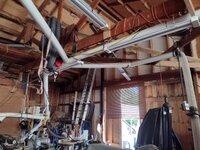
Was down in the shop a bit today, grabbed a few more pics of my DC piping - you can see by the pics that there are only 2 90 degree turns in the entire system; all others are either single or double 45's (longer radius = less chance of clogs) - in my case, this system has been up for about 14 years with ZERO clogs. Also, due to the cyclone I've only emptied the original collection bag ONCE, and that was only because I got tired of looking at that dustpan full of sawdust from BEFORE the cyclone mod -

In the pics you can also see my "nothing below head height" rule, including 120/240 electric and low and high pressure air. The trusses you see were built in place by me, then the interior poles (it was originally a horse barn) were removed and a 5" slab poured.

About 5 years later the original metal roof was replaced with 5/8 CDX and shingles to match the house - that's when it quit raining INSIDE at weather changes, and when I QUIT needing ear plugs during a rain storm :rolleyes:

Anyway, the pics... Steve
 

Attachments

  • Dust-11.jpg
    Dust-11.jpg
    351.6 KB · Views: 35
  • dust-12.jpg
    dust-12.jpg
    380.4 KB · Views: 36
  • Dust-13.jpg
    Dust-13.jpg
    407.1 KB · Views: 32
  • Dust-14.jpg
    Dust-14.jpg
    371.7 KB · Views: 31
  • Dust-15.jpg
    Dust-15.jpg
    345.8 KB · Views: 34

WilsonLR

Well-known member
Joined
Sep 5, 2021
Messages
82
Location
FL
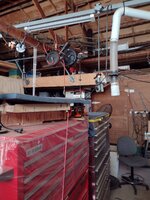
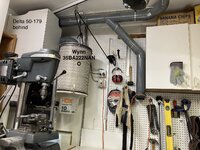
I just spent 2 days rebuilding my system based on an old but pristine Delta 50-179 (3/4hp) "dust pump" converted to use a Wynn canister filter. I designed and built it 3 years ago after consuming Bill Pentz, Stumpy Nubs and a couple others' stuff. The canister filter is amazing and I would NOT have a system without one. Period.
IMG_7802 copy.jpg

However, I had made a couple of the mistakes in the "11 common workshop dust collection mistakes" video from Stumpy Nubs that I wanted to correct. Namely, I had used 3" PVC because it's what I had before I converted to the Wynn filter. I struggled over using 6" but given the Delta has 3.5" inputs and outputs, I went with 4". If your collector is beefier and has 5" or 6" ports, consider using 6" for the part of your system between the collector and the first or second junction.

This time I used 4" Sewer pipe and fittings (NOT SCH 40 PVC and fittings). Sewer pipe and fittings are thinner and lighter. In my area, they are at Lowes not HD. Look for the down spout and drainage section not plumbing.
Dust Collection PVC.jpg

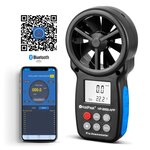
I also picked up an HP-866B-APP Handheld Wind Speed Meter, Digital Anemometer Gauge Air Volume Meter for Measuring Wind Speed fan type anemometer (so I wasn't designing blind). A guy on Sawcreek borrowed expensive measuring equipment and developed a way to use that unit to make accurate readings. The post is "Measuring Dust Collection Collector Performance - Fan Type Anemometer". Basically, you need a fixture that holds the anemometer steady at 3/8-1/2" from the hose/pipe you are testing. Be aware, these inexpensive units max out at around 5900fpm. You have to spend more to get one to handle higher FPM.
71zLyR-l3GL._SL1500_.jpg
The bottom line is that you want to get 350CFM at each machine hookup (including the hose). For 4" ducting, that's a reading of 4000 feet per minute airspeed on the fan type anemometer. The solution for hooking up to 2.5" ported machines with a 4" dust collector is to add a second port on the machine somehow and wye connect it with the 2.5" one to the 4" collector hose. Rockler has an excellent Dustright system for garage workshop dust collection designs. They are also a good one-stop shop for fittings. Here's on that splits up a 4" hose with a 2.5" spur.

20225-07-1000.jpg
ASIDE: The calculation of CFM is based on wind speed in FPM and the area of the duct IN SQUARE FEET. The formula is:
CFM = FPM x pi x radiussquared where "radiussquared" is the radius of the duct IN FEET. So for 4" duct radiussquared is 1/6 squared which is: .02777. When multiplied by pi, it is: .087266. Ergo:

CFM = FPM X .087266

For a wind speed of 4000fpm, it works out to 350cfm.
 
Last edited:

BukitCase

Well-known member
Joined
Apr 11, 2017
Messages
1,075
Location
Oregon
Excellent post; my Jet DC-1100 came with the "dust dog" canister, has a "pleat wiper" to knock off the pleats into the plastic collection bag - haven't even TOUCHED that since adding the super dust deputy mod.

I too bought an anemometer, same as you I wish it went higher velocity. I keep backing off when I see prices...

Those are the EXACT fittings/pipe I used too, since I'm (literally) a "one man band", I'm not sure kicking up to 6" is even worth the trouble/cost. My local HD carries 'em, but a couple years ago they decided that I was "only a vet" a couple days a year, unless I was in a wheel chair - 15 minutes with my DD214 @ Lowes, and it's 10% across the board - screw HD - Oh, and they thank me for my service, instead of spitting on me like some did when I came home in '69 :mad:

For a 2-1/2 to 4", I would NOT use the black one you show; you can get those in a 45* Wye - here's where I got mine


I woulda preferred a "Y" with M/F DIRECTIONAL connections, IIRC I couldn't find one at the time. You can see the Peachtree one in the pic Dust-12, above.

Your pic of which 45 ell is good, I would add the WHY - with any and ALL fittings, look for the one that will be LEAST likely to clog with shavings, sometimes the least little "snag" can cause problems. I always think in terms of flow DIRECTION (34 years in industrial instrumentation/control)

Again, thanks for a great/informative post... Steve
 
Last edited:
OP
N

ned3000

Member
Joined
Sep 2, 2019
Messages
18
Location
Massachusetts
Awesome info @WilsonLR. Sounds like modifying my 2.5" port tools or adding an additional dust collection point is another interesting option. That should work with a standard low pressure, high CFM sysem; wouldn't need the expensive (and relatively low CFM) Supercell unit.

Seems like kind of a hassle though; maybe I should just upgrade all my machines to big industrial ones with big ports ...
 

WilsonLR

Well-known member
Joined
Sep 5, 2021
Messages
82
Location
FL
- 15 minutes with my DD214 @ Lowes, and it's 10% across the board - screw HD - Oh, and they thank me for my service, instead of spitting on me like some did when I came home in '69 :mad:

For a 2-1/2 to 4", I would NOT use the black one you show; you can get those in a 45* Wye - here's where I got mine
At my Lowes there are also Vet parking spaces. Makes me smile to see them.

Right on about using a 45 wye and not 90's. I use them exclusively too.

I built a jig for my anemometer today that allows me to reliably hold the unit on all the variations of 4" female, male and hose terminals. I have not had time to test it well. I tried it at each of my three locations for 10 seconds each and I got relative measurements that made sense in terms of length of run, elbows and hose.

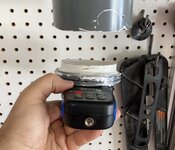
TO make the holder, I sliced a 3" PVC hub fitting to create something that would center me in the opening. The fitting's shoulder does that for most things but at the widest point, I expanded it with 3 layers of duct tape so it fit snugly in a slice of 4" sewer pipe. It may not deliver accurate measurements in terms of actual velocity but it does take how I hold it out of the equation for measurements. I can now compare them against each other to see how changes I make affect the system. This is the proof of concept:
IMG_7806 copy.jpg

My anemometer had two convenient holes for attachment. I plugged them and tested them. They had no effect on the measurement fan. A couple of 1-1/2" #6 screws and tapped holes in the PVC and voila.

IMG_7807 copy.jpg
Awesome info @WilsonLR. Sounds like modifying my 2.5" port tools or adding an additional dust collection point is another interesting option. That should work with a standard low pressure, high CFM sysem; wouldn't need the expensive (and relatively low CFM) Supercell unit.

Seems like kind of a hassle though; maybe I should just upgrade all my machines to big industrial ones with big ports ...
I am looking forward to fitting extra ports on my machines. I made a 4" port for my 1980's era Skill benchtop sander from an old plastic laptop case. I learned how to shape plastic with a heat gun and weld it with a soldering iron. Now I'm fearless and dangerous shaping old plastic into functional stuff in the shop. Only problem now is what to do with my shoebox of dust collection adapters! Well, the power hand tools still need them. I had been using my small flexible hoses hooked up to a 4" adapter. I could not believe how much sawdust was still in the hose.
 
OP
N

ned3000

Member
Joined
Sep 2, 2019
Messages
18
Location
Massachusetts
That's a good idea w/ the plastic welding. I've done some of that to modify plastic parts cases, but hadn't thought of it for forming dust collection components. Even with my existing shop vac setup it seems like I never have exactly the right adapters to get a good fit for everything (despite having a big box of different ones).
 
To avoid these ads, REGISTER NOW!
Top Bottom