To avoid these ads, REGISTER NOW!

Dust extracting masonry bits

bluedog225

Well-known member
Joined
Jan 31, 2012
Messages
3,312
Location
Texas
Is anyone a fan of the self dust extracting masonry bits? Trying to decide if they are worth the expense and hassle.

They are a little hard to find in shorter lengths. I didn’t know if they held up or were a fad.

I wouldn’t mind less dust. And I read somewhere, I think the Simpson literature, that I shouldn‘t be drilling wet or cleaning holes with water.

Thanks
IMG_4012.png
 
To avoid these ads, REGISTER NOW!
OP
B

bluedog225

Well-known member
Joined
Jan 31, 2012
Messages
3,312
Location
Texas
Maybe it doesn’t matter with 3G. That’s helpful.

Though I feel pretty sure I read something about water weakening the bond. I’ll have to find it.

IMG_4013.jpeg
 

PopcornSutton

Well-known member
Joined
Jun 10, 2024
Messages
800
Location
Northern Tip of VA
I can't imagine any epoxy doing it's proper job in a hole with drilling dust left in it. Some may work in wet conditions, but how would it adhere to the base material?

There could be value in certain conditions to extract the dust, inside reno work for instance, but for general use simply blowing the dust out works fine.
 

mike93lx

ALLIANCE MEMBER
Joined
Dec 9, 2013
Messages
37,899
Location
Richmond, VA
I can't imagine any epoxy doing it's proper job in a hole with drilling dust left in it. Some may work in wet conditions, but how would it adhere to the base material?

There could be value in certain conditions to extract the dust, inside reno work for instance, but for general use simply blowing the dust out works fine.
In commercial work, OSHA now requires dust collection for drilling at the tool. You can do that a couple ways but blowing out a hole is not one of them. Doesn't matter if it's indoors or outdoors.

Besides that controlling the dust is just smart, regardless of it being commercial or residential

For work at home, I drill and have a shop vac at hand, then use compressed air to blow out the hole with the vac running. If using epoxy, I'll brush the hole as well

Citation for OSHA requirements https://www.osha.gov/laws-regs/regulations/standardnumber/1926/1926.1153
 

PopcornSutton

Well-known member
Joined
Jun 10, 2024
Messages
800
Location
Northern Tip of VA
I have been retired from construction for 8 years. During my career, I have attended numerous OSHA classes and always had a current card. No doubt, things have changed. But as always, enforcing these rules are hard to do. Drilling a hole in concrete outside and having to use a dust collection in the process is a stretch. But, I see people on the TV shows putting a mask on to drill a hole in wood......
 

mike93lx

ALLIANCE MEMBER
Joined
Dec 9, 2013
Messages
37,899
Location
Richmond, VA
I have been retired from construction for 8 years. During my career, I have attended numerous OSHA classes and always had a current card. No doubt, things have changed. But as always, enforcing these rules are hard to do. Drilling a hole in concrete outside and having to use a dust collection in the process is a stretch. But, I see people on the TV shows putting a mask on to drill a hole in wood......
You can now get dust collectors built into the drill. No cords, no hoses and automatic activation

1761563530091.jpeg
 

Nobody-named-Olli

Well-known member
Joined
Jan 9, 2025
Messages
1,646
Location
North Rhine-Westphalia; Germany
Yes, big fan.

IMG_2079.jpeg

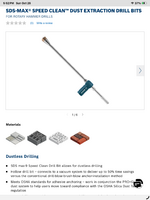
The cat’s meow when dealing with any anchor that otherwise would require brushing and blowing of the hole it’s supposed to go into, most anchor manufacturers approve using these drill bits instead of the brushing & blowing routine.

Also exceptional for any overhead work, and if it must be truly “dust free”, use Y hose, one connected to drill bit, the other connected to drilling dust extraction nozzle.

Be aware there are multiple generations of these, some are not as advanced/ easy to use. Especially considering how the dust is extracted from the tip and longevity. With the older generations, less energy (hammering power) is definitely your friend. And if they still extract dust through a hole right in the tip, a needle/ welding tip cleaner is your best friend.

If you want my advice, stay away from the ones that extract through the front of the tip, and get those that extract through holes in either the side of the drill bit tip, or the ones with exchangeable bits inside an extraction tube that were introduced by Bosch/Diablo. (SDS Clean plus-8X or SDS Clean max-8X)

Overview: https://www.bosch-presse.de/presspo...l-accessories-for-dust-extraction-266831.html

These are the most advanced currently.

Kind regards,
Olli
 

Nobody-named-Olli

Well-known member
Joined
Jan 9, 2025
Messages
1,646
Location
North Rhine-Westphalia; Germany
I hope it’s OK to cross link another thread I started on another forum about these drill bits. It has a lot of information and pictures that I don’t have the time to “migrate” one for one over here. I think the information contained in my posts there are worth it.


I will report this post myself after posting, so it can be removed immediately if not allowed. (Done.)


Kind regards,
Olli
 
OP
B

bluedog225

Well-known member
Joined
Jan 31, 2012
Messages
3,312
Location
Texas
I hope it’s OK to cross link another thread I started on another forum about these drill bits. It has a lot of information and pictures that I don’t have the time to “migrate” one for one over here. I think the information contained in my posts there are worth it.


I will report this post myself after posting, so it can be removed immediately if not allowed. (Done.)


Kind regards,
Olli

There are other forums?
 
OP
B

bluedog225

Well-known member
Joined
Jan 31, 2012
Messages
3,312
Location
Texas
I ordered two Bosch. One long, one longer. Wish they had shorter versions.

Sort of odd that EBay was the best source.

SDS Max. Only about 20 holes needed. May have to take a chance of a cheap or used drill.

Thanks all.
 
To avoid these ads, REGISTER NOW!

duneslider

Well-known member
Joined
Jan 20, 2013
Messages
2,268
Location
Riverton, Utah
We use a ton of them. They are expensive, they work fine, we are required to use them in a lot of places with vacs with hepa filters.

Where we can get away with it we just use regular bits with a vacuum hose sitting next to the drill and that seems to get almost all the dust created in my opinion. Epoxy holes get wire brushed and vacuumed. I can't imagine concrete slurry from wet drilling being good for an epoxy connection, would be fine for wedge anchors I would think but yeah epoxy would not be good.
 
OP
B

bluedog225

Well-known member
Joined
Jan 31, 2012
Messages
3,312
Location
Texas
We use a ton of them. They are expensive, they work fine, we are required to use them in a lot of places with vacs with hepa filters.

Where we can get away with it we just use regular bits with a vacuum hose sitting next to the drill and that seems to get almost all the dust created in my opinion. Epoxy holes get wire brushed and vacuumed. I can't imagine concrete slurry from wet drilling being good for an epoxy connection, would be fine for wedge anchors I would think but yeah epoxy would not be good.

Agreed, but it’s tempting to just run a light hose in the hole while drilling and then jet it out with water. Particularly if I can lay epoxy in a wet hole. Maybe blow out standing water.
 

duneslider

Well-known member
Joined
Jan 20, 2013
Messages
2,268
Location
Riverton, Utah
Agreed, but it’s tempting to just run a light hose in the hole while drilling and then jet it out with water. Particularly if I can lay epoxy in a wet hole. Maybe blow out standing water.
We do way too many holes for that to be practical, and that would be WAY too messy. I would still want the hole to be dry before I put epoxy in.
 
OP
B

bluedog225

Well-known member
Joined
Jan 31, 2012
Messages
3,312
Location
Texas
We do way too many holes for that to be practical, and that would be WAY too messy. I would still want the hole to be dry before I put epoxy in.

I’m no engineer. But for what it’s worth, I think there is a strength reduction in wet concrete.

And interestingly (not shown here), a strength reduction using a wire brush instead of a nylon brush.

IMG_6440.jpeg
 

duneslider

Well-known member
Joined
Jan 20, 2013
Messages
2,268
Location
Riverton, Utah
I shouldn't have said wire brush, that's just what I have used the most. We use whichever brush the manufacturer/engineer calls out, it can be nylon or wire. They usually specify how they want it cleaned too how many brushes vs blowing, vacuuming, etc.
 
OP
B

bluedog225

Well-known member
Joined
Jan 31, 2012
Messages
3,312
Location
Texas
Got it. I think it’s interesting the level of detail they go to test. I’d never have guessed that a nylon brush would give better bond. Just he opposite.
 

lund

Well-known member
Joined
Nov 2, 2019
Messages
832
Location
Michigan
As others have pointed out, there are drills with vacuum shrouds were you would not need this special type of shrouded drill to collect dust. I doubt any of these vacuum dust collection systems will be perfect so you should still wear a mask. In my case, I drilled many (100+ !) of 5/8" to ~3/4" holes in old, very hard concrete for retrofit anchors that I epoxied. I do NOT think you would want to immediately epoxy in any rods in holes drilled with any of these vacuum attachments alone. The vacuum is just to keep dust from getting all over and you breathing it. You need to put a hole cleaning brush (plastic bristles) in for many strokes while vacuuming the top to get the sides cleaner for a better bond. It generally takes more time to clean the hole than to drill the hole. To get a good bond, the surface of the drilled hole needs to be clean from microscopically stuck surface dust and that does not vacuum out with a standard vacuum. I do NOT recommend using compressed air (too much dust will spread, and I doubt it would be as effective as a brush with a vacuum at the top). I usually spent around 30 sec to one minute drilling with an SDS hammer drill, then followed by 5-10 minutes of cleaning the hole with a brush and vacuum. I always did a lot more cleaning than the minimum recommended brush strokes since I often saw dust coming out at the end of the recommended strokes. I would brush till nothing was being dislodged to be sucked into the vacuum (easy to see dust in headlamp light). Keep in mind also that access is often an issue in retrofit work and pipe cleaner type brushes with the hose of a portable vacuum held at the top will fit in most anywhere. Bulky drills with shrouds or drill dust collection attachments will be hit and miss to fit in where you might want in some applications. I suspect that commercial applications that are doing huge numbers of holes where efficiency is very important will have more automated brush systems with integrated vacuums for hole cleaning.

I would add there are a lot of kinds of epoxy with various requirements and curing times. I liked Hilti brand and bought a lot from overstock places. But be careful on expiration dates. The product should be good if before or around the expiration date -- but can go bad if significantly out of date or stored in poor conditions. Some not so reputable ebay sellers try to hide the dates. So be careful on small quantity buys for bargain prices.
 
Last edited:

Rusted Nut

Well-known member
Joined
Dec 11, 2022
Messages
1,825
Location
Northern Arizona
We use dustless bits a lot. They work well, but the carbide tips are small and really difficult to sharpen. The idea of slurry and epoxy is really strange.
 
To avoid these ads, REGISTER NOW!
Top Bottom